The political system in a country plays a significant role, if a multinational organization is relocating its resources. At the time of relocating abroad, huge investments are required. It is essential to assess whether the political system in that country provides security for investments in the long run. However, political system is less important when choosing a country for export, expanding a franchise business model, or making a non-equity alliance with business partners in another country.
There are several political systems in the world in which human and business freedoms are understood very differently, and the inviolability of private property is understood differently (List, 2022). In history, there have been many cases when assets, organization shares, and money in bank accounts located in foreign countries are frozen or confiscated by the decision of the political authorities of that country, for reasons that would not be the basis for such actions in other countries. The rule of law and judicial independence are not values and practices in all countries equally. Therefore, examining the main political systems and identifying the risks that foreigners may face in those countries makes a lot of sense.
Political systems can be divided into two major groups (Derbyshire & Derbyshire, 1996) – democracies and monocracies (Exhibit 8-1). Democracy is understood as how the actual de facto and de jure government is elected by the citizens of the country with certain regularity. Democracies are diverse, they may have different principles of power electing and sharing. Different powers are distributed between government institutions – the president, parliament, government, courts. Most important and common feature in democracies is that elected government representatives are elected for a limited time and are accountable to the public that elected them. If the political government does not satisfy the society of a democratic country, then through the instrument of elections, the people can choose another person to represent their interests.
The opposite of democracy is monocracy, which can also be different; it can be monarchy, authoritarianism, or its more severe versions – dictatorship and totalitarianism. The main feature of these political systems is that the country’s authorities, or an institution, or simply an individual leader, is de facto not accountable to the public. In such political systems, society has no legit right and no actual voting instrument to replace persons in power.
Ex. 8‑1 Variety of political systems

Keywords: democracy, monocracy, autocracy
In monocracies, the position of the head of state is hereditary, taken by force or obtained democratically, but during the term of leadership, the political structure is changed to a monocratic one. For instance, the National Socialist Party led by Hitler, came to power during democratic elections, but later they did not transfer that power but instead of that turned the country from a democratic one into a severe form of dictatorship, which had catastrophic consequences for the whole of Europe and many nations, when Nazi ruled Germany started the World War II.
Both democracies and monocracies can come in various forms. However, it is crucial to examine them before in more detail, because some countries falsely declare their political systems (Farkas & Schou, 2023). There are countries that officially declare themselves democratic, they hold elections, but individuals or groups of individuals in power have enormous influence on the results of elections by manipulating voters, including forced voting and vote control and even engaging in fraud of counting votes and faking results. Sometimes it can be difficult for a foreign investor to distinguish between a real democracy and a fake democracy, but the main indicators are how long the same ruler rules the country and the majority of votes the ruling force get to win the election. Of course, the opinion and conclusions of international election observers are also important. Democratic political system can be divided into following types:
• Presidential democracies.
• Parliamentary democracies.
• Constitutional democratized monarchies.
Types of monocratic political systems are as follows:
• Absolute monarchies.
• Autocracy.
• Dictatorship.
Thus, political systems are classified according to how power is acquired, transferred, exercised and controlled. In those states where is inherited or usurped power, there is very often supremacy of such power over the law and the rules. There are exceptions, it is different in those monarchies that are democratic, and monarchical rule have survived from the medieval period and have a more symbolic or representative meaning. Although the monarchy in its name requires “the rule of one”, it is still necessary to distinguish between two radically different types of monarchies. Constitutional monarchies such as the Kingdom of Spain, the United Kingdom or the Kingdom of Sweden, the Kingdom of Netherlands, the Kingdom of Belgium or other kingdoms have maintained the status of a monarchy obtained in the Middle Ages, however in reality, the power of a king or a queen is symbolic, intended more to represent the state. In those countries, a king or a queen formally appoints the head of the government, but this appointment has more signs of formalization and authorization than the selection of a person. In democratic monarchies, elections are held, and the citizens elect parties or individual candidates to power. The monarch’s power is limited to the approval of the will of the people.
Ex. 8‑2 Absolute monarchies
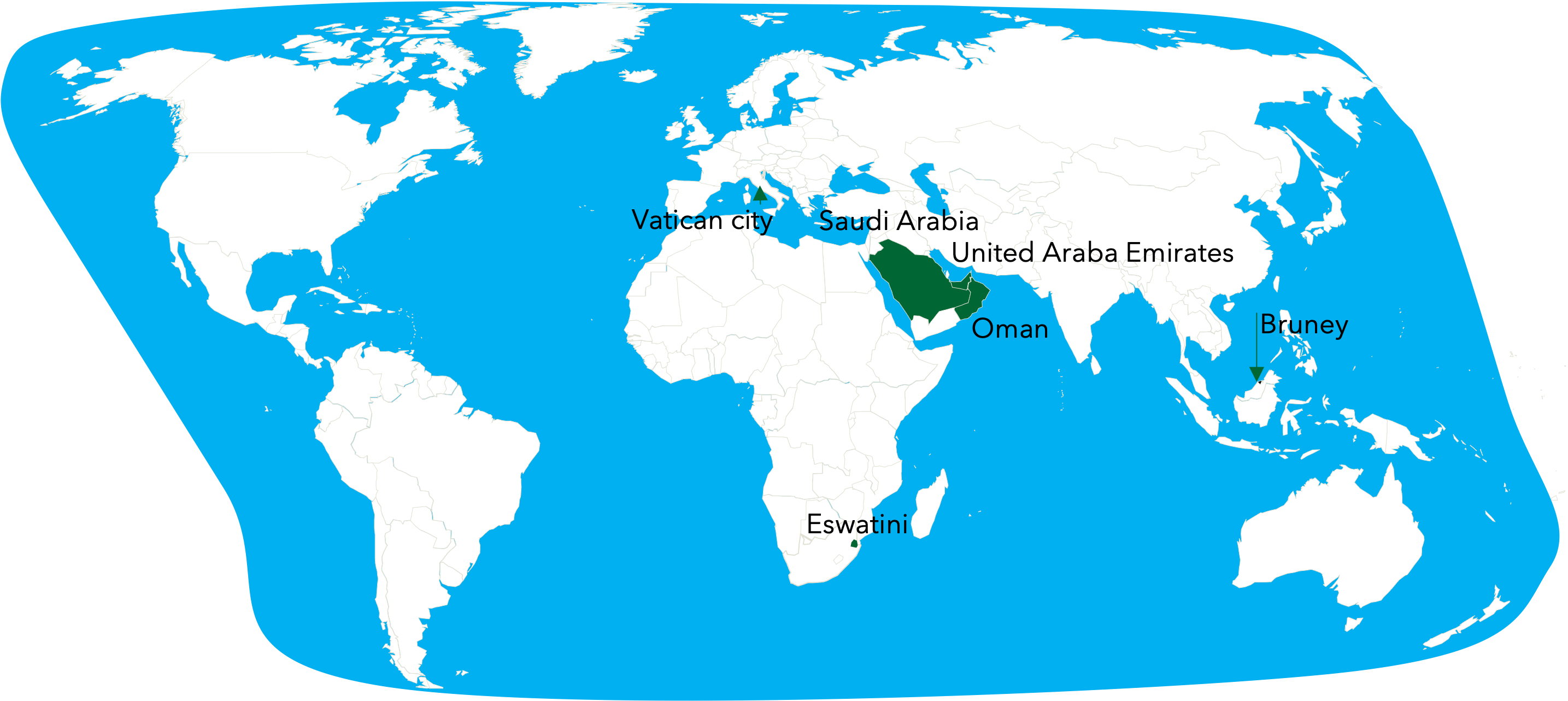
Keywords: Oman, Vatican, United Arab Emirates
Democratic monarchies are not only in European countries, but also former colonies of the British Empire – today the sovereign democracies of Australia, New Zealand, Canada, and various other small states, whose king is formally recognized as the King of the United Kingdom.
Absolute monarchy is different from constitutional democratized monarchy. In absolute monarchies, the power of the king or the head of state is essentially absolute. Some Arab countries are absolute monarchies: Saudi Arabia, Qatar, United Arab Emirates, and Oman (Exhibit 8-2). The Vatican and Eswatini are also considered absolute monarchies. Usually, Arab countries do not hold democratic elections, and the position of the head of state is hereditary, when the power comes from father to son. However, such Arab monocratic monarchies are considered safe enough for investments; many leaders of the countries seek the economic well-being of citizens. In many of these Arab countries, the basis of their wealth is the export of oil, so the countries sought, and still seek, to maintain good relations with the main buyers of oil. The business leaders of these countries successfully cooperate with North American and Western European organizations. There have been only rare examples of foreign investments being expropriated or foreign businessmen or employees being arrested for political reasons in such countries.
The operational structure of presidential or parliamentary democracies differs based on whether the main executive authority is the prime minister appointed by the parliament, in some countries also called as a president of government or a chancellor, for instance in the UK, Spain or Germany. The head of the executive power basically heads the country’s ministries or departments, which are divided into various areas. The Ministry or Department of Economy, or Business, or Innovation or similarly named is usually responsible for regulating business relations, trade, business licensing and registration. In a presidential democracy, the functions of the head of the executive power are performed by the president, for instance in US or France. In a presidential state, the representative of the executive power, the president, is elected by the citizens directly.
In a parliamentary state, the parliament, whose members are elected by the citizens voting for parties appoints executive power, namely government led by a prime minister. In some parliamentary states president and members of parliament are elected by citizens, but in this case the functions of the president are limited to represent country abroad and or the function of commander-in-chief of the military. In this case, the president does not have the executive power, as it is in the hands of the prime minister, or the chancellor appointed by parliament.
In a presidential system, when executive power is concentrated in the hands of the president, are possible more radical decisions that can impact business within or involving the country. Throughout history, there have been instances when a newly elected president drastically changes the directions of the country, either by withdrawing from international trade or environment protection treaties or by entering into new agreements, for instance US after 2016 elections. Similarly, such thing happens in parliamentary states, because of numerous members of parliament, power is more distributed, and decision-making process is slow and less radicalized.
The situation is much more complicated for international businesses in those countries that are pretending to be democracies, although de jure, that means formally those are democracies, but de facto that means practically all indications are that it is an authoritarian or dictatorial rule. Those countries often face international sanctions due to restriction on export and import. Additionally, there are cases of nationalization-the state’s expropriation of private property, and the lack of protection of private property. In fake democracies, international companies are often forced to agree with the authorities, the success of business depends heavily on the authorities and groups of people close to the country’s leaders. So called oligarchs in these countries, business competition is often unfair or even illegal, and state institutions are sometimes used to act against competitors – for example, food and hygiene supervising authorities, fire safety services, other business inspection or licensing institutions. In these countries, the courts are also not independent. Often courts, like any other law enforcement institutions or special security services, serve a state leader, who has seized power as well as his inner circle oligarchs. The general level of corruption in the countries is high.
Ex. 8‑3 Complex of political risks for international business
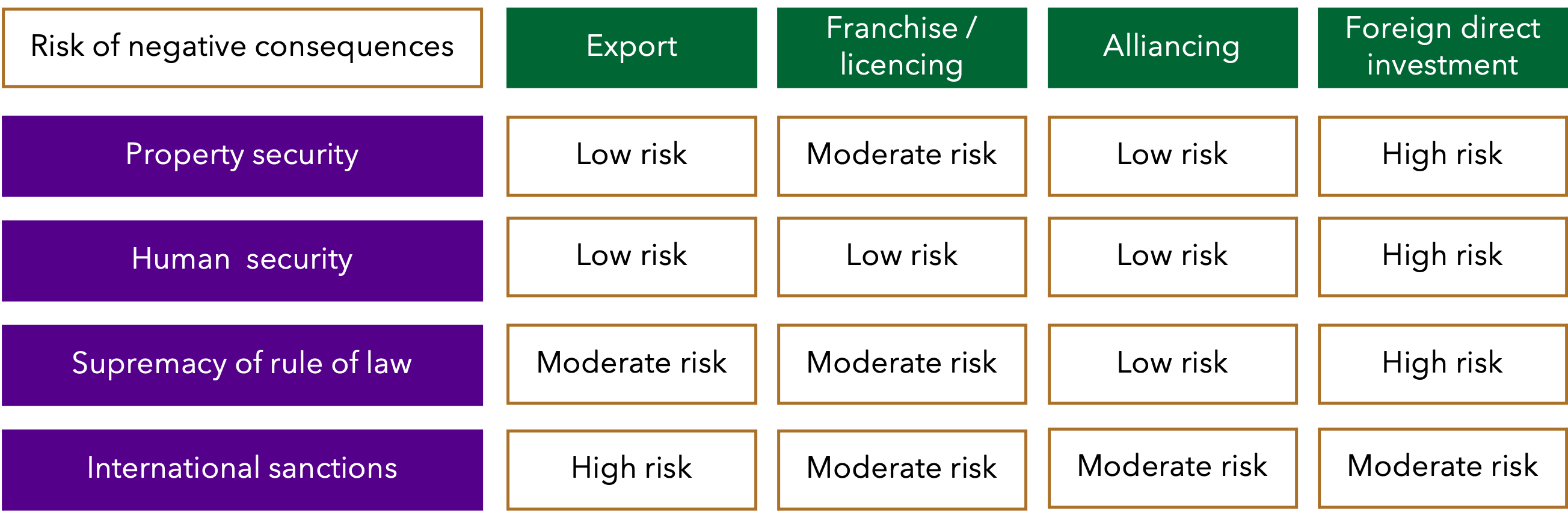
Keywords: risk, export, foreign investment, alliance
Pretended or fake democracies are quite like authoritarian regimes and dictatorships. Actually, no country declares itself officially an authoritarian or a dictatorship, and these descriptions are assigned to them by other countries of the world based on prevailing characteristics.
In fake democracies, an oligarchic form of government is formed frequently, which means that the country is ruled not by one leader, but by several competing but at the same time cooperating political and often business groups.
In such countries, state resources are utilized to enrich these individuals, the line between public and private ownership blurs, and public procurements using taxpayers’ money often are also fake. So, government spending state budget by awarding public service, works or goods contract to organizations that have very close ties to people in power.
In some cases, even countries with a one-party system, as in the case of the unified ruling Communist Party of China, exhibit the attributes of democracy, as rulers are formally elected within the party using a democratic method, i.e. by majority of votes received from members of party (Dreyer, 2018; Hayes, 2009).
In fact, it is very difficult to distinguish strict boundaries between which countries have democracy, and which do not; there is a whole gradation that can define the level of democracy. Various international organizations rank countries on a democracy index that ranges from the most liberal democracies to autocracies or dictatorships. Countries with the highest democracy index are the most open and favorable to all forms of international business.
It is also important to distinguish between countries where leaders of religious community have strong political influence. Such political systems are called as theocratic. In many European countries, the influence of the religious organization – the Catholic Church – was very strong in the Middle Ages, but after separating the secular government from the theocratic in Europe, there left no theocratic states anymore, except for the Vatican. However, in many countries of Arabic cultural cluster or Muslim dominated countries of Central Asia, the religion based theocratic government often has a strong formal power and forms the legal system and law based on that.
Ex. 3‑4 Matrix of political polarities

Keywords: left party, right party
Risks and threats arising from the political system are associated with property and human security in the country, with civil order and the principle of the rule of law, the level of corruption in the country, and formal sanctions of foreign countries (Exhibit 8-3).
The biggest impact is on international business forms involving foreign direct investment. Other forms of business are more influenced by legal systems, which are also often determined by the country’s political structure.
Another relevant division of political system is according to values represented by political parties (Exhibit 8-4). Although in general there are many differently entitled parties, trends and movements in various states of the world, two opposite poles can be distinguished – the so-called left-wing and right-wing policies. Left-wing political forces are usually associated with the representation of the broad masses of people and fair sharing ideology; it is so so-called socialist direction. The opposite is the right-wing forces that represent the interests of capital owners and business, independence and freedom of each person. The right-wing political direction is based on the paradigms that every citizen must be economically strong and can take selfcare. Ideology is based on the belief that private sector is good for the masses as it creates jobs, and economic development, so therefore private initiatives must be supported. States ruled by left-wing political forces are characterized by a very large state intervention in the free market, in the social and health protection of every citizen.
However, it is very important that the so-called political left and right can be quite different, and it depends a lot on whether the country is democratic or monocratic, especially autocracy and dictatorship. Thus, according to polarity, political systems can basically be divided into four quadrants, where the horizontal axis represents “left” and “right” ideologies, and the vertical axis represents the liberties of citizens, from full authoritarianism at the bottom of the axis to perfect liberal democracy at the top. In democratic countries with a high level of public freedom, left-wing political parties often create a legal system with high taxes for business, free health care, education, and social security for the population, which is actually paid by taxpayers. In such countries, all human freedoms and rights are often considered values, for example LGBT rights, gender equality, transparency, equal opportunities due to race, age, religion. However, experience and history show that left-wing political parties in autocratic states do the opposite. Communism, as the most left-wing political force in an authoritarian state, manifests itself in strict restrictions on human freedom. Thus, it is impossible to compare the left-wing politics in the Soviet Union of the last century or today’s China with the left-wing politics that strongly dominates Western and Northern Europe or is represented by the Democratic Party in the United States in the 21st century. In countries ruled by left-wing democratic forces, companies involved in international business will usually face high taxes, heavy state protection of workers, high environmental standards, and the state usually strongly represents the interests of workers against employers. In democracies ruled by right-wing parties, the conditions for business, especially investments, are usually more favorable, and the state in those countries takes great care of the employer’s interests.
It is not possible to assign democratic countries to the absolute left or right political orientation, because the elections that take place every four or five years can bring a different party and political direction to power. However, often a certain political direction persists for several cadencies subsequently in power. If a political direction dominates for several terms in a row, during that time a legal base and traditions are formed that more closely reflect a specific direction. For example, if a democratic country has been ruled by the same political direction for ten or fifteen years, then the opposite direction that has won elections in the first term does not always manage to change the entire legal system. When international organizations are selecting countries for export and investment, they must consider not only political landscape but also stability and predictability of the country. Multinationals strategically plan their investments, revenues, production capacities, and logistics systems far into the future, so making frequent political changes in a country is often considered as negative for business operations. There are countries where the so-called political pendulum swings, where a party of the opposite political direction comes to power every election. Such countries live in a marathon of endless reforms, where taxes are raised in one term, cut in the next term, and raised again in the next term. In addition to tax policy, migration policy is very important for multinational organizations, as it relates to labor mobility. Foreign trade policy is important, as it relates to import or export tariffs and non-tariff restrictions. Environmental policy is important especially when multinational organizations decide to invest, as it relates to opportunities shift production resources in energy-intensive industries with high greenhouse gas emissions.
Among the left-wing political trends, the most well-known and the most widespread are the communistic trends, for example, in China, North Korea, Cuba, in the 20th century in the Soviet Union, the socialistic or so called social-democratic trend, and labor parties’ trend. The right includes the conservative, republican parties in various countries, also the right-centric trends as the social-liberal or liberal-democrat trend. Left-wing parties often promote values associated with progress, globalization, equality, and human rights, while right-wing parties often consider order, traditions, nationality, and religion as values. There are also radicals in the ranks of both the left and the right.
Share or comment this information on your social media:
Fundamentals of global business
First edition
For citation:
Jarzemskis A. (2025). Fundamentals of global business, Litibero publishing, 496 p.

Full scope of the book is available in various formats
C.8. Political, legal and economic environments in global business
About author
The author has been teaching at several universities since 2005. 40+ scientific publications, 10+ international research projects. More about author.