The word “franchise” originates from a dialect of Old French and means privilege or freedom. Franchising, in contrast to licensing or patent selling, does not cover a specific product, invention or technology, but is associated with the right to sell a way of doing business. Most often, a license is granted for the use of a clearly defined object of intellectual property. Franchise includes such elements, as a branding, product ingredients, know-how and rules of doing business including details and methods described in very precise manner.
The world’s most famous fast-food restaurants, hotels, and retail chains operate on a franchise basis. For example, largest fast-food brand franchise is used by 35 thousand independent restaurants, largest kiosk-type retail business franchise is used by over 54 thousand independent retail outlets. Many of the most popular franchises, including KFC since 1952, McDonald’s since 1955, and H&R Block since 1958, began as early as the 1950s. There is estimated about one million different franchise locations, such as cafes, stores, etc. operating only in the USA. Franchises account for one third of all retail sales in the US. The beginning of the franchising business is considered to be in the USA. Object of franchising could be even manufacturing of machinery. For instance, the Singer sewing machine is considered the first franchise. Today, many well-known brands are running as worldwide expanded franchises (Exhibit 4-4).
The franchisor transfers to the franchisee not only the already created business model and “know-how”, but also undertakes to provide him with services, the purpose of which is to continuously support with proven business model improvements, newly generated “know-how” and methodological assistance. In fact, the franchisor transfers and rents out, rather than sells, the business model and “know-how” it has developed. Their relationship is by definition temporary, however, may be for a very long-term. A franchisee buys the right to use franchise to replicate the successful business of the grantor, not to experiment and create their own unique business themselves based on the grantor’s business (Exhibit 4-5). The franchisee, in turn, has the right and even the duty to ensure that the same quality standards are followed, procedures are carried out identically, and consumers receive the same products or services in all units managed by franchisees (Alon et al. 2021).
Ex. 4‑4 First franchise – “Singer” sewing machine

Keywords: Singer, franchise
There are several objects for franchising:
• Franchising of distribution of goods.
• Franchising of business model.
• Production franchising.In the distribution franchise network, the franchisee simply sells the franchisor’s goods and has the right to use the franchisor’s trademarks and other elements of the business identity. The franchisor may set certain requirements for example, the design of the commercial areas or location or provide certain recommendations for example, the staff behavior or dress standards, but usually does not provide the entire business management system (Wingrove & Urban 2017). Merchandise distribution franchises are popular in branded clothing, cosmetics, accessories, and car retail. This type of franchise is most similar to the commercial relationship of distribution, but in the case of distribution, the distributor does not get the right to open a branded store of the manufacturer’s brand but can only sell the manufacturer’s goods in his own stores himself. It should be emphasized that in the modern world of franchising, product distribution franchises by their very nature are getting closer to business model franchising – the grantor additionally transfers a number of business algorithms, management systems, IT and accounting tools to the recipients (Malkina & Malkin, 2014).
Ex. 4-5 Franchising objects

Keywords: franchisor, franchiseeThe franchise of business model is the most common and can be applied to almost any business area. In the case of a business model franchise, the franchisee produces and sells goods, provides services and gets the right to use the franchisor’s trademarks. Most importantly, the franchisee also receives detailed business management methodologies and related support and assistance. The methodologies explain how to manage the entire business and each of its components separately, and the ongoing assistance allows get the latest business management knowledge and share specific proven solutions in difficult situations. In other words, when purchasing a business model franchise, a franchisee receives right to use all the franchisor’s intellectual property and his business model to develop his own business under the franchise agreement (Bisio, 2011).
In the production franchise network, the franchisee receives all the technological “know-how” of production from the franchisor but often does not receive the right to directly distribute the manufactured product, although sometimes such a right is granted to him together with the right to use the brand and the business system of product distribution (Iddy, 2020). This type of franchise is the most common in the beverage and food industry (Moon et al., 2021). Although compared to other types of franchise it is the least popular due to the complexity of the production “know-how” transfer. This type of franchise has the most similarities with licensing, especially when it comes to the transfer of details of technological process.
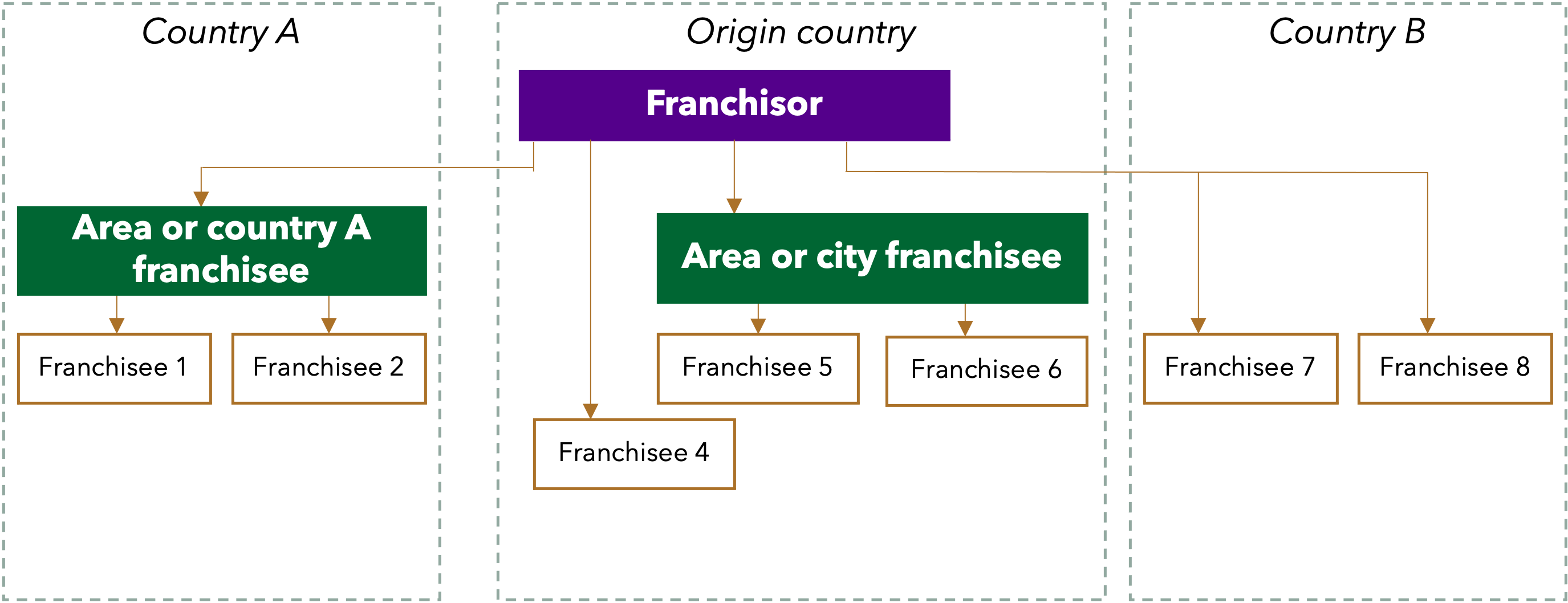
A franchisee may obtain a franchise for a single facility, e.g. for a restaurant or hotel, or several objects. Sometimes a franchise is granted exclusively to a territory, such as a city or state, and the franchisee is granted exclusive rights to expand the number of facilities in that territory. In order to speed up development, the franchisor sometimes grants a master franchise to a franchisee which acts as agent by distributing franchises to specific sub-franchisees in a specific territory. This method reduces the number of contacts for the master franchisor and requires greater trust in the master franchisees. Master franchisees essentially act as franchise brokers. At the same time, it makes the process of obtaining a franchise easier for the final franchisees, since they need to contact the master franchisee serving in that region, state or city, and not the main franchisee, which may be located in another continent (Exhibit 4-6). As a rule, “master” franchisee does not open and develop the activities of franchisees themselves, although this is usually not prohibited. Their main function is to expand and manage the network of final franchisees in a certain territory. Master franchisees invest in finding, maintaining and supporting franchisees, and earn a return on their investment from the difference in fees received by franchisees and fees paid to the franchisor (Weaven, 2014). Another specific method of franchise development is conversion. A distinctive feature of the conversion franchise is that managers and owners of businesses operating in the same business area as the franchisor become franchisees.
Ex. 4-6 The structure of the franchisor-franchisee relationship
Keywords: franchisor, franchisee
Independent entrepreneurs, by purchasing a conversion franchise and becoming a franchisee, continue to carry on their business, which they know and are experienced in, but receive from the franchisor the opportunity to use network brands, accumulated knowledge, optimized business processes, get access to cheaper supplies and to a wider and more loyal customer segment (Sharma et al., 2021).
Franchising is most widely used in those businesses that can be easily organized systematically, that can be easily acquired. If most business processes can be standardized and business processes are not difficult to replicate, then it is likely that franchising can become a suitable way of developing such a business. The franchisor is the original developer of the business. A franchisee is an investor who buys the right to market a brand using the franchisor’s concept. Franchisors can only be successful if their franchisees are successful. This creates a mutually beneficial relationship.
Share or comment this information on your social media:
Fundamentals of global business
First edition
For citation:
Jarzemskis A. (2025). Fundamentals of global business, Litibero publishing, 496 p.

Full scope of the book is available in various formats
B.4. Intelectual property internationalization business
About author
The author has been teaching at several universities since 2005. 40+ scientific publications, 10+ international research projects. More about author.