One of the factors that encouraged private entrepreneurship was the limitation of business owner’s liability and the protection of shareholders from organization’s debts when the first international companies were founded at the beginning of the 16th century. This greatly reduced risk and motivated people to start new businesses without the risk of losing what they had already accumulated. Another method of reducing business risk that made a breakthrough on a similar scale was the emergence of the start-up concept. Although the concept of start-ups was first introduced in 1851 in a US newspaper, the first wave of start-ups was in the 1930s and 1940s, the second wave that formed the framework of the ecosystem was in the 1970s and 1980s, and the third wave and the spread of the concept of start-ups in the world began with the advent of the internet and information technology that created a boom in the early 21st century.
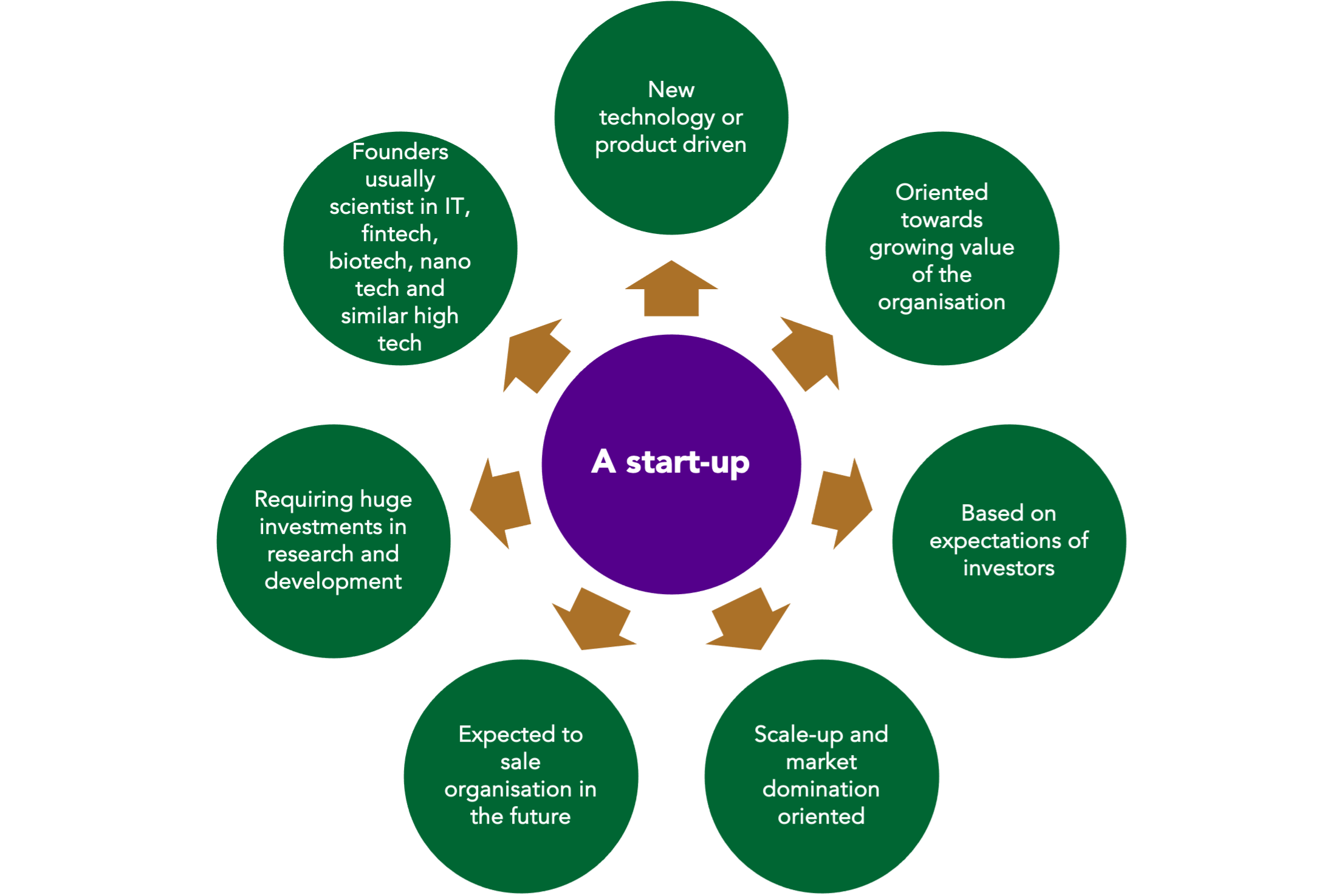
Ex. 11-7 Main criteria for start-up
Keywords: start-up, scale-up
A start-up is a newly formed organization that is usually based on the invention development of a new innovative product or technology and, if successful, attracting external investment to rapidly commercialize the product and begin large-scale production (Jin, 2017). Thus, a start-up is distinguished from other companies by several important attributes – innovation, attracting external investment, and rapid scale growth (Exhibit 11-7).
Since start-ups are focused on an innovative product, that is, creating something that did not exist in the market before, involves greater risk that it will not be possible to sell and commercialize widely such a new thing. Developing an innovative product requires a lot of money. If the innovation is radical, very often product development involves fundamental scientific research, experimental development. It is widely accepted to divide innovations into nine levels, called technological readiness levels – TRL:
1st TRL is an acquisition of fundamental knowledge. The initial phase is research and experimental development. The theoretical fundamental research usually ends within the phase and begins the phase of applied research or experimental development. So, at the end, the results of fundamental research are obtained, and the idea of their application and options of use is formulated.
2nd TRL is the formulation of the concept of knowledge application. The concept is formulated at the theoretical level, based on the analysis of research findings. However, there is no concrete evidence to support the feasibility of the concept in this phase. The result of the activity is the formulation of the concept of application of knowledge, in other words, the creation of a product or technology concept.
3rd TRL is a proof and validation of concept feasibility. Theoretical and experimental applied scientific research is carried out and their results prove and confirm assumptions about individual product elements in this phase. The final result of the activity – the fact that essential parameters for product development have been determined, that proves the feasibility of the concept.
4th TRL is the creation and testing of a layout or model in the laboratory conditions. The activity involves the integration of different and essential components of the future product to validate their systemic performance under controlled environment. A layout ore model is still very far from the intended final product. Testing results usually indicates the need for additional applied scientific research. Elements of experimental development may emerge at this stage. The final result of this activity is a working primary model, as well as it could be a model of a process, service, design that pass the test.
5th TRL is the verification of the pre-demo version of layout or model by simulating real conditions. The presentation of the layout or model is possible to a wider public at this stage. A model at this level is very close to the final product. To confirm the actual performance, it is tested in laboratory or other test conditions simulating a real environment or observed in a certain social environment. The project of the art object is presented and coordinated with the interested persons to determine its viability and feasibility of implementation. As result a layout or model is operating in a real operating environment.
1st TRL activities are classified as fundamental research, 2nd to 5th TRL activities are considered as applied research. The risk is higher at research phase because it requires huge capital and investment as the research may demonstrate the impossibility of the technology and innovation or serious fundamentals barriers.
From 6th TRL to 9th TRL, activities are considered as experimental development, these activities are less risky. The higher the TRL, the more advanced the innovation, the lower the risk.
6th TRL is the development of a prototype or trial version. A specific product prototype is being developed that is much more advanced than specified in the 5th stage, given the necessary configuration, content, appearance or other characteristics. Additional applied research may be required at this stage. The likelihood of such a need decreases in later stages. The result of the activity is a prototype or a trial version of the product, process, system, service, human, cultural or societal problem solution.
7th TRL – display of prototype or test version. At this level, a prototype is very close to the final product, that is tested and demonstrated in a real operating environment. Additional applied research still may be required at this stage, but with less probability as it is in previous TRL. The result of the activity is the final prototype – the final version of the product, process, system, service, human, cultural or societal problem solution.
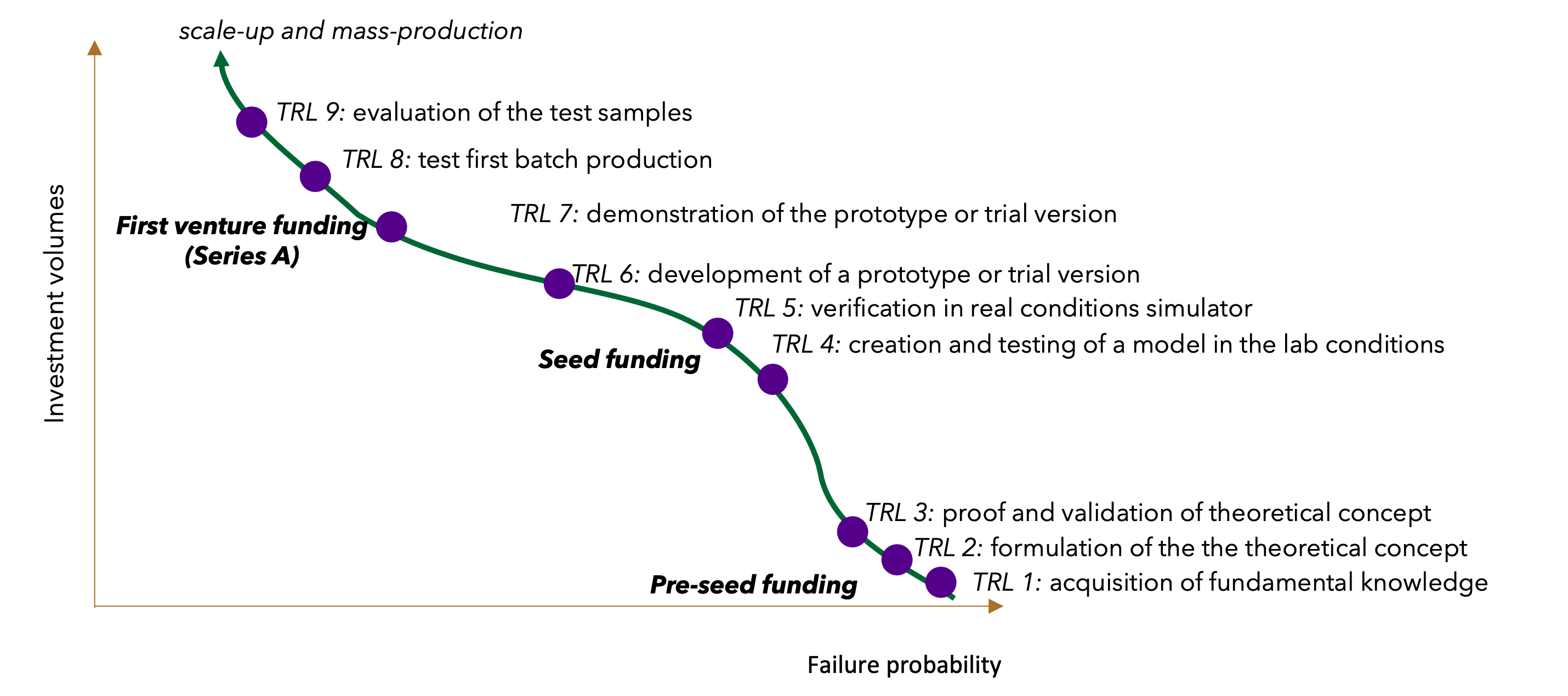
Ex. 11‑8 Relation of investment risk with a technology readiness level
Keywords: Technological readiness level, seed funding, pre-seed-funding
8th TRL – conduct first batch production trial. For this phase all equipment is being prepared, resources are being accumulated for the production of a trial batch of the final product, process, system or service. The result of the activity is a trial batch of the final product, so it a tested final version of product itself and production process.
9th TRL – assessment of the new product, process, system, and service through trial samples. An evaluation is done in this phase by the users and/or customer. Product quality and durability are evaluated in this stage. The product is presented to potential users. The result that is expected in the activity is the acceptance of the clients. After finishing ninth phase product is ready to go by large scale to the market.
These nine levels of technology readiness are standard worldwide. Organizations which are developing new products are aware of them and use them for internal and external communication to avoid misunderstandings. Multinational organizations often have their own research and development departments for the development of new products, which use significant financial resources, internal or external. A lot of investments in the development of new products at various levels of technological readiness are allocated by multinational organizations, especially in such fields like biotech, pharmaceuticals, electronics, fintech and new materials. The biggest problem is that at low TRL levels, the risk is very high because of the high scientific uncertainty. So many different attempts and efforts are required but only a small percentage succeeds. Thus, in order to minimize the risk of creating innovations, the principles of probability theory are used, which say that the probability of success increases as the number of attempts increases. The start-up concept serves to apply this principle. Multinational organizations are very often inclined to invest funds in an already proven product, about which at least a prototype has been created, or to develop scientific research in their own departments.
In order to achieve a competitive advantage, international companies usually carry out both activities, both experimenting and creating new products in their own departments or subsidiaries focused primarily on research and development as well as looking for scientists and start-ups that have created innovations, and when possible, they purchase start-up companies or purchase patents for developed technology or solutions or other rights.
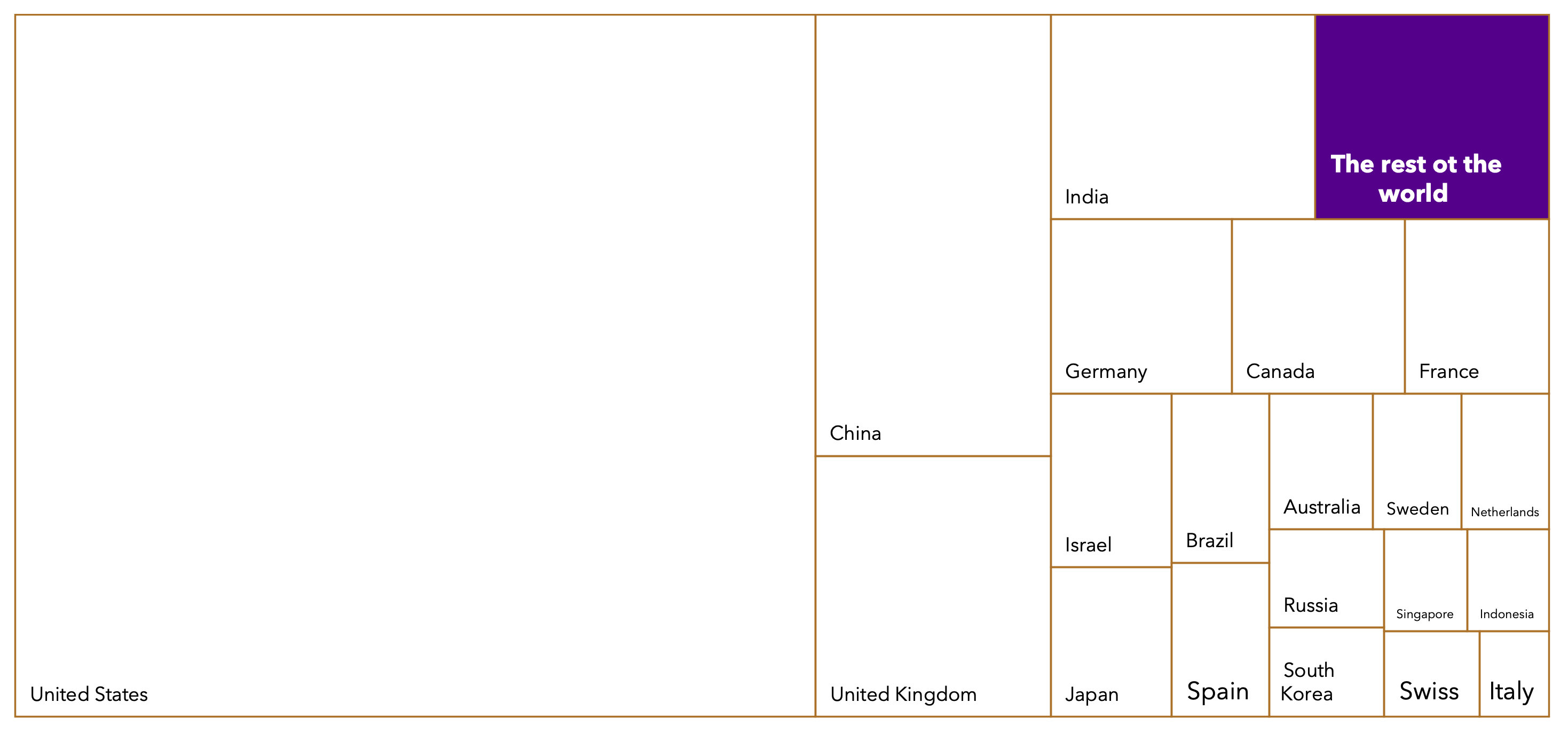
Considering nine levels of technological readiness ranging from the idea of innovation to product commercialization, the main question is how and who should finance research and development activities as they are at a very risky stage prior to attracting interest from multinational organizations. Realizing the importance of research and development, various countries have created ecosystems that fill this funding gap. Start-ups are spread all over the world, but the USA clearly dominates, followed by China, India, UK, Canada, Indonesia, Germany, Australia, France, and Spain (Exhibit 11-9).
Judging by industry, the most start-ups are established in the field of fintech, life sciences, artificial intelligence, computer games, online advertising, educational technology, blockchain, robotics, cyber security, biotechnologies. In general, two areas can be seen as focus for start-ups, it is the industry based on information technology and the industry based on biochemical sciences.
The start-up ecosystem includes five funding stages, which are necessary for the idea to reach such maturity that multinational organization are interested in purchasing part of shares or whole start-up. Another option for start-up is to become itself a multinational organization operating in the global market.
Startup stages are presented in exhibit 11-8. The first stage of start-up funding is pre-seed. In this stage, financing is usually provided by the founders of the start-up, as well as family members or close friends. The level of technological readiness at this stage can be between 1 and 4. Approximately, up to 50 thousand US dollars are required at this stage. The market value of such a start-up can vary from 0 to 100 thousand US dollars.
Ex. 11‑9 Countries by proportion of established startups in 2023
Keywords: start-up, USA, China, UK
The second stage is the seed-funding, in which the need for funding reaches up to 3 million US dollars, but the value of the organization can already reach up to 3 to 6 million dollars. At this stage, the sources of financing are usually business angels, micro venture capital firms, state subsidies, financial instruments available from business incubators, as well as personal savings, funds from family and friends. The level of technological readiness at this stage is expected to be between 4 and 8. At this stage, the start-up is not yet generating income, so investments become risky. However, already at this stage, venture investors become shareholders of companies, hoping that if the project is successful, the return on investment will be later. The earlier in the phase investors invest, the relatively smaller investment can bring higher returns later.
The third is the early-stage venture funding, so called Series A funding, when the investment is usually between 2 and 15 million US dollars, and the expected value of the start-up can reach 10-30 million US dollars. At this stage, venture capital funds, business angels actively participate; various state-subsidized business acceleration programs are active. At this stage, banks start lending to start-up, microloans and crowd funding are also available and used. At this stage, 9th technological readiness level is expected.
At the fourth, the growth stage, financing is calculated up to 30 million US dollars, and the value of the start-up can reach up to 30-60 million US dollars. At this stage, venture capital investors invest in companies, bank loans and state loans are provided widely. It is so called Series B funding.
The last stage is actually the exit stage, when the shareholders sell the start-up to new investors. It is Series C funding). At this stage, both the external investors of the previous stage and the initial investors and often founders and originators of the idea of the start-up aim to earn. Start-ups in this stage are often acquired by Multinational organizations to capture and scale technological innovation, thus start-ups become part of a multinational organizations.
Another option is when the start-up itself becomes a multinational organization, but in this case in order to attract more funding and to earn seriously, shareholders of start-up usually go for an initial public offering of shares called IPO through stock exchanges. Start-ups at this stage can be valued at 100 million US dollars or more. However, even after the start-up becomes a public corporation with shares issued to the public, the activity is often not yet profitable. It may take a long time before the organization begins to generate more revenue than expenses, have a profit and pay dividends to shareholders. One may wonder why investors should invest in an organization that is unprofitable. The answer to this is good but difficult question lies in an economic system based on expectations theory. Investors often make investments not with the expectation of dividends and returns on profits in short term, but with the expectation of an increase in the value of the organization. As the value of the organization increases, the value of the invested amount increases, and the investor can sell the shares at a higher price later. It is essentially a speculative or portfolio investment, hoping to buy shares, i.e., invest cheaper and sell shares at a higher price. International portfolio investments are described in chapter 6. As long as investors believe in the organization and the product or technology the organization is developing, then the organization’s stock market value increases, despite the fact that the organization is not profitable. A very important indicator for investors is the organization’s market share, especially for a new technology market. Expecting the growth of the market itself, the sales will also grow proportionally if this organization has a significant percentage of the market. Market dominance allows for monopolistic or oligopolistic pricing and can guarantee rapid revenue growth if market demand for a product or technology increases significantly. The famous American electric vehicle manufacturer has suffered losses since 2009, when it started operating, until 2019, and the first profit was made only in 2020. However, the profit of the following years increased so strongly, which made it possible to pay dividends to the shareholders and even more increased confidence in the organization. So, it can take ten years for a new product or a new technology to really pay off and start making profit. However, not all stories are so successful. Success stories are learned from news headlines on the internet or on television, successful stories are included in business textbooks, but many cases of failure remain unknown. It is estimated that 10 percent of start-ups do not survive for more than a year, 20 percent does not survive for more than 2 years, 40 percent – for more than 5 years, 65 percent – for more than 10 years, and even 75 percent does not survive more than 15 years. Thus, investors apply probability theory and invest in many start-ups in the early stages, hoping that at least one or a few will succeed, and the future profits and increase in value of the successful start-ups will cover the lost money or so-called burned investments that were invested in the failed start-ups.
Share or comment this information on your social media:
Fundamentals of global business
First edition
For citation:
Jarzemskis A. (2025). Fundamentals of global business, Litibero publishing, 496 p.

Full scope of the book is available in various formats
C.11. Structures of multinational organizations
About author
The author has been teaching at several universities since 2005. 40+ scientific publications, 10+ international research projects. More about author.