Direct foreign investments (FDI) are the actual and tangible investments in factories, production facilities, land and stocks in which the investor retains control over the use of the invested capital. FDI is often called strategic, and such an investor is called a strategic investor. Strategic investment is when an organization views an investment as an integral part of its business strategy. These investments are targeted towards a specific sector, which aligns with the investor’s strategic priorities. For example, a furniture manufacturer, decides to invest in another country and opens a new factory to make production cheaper, due to low labor costs (Jaworek et al., 2018).
Strategic investment can be associated with investing in the market of the country being targeted. Particularly, such investments appear when there are restrictions on international trade, but there are no restrictions on the transfer of capital. When a factory is opened in another country, products can be traded there, and this exchange of products within the country be considered as domestic trade of that country (Huijie, 2018).
In the international context, direct investment is usually carried out by global corporations engaged in manufacturing, resource extraction or services. Although developed countries invariably dominate in terms of the value of capitals allocated in the form of FDI, their share is gradually decreasing. Contemporary multinational enterprises – MNEs is not limited to global corporations but include a whole range of medium-sized enterprises (Jaworek & Kuzel 2015). Direct investment usually takes the form of an organization setting up a subsidiary or taking control of another organization, for example, by acquiring a majority stake. Very often, strategic investors are of the same specific sector or industry. For example, electronics business companies invest in other countries by opening factories that will produce electronic equipment or components, organizations operating in apparel and fashion invest abroad by opening sewing factories. Companies can outsource the production of electronic components or garments they need in foreign factories and simply conduct an international trade transaction. The decision to have their own or partially owned factory in another country is associated with the desire to control all processes, including hiring of personnel, operational level procedures and production quality control.
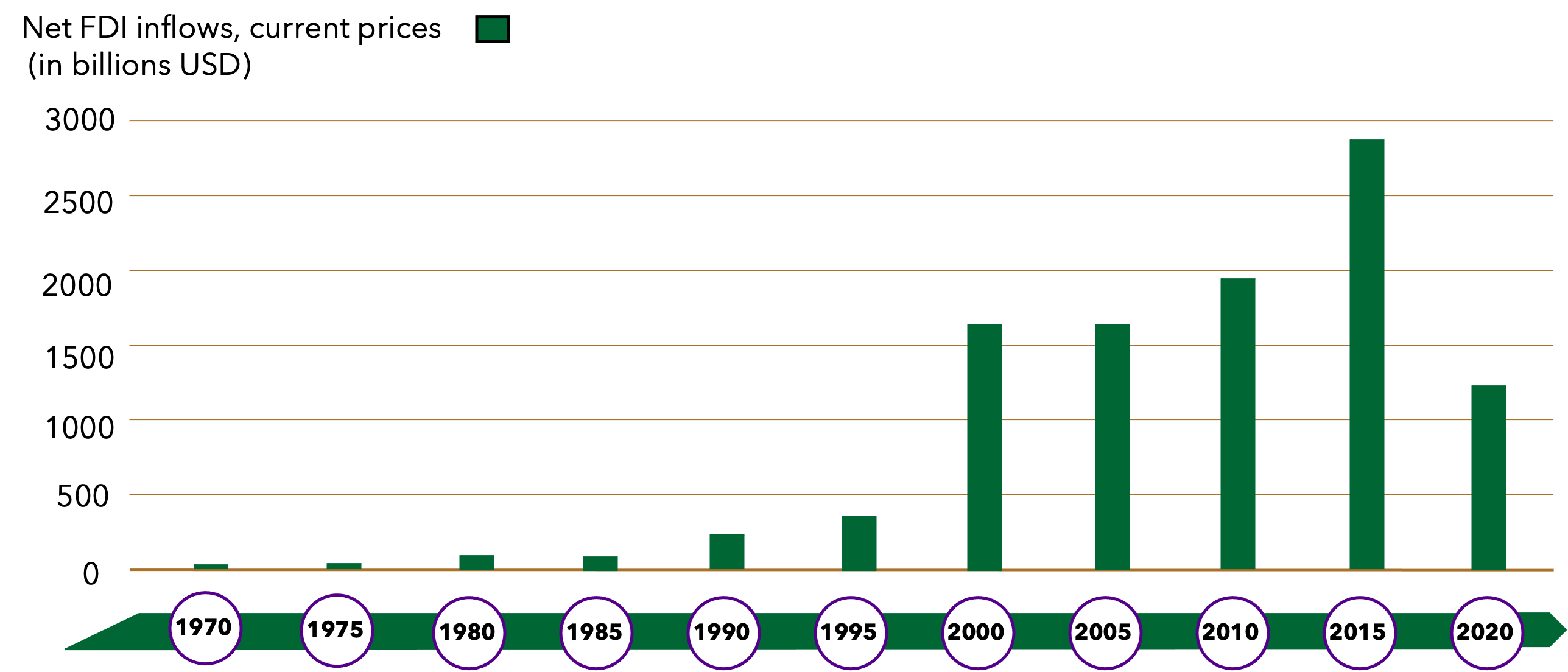
Ex. 6‑3 Worldwide growth of foreign direct investments (FDI)
Source: UN Trade and development, www.unctad.org
Keywords: FDI, United Nations
However, it is important to consider that strategic investors may not necessarily be of the same sector, but also investment companies, holdings or funds that specialize in mobilizing and controlling companies in a certain industry in various countries around the world. Typically, such investments are also an integral part of the investor’s long-term strategy. The strategic control aimed at cases of direct foreign investment may not always require the acquisition of 100 percent shares. It is very important to motivate local leaders and entrepreneurs selling them some part of shares, as they know the specifics of their country much better. Thus, investors in foreign companies often do not purchase all the shares of these companies but leave some of them to the former local shareholders. If it is a new company, then foreign investors often offer to contribute investment to local investors for the same reason.
Foreign direct investment covers not only the initial capital investment, but also subsequent financial transactions and positions between the direct investor and the direct investment company, including further capital commitment, as well as reinvested earnings and intra-company debt. Since foreign direct investment can vary greatly in the proportion of its invested capital, the level of management and control, the International Monetary Fund – IMF and the Organization of Economic Cooperation and Development – OECD, led by the United States, were the initiators of establishing a specific threshold to define an investment as a foreign direct. Globally, statistical records are kept on foreign direct investments, as well as on the volumes of international trade, so the introduction of a unified standard facilitated state monitoring. A direct investment is defined as any purchase of 10 percent or more of a company’s voting stock. In the last 20 years, foreign direct investment in the world has increased significantly. Even a significant decrease in trade barriers, foreign direct investment FDI grew faster than international trade as businesses feared protectionist pressures, and FDI being viewed as a way around trade barriers. Companies to invest in other countries have been encouraged by enormous political and economic changes in many countries around the world. Globalization of the world economy has created organizations that consider the entire world market as their market, and as a result, instead of the previously used term an international organization or an international business, it is increasingly used term as a global organization and global business. One of the main factors that boosted foreign direct investment was the rapidly increasing globalization, which reached its peak in the late 2020s (Exhibit 6-3). Still, the third decade has created great challenges. The pandemic, the war in Ukraine and Israel, attacks on international shipping lines, tensions between the United States and China over economic relations, and the increasing military capabilities of North Korea, China, Russia, and Iran have shaken the established international business order to its foundations. The threat that the assets of foreign companies may be nationalized, the threat of disrupting international supply chains from their controlled factories in other continents, the threat of military attacks and terrorist attacks in some countries of the world forces many business owners and investors to rethink their business’ long-term strategies and in the long term, this may slow down globalization extent. Although the flow of direct investment to Asia has grown quite rapidly in the 21st century, more than half of all US investments are made in Europe and investments in Asia account for the same amount as in Latin America.
The advantages of strategic investments in an organization operating abroad are:
• It is possible to start operations at that plant very quickly.
• No need to waste time searching for employees and construction-related activities.
• It is possible to choose from countries depending on their labor supply, labor price, supply and price of energy resources, distances to raw material deposits.
• If an investment is made in a technological company, there is an opportunity to acquire the technology ourselves and limit competitors’ access to that technology or solution.
The disadvantages of strategic investment in an organization operating in foreign markets are:
• Finding an organization suitable for investment is not so easy, because the more the organization needs to be restructured, the more investment is needed, so the search is for the most suitable organization whose owners agrees or want to sell shares.
• Certain surprises are possible during the acquisition of a company, which become clear only after starting work, so careful inspections and due diligence procedures are usually carried out before and during the acquisition.
• Long and sometimes difficult change of organizational culture and resistance of existing employees to changes in the acquired company.
• Sometimes a lot of changes, equipment modernization and customization have to be done, which involves extra costs and takes time.
Share or comment this information on your social media:
Fundamentals of global business
First edition
For citation:
Jarzemskis A. (2025). Fundamentals of global business, Litibero publishing, 496 p.

Full scope of the book is available in various formats
B.6. Foreign investments
- International resource movements
- Foreign direct investments
- Foreign portfolio investments
- Pros and cons for investing abroad
- Incoming foreign investments
- Management and design of foreign investments
- Attraction of foreign investments and free economic zones
- Mergers and acquisitions
- Questions for chapter review
- Chapter bibliography
About author
The author has been teaching at several universities since 2005. 40+ scientific publications, 10+ international research projects. More about author.