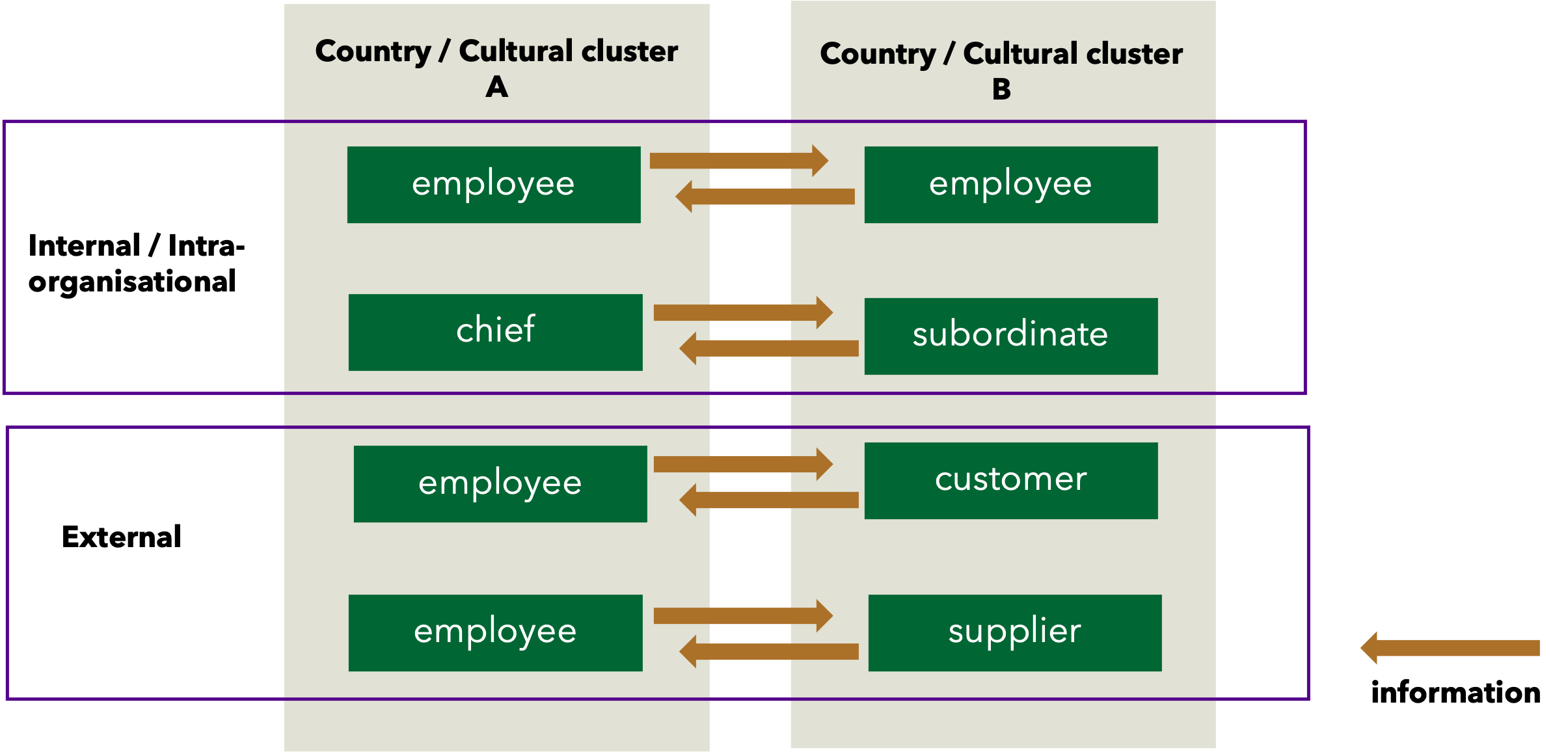
Countries with similar values, attitudes and behavior are grouped into cultural clusters based on their dominant characteristics and those are described in the Chapter 9. Although business is conducted by an organization, communication is between people. Nowadays, the use of artificial intelligence is more prevalent in consumer consulting, order formation, operations planning and control, however, it is impossible to avoid human-to-human communication when conducting business. Communication can take place between a manager and a subordinate, between two employees of the same hierarchical level, between an employee and a customer. There can be internal communication, between units of the same organization or between members of a network of affiliated firms, and external communication, with employees of other companies and with customers as well (Exhibit 10-1). It is a very common situation while conducting business internationally, that people of different cultural clusters communicate with each other. Marketing and sales are also inseparable from intercultural communication, so while planning and creating advertising materials, slogans, advertising messages to customers, public relations campaigns, the characteristic of each cultural cluster that need to be addressed are very significant.
Communication can be verbal and non-verbal. Verbal communication is understood as saying or writing down words, sentences, paragraphs or whole thoughts. Non-verbal communication includes not only what is said or written, but also the entire surrounding context – how, where, under what circumstances it was done.
Ex. 10‑1Communication subjects in international business
Keywords: communication, cultues
Drawings, photos, color pallet, video footage, body language, facial expressions, eye movements, tone, rate and speed of speech are all part of the message.
So, communication is essentially the transmission of a message. It does not matter whether the message is transmitted by a manager to a subordinate, a subordinate to a manager, between two employees, an employee to a customer, or a firm to a customer – it must be done in such a way that the sender of the message and the recipient of the message understand each other clearly. The interaction between the sender and receiver of the message can be distinctive – direct conversation, phone conversation, virtual video chat, text message by e-mail, sms, or various other electronic message methods, sign on the wall, outdoor advertising, television, radio or internet advertising.
Although, communication between employees and communication with customers differs, the same factors of cultural clusters make sense. The sender and recipient of the message are the two parties involved in the communication process. Communication channels are the means by which messages are transmitted from the sender to the recipient, and the communication message itself is considered as the object of communication. Basically, the object of communication, or the message, first generates in the mind of the sender of the message as a manifestation of the idea to be communicated. The goal of sender of a message is to ensure that the same manifestation of the idea appears in the mind of the receiver and induces the behavior or reaction of the receiver in the way that the sender wants. Thus, the sender of a message can give a task to an employee, ask a question to an employee, or encourage a customer to buy a product. The sender encodes the message verbally or non-verbally, and the receiver decodes it. When the sender and recipient of the message are from different cultural clusters, there might be a possibility of misunderstanding, and this is one of the major problems of intercultural business communication. Forces influencing verbal and non-verbal communication in international business are presented in exhibit 10.2.
Language is one of the major barriers in verbal communication among people of different cultural clusters. Although, English is the global language in businesses, it is only the people of the Anglo cultural cluster are native English speakers. A lot of other nations have learned English, as the second language and their language proficiency differ. The uniqueness of a person whose native language is English is that he speaks English fluently, think in English, knows the intricacies of the language, expressions, and sayings which are common in English. But let’s take a Spaniard who has a business conversation in English.
First of all, a Spaniard speaks Spanish, think in Spanish, learns English and is able to express himself in English, or is able to understand a thought expressed in English. If a Spaniard is not using English in his daily activities, he is most likely to generate the thought he wants to convey in Spanish and then translate it directly or indirectly into English and express it in front of the listener.
Ex. 10‑2 Forces influencing verbal and non-verbal communication in international business

Keywords: time zones, context, distance, communication
So, first of all, a logical translation error can happen when a certain subtle thing is expressed differently in another language. The English language has rich vocabulary to express a wish, for instance “must”, “should” or “shall”. Technically, all of these variations are possible when translating into English, and the translation would be considered correct, but to an English native speaker, it might send a completely different message. There are even misunderstandings between people of the same cultural cluster who both share the same language, for example the English used in the USA, England and Scotland differs in certain subtleties and expressions and even in grammar. In the case of a Mexican speaking to a German, or an Indian speaking to a Frenchman in English, there may be more misinterpretations and misunderstandings in abundance.
There are curious situations when the verbal communication remains misunderstood due to its subtlety or is understood in the opposite way. For example, the English phrase “that’s very interesting”, in English culture means a suggestion or idea that is surprising and unexpected or even is more absurd. When a representative of other cultures hears that an English person is interested, he can be happy and think that the business counterpart liked the offer and that the expressed idea is really interesting.
The biggest challenges arise when one or both communicating parties come from cultures where context is very important. In such cases, not only what is said in verbal language is important, i.e. content but also form. In cultures where context is important, it is customary to deliver the main idea not through words, but through gestures, facial expressions, body language and the manner and circumstances in which the message is delivered. For example, rejection of a business proposal can be expressed through gestures and facial expressions, while words can express a neutral or positive reaction, such as “this proposal seems good”. In low context countries, people usually speak directly, and the content of the message delivers the essence very clearly, while gestures and circumstances are not worth paying attention to.
Share or comment this information on your social media:
Fundamentals of global business
First edition
For citation:
Jarzemskis A. (2025). Fundamentals of global business, Litibero publishing, 496 p.

Full scope of the book is available in various formats
C.10. Communication in intercultural environment
- Communication in intercultural environment
- Theories of motivation and motivators in various cultures
- Intercultural differences in attitude towards work and career
- Intercultural management challenges
- Variety of labor relations and compensation
- Multicultural teams and communication in them
- Negotiations in multicultural environment
- Questions for chapter review
- Chapter bibliography
About author
The author has been teaching at several universities since 2005. 40+ scientific publications, 10+ international research projects. More about author.