Get the book
The soft cover paper version of the book is available in e-shops since 2025.
Logistics is very important during the transaction itself in the business-to-consumer segment, especially in finished goods retail. Holding inventory of manufactured goods is not cost-efficient for either sellers or manufacturers, because it means storage costs and frozen funds. If in the business-to-business segment, it is quite common for the goods to be delivered to the buyer not on the day of the financial transaction, but later (more in Chapter 3). Depending on the product, this can be in the range of a few days, a few weeks or even a few months. In the retail sector, the dynamic changes when the customer is an individual consumer (Dawson, 2013). When a buyer comes to buy a piece of clothing, a phone or grocery, he usually wants to take it and use it immediately after paying for it. For global organizations, this is quite a challenge. It becomes a challenge for a global sports goods retail chain or a smartphone market leader to make the product available in all stores, including remote places of the world. Global organizations have hundreds or even thousands of such sale places, so if even 10 units of each product are kept in stock at each point of sale, this means thousands and tens of thousands of units distributed all over the world. In the smartphone market, considering the global sales in 2022 of more than 1.3 bn units, the logistics challenge to resupply on time is not always met.
Although the buyer will be able to buy the product if it’s on the shelf when he comes to the store, how will a transaction happen if the product is missing because it’s out of stock, or the manufacturer has decided not to deliver the product to this particular store? It is very important to mention here that e-commerce has changed the situation a little. Many manufacturers, realizing the benefits of e-commerce, sell their products through e-stores. Some manufacturers have their own e-stores and online sales platforms, but some manufacturers use global e-stores as a platform where many manufacturers sell their products. The COVID-19 pandemic further encouraged e-commerce, and if before the pandemic e-commerce was a minor additional function to shopping in a physical store, then during and after the pandemic, buyers began to use e-stores much more. E-stores have in many cases become even a more important sales channel than physical stores.
However, product availability remained important for both online and physical stores (Levinson, 2020). Often, even in an electronic store, a customer has to face a situation when he wants to buy a product he likes on his computer or phone screen and sees that the product is currently sold out. The same situation happens in a physical store, when the buyer can touch the demo version of the product, but the seller regretfully says that he does not have this product for sale and cannot sell the demo version. Sometimes selling a demo version is a possibility, but at least global organizations tend to avoid it.
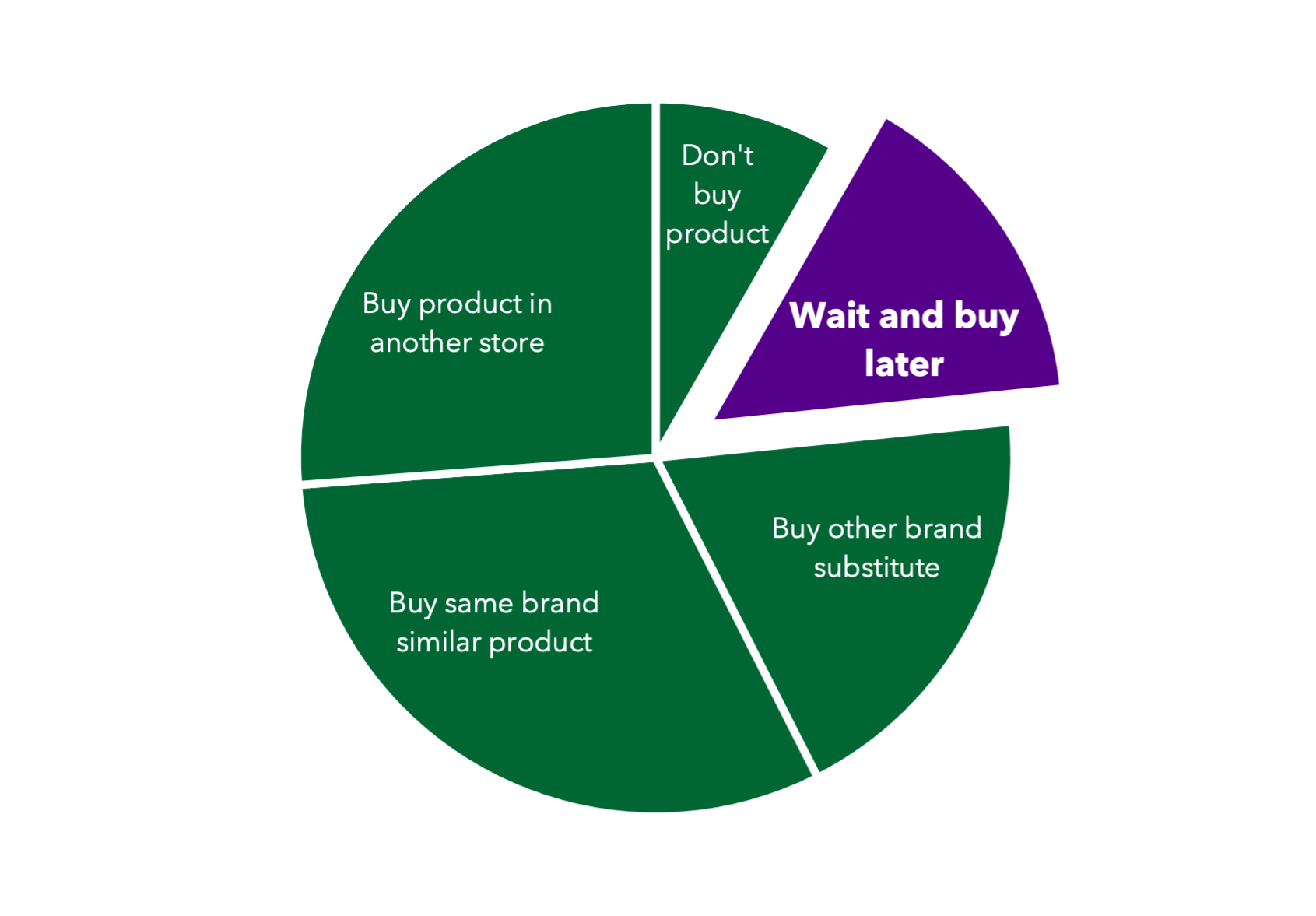
So, the question is what the buyer does when he cannot buy a product, because it is not available or is no longer on the shelf or online store (Exhibit Error! No text of specified style in document.-21). Basically, the buyer has five choices: do not buy the product, buy later, buy a similar product of another brand, buy a similar product of the same brand, and buy the desired product in another store. Researchers have conducted many studies with different results, but in summary it can be said that the situation when a customer cannot buy the desired product in a physical store is up to a tenth of all purchase attempts. Almost a quarter of buyers buy a similar product of another brand, a third of buyers buy that product in another store. This is bad news for both the manufacturer and the retailer. Basically, three-quarters of the choice is related to the product being seen and physically present on the shelf. A large proportion of shopping decisions are made at the point of purchase. If the product is not on the shelf, then the purchase decision will not be triggered. Thus, the physical absence of a product often means lost sales.
At first glance, the solution seems simple – just to have more inventories. Adequate inventory levels can indeed ensure product availability and increase sales, but there is a downside to high inventory levels.
Ex. 12‑21 Customer behaviour when out of stock
Keywords: out of stock, customer behaviour
Source: Adopted from (Corsten & Gruen, 2004)
As mentioned earlier, inventory actually means capital costs or frozen funds. Another aspect is inventory storage costs. In addition, it is very important that stocks can become outdated. Paints, food and other perishable products have an expiration date, so the threat of obsolescence is obvious. However, other goods also can become out of fashion and obsolete morally. Clothing manufacturers present a new collection every year; phone manufacturers release a new generation phone every year. Having accumulated a large amount of clothes or phones, there is a threat of not selling them when new generation products appear in the market.
In such cases consumers could expect sales, when stores or wholesalers sell out their goods. Some countries even have specific, regular dates for this. There are well-known Black Friday, Christmas discounts and other regular promotions, when outdated goods are sold out first. Such sales are sometimes called warehouse clearances. Selling at a reduced price is the only way to sell such items, it is better than nothing, but in any case, it is not as profitable as selling new collections.
Some international brands do not want their products to be sold at cheaper prices in the market and have a policy of recalling and recycling of old dated or old fashion products. For example, a Swedish clothing chain collects unsold clothing of the current year and recycles or re-uses them. This utilization policy is used when the manufacturer does not want the consumer to have the opportunity to buy their product cheaply, because in this case, when a new collection is released, it will be difficult to get as many buyers who are ready to pay a high price for the product. Some producers agree to sell the goods even cheaper than the cost price, this is called sporadic dumping, and this is discussed in more detail in chapter 3 of the book. Often old collections are moved to another usually to underdeveloped country for sale.
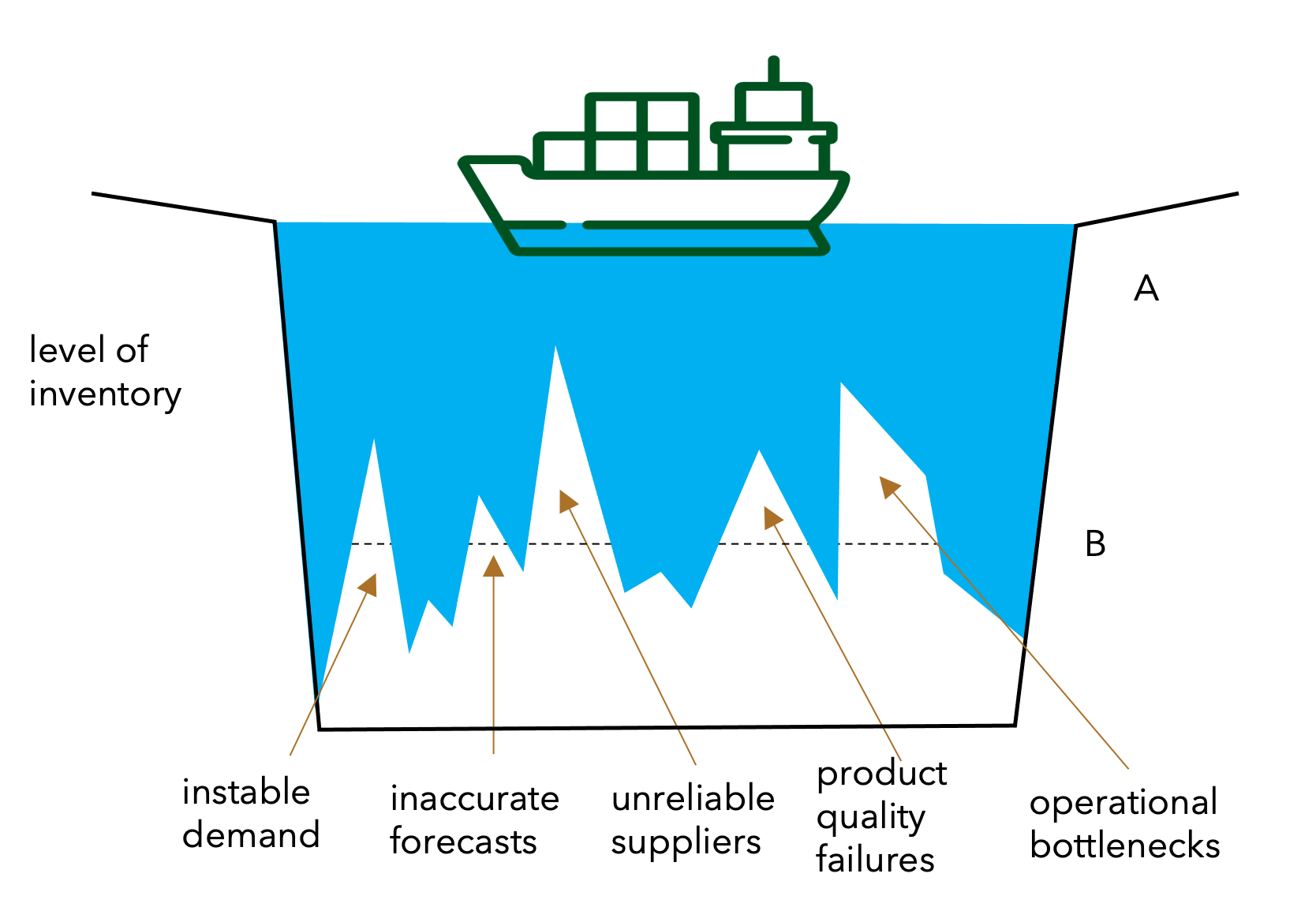
Ex. 12‑22 Price of inventory level
Keywords: inventory, demand, supply, forecasts
Source: (Christopher, 1992)
Too much inventory can also hide more problems within the business (Exhibit 12-22). Inaccurate demand forecasts, unreliable suppliers, quality problems in internal processes, bottlenecks in internal processes are often hidden with excess inventory, and business managers are not even aware of the existence of those problems. As organizations begin to reduce inventory levels, one problem after another could potentially emerge.
Share or comment this information on your social media:
The author has been teaching at several universities since 2005. 40+ scientific publications, 10+ international research projects. More about author.