This section describes doctrine of communism presented by Karl Marx and implications of this ideology. The failed attempts to introduce communism in the Soviet Union and the currently actual example of China are discussed too. The doctrine of communism is rarely included in comprehensive management and economics textbooks for students, but it still plays a role in business.
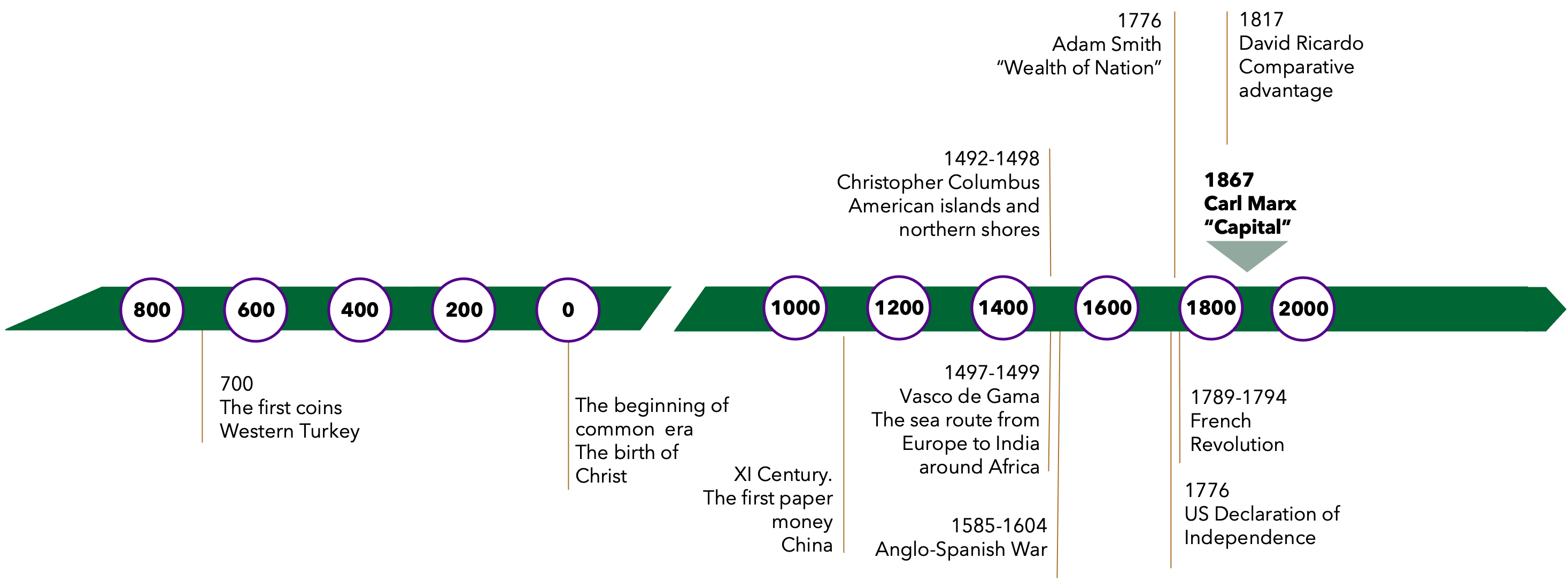
All the theories described in Part A, Chapter 1, except for Karl Marx’s theory, are based on a few fundamental principles of capitalism and on the belief that private property is inviolable, that private individuals can engage in economic activity in a free market, and that the state interferes with the free market only to the extent that is necessary for the state’s essential needs. Karl Marx criticized capitalism in his book “Capital” and proposed an alternative theory of how business and economic relations can work (Exhibit 1-16).
Communism is fundamentally opposed to capitalism and the free market, and for that reason it is avoided in the academic literature for students in Western countries. Regarding international business Reza Ghorashi mentioned that Marx was neither a “free trader” nor a “protectionist,” and he did consider free trade to be more compatible with industrial capitalism and conducive to general economic development than protectionism, which he associated with the era of merchant capitalism (Ghorashi, 1995).
Ex. 1‑16 Karl Marx’s Capital in the context of other historical events
Keywords: capital, comunism, Karl Marx
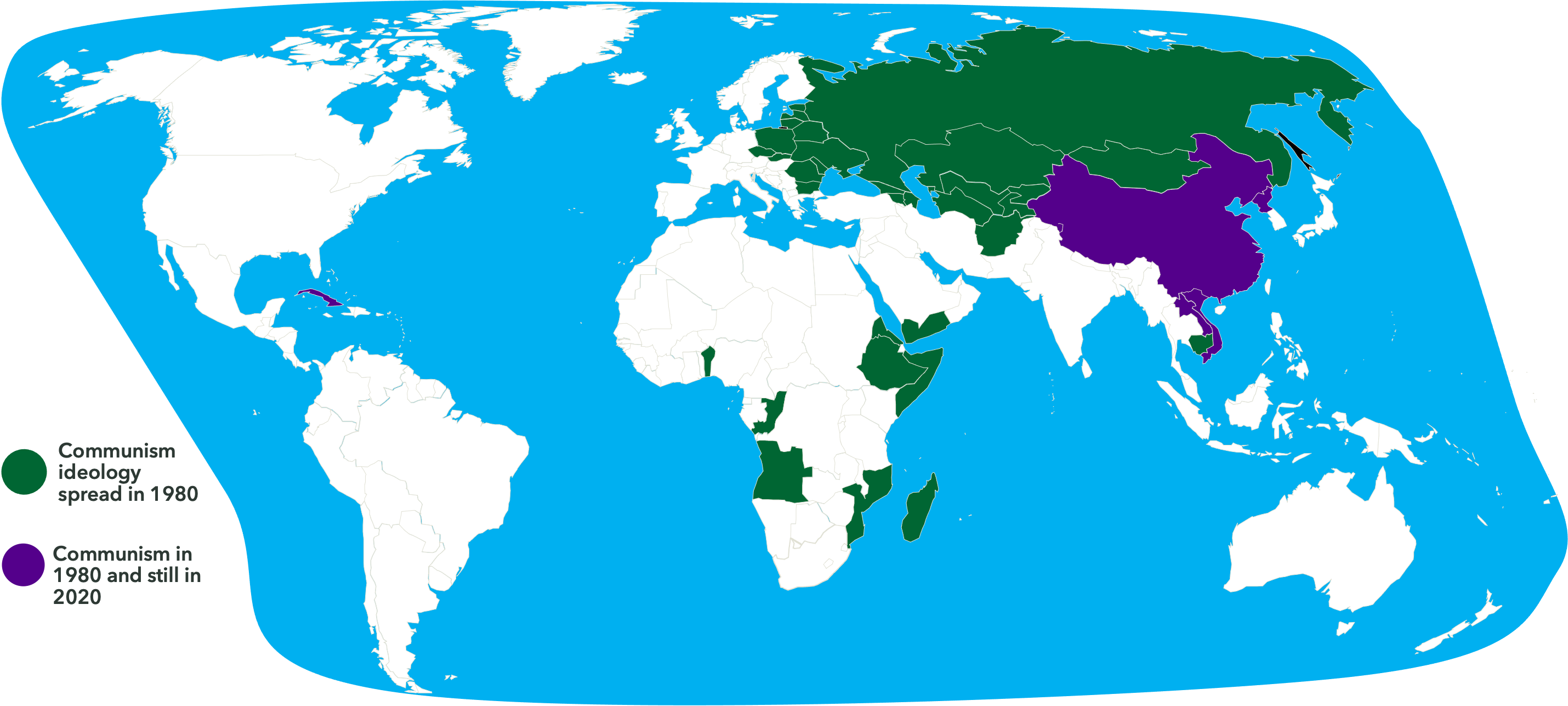
In this historical sense, then, Marx preferred free trade to protectionism. However, it is essential to know about appearance and implications of this ideology because it has been introduced rapidly in Eastern Europe since the Russian Revolution of 1917 and manifested by 1991. Moreover, it has been exported to parts of South America and has defined economics structures there. One of the most significant changes has been in Cuba, where the ideology of communism has become a bastion in South America. Asia was another direction of spreading communism ideas. Today’s China is officially a communist party-ruled country that has managed to create a symbiosis between the ideology of communism and capitalism with free market. Moreover, communist China is already rivalling the USA in terms of GDP. The communist Soviet Union, led by Russia, tried to create a similar competition to the capitalist system from 1917 to 1991, but the attempt ended in the collapse of the Soviet Union (Exhibit 1-17).
This textbook deals with global business, so discussion and understanding how business is running in countries under communist ruling, especially as China is important. Especially having in mind, that China is one of the biggest trading partners for many countries and has earned the title as “factory serving the world” in the 21st century.
The basic idea of communism is based on the Marx notion that the basic resources needed for any kind of industry are capital and labor. This is entirely analogous to the case of capitalism. However, in the case of capitalism, there is also a provision for the independent ownership of capital. Capitalism states that production assets belong to the owner and not necessarily to those who work with these assets. The main dilemma in capitalism is how to divide earnings from produced goods between the owners of assets and those who are working using those assets. Karl Marx, in his communist ideology, put forward the notion that all the earnings from produced goods should go to the workers and that the assists should also belong to the workers. So, as consequence, to implement communism in practice, the first step was to take property away from its owners by the state, i.e., nationalize it.
Ex. 1‑17 Countries where the doctrine of communism has been or is being implemented
Keywords: communism, Asia, Africa
Enterprises, land, factories, and all other private economic activity were nationalized. These processes took place in Russia and later on in whole territory of the Soviet Union in the 20th century.
Another important aspect of communism is the planned economy. Since private ownership and profit from activities are restricted in communism ideology, and a free market did not exist, the state itself has to take on the function of the market, i.e., to forecast and regulate demand and supply. It was not the market but the state that determined which products should be produced in what quantity and at what price they should be sold. In the absence of a free market, prices were often even physically stamped into the product because they were considered as fixed and fully reflected the value of the labor involved. The state also controlled the labor market, which determined how many jobs were needed in which industries, people were employed under compulsion, and all wage rates were also set centrally by the state.
Although the values of communist countries are at odds with those of Western culture, international trade deals are made with, exported to and imported from communist countries even in current times. Some communist countries are subject of sanctions and trade restrictions by democratic countries and international organizations, for example, North Korea, but some countries continue to be the economic partner of the capitalistic democracies and are heavily involved in global business, despite domination of communist doctrine. For example, state-owned enterprises in the People’s Republic of China are among the world leading producers of mobile phones and 5G communications technology. China subsidises emerging industry of electric vehicles and challenge the well know European and American car manufacturers. In global business, there is happening strange mix of competition and partnership between organizations from communist countries and organizations from capitalist countries.
Communism has several shortcomings, which were very apparent during the Soviet period (1917-1991):• Expropriation and restriction of private property have reduced people’s motivation to strive, do business and innovate.
• People’s wealth and well-being depended little on their work effort or talent; the wage system was centralized for all professions, people were assigned jobs, and there was no free labor market.
• Civil servants appointed by the political leadership planned and managed production volumes in the various industries without competition. Much of the production was of poor quality, and sales were guaranteed by a permanent deficit, because of having always production a little less than demand. The deficit meant that the local market would buy all the output, even if it was of poor quality. Deficits further reduced efforts to produce quality, as the buyer had no bargaining power as imports were restricted.
• Tight state restrictions led to the creation of shadow market structures, and ongoing underground trade was outside the law. Some industrial production was unaccounted for and sold on the shadow markets at much higher prices than in state-run shops, where there was a deficit. In addition, the law enforcement and secret services that controlled it were mired in corruption.Communism, as it existed in the Soviet Union, has collapsed, along with the entire political system. Still, it is being implemented quite successfully in China, where it is enriched by the advantages of capitalism – private ownership and competition in the market for goods and labor.
Timothy O’Hagan in “International Encyclopedia of the Social & Behavioral Sciences” well defined main principles of Neo-Marxism ideology, that is spreading in 21st century (O’Hagan, 2015). Neo-Marxists agree with liberals that freedom of the individual is the most important political value, and that modern capitalism delivers it to all members of society, including proletarians, in several important ways – by making worker and capitalist legally free, by making particular worker always legally free, and often economically free, to leave the proletariat and become a petty bourgeois or even a capitalist; and by delivering “important freedoms beyond that of buying and selling” including “freedom of speech, assembly, worship, publication, movement, and political participation”.
Share or comment this information on your social media:
Fundamentals of global business
First edition
For citation:
Jarzemskis A. (2025). Fundamentals of global business, Litibero publishing, 496 p.

Full scope of the book is available in various formats
A.1 Theories of international economics
- Mercantilism
- Adam Smith and absolute advantage
- David Ricardo and Comparative advantage
- Standard theory of International trade
- Karl Marx and communism
- Hekscher – Ohlin theory
- Paul A Samuelson theory
- Leontief paradox
- Rybczynski theory
- John Hicks and progress
- Economies of scale theory
- Contemporary business internationalisation theories
- Questions for chapter review
- Chapter bibliography
About author
The author has been teaching at several universities since 2005. 40+ scientific publications, 10+ international research projects. More about author.