Logistical packaging. All goods must be packed properly before being transported or stored as general cargo, with the except for large items such as cars, or tin rolls. Packaging basically has two functions – a protective function and a marketing function. Although the variety of packaging may be extensive worldwide, the essential principles are remaining consistent (Bix et al, 2009).
A very important principle is the dimensions of the package, which must be compatible with standardized vehicles, loading and storage equipment and facilities. Manufacturers are not obliged to follow these principles when planning their package size, but if not, then the resources of transportation and storage equipment will not be used efficiently, and this will mean that the logistics costs for the same amount of goods could be higher. Since cost reduction is one of the functions of logistics, product packaging, its dimensions and shape are very important. This importance increases proportionally with the quantity of goods. For global organizations that produce and distribute hundreds of millions of items worldwide, even a one-dollar cost reduction per item can mean hundreds of millions of dollars (David, 2021).
From a marketing point of view, the packaging or container is designed to encourage the customer to buy the product. In this case, the aesthetic qualities of the package or container are emphasized. Depending on their purpose, the goods are packed in attractive, vibrant, glossy, or professional and sturdy packaging. Sometimes a very small but expensive item is specially packaged in a large package (Kaestner, 2023). For example, in the field of electronics, a small USB connector or a mobile modem or a telephone can be packed in a package that exceeds its dimensions several dozen times, because according to the laws of psychology, the tangible size of the package for the buyer can justify the price of the small product.
In terms of logistics and transportation, goods are packaged to ensure their own safety during loading, transportation, or storage, as well as to protect them from damage or environmental exposure. Other cargoes (such as liquids) simply cannot be physically stored or transported without first being packaged. Packaged goods are often packed with more space than required – this is convenient when transporting or storing them. For example, to increase the space in a freight vehicle or warehouse it is important to ensure that the container or packaging are rectangular in sides, bottom and top. For example, even beverage sellers increasingly pour their products into plastic containers that are not cylindrical, but rectangular.
The cargo packaging material and shape must correspond to the type and nature of the cargo, it must be durable enough to be loaded using various mechanisms and withstand various forces during transportation (Zhu et al., 2022). When choosing a cargo package, it is necessary to consider the fact that for the transportation, only the total gross weight of cargo counts, it means both product and package weight. The customer will have to pay for transportation of the package too, and a heavier package implies an increase in the transportation costs, which in turns increases the final price of the product. The package itself can consist of wooden, metal, glass, plastic, ceramic, paper, textile materials or be made of other materials or composites. According to the degree of rigidity, it can be rigid, for instance various barrels and boxes, semi-rigid for instance baskets and soft for instance shells, bags or bundles. Double packaging is used when transporting some cargoes. For example, glass containers with poured liquids are still placed in other packages, for instance wooden boxes. In all cases, whatever the packaging, its purpose is to protect the cargo itself from side effects, deformation, damage, scattering or spillage, rotting, possible spread of materials, especially when transporting dangerous, unsanitary cargo, and environmental pollution. To protect cargo from theft, special packaging or a special loading method is used during cargo transportation.
For example, when transporting goods in containers by rail, the containers are positioned close together, so that the doors can only be opened after containers have been unloaded.
Ex. 14‑12 Levels of packaging

Keywords: primary packaging, secondary packaging, tertiary packaging
Packaging has three levels: primary, secondary and tertiary, according to its functions (Exhibit 14-2). In the primary packaging, the product itself is placed in the primary packaging, this packaging is also called marketing packaging. Since this package performs and looks at satisfying marketing objectives, but also comes into direct contact with the goods, many requirements apply to it (McKinlay, 1999):
- Strength, so that it does not tear, distort when stacked, or does not disintegrate.
- Temperature resistance of the product.
- Ease of cleaning.
- Ease of sticking labels.
- Aesthetic beauty from the point of view of trade.
- Environmental requirement in terms of waste management.
- Safety requirement in the case of food, medicines, hygiene products.
Ex. 14-3 Two levels of marketing packaging

Keywords: marketing packaging, primary packaging
Secondary packaging is usually a box into which primary package filled with goods is placed. The main requirements for secondary packaging are:
- Strength, so that it does not tear, does not disintegrate.
- Compatibility of height, width and length with the original packaging
- Compatibility with the dimensions of the most popular pallet, roll-cage or retail shelf size used in the destination region
- Environmental requirement in terms of waste management.
In some cases, there is an additional package between the primary and secondary packaging. Some products have first and second level of primary marketing packaging, for instance perfumes or toothpaste. For example, a bottle with hand cream is placed in a marketing box and this is later placed in the secondary packaging. Another example is that each of individually packed chocolate bars is placed in a pocket containing several chocolates units. Such pockets which also serve marketing function later are in a secondary package. Secondary packaging is used only for logistics purposes and usually, it doesn’t contain any brand related attributes. This is the reason why there is a need to have additional marketing packaging before placing the product in the logistics packaging (14-13).
Ex. 14‑4 Dimensions of pallet used in continental Europe
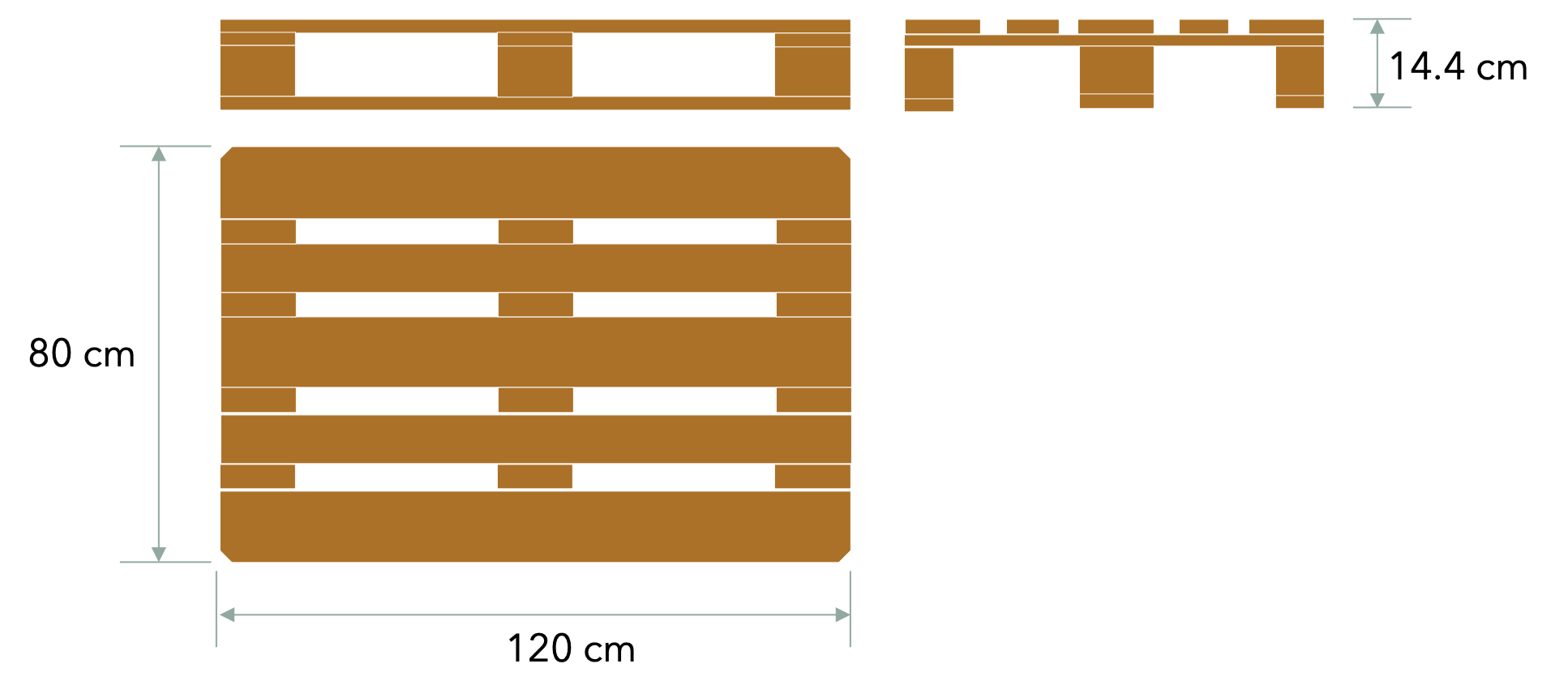
Keywords: palet, EPL, europallet
Tertiary packaging is assumed as a transport unit from the point of view of logistics. The tertiary packaging is consisting of a consolidated shipment, stacked boxes, buckets or other packages, which are usually wrapped in packing film and placed on a pallet. There are two main requirements for tertiary packaging – first its compatibility of width and length with secondary packaging and with the dimensions of freight vehicles, and secondly an environmental requirement in terms of limited waste management.
It is very important to note a pallet which actually is a tertiary packaging level is the most standardized around the world. So, to the measurements of pallet the size of secondary package needs to be adjusted.
A most common transportation unit is a box which is easily lifted by hand. Organizations in manufacturing facilities, or logistics centres, fill and move primary and secondary packaging by hand, or using semi- or fully automated packaging and filling lines. When loading mechanization was invented, there was huge demand for a common standard. In the long run, a global agreement was reached on the standardization of tertiary packaging. Pallets are mostly used as the basis of tertiary packaging. Pallets can be lifted by a standardized mechanized forklift in any place of the world and stacked in storage racks of standard sizes. Moreover, the measurement of the pallet is standardized to fit with the floor surface of freight vehicles. So, goods, packaged in secondary package, are stacked on pallets, which could be loaded into vehicles, or placed on warehouse racks as a single package, or as a single unit. The main advantage of the pallet is that the load can be lifted from below with a forklift, by inserting the forks of the forklift into the specially designed holes at the bottom of the pallet (Exhibit 14-14).
There are also methods of transport without pallets. Dry bulk, liquid bulk or large general cargo units are transported without using pallets. However bulk cargo can be transported packaged in boxes, bags buckets or specialized tanks on pallets if the size of package fit the size of pallet.
Palletized cargo transportation is used all over the world, and the standards for handling equipment are also standardized. However, the sizes of the pallets themselves differ in different continents and that creates some issues. The size pallet size in continental Europe is standardized and the dimensions are 0.8-meter width and 1.2-meter length. These pallets are called Euro pallets. They are marked with the letters EUR in an oval circle. For example, pallets with the same length and width of 1.2 m are used in the United Kingdom, and there are also pallets with dimensions of 1.0×1.0 meter, 1.0×0.8 meters in various countries.
To illustrate the principle of adapting the different levels of packaging to each other, in continental Europe, where the dimensions of the pallet are 0.8×1.2 m, the width and length of the secondary packaging should be exactly fitting, such that, when they are placed on the pallet, the surface area of the pallet is fully utilized (Exhibit 14-14). This would be the case for a pallet of apple boxes, each of 40 x 60 x 17 centimeters, as a good example because 6 such boxes fully fill the floor of pallet. As a wrong example, if the floor size of a parcel used as secondary packaging is a square of 30 x30 centimeters, and if it would be stacked on a Euro pallet in a 3 x 4 parcels pattern, then 10 centimeters of boxes would protrude beyond the pallet. Loading goods beyond the length or the width of the pallet is not recommended for two reasons. First of all, because of packaging damage – when many boxes are stacked on top of each other, the bottom box is under a lot of pressure, and if its bottom protrudes beyond the pallets, the package can be damaged. Another reason is loading the pallet into the vehicle. The width and length of the vehicle’s cargo compartment is also standardized and most often matched to the width of the pallets. To place less boxes than it is pallet floor capacity is also inappropriate, because it is inefficient as price of transportation depends on number of pallets and not boxes.
Ex. 14‑15 Deployment of pallet on the floor of trailer in Europe
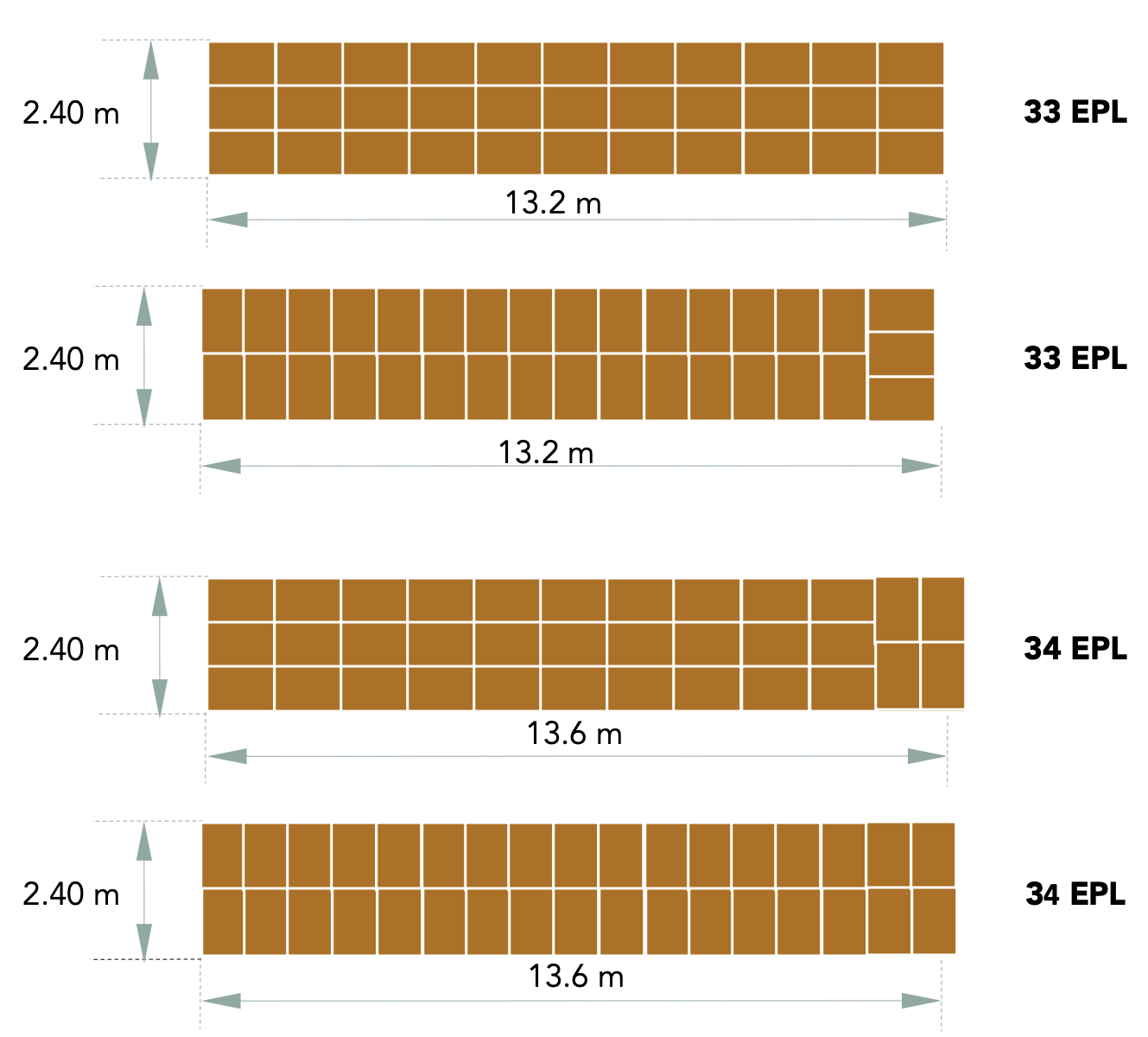
Keywords: trailer, pallet
In many continents, general cargo is mainly transported by road transport. As a result of the growing policy demands for CO2 reduction, congestion alleviation and transport efficiency, various countries are implementing measures to impose additional taxes and restrictions on road transport, which is considered to be the most damaging mode of transport. Many countries are trying to encourage as much as possible the use of rail, waterways or short sea shipping for long distances. However, it is inevitable that the so-called first mile and the last mile, when the cargo is either picked up from the factory warehouse or delivered to the distribution warehouse or store, logistics managers will choose road transport. For example, in the European Union, it is planned to restrict the use road transport for distances of up to 300 kilometers.
If the distance is longer, then measures are applied to encourage the cargo to be transshipped to a more environmentally friendly mode of transport. Since the first and last miles are and will inevitably be mostly served by road transport, the coordination between road vehicles and tertiary packaging, i.e. pallet dimensions, becomes very important.
In long distance road transport, goods are mostly transported by rigid trucks or semi-trailers. The width of semi-trailers in Europe is adapted to European pallets and varies depending on the thickness of the frame construction, from 2.40 to 2.48 meters. Thus, two transversally loaded or three longitudinally loaded euro pallets fit within the width of the semi-trailer. A semi-trailer with a total length of 13.6 m can accommodate 33 or 34 euro-pallets on the floor (Exhibit 15-15). A trailer with door has a length capacity of 13,2 m, so it accommodates less pallets (Exhibit 14-15). In America, Australia, Asia, semi-trailer measurements are slightly different, so the respective pallets used in these continents are different from European pallets.
An international manufacturing or trading organization cannot determine the dimensions of pallets or semi-trailers, but it can and seeks to adapt primary and secondary packaging to their sizes. Often, the design and dimensions of the product itself are designed considering logistically efficient measurements. For example, the Swedish global furniture manufacturing company, which has used the advantage of logistics to expand its business to the largest furniture manufacturer in the world, even combines the dimensions of tables or cabinet panels with the dimensions of pallets and semi-trailers at the design stage. It is very important to do this in the design phase, because it is too late to realize that its logistics costs increase due to mismatched measurements after the product has been manufactured.
Because in different continents are used different dimensions of semi-trailers and pallets, international organizations often adapt to the market they serve. However, the dimensions of a road transport semi-trailer are not the only size that global organizations focus on when designing packaging. Chapter 2 describes how the structure of the world economy changed in the late 20th and early 21st centuries. European and US manufacturers have moved their factories to Asia, mainly to China. One of the enablers for such a transfer was the cheapening of logistics by containerization. Goods made in China reach the American and European continents mainly by sea transport, while raw materials and components are also brought to Asia and China by sea transport, mainly in containers or in bulk. The dimensions of the container are very inconvenient for the use of euro-pallets, because the width of the container is 2.35 meters, which means that two euro-pallets which each is 1.2 meter long to place into the container in one row is not possible. Three euro-pallets each 0.8-meter width cannot be placed in one row in the container either, because of 5 centimeters of width is missing.
When loading cargo into semi-trailers, the term loading meter – LDM is used. It means how many meters long semi-trailers are loaded. For example, if loaded into two continental European standard pallets (1,2 m. X 0.8 m) it is considered to be loaded 0.8 LDM. Four pallets will be 1.6 LDM, six pallets will be 2.4 LDM, etc. The semi-trailer can be loaded up to 13.2-13.6 LDM. The concept of LDM is often used when transport services are ordered and transportation price negotiated. The cost of transportation for transporting partially loaded trucks, called less than truckload – LTL, is also calculated as price for 1 LDM.
Goods from China are often transported on standard pallets common in Asia, but such pallets do not fully utilize the floor of the semi-trailer used in Europe. When planning their production and trade, global organizations pay attention not only to primary and secondary packaging, but also plan in advance how products, components or raw materials will be transported, because efficient use of space during transportation creates a competitive advantage. With very large quantities of transported production, even small space savings turn into big money.
Cargo packaging depends a lot on the size of the shipment. According to the size of the shipment, cargo is divided into small shipments, medium-sized shipments, and massive shipments. This division is conditional, it is not legally regulated, such division may vary for different types of transport. A cargo shipment is a quantity of cargo submitted for transportation at one time to one address, according to one transport document.
For example, a rail shipment may be a complete train set or consist of one or more wagons transported at the same time from the same consignor and from the same station without changing the set of train wagons to the final destination station. Wagon shipment is a freight shipment that requires an entire wagon to be transported, regardless of whether the wagon’s carrying capacity is fully utilized. Small shipment – a cargo delivery that does not require the utilization of entire wagon.
For example, in road transport, a full load is considered when one sender fills the entire vehicle, and the cargo is transported directly to the recipient. A partial load in road transport is one that does not occupy the entire vehicle, and another shipment could be loaded into the same vehicle as another partial load. Before carrying out cargo transportation in this way, it is necessary to combine or consolidate such cargoes which belong to different consignors and different consignees. If such cargo is intended for more than one client, it is necessary to apply the distribution procedure to deliver it to several destinations.
Small loads are loads weighing up to a dozen kilograms, although they can be less than 1 kg. Such cargoes are usually transported by postal couriers or express delivery services. The mentioned cargoes require high labor costs, application of information technologies, they can be transported individually or using various transportation units (boxes, small containers). This type of shipment was growing exponentially after COVID-19 when e-commerce accelerates. Home delivery accounts for a share of all urban goods transportation of more than 10 percent in number of vehicles, more if measured in value of goods.
Share or comment this information on your social media:
Fundamentals of global business
First edition
For citation:
Jarzemskis A. (2025). Fundamentals of global business, Litibero publishing, 496 p.

Full scope of the book is available in various formats
D.14. Packaging and international freight operations
About author
The author has been teaching at several universities since 2005. 40+ scientific publications, 10+ international research projects. More about author.