Globalization picked up pace in the midst of the 20th century driven by transportation technology, political and economic unions, and free trade. People from different nations and diversities prefer to use the same brands for smartphones and apparel and they even choose to eat at restaurants within the same franchise chain. Due to similar preferences even if the person is brought blindfolded to any store or restaurant of an international chain, most people can hard to identify which continent or country they are in. The United Nations and other international organizations declare universal human rights, universally accepted norms, as exclusive and undeniable entitlements. However, if we peel back the curtain of multinational corporations and look at each country separately, it is possible to find a lot of differences (Hampden-Turner et al., 2020). This is not about race or skin color, but about those differences and those qualities of people that are not visible physically. At best, we can see some differences that arise from human behavior (Hill, 2022). Sometimes the differences can be observed in person’s clothing, how a person reacts in various situations, how they speak and how they express their thoughts. However, these differences are often hard to see because they are masked by the so-called global culture (Soares et al., 2007) and global fashion, which includes clothing and behavior.
Nancy Adler in 2001 linked culture and behavior to another important and hard to see external element – values and attitudes. She proposed cycle concept to reflect relations between culture, values, attitudes and behavior (Exhibit 9-1). Culture is what surrounds a born and growing child – be it environment or various personalities around, that includes parents, relatives, friends, school mates, teachers, relatives, neighbors, residents of the same district or city, citizens of the same country (Adler, 1983). All these surrounding behavioral patterns and traditions shape the psyche of a child during the growing years, and later, as the personality matures and develops, it forms the human value system. The influence of each personality around during the formation of the value system is different. A person usually adopts the value system of those around him, with whom he spends the most time, who are considered role models in his environment. Identical twins raised in different cultures have different value systems.
Ex. 9‑1 Nancy Adler’s cycle

Keywords: behaviour, Adler, culture
Source: (Adler, 2001)
Culture includes many dimensions, and various authors, like Hall, Hofstede, Trompenaars group them differently and even attribute them to a certain state or cultural – ethnic group or group of states. This is covered in other sections of this chapter. If a person is raised in a culture that believes in God and displays it in some manner, there is a very high probability that he will also believe in God and express it in daily life, on the contrary, if a person is raised in an atheistic culture that does not believe in God, it is likely that the person will also not believe in God. If a person grows up in a culture where polygamy prevails, then in that person’s value system the fact that a man lives with several women is considered to be the norm. If a person grew up in a culture where marriage and sexual relations between two men are considered normal and equal to marriage and relations between a man and a woman, such a person considers homosexuality as a norm.
The unbiased approach towards diversity of values is viewed absolutely in a neutral way in this book. However, it is easy to achieve neutrality while talking about hypothetical and theoretical concepts. Real challenges arise when members of different cultures, representing different value systems, must interact, communicate, work, trade and do business together. Movie producers produce many comedies and tragedies in which they present curious situations where people of different values and cultures come into contact. However, not all clashes between different values and cultures have similar scenarios in real life that are depicted in cinema.
The biggest challenge of cross cultures is the question that arises from the fact about the supremacy of the value systems. Not because of the differences in values themselves, but because of the question itself, or even the idea that some value system is better than another. Every person’s value system has certain beliefs, which are usually very difficult or impossible to change. So, if two people have different beliefs about God, human relationships, or even the food they eat, these two believe that the other is wrong or narrow minded.
Coming back to variation of values, it is very important to return to the fact that these values are shaped by culture. Changing a value system, even in the presence of obvious and objective scientific evidence, is very difficult. So certainly, in matters where the scientific evidence is less obvious and subjective, or where science cannot explain, value systems are even more difficult to change.
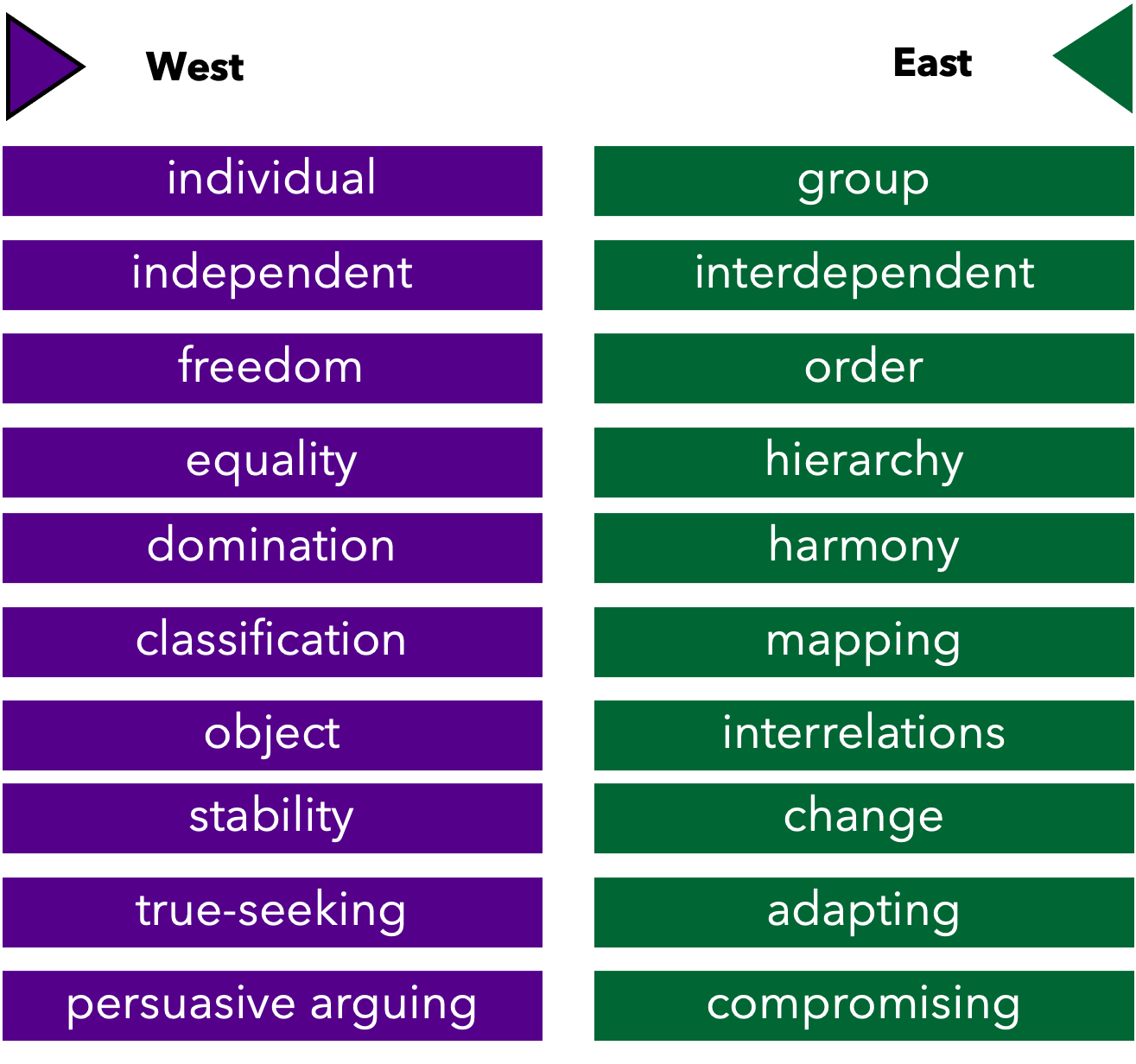
Today humans live in a global world where English is considered the international language of business, English is considered the international language of science, and among the world’s strongest economies are those where English is the mother tongue. The evolution of globalization which is described in chapter 2 and theories of international economic which are described in chapter 1 have shaped the world that the generation reading this book has inherited from ancestors. The breakthrough in scientific achievement in England in the late Middle Ages, which later led to the industrial revolution, and industrialization gave a huge advantage to the spread of Anglo-Saxonist culture, English language becoming dominant in the world of global business and science. Even today, majority of all scientific journals in the world are published in England or the United States. Apparently, there are many reasons that explain why the scientific breakthrough happened in England and not, for example, in Spain, India or Iran. Two reasons that are related to each other are still worth mentioning. One of them is religious reform and Protestantism. Protestants broke away from Roman Catholic traditions and sought to make people read themselves, at first it was reading the Bible, later it led to general Protestant literacy. Another important aspect, England’s colonial international trade with the other nations they found led to the enrichment of this country, same as it was experienced in Spain, France and Netherlands too. Both reasons allowed the formation of a critical mass of literate people in England who no longer had to deal with the daily issues of feeding themselves. In England a system was formed which allowed the retention of the brightest and most ambitious minds who could devote sufficient time to scientific thoughts, experiments and explorations. The laws of mechanics discovered by Isaac Newton in the 17th and 18th centuries, and later the progress of other scientists in the field of electromagnetism allowed the use of natural laws for the development of industry and the dominance in the world economy by England and its colonies, which later gained sovereignty and political independence. But the fact that the British became superior in science, technology and business did nothing to ensure that only British values dominated in the entire world. Although many different countries and cultures with their own value systems have adopted English as the dominant language in science and business, many nations still retain their own distinct values. In the 20th-21st century, technological progress and scientific achievements became available to many countries of the world, in some scientific fields even greater progress was made by countries and cultures whose value systems are different from those of the English, their former colonies or cultures that strongly assimilated with the English during the period of industrialization. Today, this type of culture and value system is often referred to as “Western” culture or “Western” values. It cannot be said that “Western” culture was formed and composed exclusively by the English. England, along with other countries that first developed industry, such as Germany, France, as well as other western European countries, began to form a value system in the eighteenth and nineteenth centuries, which has strong Protestant foundations. As this value system developed in Western Europe, it acquired the name “Western” culture. However, the USA, Canada, even Australia is also included in this culture today, and it does not reflect the word “West” as a geographical area. However, unequivocally, this culture and value system began in Western Europe. As opposed to “West”, the term “East” has been used, which essentially reflects the cultures and value systems of many Asian countries. Richard E. Nisbett shaped and justified very well those two polarities of cultures in his book in 2005 (Exhibit 9-2). The “Global South” it is a new paradigm that is articulated in the speeches of politicians more and more often in the third decade of the 21st century. The “Global South” basically covers South Asia, South America and Africa and is estimated as rival of “Collective West”. In any case, newly entitled “Global Southerners” has many same characteristics as Nisbet’s “Easterners”, which are in opposite values systems with “Westerners”.
Westerns and Eastern polarities are in such attributes as individual versus group, independent versus interdependent, freedom versus order, equality versus hierarchy, domination versus harmony, classification versus mapping, object versus interrelations, stability versus change, true seeking versus adapting, persuasive arguing versus compromising (Nisbett, 2005). Some scientists, politicians, non-governmental organizations strongly encourage avoiding at least any stereotypes and attitudes about people or ethnic groups. They are right, because it is not possible to describe the value system with one word “Eastern” values.
Ex. 9‑2 Nisbett’s East versus West polarization
Source: (Nisbett, 2005)
Keywords: Nissbet, Westeners, Easteners
Japan, China and India have very different value systems, although all three cultures are called “Eastern”. On the other hand, saying that all people are the same and there is no difference to the culture of the employed person may be a mistake. People with different value systems have very different views on the same phenomenon, thing or process. In different cultures, even the attitude towards work is different. Some cultures consider it a very great value and good, but there are cultures in which the attitude that work is a shame is rooted. Depending on the value system, the ways of motivating people, the ways of communication will differ. The approach to time and punctuality is different. In some cultures, being on time is highly valued, and being late is even considered an insult or humiliation, but there are cultures where it is not valued at all, where people are relaxed, and people who are punctual and always in a hurry are seen as neurotic and ridiculed. Some cultures place great value on personal achievement and showing it off, but others value a modesty and concealing one’s superiority. Author of this book does not try to say that some values are better than others, but it is very important to know that values can be different and that they are formed by different attitudes that will lead to quite different behavior in the same situation if people from different cultures interact. Thus, the culture in which the personality is formed shapes the value system, and the value system determines the attitudes. The value system and attitude are a personal matter of everyone, and those around a person may not even know it, but attitude finally shapes behavior, and it has concrete consequences for other persons around. In a certain culture, the attitudes and value system can be discerned through observation of the prevailing behavior in various situations. For example, if in a country woman do not drive cars, or do not walk alone, this shows the attitude towards women and perception of a women’s role in the society. If a young person stands up to give way to an older person on a bus, this behavior shows that certain attitudes towards elders and certain values associated with it are dominant in the culture. Behavior is important not only as manifested element of values and attitudes, but it forms the environment in which children grow, and new personalities are formed, so behavior determines what culture will remain in the future in a particular country or region. Although globalization, increased human mobility and increased tourism greatly determine the external similarity of cultures, values and attitudes of different nations change slow. If the immigrants live together in the same house or city area with the natives, it is likely that their culture is similar to natives, but if the immigrants live in the territories they created, so called ghetto, communicating only with likeminded persons of same culture, integration and assimilation does not occur. Sometimes communities create so called isolated islands where values, attitudes and behavior are different from the rest of the cities or countries’ population. Such barriers and obstacles to assimilation cause a lot of social tensions and social exclusion. Since the culture-values-attitude-behavior cycle is closed and behavior again shapes culture, in the long run, when people from different cultures adopt behavior patterns from other cultures, values and attitudes become similar, but it takes more than one generation to change before the changes become obvious.
After studying the behavior of certain cultures for a long time, scientists have sorted and described cultural differences according to certain elements, or so-called cultural dimensions.
Share or comment this information on your social media:
Fundamentals of global business
First edition
For citation:
Jarzemskis A. (2025). Fundamentals of global business, Litibero publishing, 496 p.

Full scope of the book is available in various formats
C.9. Theories and elements of cross-cultural business environment
- Culture and behavior relations
- Cultural dimension by Hall
- Cultural dimension by Hofstede
- Cultural clusters by Trompenaars
- Cultural dimension by Kluckhohn and Strodtbeck
- Variety of cultural clusters and its impact on business
- Cross cultural differences in business processes
- Questions for chapter review
- Chapter bibliography
About author
The author has been teaching at several universities since 2005. 40+ scientific publications, 10+ international research projects. More about author.