For the franchisee, acquiring an international franchise has both positive and negative aspects that are important to consider.
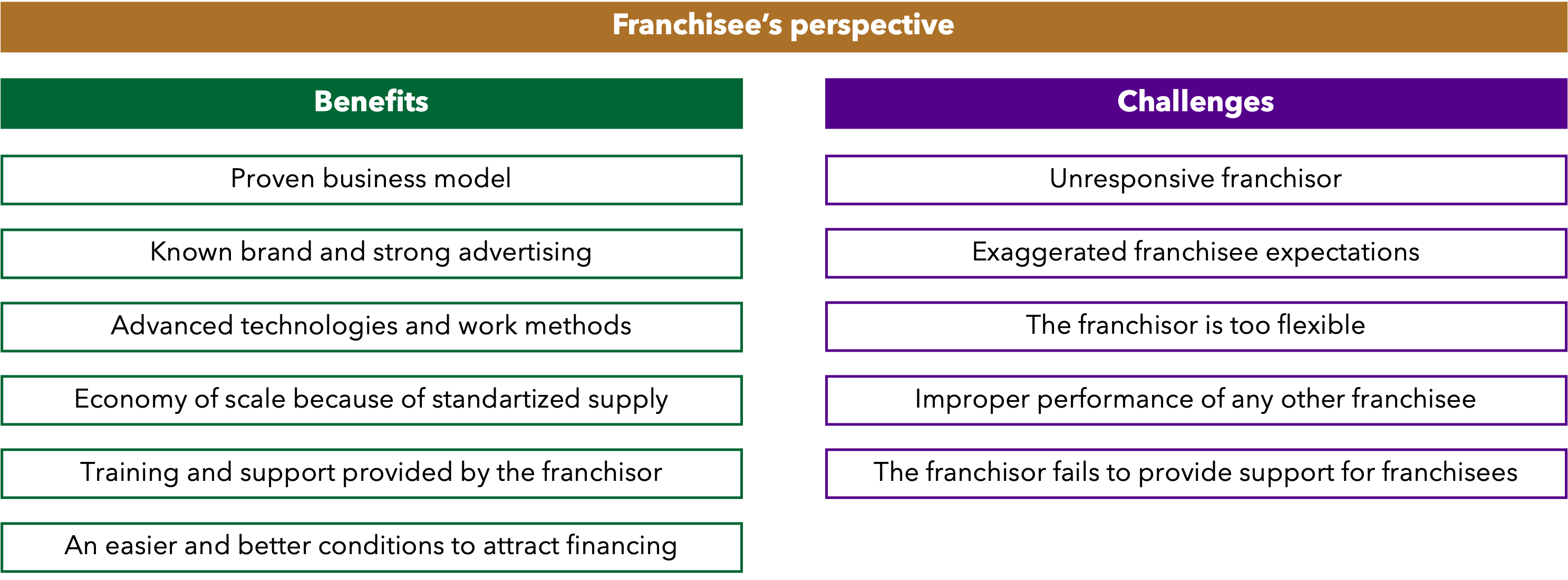
The franchisee’s benefits and motivations for purchasing a franchise include:
• Proven business model.
• Known and already famous brand and advertising of the franchised business.
• Developed technologies, advanced work methods, reliable suppliers and a wide network of partners.
• Economy of scale, because purchases of raw materials, materials, and equipment are more often standardized for the entire franchise network.
• Training and support provided by the franchisor.
• An easier way and better conditions to attract financing.
Ex. 4-8 Franchisee’s Pros and Cons
Keywords: franchisee’s benefits, franchisee‘s challenges
A franchisee usually opts to purchase a franchise because they trust a proven business model that significantly reduces the risk of business failure. The risk of failure decreases because the business has been operating for many years, has faced difficulties, unfavorable situations, made mistakes and corrected them, thus gaining experience. By purchasing a franchise, the franchisee is likely to avoid many of the mistakes that have already been made by the franchisor and other franchisees. This gives additional confidence to the franchise and the business. The franchisor plans and organizes both international and national advertising companies, advertising materials and channels (Perrigot et al. 2017).
The franchisee receives from the start of the business a well-known brand of the franchise network, which, if popular in the market of the franchisee, helps to attract consumers without much additional effort on the part of the franchisee. If the franchisee were to start a non-franchised but independent business, creating, promoting and raising awareness of his new brand, attracting consumers would take significantly more time and demand more resources.
After joining the franchise network, a new franchisee in a short span of time acquires the knowledge and technology that the franchisor and existing franchisees have accumulated since the establishment of the business. A new franchisee will be able to avoid mistakes typical of starting a business, get access to proven suppliers and developed work methods. This substantially reduces the likelihood of bankruptcy and potential losses that could result from inexperience in the business.
Each franchisee that joins the franchise network usually gets the opportunity to use the advantages of economies of scale in the areas of supply of goods and services, marketing, research and technological development and other important business processes. When developing his own non-franchise business, an entrepreneur would not have the opportunity to obtain the same cost-benefit ratio in defined processes in a short period of time. Franchisors offer important pre-opening support in areas such as site selection, design and construction, financing, in some cases, training or grand opening event.
It is not uncommon for novice entrepreneurs to face difficulties because they do not know how to act in various kinds of situation, and do not have relevant experience of business management. Most of them, if given the opportunity, would gladly acquire the knowledge required from experienced entrepreneurs and seek advice on matters relating to business management, that happens on daily basis. The franchisor has a direct interest in the franchisee’s success (Jang & Park, 2019). Therefore, the franchisees are not only under the control of the franchisor, but also constantly supported by him. Franchisors use various means of supporting franchisees. Ongoing training is one of these measures, but ongoing support is not limited to it. One of the main tools present in almost all franchises is operational manuals, which provide the franchisee with detailed instructions for organizing and managing business processes. Unfortunately, even the best operations manager cannot predict and describe all possible situations. Therefore, most advanced franchisors provide franchisees with the opportunity to receive prompt responses from competent professionals for questions related to business management. Often, the answer can be addressed not only to the franchisor, but also to other franchisees of the network (Paswan et al., 2014).
Most people who decide to start their own business face the issue of attracting initial investment. An entrepreneur can attract additional funds for investments in starting a business from banks, relatives or investors, but usually all these methods are associated with a sufficiently high risk of lenders/investors. To mitigate this risk, lenders or investors may require large collateral, significant co-financing or other risk mitigation measures. These requirements often become unbearable for a new entrepreneur. In the case of acquiring a franchise, the risk for investors is lower than in the case of investing in a new independent business. Banks, other lenders, strategic investors or business angels, seeing not an abstract and untested business idea, but specific financial indicators of other already operating franchisees, the history and reputation of the franchisor, makes it easy for the financer to decide on the allocation of financing.
Acquiring a franchise also has negative aspects and risks, which the franchisee must find out from the beginning:
• Unresponsive franchisor.
• Exaggerated franchisee expectations.
• The franchisor is too flexible.
• Dependence on the improper performance of any other franchisee.
• The franchisor fails to provide support for franchisees.
Sometimes the franchisor avoids responding to market changes and does not pay enough attention to constantly improving the business model (Watson et al., 2020), as a result of which the franchisee may find himself in a situation where he cannot change the business model because it is limited by the terms of the franchise agreement, even the existing model does not bring profit (Paswan et al., 2009).
Franchisees sometimes tend to expect more from the franchisor than the franchisor can provide (Bretas & Alon, 2021). Although franchising is an effective tool, it does not remove the responsibility of franchisees to work and being responsible for the results, success or failure of their business. In other words, franchising only provides prerequisites for business success, based on the experience of other franchisees and historical facts, but this in no way guarantees one hundred percent that in a specific city or country, a specific case of a franchisee will be successful (Gorovaia & Windsperger, 2013).
Despite the fact that franchisees are highly dependent on the franchisor, it is common for the franchisor to feel pressure from franchisees to deviate from the standard. Excessive flexibility of the franchisor can lead to a decrease in unification and quality throughout the franchise network, which can have a negative impact on the business performance of the entire franchise network.
If an undesirable event occurs in at least one object of the franchise network, it affects all the beneficiaries of this franchise. For example, food poisoning in at least one franchise restaurant can lead to a decrease in the number of visitors in a restaurant of the same franchise chain located in another continent as well.
Sometimes, especially in the case of rapid development, the franchisor may face a shortage of resources to adequately support franchisees, the supply of materials, raw materials and equipment. The franchisor can begin to prioritize franchisees, for example, a master franchisee working in a large market with high purchasing power and having dozens or hundreds of sales or service locations likely to receive more support from the franchisor than a franchisee managing a single franchise unit in a small country.
Share or comment this information on your social media:
Fundamentals of global business
First edition
For citation:
Jarzemskis A. (2025). Fundamentals of global business, Litibero publishing, 496 p.

Full scope of the book is available in various formats
B.4. Intelectual property internationalization business
About author
The author has been teaching at several universities since 2005. 40+ scientific publications, 10+ international research projects. More about author.