A horizontal alliance is a form of cooperation between different organizations that are at the same level of the supply chain. Horizontal alliance partners are not related to each other in a buyer-seller relationship, but they jointly sell their goods or services to the same consumer segment or jointly purchase goods and services from the same supplier. A horizontal alliance is based on the synergy effect. The activities of partners in a horizontal alliance complement each other in such a way that customers or suppliers of the alliance have a greater benefit and interest in dealing with the alliance as compared to individual organizations. One of the main reasons why horizontal alliances are created is increase competitiveness against rivals. Horizontal alliances are very often created in the field of services and trade. Horizontal alliance partners share the same customers, risks, costs or even suppliers. By working together, they have greater bargaining power and the services they provide become larger in scale or in a wider range. By working together, alliance partners can ensure better geographical coverage of their services.
Very good example of a horizontal alliance is airline industry (Park & Cho, 1997). Airline alliances were formed before airline market deregulation, when airline companies could not freely organize flights between countries, and the market was dominated by national carriers. Flights between the two countries were usually organized by the national carriers of those two countries. It was difficult for each airline to provide flights to each country, so airlines began to cooperate by offering their customers a connecting flight. This way of cooperation made it possible to secure a better utilization of aircraft capacity. So, airlines began to share customers to their partners. The consolidated flights were promoted as a single service, even though technically they were separate flights operated by different organizations. To organize connected flights, it has become important for airlines to coordinate routes, departure and arrival schedules with each other. To gain a competitive advantage over customers, airline organizations have even started to coordinate prices with each other.
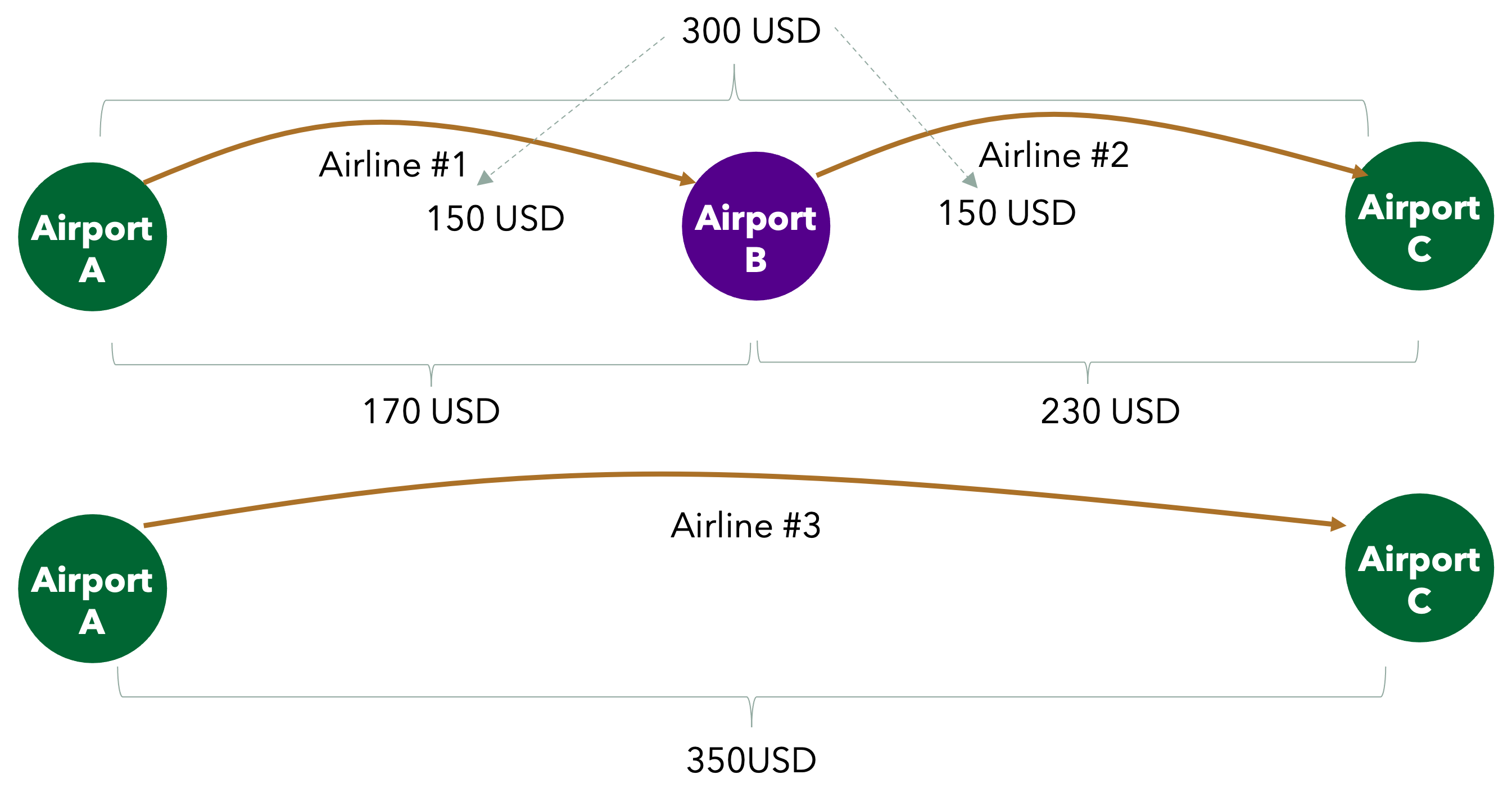
Given above is an example of joint pricing between airline alliance partners. Let’s say there are three airports: A, B and C (Exhibit 5-9). There is competition in the market for a passenger who wants to fly from airport A and C. Between airports A and C, direct flights are operated by airline organization # 3 and offer a price of 350 USD per flight. Airline # 1 operates flights from airport A to airport B and the price of a flight there is 170 US dollars, while airline # 2 operates flights from airport B to airport C and the price is 230 US dollars. If airlines # 1 and # 2 decide to cooperate in a horizontal alliance, they have the possibility to coordinate flight schedules in such a way that the passenger can transfer at airport B without having to wait very long. Although the total price should be 170+230=400 US dollars, but seeking to compete with the airline organization # 3, airlines #1 and # 2 must offer the passenger a lower price than airline organization # 3.
Ex. 5‑9 Advantage of shared pricing policy
Keywords: airport, shared pricing, connecting flight, alliance
So, the new suggested price for the connecting flight in this example is 300 US dollars. Utilization of a plane’s capacity is very important here. If, due to an additional passenger, airlines # 1 or # 2 would have to assign a larger plane and incur more extra costs, in which case the price reduction for an additional passenger would not seem rational. In most cases before deregulation of airline industry, airlines used to operate partially loaded planes, so it won’t cost more to serve an extra passenger. It means an additional passenger will bring two benefits. The first benefit is purely financial, – both airline organization # 1 and # 2 will receive additional income without incurring additional costs. The second benefit is strategic, because it affects rival. Airline #3 eventually is losing price competition and possibly withdraw from the market. This example clearly illustrates the strategic advantage of a horizontal alliance over competitors.
The fact that the benefits of being in an airline alliance are unquestionable is proven by the boom in the creation of airline alliances that began in the last decade of the 20th century. In 1997, 1999 and 2000, three major airline alliances were formed one after the other, which immediately captured 60 percent of the global airline passenger market. Alliances were established by one each of the leading companies of North America, Europe and Asia, and they were soon joined by airlines from other countries (Amoah & Debrah, 2011).
After the liberalization of the market, these alliances were challenged by the so-called low-cost airlines. Low-cost airlines have decided to choose a different business model, offering passengers many direct flights instead of connecting flights. Low-cost airlines have not joined alliances, instead focusing and gaining competitive advantage through economies of scale by purchasing very large numbers of identical aircraft, flying between non-major airports where airport charges are lower than major airports. Low-cost airlines do not need to coordinate flight times with their partners, so they focus on increasing the number of airplane flight hours per day. Alliance member’s planes spend more time at airports, waiting and adjusting to the schedule of their partner airlines’ arrival and departure. Competition between airline alliances and low-cost airlines continues to this day, and airlines belonging to alliances are known as conventional airlines (Perez Gonzalez, 2011).
An example of an airline alliance is a case where the partners of the alliance have the same main activity – the operation of flights. However, these core activities are carried out in different markets that are geographically distant. When organizations in the professional services sector engaged in the same core activity come together in alliances, is another example of such collaboration. For example, international audit organizations, international professional service providers such as management consulting or legal firms organize their activities in a horizontal alliance. Although distance should not be a significant barrier to providing professional services, difficulties arise due to different languages and different legal acts. An international audit firm operating in the US must be familiar with US law and English, in Germany with German law and German, and in Japan with Japanese law and Japanese. However, very often a US client may need audit or legal services in Germany or Japan and vice versa, a German – in the US and Japan, a Japanese – in the US and Germany. Although English is considered the main international business language, knowledge of the national language and national specifics is a necessary condition. Some professional service companies, even the most famous international brands, operate as a network of organizations that are essentially horizontal alliances. Such type of alliances could be equity relations based, so the organizations operating in the alliance are connected by capital ties, some being subsidiaries of a common parent organization or the headquarters for a separate continent, and some of the alliances are non-equity. Non-equity alliances of professional services usually operate based on a franchise or license agreement if they use the same brand. In a non-equity professional services alliance, the companies are independent, although they use the same brand in different countries and are perceived by customers as one organization. It would take a lot of time for an organization to expand abroad by setting up own offices worldwide. Bringing existing local companies into a horizontal alliance is much faster, and these companies already have their own customer base and employees, saving a lot of time in building capabilities and brand penetration.
Horizontal alliances also exist between organizations with different core activities. For example, food retailers often form alliances with pharmacies, gas stations with fast food restaurants, airlines with cafes. This often happens not just at the level of two local organizations, but at the level of the entire network. For example, a gas station chain enters a contract with a fast-food chain, when a customer goes to a gas station of a particular gas station chain; he knows in advance what brand of restaurant he will find there. The basis of such a horizontal alliance is the complementarities of services. Making coffee is not the main business of airlines, but passengers would like to enjoy a cup of coffee during the flight. Such cooperation is based on the principles of so-called cross-selling and cross-marketing. Loyal to a catering establishment of a certain brand can attract a customer to a gas station or choose airlines, and vice versa, after a flight or a stop at a gas station, the customer may order to eat or drink a cup of coffee. Of course, this does not work everywhere, and not every passenger will choose an airline because of a coffee brand, but the general trend is that such cooperation still brings additional customers and strengthens the competitive advantage over competitors. To motivate customers to choose sellers of different services or products from the same alliance, discount systems based on loyalty to the entire alliance are often applied. For example, the same discount program or discount card is valid for both a grocery store and a fruit shop, if both are members of the same alliance. Airlines have loyalty programs, such as collecting points for flights. A passenger who has accumulated a lot of points for flights in Europe on alliance airlines can take advantage of discounts and privileges provided by airlines of the same alliance flying even in North America.
Another reason to be part of a horizontal alliance is joint procurement. To purchase goods, technologies or services from their suppliers, companies usually receive an offer price depending on the size of the order. The larger the quantity ordered, the lower price. For this reason, to form larger orders and obtain better prices, companies form horizontal alliances.
Alliance partners sometimes work together to fulfil a large order for one customer or to gain more visibility in the market. Many small organizations gathered in an alliance have greater capacity when taken together. Such alliances are sometimes called clusters. For example, to compete with international dairy brands, Italian small milk producers gathered in a cluster, gave it a name, and this name became a well-recognized brand in international markets. To receive orders for logistics services from large European manufacturers, cargo carriers join alliances, because this is the only way they can have the capacity to offer logistics service.
In some cases, especially in countries where dominating small and medium size business there are very common alliances of local organizations for foreign trade. Especially the case of export/import consortia or cluster, whose motivations can vary from just promotion to generate sales, especially for those business with little or no international experience or few tools and resources to do it on their own. Thanks to cooperation small local firms can generate an exportable offer, more robust in terms of production capacity, conglomerate search for producers, representing a more interesting volume of demand. Such experiences are very common for instance in Italy, Spain and Argentina where export consortia have been developed from initiatives of previous national states and an international bank.
Export consortia would be a type of alliance, preferably horizontal, multi-sectoral of a region or sectoral focused on productive sectors and sometimes specific products. For instance, Italian model proposes regions called Industrial Districts. These are alliances of local companies to form a framework that supports the development of the region and, among them, Export Consortia.
The advantages of horizontal alliances are:
• The possibility to strengthen marketing and sales and to appear as a bigger player and recognized well in the international market.
• Joint sales promotion, pricing, and customer data exchange programs allow alliance members to provide better value propositions to their customers than individual competitors are capable of.
• An opportunity to try cooperation between organizations without more serious commitments.
Disadvantages of horizontal alliances are:
• Very often non-equity alliances break up in the absence of equal contributions and benefits.
• Sometimes members join horizontal alliances purely for predatory purposes to explore other markets at the expense of information from partners.
• Sometimes horizontal alliances are joined by some members purely for predatory purposes to find potential targets for foreign investment, and some partners consider it unfair.
International horizontal alliances. This method is similar to franchising. In the case of franchising, the same service or product is provided by franchisees in different countries, and the franchisor sets the business principles, procedures and rules. In the case of a horizontal alliance, the partners also provide the same service or product, only the partners are not bound by the franchisor-franchisee contract. However, a horizontal alliance can develop into a franchise model if some dominant partner of the alliance begins to set the rules for smaller partners. In a horizontal alliance, to achieve sales and marketing goals, coordination and control are required mandatorily so that all alliance partners work in unison, it is common for the alliance partners assign this function to one of the partners or establish a joint association that takes care of the development of the alliance. Although horizontal alliances frequently begin their activities as non-equity, when all partners are independent of each other. However, it often happens when one of the larger partners starts to acquire other alliance partners. This method has the characteristics of direct foreign investment. Non-equity alliances often break down if there is no equal contribution from the partners and unequal benefits. Thus, the transformation of a non-equity alliance into a equity alliance through mergers and acquisitions is quite common. Many mergers occur after the organizations were previously partners in a horizontal alliance. Sometimes organizations join a horizontal alliance to test the benefits of partnership and only at the next stage do they start talking about merging into one company.
Share or comment this information on your social media:
Fundamentals of global business
First edition
For citation:
Jarzemskis A. (2025). Fundamentals of global business, Litibero publishing, 496 p.

Full scope of the book is available in various formats
About author
The author has been teaching at several universities since 2005. 40+ scientific publications, 10+ international research projects. More about author.