Industrial revolution began in the end of the 18th century in England, in three industries: textiles, metallurgy, and energy. It was a result of the application of scientific inventions and discoveries to the development of various mechanisms and machines. Industrial revolution was mainly based machines where on steam power and a piston mechanism coupled to a wheel to create rotary motion. Various machine tools requiring rotational, or impact energy were developed. Mechanical spinning in 1767 and weaving in 1785 looms were designed, as well as the steam engine, invented by James Watt in1769. New metal smelting furnaces using coal were developed, enabling the widespread and large-scale production and use of metal products, tools, and machine tools. This led to the development of the steamboat in 1807, the steam locomotive in 1815, and the first railway line in 1825 in England. The Industrial Revolution led to a substantial growth in the scale of production and a shift from the concept of small manufactories to mass production factories. Human’s physical power was replaced in many places by the power of machines. Many industries became more capital-intensive and less intensive in human labor. It can be argued that the industrial revolution has only made capitalism more capitalistic, increased the importance of capital, and reduced the importance of the worker (Bath, 2016). At the end of the 18th century, England became the largest manufacturer, just as China is now in the 21st century. This contributed significantly to England’s consolidation as a colonial power and its emergence as a world trade leader (Wrigley, 2018). England had all the necessary preconditions – a strong navy, plenty of coal, sufficient labor, large foreign markets, and accessible capital in abundance. Factories have attracted much of the workers to urbanized areas, large population moved from rural areas to towns and cities to find work there.
In England, the Anglican and Puritan faith encouraged saving and accumulating of wealth, unlike, for example, Confucianism in China, which encouraged giving money to the poor and not trying to get rich, or, for example, Spain and the culturally influenced South America, where Roman Catholicism is very strong, which develops a view that there is sin in being riche. Chapter 9 in Part C of the book discusses differences of cultures and reasons behind.
Factory production was immense and brought very high profits to factory owners, creating a class of affluent, capital-intensive entrepreneurs. It caused gap between rich and poor. It has laid the fundamentals of reach class of capitalists and created inequality that through next centuries even increased. This led to workers’ movements, the beginnings ideas of socialism. It made inspiration for Karl Marx’s to criticize capitalism. His works and proposed ideology are considered as roots of communism. Even now, on this ideology is based political system of contemporary largest manufacturer – China.
From England, the industrial revolution spread soon to other Western European countries, especially France and Germany, and then to the USA, Japan, and Russia. The industrial revolution was accompanied by the agrarian revolution. New agricultural machines and facilities increased the importance of capital factor in agricultural productivity and reduced the intensity of labor. As a result, agriculture, which had been very labor-intensive before, became partly industrialized.
In the 1830s, a wave of political revolutions broke out in Europe because of the effects of the industrial revolution and structural economic changes. As a result, the emergence of political parties was observed in Europe. Form of debates in parliaments on economics system became new trend in Europe. The new wave of revolutions in Europe between 1848 and 1849 made economic and political requirements on governments. Questions on freedom and self-determination of nations were placed to on debates as well. The mid-19th century saw the intensification of women’s struggle for political rights and the beginnings of women’s emancipation. The second half of the 19th century is known as the Spring of Nations, which saw the creation of independent states in the Balkans, the unification of Italy, the establishment of the Vatican, the Prussian wars to unify Germany, the declaration of Austro-Hungarian Empire, and the Zionist movement. The industrial revolution reached the USA in the mid-of 19th century. The gold rush forced the destruction of slavery in the southern states. This led to the USA Civil War in 1861-1865, after which slavery was abolished. The industrial revolution then reached Russia in mid-19th century, reforms were carried out in that country, and serfdom as form of slavery was abolished in 1861. Reforms opened doors to Russia for the industrial revolution, which later led to political changes caused national movements and workers’ movements. Finally, in 1905, the first Russian Revolution against the Tsar broke out in Russia.
Although in the 19th century, it was not customary to give number for industrial revolution, and the changes in the industry in the 18th and 19th centuries were treated as a single revolution. As industrial progress continued in the 20th and 21st centuries, it is usual to entitle industrial revolutions by numbers that reflect stages of technological progress. It is widely applied division into four stages, but there are discussions now about the fifth stage, that could include mix technologies of life-sciences and artificial intelligence.
Ex. 2‑18 1-4 industrial revolutions
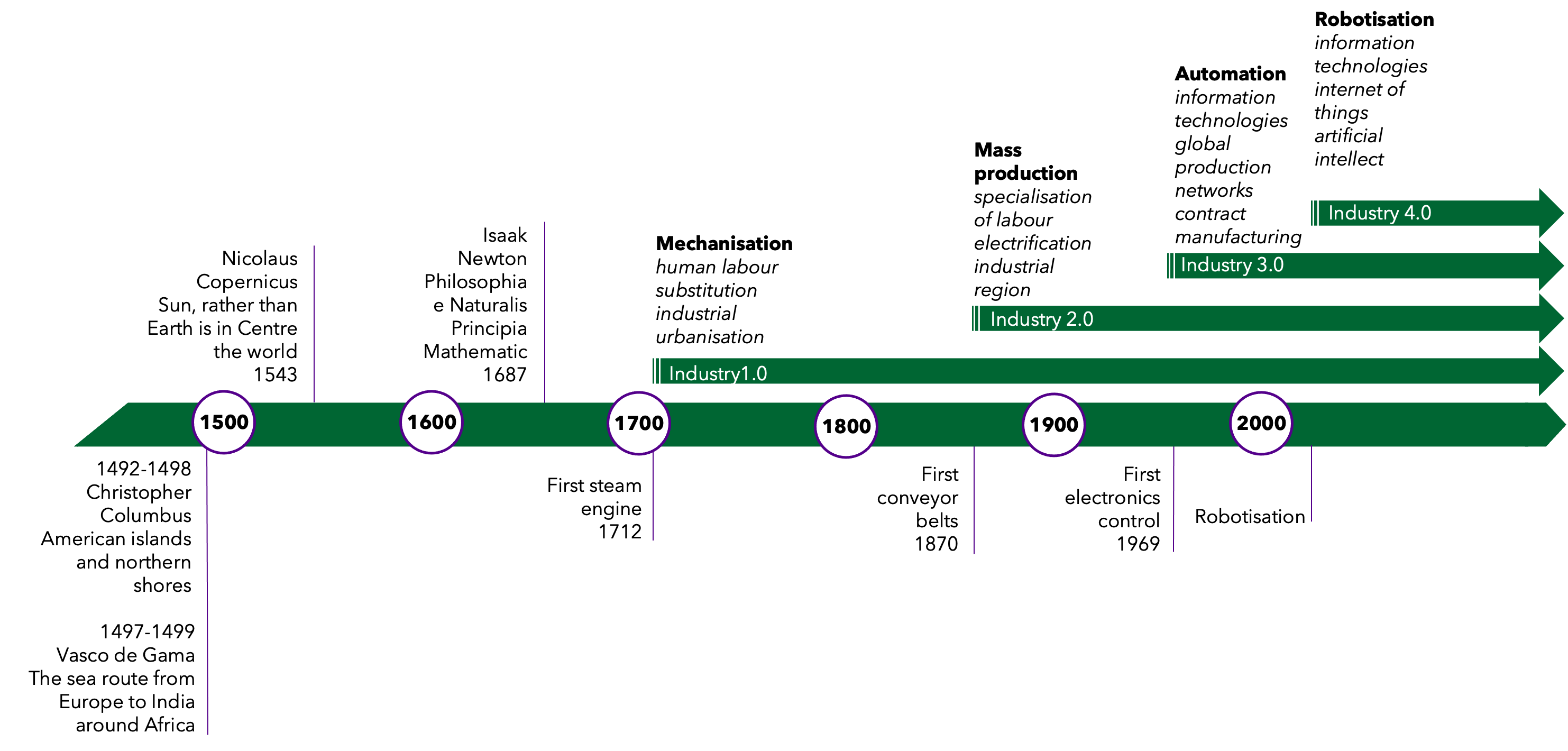
Keywords: mechanisation, mass production, automations, robotisation, industrial revolution
The industrial revolution, Industry 1.0, officially dates back to 1784, while 1870 is considered the start of Industry 2.0. The hallmarks of the Industry 2.0 were the use of electricity in industry, conveyorized assembly lines, and the development of mass production (Exhibit 2-15).
During the Industry 2.0, the demand for raw materials grew even more due to rising production volumes and global consumption needs. This is one of the reasons for imperialist policies. At the end of the 19th century, the industrialized countries of Europe, the USA, Japan, and Russia became colonial empires. The struggle for colonies increased tensions and led to an arms race between industrialized countries. Significant scientific and technical advances, which were supposed to make people’s lives easier and more enriching, were ripe for militaristic sentiments. In the 1890s, the Triple Alliance – Germany, Austria-Hungary, and Italy was created as a military bloc. The Entente military bloc was created in response to it in the early 20th century. Europe was preparing for war. In cultural life, the Romantic Movement began in Europe in the early 19th century. Urbanization process led to changes in urban life, household, lifted the quality of life. There were significant developments in funding and results of science medicine. Industrial production allowed the rapid application of scientific inventions to the production of household goods. The use of electricity and the appliances that use it began in the middle of the 19th century. Transport and communication technology advanced. The conquests of the workers’ movement paved the way for the emergence of mass culture. The end of the 19th century saw the rise of sport and the revival of the Olympic Movement. Cultural and sporting exchanges between the various countries became intense, but competitive tensions over resources, raw materials, and trade rights grew. Industrial achievements were put to military use, with advanced killing machines, self-propelled artillery, tanks, and optical sights being developed in the military industry. The competition for resources inspired by the first and second industrial revolutions and ability of advanced military technology led to two world wars that began in Europe. More than 13.6 million people were killed and died of their injuries in the World War I, 1914-1918. The name World War I did not become established in historiography until the outbreak of the World War II in 1939, replacing the term Great War, which had been used in the inter-war period until then. Approximately 58 million people died in the World War II between 1939 and 1945. Although the World War II ended with the capitulation of the aggressor and their allies, it was followed by the Cold War between the Western capitalist world and the communist Soviet Union and its spheres of influence.
In 1969, the emergence of the electronics industry and computers led to the automation of the industry, which came to be known as the industrial revolution Industry 3.0. The automation of production processes has made it possible to reduce the chances of human error in the production process and further reduced the need for human resources in manufacturing. The third industrial revolution allowed installing computer-controlled automated production lines in any country with limited teams of workers. Consequently, human resource expertise has become less focused on the specialization of the industry itself but on computer literacy and the skill to operate automated systems. This has greatly facilitated the movement of capital and enabled Western industrialized countries to relocate their production capacities to countries with more favorable production conditions – cheaper labor and lower environmental requirements. The benefits of the Third Industrial Revolution were crucial to Asia’s economic growth and China’s emergence as the world’s leading manufacturer in the early 21st century.
The hallmarks of Industry 4.0, or the fourth industrial revolution, include robotics, cybersecurity, artificial intelligence, 3-dimension print, augmented reality, big data, digitization, the internet of things, remote communications, and real-time transactions. The fourth industrial revolution is accompanied by the emergence of remote working, the development of social networks, the growth of e-commerce, the emergence of virtual relationships between people, and the emergence of virtual money and crypto currencies. At the same time, it is changing international business models and global supply chains (see more in Book D). While the first industrial revolutions created a demand for coal as energy and steel as raw materials and made these resources very important, subsequent industrial revolutions were more focused on creating demand for oil products. Countries with abundant oil resources on their territory shifted their economies towards exporting raw materials and essentially became suppliers of raw materials to industrialized countries. The fourth industrial revolution is on par with social movements that are concerned about the carbon dioxide emissions and climate warming caused by the burning of fossil fuel products, the air pollution caused by the industry, the exploitation of children in the industry, and the unfair remuneration system in the poor countries to which Western industrialists have transferred their production capacities. The largest use fossil fuels and as consequence the CO2 emissions is caused by transport. Growing global trade is increasing freight transport demand almost proportionally. The rising purchasing power of the world’s population makes personal vehicles also more affordable, which also increases the consumption of diesel and petrol by households. The fourth industrial revolution is also accompanied by advances in electrical energy storage technologies, which make it possible to use electricity in transport instead of petroleum products. However, electricity storage requires rare metals such as lithium, for which a growing global demand exists. If transport could substitute the demand for petroleum products with other energy sources to a significant extent, the need for oil would be significantly reduced, which could substantially change the economic structure of many countries that depend on oil exports. Conversion from oil era has just begun and it makes geopolitical tensions in the higher level in the third decade of 21st century.
Growing industrial scale worldwide requires more and more energy. Despite the innovations driven by fourth industrial revolution, the need for energy, both for physical products and the operation of digitalized and robotic production lines, remains. In China, which today has become the leading manufacturer, the demand for energy and raw materials is highest. China imports gas and petroleum products from Russia while it seeks to generate its electricity through the use and construction of new power stations, a significant proportion of which are still coal-fired. With the fourth industrial revolution, economic tensions between the world’s most powerful economies are intensifying, and the threat of a third world war is becoming an increasingly frequent public debate.
Share or comment this information on your social media:
Fundamentals of global business
First edition
For citation:
Jarzemskis A. (2025). Fundamentals of global business, Litibero publishing, 496 p.

Full scope of the book is available in various formats
A.2 History and trends of business globalisation
- The origins and genesis of globalisation in different eras
- Evolutions and shift of world economic powers and trade
- Evolution of money as unit of exchange
- The first international companies
- Mobility and communication technologies as key enablers of globalisation
- Industrial revolutions
- Differences of international business in Fordism and post-Fordism
- Questions for Chapter Review
- Chapter Bibliography
About author
The author has been teaching at several universities since 2005. 40+ scientific publications, 10+ international research projects. More about author.