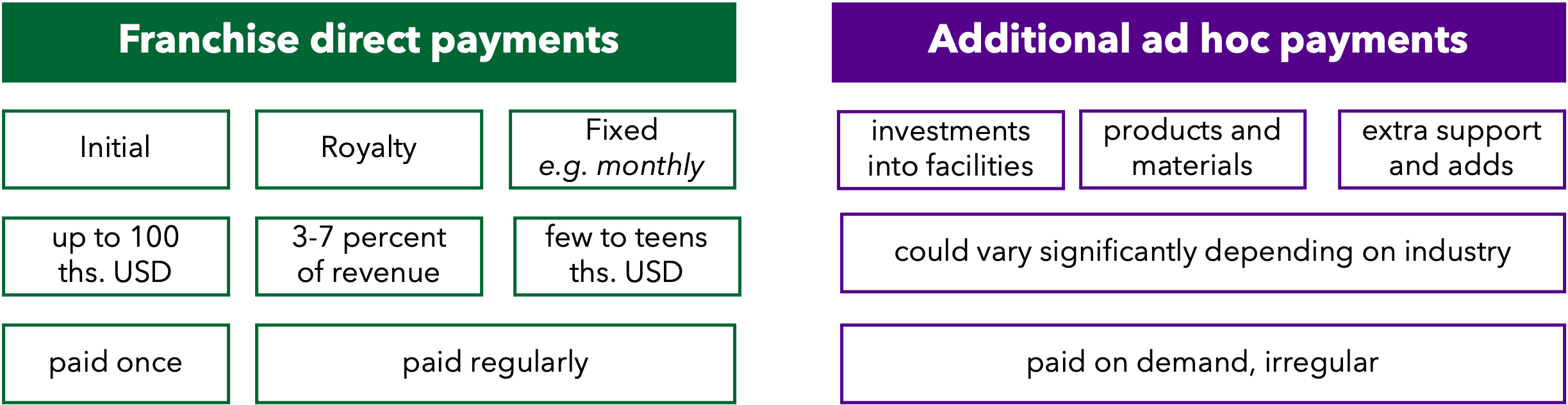
Payment for the use of the franchise usually consists of three main fees (Exhibit 4-9). The three main fees in franchising business model are (Malkina & Malkin, 2014):
• Initial franchise fee – admission fee.
• Periodic variable fee – royalty fee.
• Periodic fixed fee.
The initial franchise fee is usually paid immediately after signing the franchise agreement. This fee gives the franchisee the right to join the franchise network and start a business on a franchise basis, to receive from the franchisor all the “know-how” necessary for business management and to use elements of the franchisor’s business identity. The amount of the initial fee varies from few to several hundred thousand Euros, depending on the sector of the franchise activity, the popularity of the franchise brand, the uniqueness of the “know-how” transferred by the franchisor, etc. The initial franchise fee is paid once. The initial franchise fee may be repaid when the franchisee opens a new unit or renews an expiring franchise agreement for a new period. Most often, franchisors include in the initial fee the cost of assistance provided in the process of opening the franchisee’s unit and the cost of initial training of the franchisee and his employees.
A periodic variable franchise fee, so called royalty fee is paid regularly, usually once a month, quarter or year. The periodic franchise fee is calculated as a percentage of the franchisee’s revenue. Most often, the variable franchise fee varies between 3-7 percent, depending on the franchisee’s income. Thus, a situation may arise that the franchisee experiences higher costs than income, i.e. operates at a loss, but still has to pay a regular fixed fee. The franchisee has no leverage to control the franchisee’s costs, and therefore profits. Only in very rare cases can the fee be paid calculated from the profit, but in such cases the franchisor has to conduct an audit, check whether there are no artificially inflated costs and reduced profits. Controlling the finances of a business in another country with different laws and regulations can be quite expensive and difficult. So, to avoid this complication, franchisors usually calculate the fee directly from the income. In businesses that do not require large investments and have sufficiently large profit margins, such as management consulting or training activities, such a type of fee has the potential to reach 15 or 20 percent. When determining the percent of the periodic fee, the franchisor should also assess the degree of his involvement in the management of the franchisee’s business. The more support the franchisor provides to the franchisee and the more obligations it assumes to the franchisee, the higher the recurring fee.
Another tape of the periodic franchise fee is fixed and does not depend on the income and performance of the franchisee. The purpose of this fee is to ensure that franchisees put in as much effort and pressure as possible to increase sales revenue. If this fee did not exist, then a franchise owner who is inactive or who makes minimal effort would pay nothing to the franchisor. This is not acceptable to the franchisor, because unsuccessful franchisees reduce the value of the entire franchise business, make the franchise less attractive to new potential franchisees, and ultimately damage the image of the franchise in the eyes of consumers. This fee pushes franchisee of either to work efficiently or to quit. A constant fee independent of income forces the franchisee to make efforts to increase sales, and in the case of low sales it becomes a pressure tool to abandon the franchise, which the franchisor can sell to another potential franchisee who wants to operate it in the same location.
However, not all three franchise fees are always applicable. The initial fee is always applied, the variable fee is almost always applied, but the fixed fee is sometimes not applied. If the fixed fee is not applied, the variable fee percentage is usually calculated higher. In addition to these fees paid to the franchisor, the franchisee is obliged to incur other necessary costs. For example, raw materials, equipment, building design and installation are usually strictly defined, and the franchisee must purchase these from sources specified in the franchise contract. Very often, the franchisee must purchase resources from the franchisor. A franchisor does not have usually the main purpose of making money from such trade.
Ex. 4-9 Pricing of franchise
Keywords: franchise royalty, franchise costs, franchising
On the contrary, it seeks to obtain, through economies of scale, the ability to supply its franchisees around the world with raw materials, materials and equipment at a lower cost than they could purchase on the market. In addition, all these resources are standardized worldwide (Baena, 2015), so when a person enter any franchise cafe, restaurant or hotel, he or she can find the same equipment or furniture, whether in America, Asia or Europe. On the other hand, the franchisee does not have the right to look for alternative suppliers, to install cheaper equipment, or to refuse some element. Mandatory expenses of the franchisee include expenses such as employee training and enhancement of skills. Training is organized by the franchisor, but again, not because of the desire to earn extra, but because franchisor is interested in the success of the franchisee.
Apart from initial and periodic fees, there is an additional advertising fee that can be collected separately. The advertisement fee is intended to form the general marketing budget of the franchise network, from which general and beneficial marketing actions for the entire franchise network are financed, i.e. promotions and marketing measures aimed at increasing the overall awareness of the franchise brand worldwide. These funds can be used centrally or distributed to recipients for marketing campaigns in their respective markets. Sometimes professional service fees are collected separately. The professional services fee is usually covering the cost of hiring professionals such as lawyers, auditors, designers, architects and other experts, that are needed for a franchisee.
Franchise contracts usually have a fixed duration, in addition to pricing, they provide for the extension and termination of the contract, including the payment of compensation.
Franchising
Share or comment this information on your social media:
Fundamentals of global business
First edition
For citation:
Jarzemskis A. (2025). Fundamentals of global business, Litibero publishing, 496 p.

Full scope of the book is available in various formats
B.4. Intelectual property internationalization business
About author
The author has been teaching at several universities since 2005. 40+ scientific publications, 10+ international research projects. More about author.