Although franchising is an attractive way of doing business for the franchisor, it has pros and cons that are important to consider (Rosado-Serrano et al. 2018).
Franchisees benefit from:
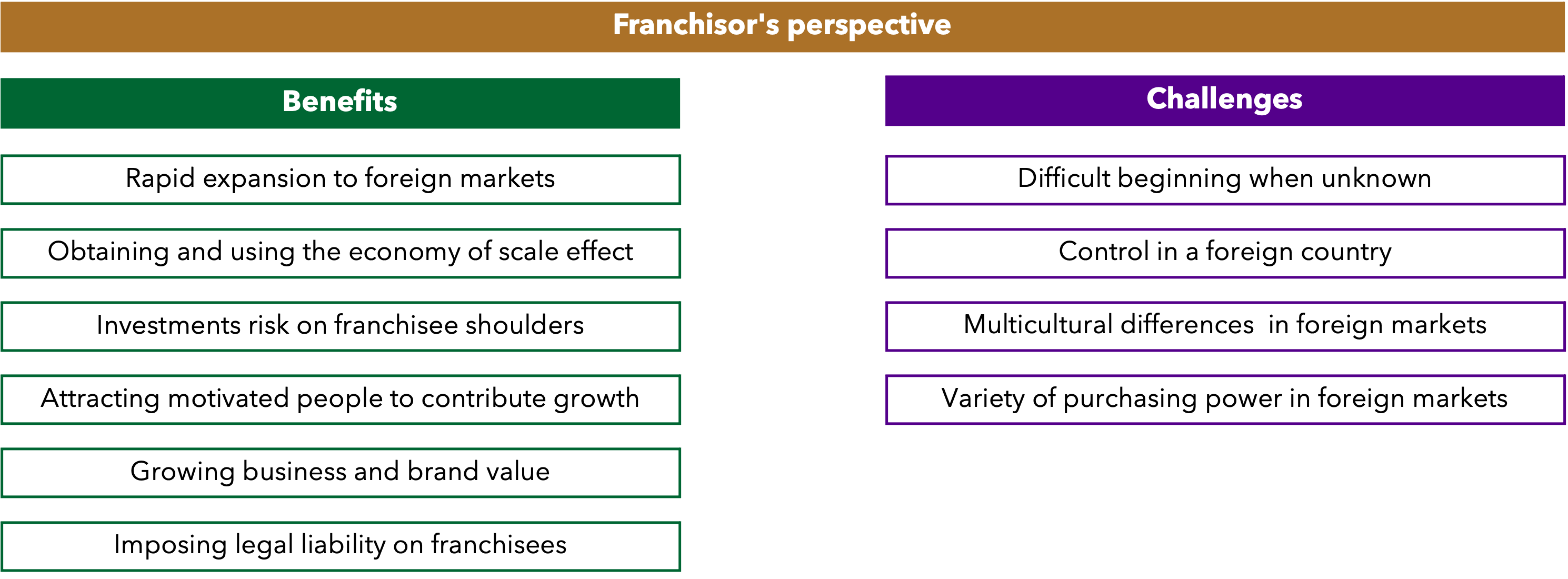
• Rapid expansion to foreign markets.
• Obtaining and using the economy of scale effect.
• The burden of investment is placed on the shoulders of the franchisee.
• Motivated people who are the owners of their own businesses are used for the development of the franchise network.
• Growing business and brand awareness and value.
• Imposing legal liability on franchisees.
This business method provides the franchisor an opportunity to expand to foreign markets very quickly (Wu, 2015).
Ex. 4‑7 Franchisor’s pros and cons
Keywords: franchisor’s benefits, franchisor’s challenges
Instead of establishing subsidiaries in other countries, or joint ventures with partners in different countries, both of which require large investments, the franchisor takes advantage of the franchisee’s investment and risk. The franchisor does not own the assets such as infrastructure, buildings, and equipment of businesses that have expanded all over the world. The franchisor does not need to hire and pay employees in different countries. All this is financed by the franchisee with his own or borrowed money. The franchisor’s expenses are limited to the description of the business model and its legal protection, the creation and maintenance of business processes, but not the financing of the processes. For example, the franchisor organizes centralized purchases of materials, raw materials or equipment, which are intended for the franchisee and are distributed worldwide, but this is financed by the franchisees themselves. Thus, the franchisor essentially needs to finance the process of business support, but not the physical support and assets itself. This makes it possible with relatively small resources to develop rapidly, even in the most remote part of the world.
Economies of scale are a very important tool that a franchisor can exploit. Focusing on the needs and finances of the franchisees, the franchisor gains great bargaining power when purchasing the raw materials, materials or even equipment needed for the business, or even when ordering specialized production. As a result, a franchisor can negotiate prices that individual businesses would never be able to do. Discounts available are often significant, sometimes half price or even more. This creates prerequisites for franchisees to be competitive, especially with respect to individual local competitors.
Additionally, a franchise is motivated by the pricing scheme, which ensures that the franchisor wins when the franchisee’s business does well. However, the pricing principles are such that the franchisor get less, but still wins, even if the franchisee’s business does not do well. The franchisee assumes a significant investment risk and commitment to the franchisor, which can only be done by highly motivated people who are dedicated to their business. Although franchisees must comply with all the terms, standards and procedures of the franchise agreement, they remain the owners of their own business, so their motivation to take care of the success of their own is very strong.
The growth of the franchise network creates conditions to take a large share of the market, to accustom consumers to the well-known brand, product or service. In this way, not only the value of the entire network increases, but also the value of the brand directly owned by the franchisor worldwide.
In the case of a franchise business model, the owners and managers of individual sales or service points are franchisees. Legal liability against consumers, against employees or against other third parties does not lie with the franchisor who owns the brand, but with the manager of the specific organization that uses the franchise. Of course, damage caused to third parties by each individual franchisee can undoubtedly cause reputational damage to the entire franchise network, and there have even been cases where the value of the brand and the franchisor’s business is reduced due to the misconduct or damage caused by an individual unit. However, the franchisor does not suffer direct legal damage, unless it is proven that the damage did not arise from the activities of the individual franchisee, but from improper instructions, materials, raw materials or equipment provided by the franchisor.
The main challenges faced by an international franchisor are:
• Difficult beginning when unknown.
• Challenges to control.
• Differences in culture, tastes and interests and legal requirements in the markets of different countries.
• Differences in purchasing power in the markets of different countries.
Franchise development is very similar to the snowball principle. As long as the franchise has few locations, it is little known, and the franchisor’s bargaining power is low. So, when an entrepreneur decides to internationalize his business, he must carefully assess whether there will be franchisees, especially in other countries, if the entrepreneur’s brand lacks global recognition. As franchised units become more widespread globally, the demand for buying franchisee increases, due to which the franchisor’s bargaining power increases. Standardization of the product and service and as little deviation from the standard as possible is very important in the franchise business. So, in the franchising business, the condition “take it or leave it” is usual. This is essentially the principle of the joining agreement, which means that the terms of the agreement are constant and dictated by the franchisor. As the number of franchise units increases, the growth takes on a geometric progression, and it is like a large snowball rolling down the hill, which attracts even larger amounts of snow around itself (Alon, 2004). The most difficult stage is beginning, when trying to stick it together and roll it in the snow until it at least gets a little bigger.
Most franchised businesses are international. It is difficult to find a franchise whose brand has developed and is only known in one country. The size of the country of origin, or rather the market size of that country, is very important for franchise business. It is estimated that the largest number of franchise-type businesses started in the United States, and the United States is considered the pioneer of franchising. A large local market, large cities, many cities in the country are such important factors that, like an incubator, allow the birth and growth of a franchise business to a size that allows the franchisor to achieve economies of scale and to offer it to the markets of other countries. Just like exports, a large local market for franchising offers provides an opportunity to grow and, once grown, chance to expand across borders increases.
The franchisor transfers to the franchisee the right to use franchise, trademarks and the entire way of doing business, however, he retains the reputational risk for himself because he remains the owner of the brand (Calderon-Monge & Pastor-Sanz, 2017). Although contracts are signed with franchisees that provide detailed instructions for doing business, franchisees are not employees of the franchisor; they are business partners who have their own businesses. Trust remains a critical factor, as it is not possible to control every action of a franchisee at an operational level. In different countries of the world, people’s values, attitudes, traditions, concepts of things like time, work, and communication differ. This diversity sometimes creates unexpected and unpleasant surprises that are detrimental to a type of business-like franchising, which basically relies on strict standardization (Susanti et al. 2019). This variety is described more in detail in Part C of the book. Tools such as planned and unplanned audits, inspections, secret shopper tests are often used to control franchisees. If the franchisee is found not to follow the instructions, the franchisor often imposes penalties, which are usually stipulated in the franchise agreement.
The purchasing power and market sizes of foreign markets are very important for the franchisor. For example, when entering a small market with low purchasing power, the franchisor may have to assess whether it is worthwhile. When entering the market of a new country, it may be necessary to get familiar with the legal system and requirements of that country, to translate many aspects related to the application of the franchise into the language of that country, such as advertisements, descriptions of products or services, certificates and ending with employment contracts with employees. Adding each new country to the franchise means additional costs for the franchisor, so market size and purchasing power are important. Purchasing power is also important in determining the pricing of goods or services. Paying 5 dollars for a burger may be easy for many middle-class consumers in the US and Western Europe, but in poorer countries, this price may be unaffordable and unable to withstand local competition. The perception of customers might be very different. Even largest franchise restaurant is not highly regarded in the US, it is, after all, fast food, but in some places, those brand restaurants may be considered as luxury (Kalargyrou, 2018).
Share or comment this information on your social media:
Fundamentals of global business
First edition
For citation:
Jarzemskis A. (2025). Fundamentals of global business, Litibero publishing, 496 p.

Full scope of the book is available in various formats
B.4. Intelectual property internationalization business
About author
The author has been teaching at several universities since 2005. 40+ scientific publications, 10+ international research projects. More about author.