A patent is primarily intended to protect an invention. A patent is a form of legal protection of intellectual property that gives its holder exclusive ownership rights over a work. There are basically two types of patents – design patents and utility patents. A utility patent legally protects what a single invention does, how it is used, and how it is functioning. Each product or invention requires its own patent. Some ideas are not patentable for instance nature’s laws, biological processes or very abstract ideas. Design patents legally protect what an invention or creative work looks like, its shape, color, image. However, a design patent is not the same thing as a trademark. Nevertheless, both protect intellectual property, trademarks cover specific marketing related designs like logos, labels, packaging, or other identifiers of goods or services. Design patent can be easily circumvented by changing some details of work image (Hall & Ziedonis, 2001).
A business protected by a patent is protected by laws that give the owner the right to use the work at his discretion – to manufacture, pledge, sell, and license and otherwise use it (Exhibit 4-2). Inventor can use the own invention even without patenting. However, the patent provides the owner protection from others that might want to use same invention. Only the owner can decide whether others can use the patented work. Using the exclusive right, the owner can prohibit the import or export of goods that infringe his rights.
Ex. 4‑2 Structure and objects of patent selling business
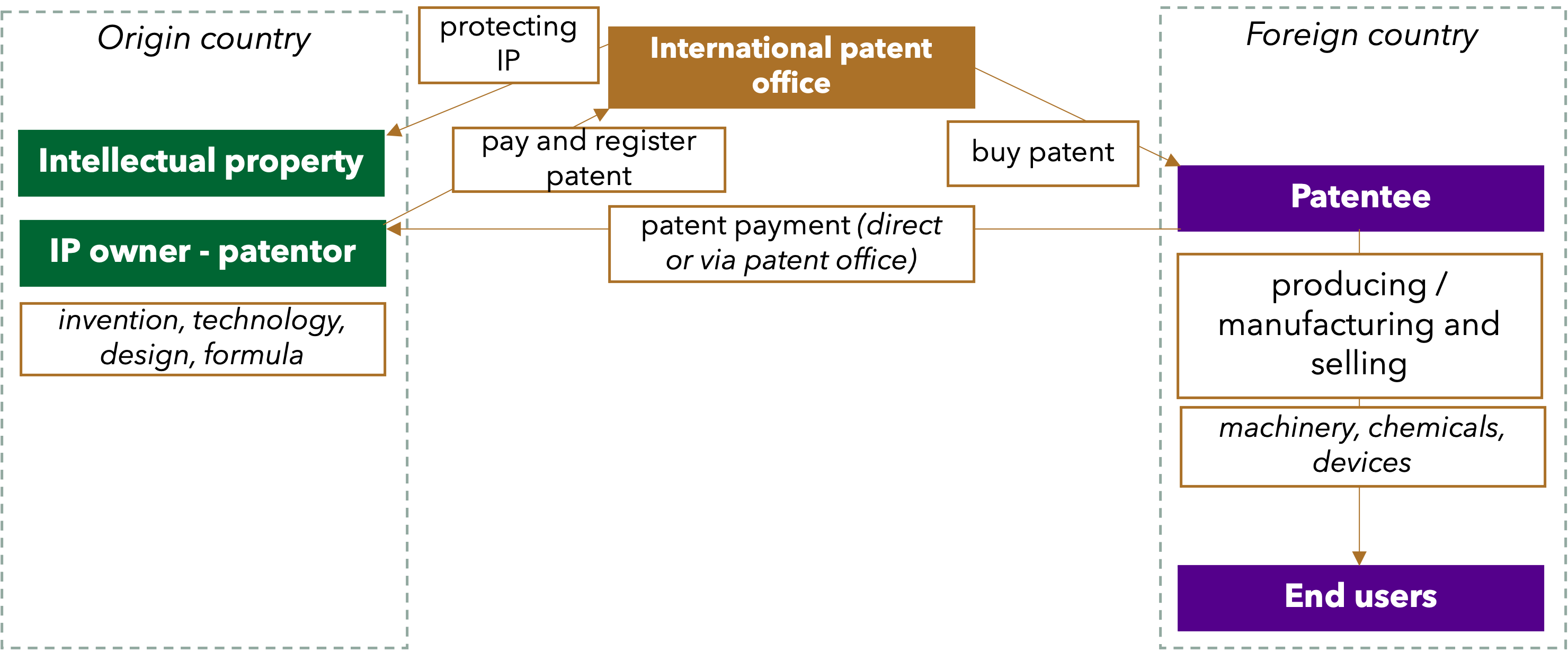
Keywords: patent owner, patenting, selling patent
Others can decide to ignore a patent and use the information anyway. It is then up to the courts to decide whether something infringes upon a patent or not. In fact, for many small businesses a patent is useless. The reality is that a patent doesn’t really provide legal protection, it only provides legal protection if the patent holder has the significant financial means to bring the patent infringer to court (Noor, 2021).
A patent is valid in the territory of a certain country where it is issued. To have a broader protection of invention, it is appropriate to protect it in other countries as well. An invention can be patented either separately in each country according to the national legislation of that country, or simultaneously in several countries, using the option provided by international agreements. To patent invention in a larger group of countries, the regional principle is applied. A European patent application can be filed in the European Patent Office. In this case protection is granted in European countries. Some countries have also signed regional agreements that provide the opportunity to obtain protection for an invention in several countries through a unified patenting procedure for instance Eurasian Patent Convention or Harare Protocol on African Regional Industrial Property Organization for Patents and Industrial Designs.
International patent registration is carried out by the World Intellectual Property Organization – WIPO. Such an international patent application later allows the protection of the invention to be extended in the countries belonging to the Patent Cooperation Treaty. In this way, it is possible to patent an invention in almost all the countries of the world. After obtaining a regional patent, its protection does not automatically become valid in all states of the region. To protect an invention in specific countries, a patent extension to selected countries is required.
The procedure for obtaining a patent for an invention is called patenting. Not just any work can be patented, but one that meets the necessary criteria for an invention: novelty, level of invention, industrial applicability. The criterion of novelty means that the invention cannot be known in the prior art before the start of the patenting procedure, it must not be published anywhere. The inventive step ensures that the technical solution is not obvious to a person skilled in the art. When applying the industrial applicability criterion, it is assessed whether the solution is applicable in a specific industrial area.
Patenting an invention requires both time and financial resources. The final price of patent registration depends on the fact that in how many countries the procedure has to be started, what are the specific features of the invention that determine its scope, how many definition points are specified in the application, etc. The costs of patenting depend on lot of factors. It is also occupied by an incorrectly or inaccurately filled patent application, for example, inaccuracies in the description, incorrectly presented drawings or errors in the data (Boeing & Mueller, 2011). Other factors determining the final price are state fees, request for accelerated patent application and examination, translations, annual fees, etc. The maximum patent term is 20 years. A registered patent is valid in those countries where it is protected and for which a prescribed annual fee is paid. After the patent is issued, it must be renewed annually starting from the third year on payment of a prescribed fee. If the fee is not paid on time, the patent ceases to be valid.
The procedure for patenting an invention is not mandatory. However, it only guarantees that the owner’s right to the invention will be protected against the production, copying, and use of the same work. This will ensure the protection of the investments made in the development of the invention and the future profits that are likely to be derived from the use of the invention (Noel & Schankerman, 2013). An original and unique invention used in a specific industry will also ensure business competitiveness. By giving for and invention legal protection, it is kind of perception of guaranty, that it will not be used by unscrupulous competitors. However, in international business there are many examples of organizations illegally using competitors’ inventions, even if they are patented. In practice, many legal disputes have taken place, which often last for several or even a dozen years. Even famous business organizations with a very good international reputation participate in legal disputes. Such disputes arise in a wide variety of industries, especially electronics, software, and, for example, the automotive industry (Shu et al. 2015).
Share or comment this information on your social media:
Fundamentals of global business
First edition
For citation:
Jarzemskis A. (2025). Fundamentals of global business, Litibero publishing, 496 p.

Full scope of the book is available in various formats
B.4. Intelectual property internationalization business
About author
The author has been teaching at several universities since 2005. 40+ scientific publications, 10+ international research projects. More about author.