This section presents the theory of absolute advantage developed by Adam Smith. The section gives examples of entrepreneurs or farmers in one country engaging in activities whose products are sold to other countries. The section provides an overview of the main criteria for absolute advantage and explains in general terms the reasons for the emergence of international trade and international business in general. The concepts of absolute and comparative advantage are compared in this section too.
Adam Smith published his book “The Wealth of Nations” in 1776 (Exhibit 1-8). Inspired by nearly two centuries of mercantilist philosophy, Adam Smith sought more explanations for why nations should trade with each other. He also tried to find systematic reasons why some countries sell more of one type of commodity and others another. The simplest way to argue the reasons for trade is the principle of advantage, which is determined by climatic conditions or geology. For example, countries with warmer climates grow agricultural products that is impossible in colder climate. It follows that some countries have what is known as an absolute advantage, which is essentially determined by that country’s location.
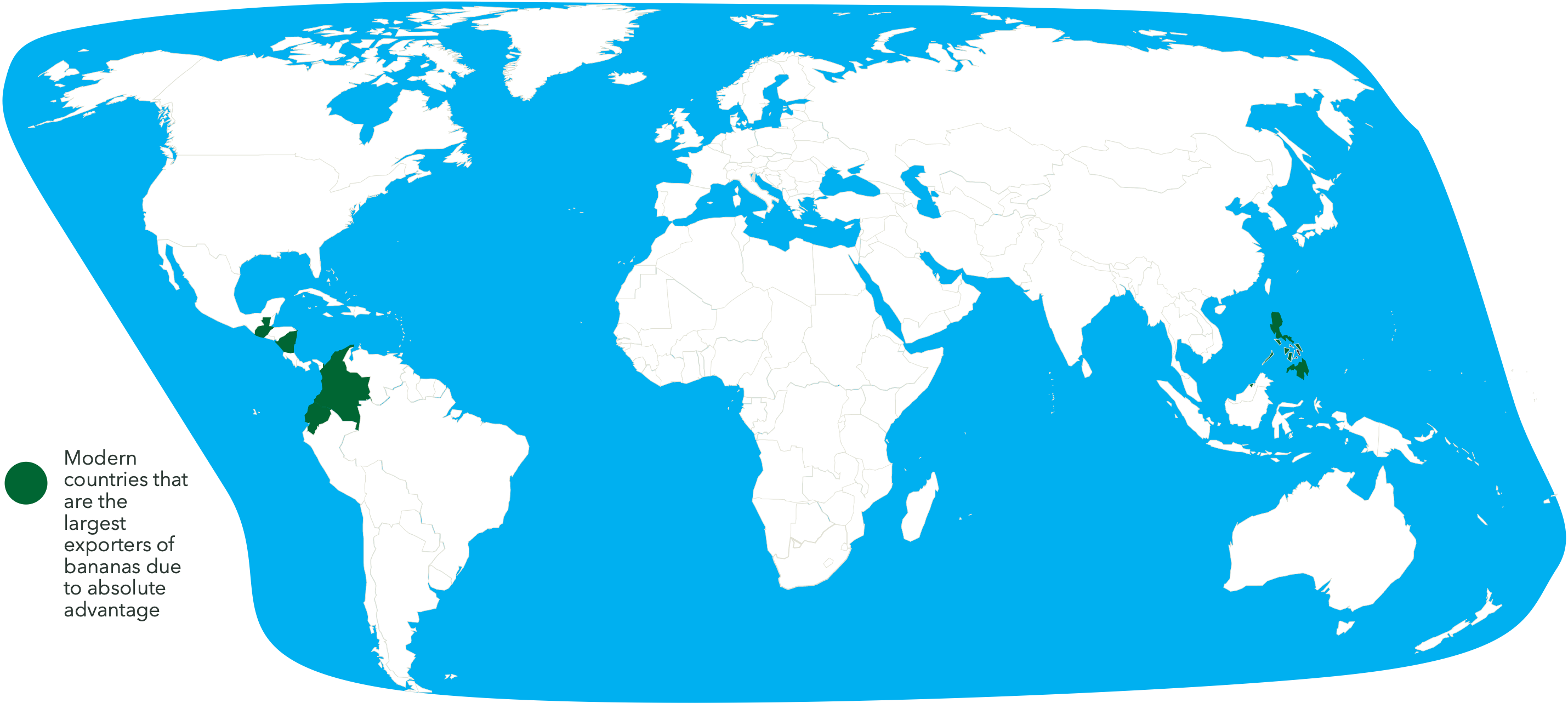
The climate zone is a significant factor in determining the specialization of agricultural production. For example, the top 5 banana exporters are located close to the equator, which provides the right climatic conditions for banana harvests (Exhibit 1-4). This enables Ecuador, Guatemala, Costa Rica, the Philippines, and Colombia to be the world’s largest banana exporters. Meanwhile, in Northern European countries and Canada, the climatic conditions make bananas harvesting impossible in natural environment, so these countries become banana importers. According to the theory of absolute advantage, if a country grows its bananas, it should only sell them to countries that do not grow bananas.
Ex. 1‑4 5 Largest banana exporters are located in the same climate zone that determines banana yields
Keywords: export, climate
This would mean that if a country grows bananas, then importing them is not appropriate. However, Adam Smith’s theory of absolute advantage has been criticized, and there are countries that, although able to grow their own produce, import it. Another better example to look at is the countries which exports oil.
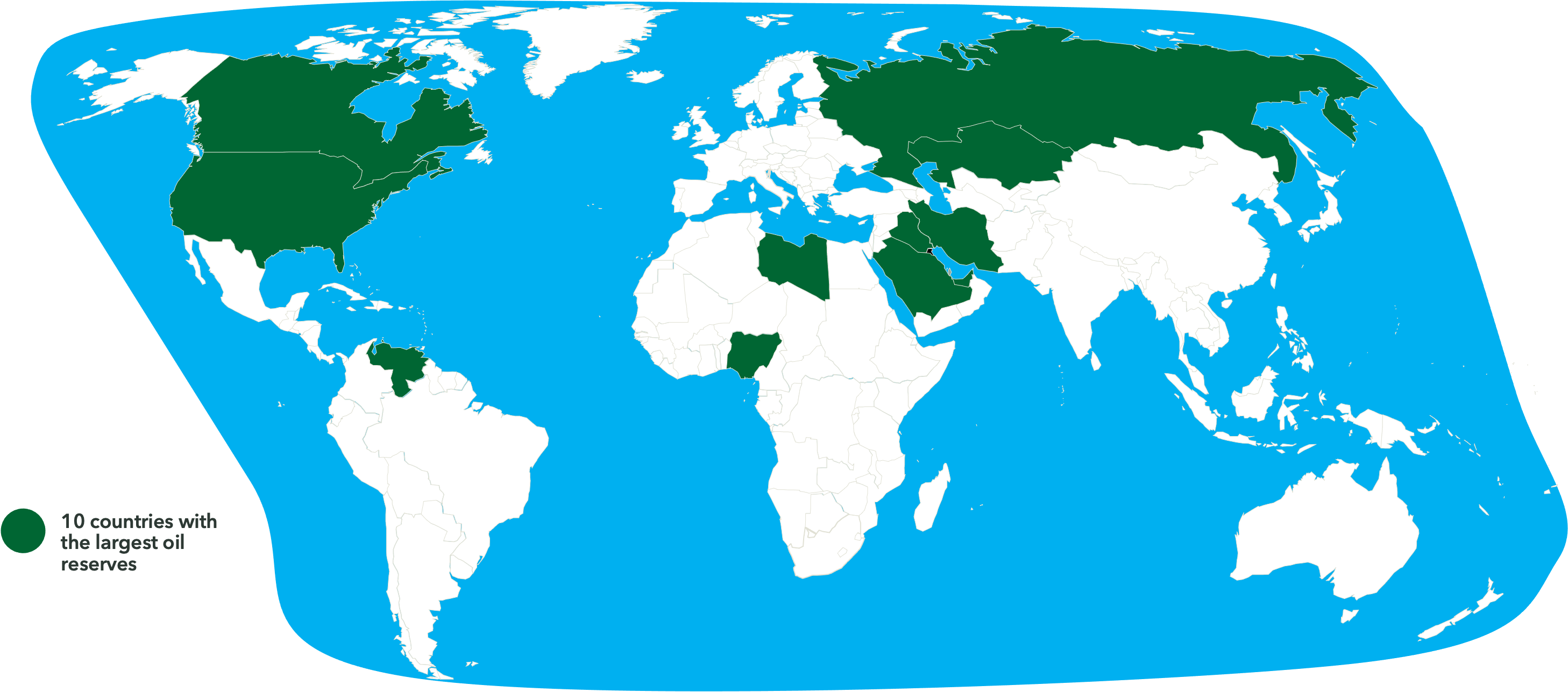
When considering absolute advantage, the geological characteristics of a country are the next most important factor after the climate zone. The largest oil deposits are found in a small number of countries, but it is not only countries that do not have oil themselves that import oil. Canada, for example, is among the ten countries with the largest oil reserves, alongside Venezuela, Saudi Arabia, Iraq, Iran, Libya, the United Arab Emirates, Kuwait, Russia, and Kazakhstan (Exhibit 1-5). However, Canada imports its oil. Likewise, the United States of America and Norway have sufficient oil reserves, yet they prefer to import oil. This example perfectly illustrates the imperfection of the concept of absolute advantage. Nevertheless, the absolute advantage does explain the specialization effect. Even if a country has an absolute advantage, or at least a partial advantage, over another country in agriculture or minerals, there is a high probability that it will be beneficial for the country to specialize in that area. Absolute advantage explains the specialization of countries and the division of countries into agricultural and industrial countries that still exist today. The law of absolute advantage partly explains why scientific progress and the industrial revolution began in Northern Europe. The lack of natural and agricultural resources created an ecosystem that allowed science and innovation to flourish.
Adam Smith developed the theory of absolute advantage as a kind of counterpoint to the theory of mercantilism. Whereas the Mercantilists believed in restricting imports and promoting exports, Adam Smith argued that countries should trade – both exports and imports. In essence, Adam Smith was a proponent and pioneer of free trade. His theory presents the argument that the state should interfere as little as possible with trade restrictions and ensure laissez-faire trade.
Ex. 1‑5 The 10 countries with the largest oil reserves are also oil importers
Keywords: oil, export, import
Moreover, he believed that a free market based on the absolute advantage of countries would form specializations between countries to benefit all countries and increase the overall well-being of the world’s population.
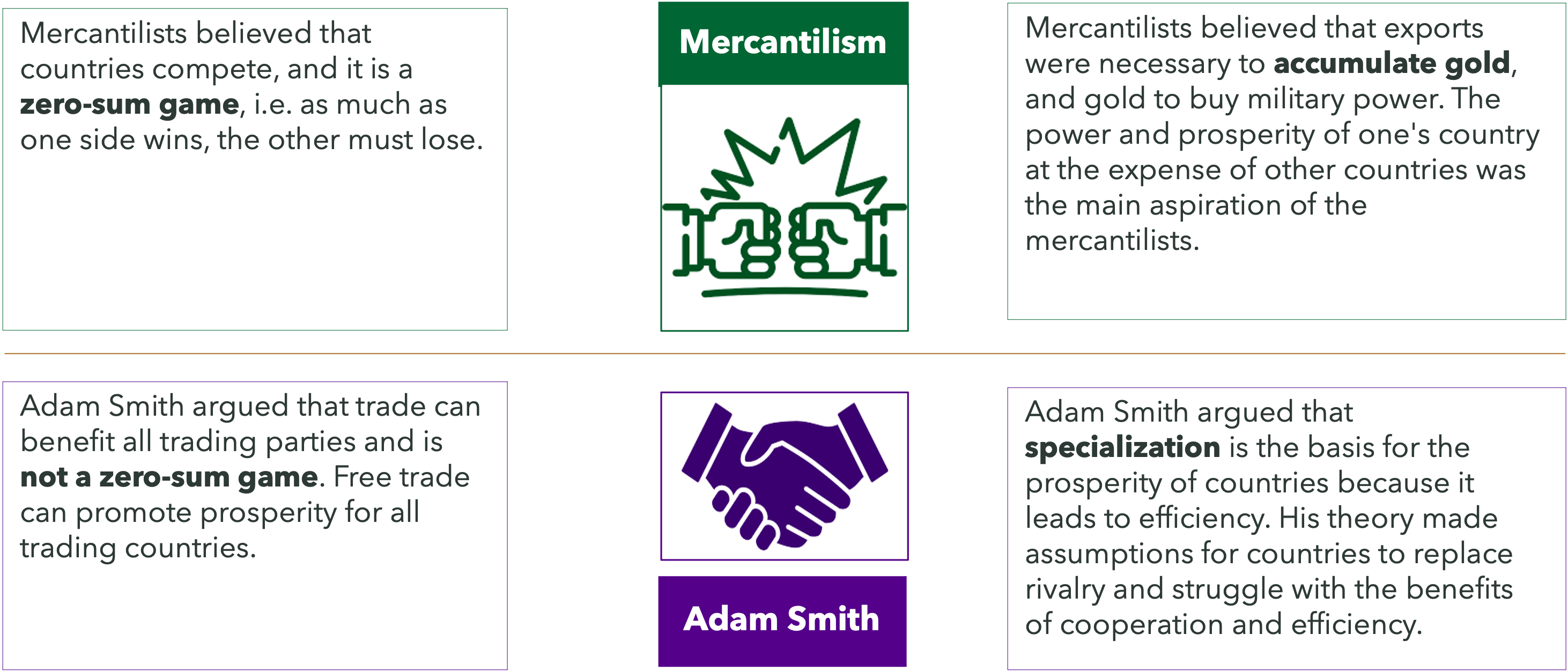
Ex. 1‑6 The divergence between the Mercantilist and Adam Smith views
Keywords: zero-sum game, specialisation, mercantilism
The mercantilists and Adam Smith had very different views on the relationship between countries. The mercantilists believed that countries compete with each other in a zero-sum game, i.e. to the extent that one country wins, the other must lose. Adam Smith argued that trade can benefit all trading parties and is not a zero-sum game (Exhibit 1-6). Free trade can lead to prosperity for all trading countries. The mercantilists believed that exports were needed to accumulate gold, and that gold was necessary to buy military power. The power and prosperity of one’s own country at the expense of other countries was the main ambition of the mercantilists. Adam Smith argued that specialization was the basis of national prosperity because it achieved efficiency. Adam Smith’s theory allowed countries to exchange competition and struggle for the benefits of cooperation and efficiency.
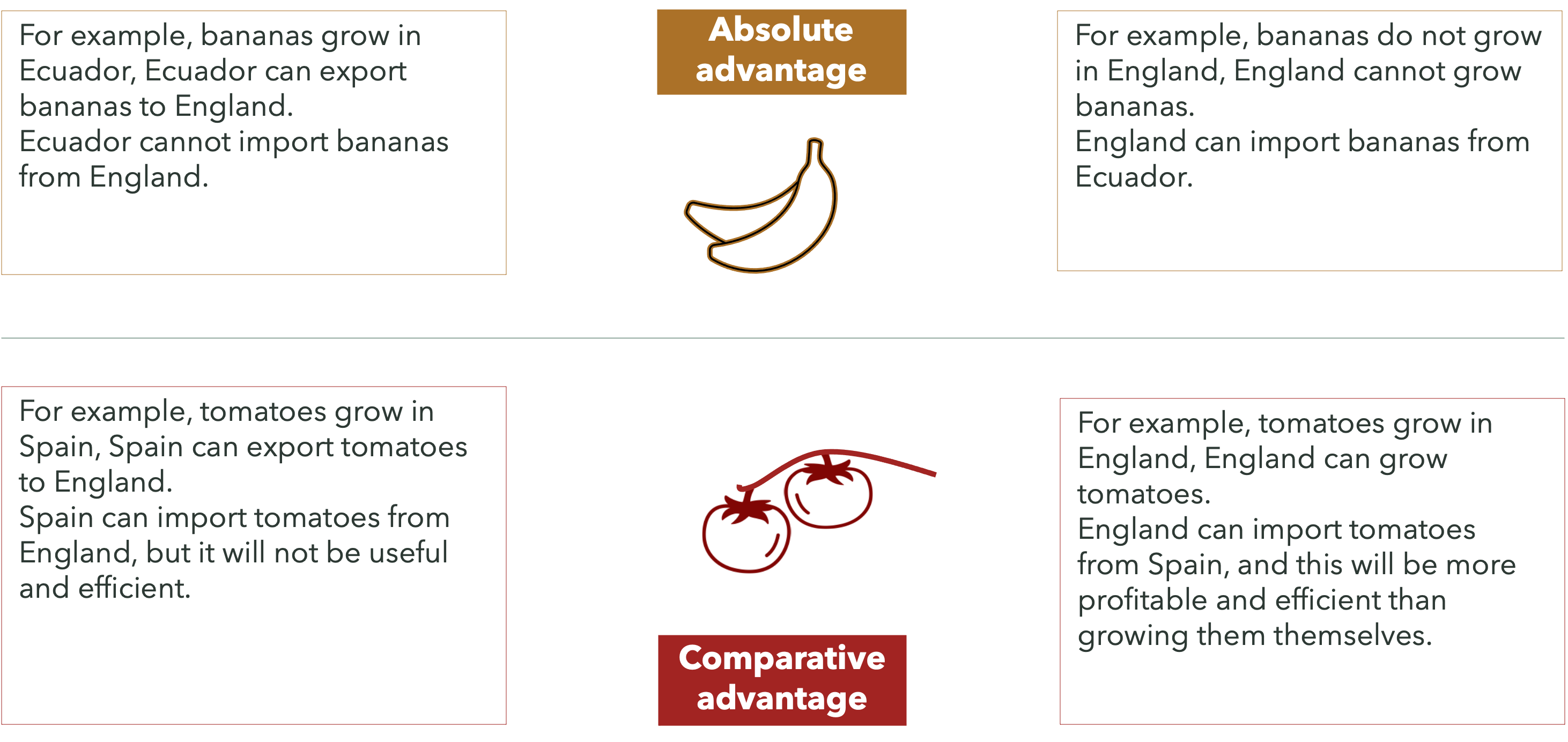
Ex. 1‑7 Absolute advantage and comparative advantage
Keywords: absolute advantage, comparative advantage, Adam SmithSelf-interest is another important element in Smith`s theories. Smith envisioned a system that would give people the incentive to better themselves through economic activities, where they would create wealth by serving others through market exchange rather than through political activities, where they might seek to redistribute existing wealth through brute force or legal restraints on competition. Under such a system, the powerful motivating force of self-interest could be channeled toward socially beneficial activities that would serve the general interest rather than toward socially unproductive activities that might advance the interests of a select few but would come at the expense of society as a whole.
Absolute advantage or absolute inadequacies are often hypothetical concepts. In the case of bananas, it is not possible to grow them in England in natural conditions, apart from the laboratories, and this is an excellent example of absolute advantage. Still, in many cases, the advantage is not completely absolute. For example, tomatoes can be grown in Spain and England, but in Spain, multiple harvests can be expected, while in England, only one. In England, tomato production will require greenhouses and other technological solutions, due to which cost of tomato production will be increased compared to southern European countries. So, the absolute advantage may indeed be absolute, as in the case of bananas, or relative, as in the case of tomatoes (Exhibit 1-7).
If to say that it is less efficient to grow tomatoes in England than in Spain, this raises the question of measuring efficiency. This is where David Ricardo developed the theory of comparative advantage to a great extent by introducing the additional factors of labor and capital. If there were no other labor in England, it would be more profitable to grow tomatoes on its own, albeit with great exertion, than to do nothing and import tomatoes from Spain. However, there are other activities happening in England. It was precisely the valuation of alternative activities that form the basis for measuring efficiency in David Ricardo’s theory, which is discussed in the next section. In addition to the theory of absolute advantage, Adam Smith introduced the principles of Gross Domestic Product, which allowed the growth of countries to be calculated by comparing them both over time and with other countries.
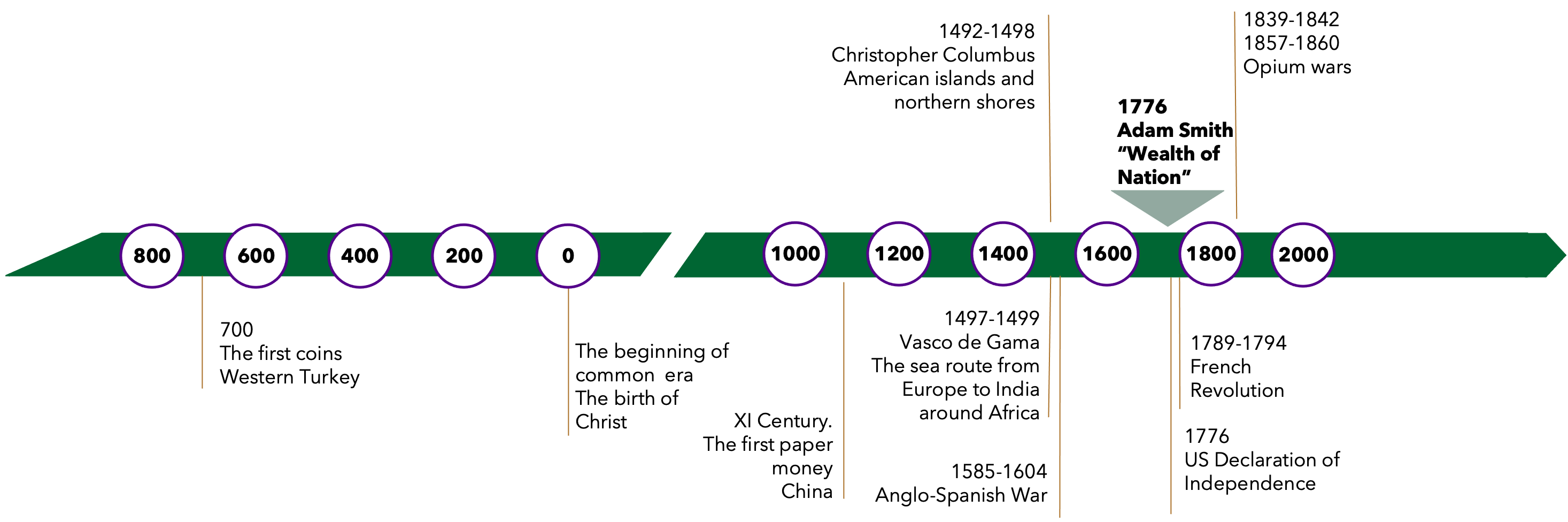
Ex. 1‑8 Adam Smith’s “Wealth of Nations” period in the context of other significant events
Keywords: Wealth of Nations, French revolution, Anglo-Spanish War, Vasco de Gama, Columbus
This scientist has profoundly influenced philosophers and politicians and is often referred to as the founder of modern economics. He described the principles of competition, supply and demand, and self-interest, which are the fundamental laws of free market economics that are in place today. In addition, he introduced the principle of the “invisible hand of the market” and, in fact, became one of the philosophical pillars of liberal political thought. Adam Smith also described that free trade is one of the most important pillars of a system of economic liberty. According to him, in a system of natural liberty commerce inside a country is principally free from restraints on competition and commerce is allowed to operate freely between countries. Smith argued that free trade would increase welfare because of the competition of domestic firms. Additionally, the country would gain by putting the best prices of exports and imports in the world market.
Share or comment this information on your social media:
Fundamentals of global business
First edition
For citation:
Jarzemskis A. (2025). Fundamentals of global business, Litibero publishing, 496 p.

Full scope of the book is available in various formats
A.1 Theories of international economics
- Mercantilism
- Adam Smith and absolute advantage
- David Ricardo and Comparative advantage
- Standard theory of International trade
- Karl Marx and communism
- Hekscher – Ohlin theory
- Paul A Samuelson theory
- Leontief paradox
- Rybczynski theory
- John Hicks and progress
- Economies of scale theory
- Contemporary business internationalisation theories
- Questions for chapter review
- Chapter bibliography
About author
The author has been teaching at several universities since 2005. 40+ scientific publications, 10+ international research projects. More about author.