Interpersonal communication during the preparation and closing of business deals, negotiating and making proposals for cooperation in global business often takes place between people from different cultural clusters. Differences in communication and their cultural reasons are quite similar to internal communication, but the management within the organization, both in the selection of employees and their training, as well as in setting the company’s internal standards of cooperation and communication facilitates better and interculturally adjusted internal communication (Ulijn et al., 2000). On the other hand, when employees from different organizations have to communicate, especially if they are from very different cultural clusters, the challenges are significantly greater.
Communication between different organizations can be divided in various stages:
- Introduction and proposal for cooperation.
- Negotiations.
- General communication after signing the contract.
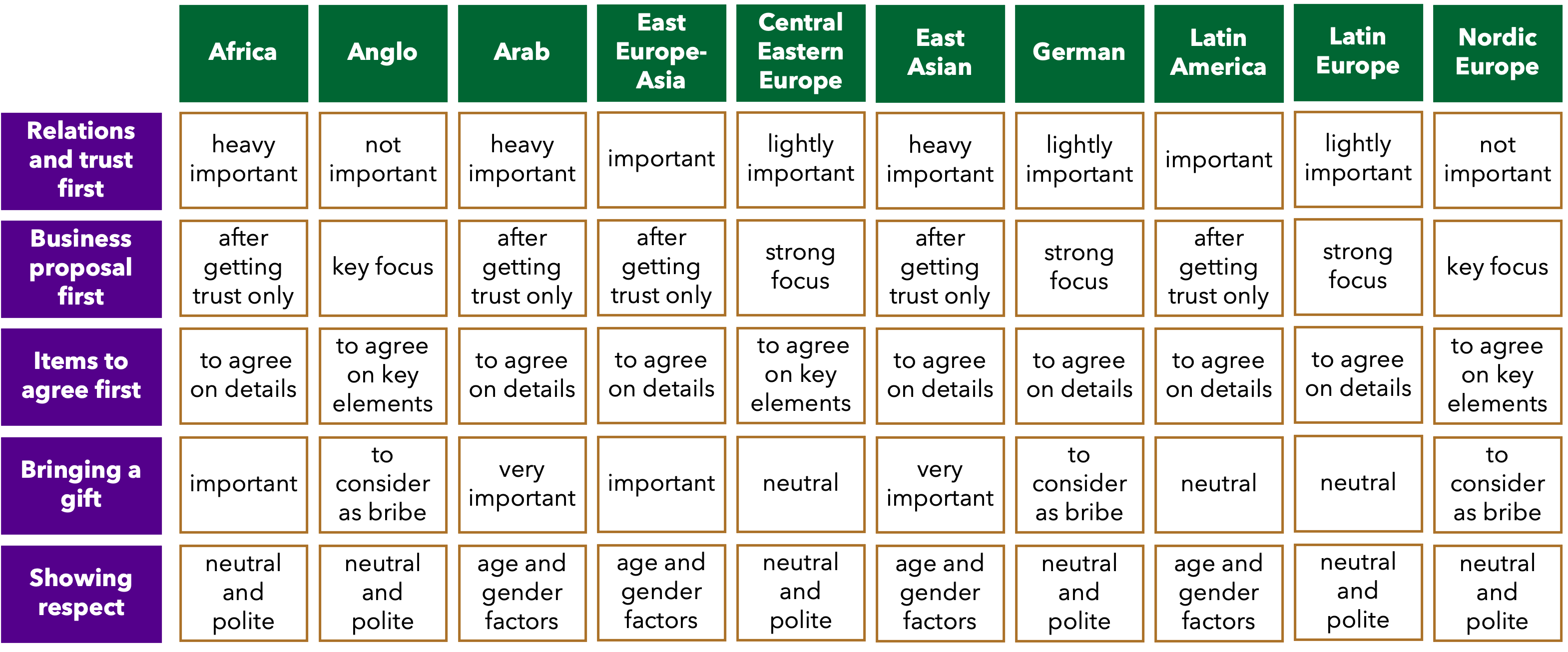
The stages of getting to know each other and offering to collaborate vary greatly in terms of duration and content of different cultural clusters (Exhibit 10-12). In collectivistic cultures, especially in high-context cultures, tend to prolong this stage for a very long time, while in individualistic cultural clusters this process is much shorter and simpler. In the Anglo, Germanic and Nordic cultural clusters, it is quite normal and tolerable to go to the core of the matter and make a proposal straight forward in the first meeting. Western Europeans and Americans express the content of their proposal quite directly and expect a clear and direct answer from their business partners or customers. These cultural clusters, focuses majorly on the very core of the proposal, its pragmatic benefits. In business meetings, it is common to get to know each other and exchange a few polite phrases or trivial conversation known as small talk, such as the weather or yesterday’s football game, and then immediately make a presentation of proposal. Visual aids such as PowerPoint presentations are often used. Respecting the time of the recipients, the party that initiated the proposal and the meeting tries to keep the meeting to a length that is necessary to reveal the essence of the presentation. The proposal aims to eliminate personalities. The meetings are attended with prior preparation and careful consideration of each element of the presentation of the proposal in order to reveal the value of the proposal to the listener as clearly and briefly as possible. Business meetings are usually organized in dedicated meeting rooms on the premises of hosting organization, in rare cases it can also take place in a cafe or restaurant, organizing so-called business lunches or business breakfasts in a hotel restaurant or a dedicated conference hall. Often in international business, meetings are organized in specially adapted spaces of international airports – airport conference and meeting centres, halls or specially designated VIP areas. Airports are chosen for time saving and convenience, so meetings can easily take place after flying several thousand kilometers to a business partner or client in the morning and flying back home in the evening without even having to leave the visited airport.
In Asian and Arabic, cultural clusters, this stage is quite opposite, though less but still opposite in Latin American and in Latin European cultural clusters. In Asian and Arabic cultural clusters, it is very crucial to build relationships and gain trust before getting into any business. Going down to business on the first or even the first few meetings is a sign of bad tone. For example, in Arabic culture, the first and the foremost question that arises is “with whom to do business?” than “what kind of business to do?” Only after answering the first question and deciding to trust it makes sense to move on to the second question. Establishing relations, getting to know each other and gaining trust is the foundation of building a business relationship, because without these things, even the best business proposal may go unheard or rejected. Familiarity and trust are like a filter that filters out those with whom one can have any dealings and those who cannot. This concept is described in the book “Three Cups of Tea” by Greg Mortenson, a US soldier who served in Afghanistan (Mortensen & Relin, 2007). Three cups of tea drunk together symbolize the numerous meetings and the process of getting to know each other, only after which a relationship is possible or impossible. Thus, if in the stage of getting to know and trust, the collectivist cultural clusters in the country fail to gain the trust of the local people, then the speeches, presentation, showing value of proposal and any further efforts to make a business proposal are meaningless. The context and the rituals illustrating it are also very important in the cognitive process in these cultures. Individualistic countries are mostly low-context and more egalitarian, so eliminating certain details of the context or ignoring the hierarchy can end the business meeting with undesirable results, and the relationship does not develop further.
For example, in Asian countries, it is common for organizations that managers are older people with a lot of experience, so sending a young person to negotiate can be considered as a sign of disrespect. In the countries of the masculine cultural cluster, when a woman comes to negotiations, they might not be taken seriously. Although in the 21st century the movement to promote equality and tolerance is gaining momentum all over the world, the cultural clusters are still moving inertly and not changing as fast as it might offend the people of the Anglo, Germanic, or Nordic countries and organizations that value human equality.
In Asian and Arabic cluster countries have very important meeting rituals, for example, when going to China or Japan, a business gift is a mandatory attribute that shows the goodwill and respect of the visitor towards host.
Ex. 10‑12Business initiation and negotiation in different cultures
Keywords: cultural cluster, negotiations
Source: partly adopted from House at al., 2004 and Steers & Osland, 2019
During the meeting, while exchanging business cards, it is customary to accept the given card respectfully, hold it with both hands, read what is written on it and very respectfully put it in a place of honor. When receiving a business card, putting it quickly into the back pocket of a jeans can be seen as an insult.
In Arabic cluster countries it is important to accept the hospitality of the host. So, when come to Asian or Arabic cultural clusters, it is needed to get ready for a long ritual process of getting to know each other, enjoy common lunch or dinner, and socializing. Often, during the first meeting, there may not even be an opportunity to talk about business matters. For example, in Central Asian countries, it should not be surprising that the head of the host organization will organize a peaceful dinner and then invite potential business partner to discuss life and values together over a cup of tea, a glass of alcoholic drink if it is not forbidden by religion or a cigar smoke. Similar welcome and familiarization ceremonies can be found in the countries of the Russo-Slavic cultural cluster, especially in Russia itself. There is a saying in Russia that no business matters can be discussed until the business partners have bathed naked in the Russian “bania” which is actually a sauna in a lot of steam, accompanied by a side dish and alcohol. Use an alcohol and informal relationships in the getting-to-know phase is for a reason – a person who has consumed alcohol often becomes more open, disclose his worldview, reveals value system, which is very important in Eastern cultures. Conversations in the sauna are organized according to an old tradition to make sure that the companion does not have any malaise intentions, audio recording equipment or other spying equipment as it was widely used during cold war in 20 centuries by Soviet secret service KGB. This familiarization and trust building phase is very important in these cultural clusters. Similar but not so hard manifestations can be found in the cultural clusters of Latin Europe and Latin America, but they are much less manifested than in Asian, Arabic or Russo-Slavic cultural clusters.
Gift-carrying, lavishness in the Nordic, Anglo and Germanic cultural clusters balances on the edge of the perception of corruption and can often be considered a bad style, as it is believed that the value of the business offer itself should be evaluated, and non-contextually attributes such as an attempt to ingratiate oneself with gifts and hospitality.
Negotiations are understood and organized differently in different cultures. The Anglo cultural cluster, particularly the United States, and Asian cluster, especially China, best reflect the differences in perceptions of reaching an agreement. For example, in the USA, the prevailing opinion is that an agreement is considered to have been reached when essential matters and principles are agreed upon, and the details are still having to be agreed upon as the regular base of technical adjustments, considering that the fundamental decision to cooperate has already been reached. In China, first of all, small things and details are discussed, exchanged and negotiated, and only after as the subtle things are agreed, they move on to the decision to cooperate. These two opposing modes of perceptual negotiation, “deal first – details later” and “details first and deal later ” are extremes, but negotiators must understand when really an agreement has been reached.
Verbal and non-verbal communication is also very important in negotiations. In Asian nations, it is unacceptable to say negative information to a face. Objection or disagreement are usually not expressed by words there. Often the spoken “yes” may actually mean “no”, and the real answer will be best illustrated by contextual information, where, under what circumstances and who said “yes”. Due to these cultural differences, negotiations with business partners from another cultural cluster often involve employees who are aware of the characteristics of the other cultural cluster and are able to recognize signs of communication and especially in contextual and non-verbal communication.
During negotiations, it is customary for both negotiating parties to exchange initial offers and ask for more information about the details of the offer. For example, in the Asian cultural cluster countries, in Russia is very often asked to detail the proposal, to provide all the technical details. A lot of time is devoted to the analysis of technical details, clarifications are requested in in many cases. In the cultures of South America as well as in Middle East, it is customary not to pay attention to details in the beginning, but to further deepen the relationship and discuss why it is worth working with this particular partner, i.e. to strengthen and verify the details of mutual trust rather than the details of the business matter itself. In North America, it is customary in negotiations to focus on the essentials, discuss their value, ask for evidence and justification of the value, and leave the details to be discussed after the agreement has been made.
When negotiating, flexibility and tolerance limits for price or value reductions are very important. The probability of getting discount on first proposal in the Anglo, Germanic and Nordic cultural clusters is low, expected discount is in range of 5 to 10 percent. In Asian countries, this percentage is between 10 and 20 percent. Meanwhile, in the cultural cluster of the Middle East, especially the Arab countries, as well as in the cultural cluster of Latin America, in Russia, one can expect to achieve discount from 20 to 50 percent from a primary proposal. It is common there for the buyer to ask for such a discount, and it is likely that the seller has raised the price in advance to make large discount later.
When deal is achieved later communication is mainly associated with placing orders, processing orders and shipping goods. The biggest challenges in these technical elements of collaboration arise from language differences, from misunderstandings caused due to different time dimensions, especially in meeting particular standards for production and delivery deadlines. The implementation of most contractual relationships and collaboration between companies operating in different countries faces the same challenges as communication between subsidiaries or branches of the same multinational organization operating in different countries.
Share or comment this information on your social media:
Fundamentals of global business
First edition
For citation:
Jarzemskis A. (2025). Fundamentals of global business, Litibero publishing, 496 p.

Full scope of the book is available in various formats
C.10. Communication in intercultural environment
- Communication in intercultural environment
- Theories of motivation and motivators in various cultures
- Intercultural differences in attitude towards work and career
- Intercultural management challenges
- Variety of labor relations and compensation
- Multicultural teams and communication in them
- Negotiations in multicultural environment
- Questions for chapter review
- Chapter bibliography
About author
The author has been teaching at several universities since 2005. 40+ scientific publications, 10+ international research projects. More about author.