This section presents the Standard theory of international trade, which explains the relocation of industry from the USA and Western European countries to Asia, South America and elsewhere in the 20th century.
David Ricardo’s Law of Comparative Advantage is the basis for today’s standard international trade theory (Salvatore, 2013). This theory explains how comparative advantage varies according to cost changes in each country. This theory is closer to the practical situation than David Ricardo’s comparative advantage, which has many limitations. The standard theory of international trade also explains why the deindustrialization of the developed countries of Western Europe and the United States of America began in the late 20th century (Dixit et all. 1980).
When a country specializes in a particular product because of its comparative advantage, it increases production and exports. The most efficient resources are used first, for instance the most fertile land or most productive labor.
Ex. 1‑14 The problem of declining resource quality
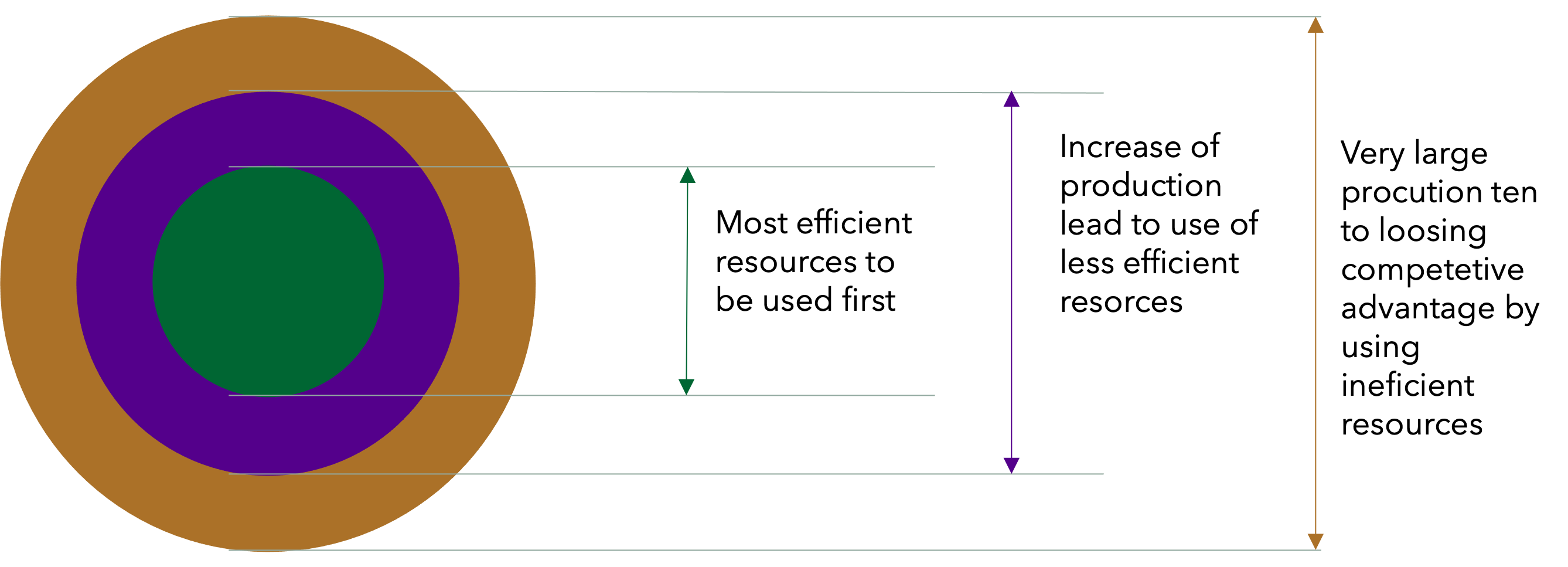
Keywords: resource, standard, productionLater if production and exports further increase, then the reserve of efficient resources is coming to an end and as consequence less efficient resources are demanded to use to satisfy the volumes of production (Exhibit 1-14). Ultimately, this leads to a loss of comparative advantage, as the resources used are no longer at a comparative advantage over those of the other country (Grossman et. al 1990).
This problem of resource scarcity is not only present in the theoretical model but also in the real world. Resource scarcity for one product will not only lead to the use of other domestic’s resources but also it takes resources from another product. Thus, locally produced products will start to compete for the same resource.
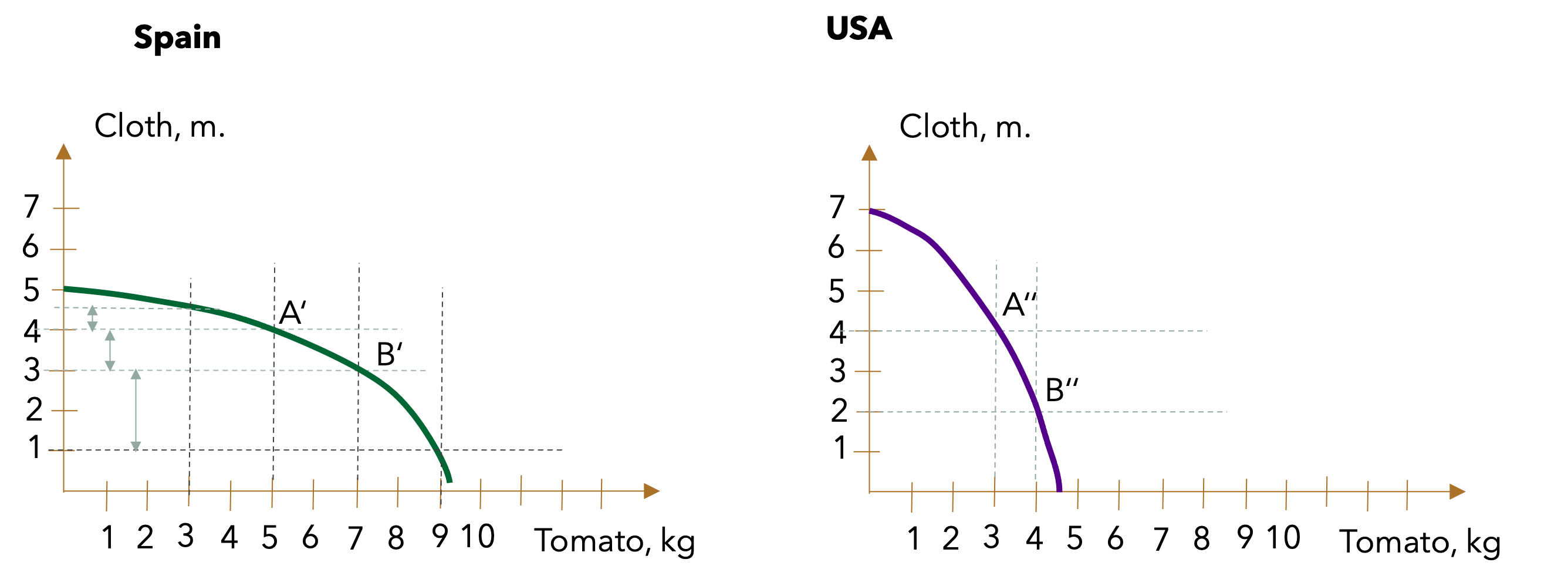
The exhibit 1-15 shows an example of two countries and two products. Suppose that in Spain, it takes the same volume of resources to produce 4 meters of cloth as it takes to produce 5 kilograms of tomatoes (point A’), while in England, it takes the same volume of resources to produce 4 meters of cloth as it takes to produce 3 kilograms of tomatoes (point A”). In Spain if resources are limited, to produce an additional 2 kilograms of tomatoes, 1 meter of cloth would have to be abandoned (point B’). In England if resources are limited, to produce an extra one kilogram of tomatoes, two meters of cloth must be given up (point B”). In this example, Spain has advantage in tomato production, while England has advantage in cloth production. In practice, it is important to consider how much a meter of textile, and a kilo of tomatoes cost and how the price of these products varies over time and in relation to each other. However, this example illustrates the competition for resources and the resource shifting effect. This effect can also be referred to as the opportunity cost effect. The opportunity cost effect means that if resources are allocated to producing one product, the same resources cannot be allocated to producing another product.
Although the example illustrates only two products – tomatoes and cloth – there are many more products in the real world. Each product has a different absolute value and a different added value. With limited resources, a country seeking to produce higher value-added products is forced to forego producing lower value products.
Ex. 1‑15 Impact of cost changes on comparative advantage
Keywords: costs, comparative advantage
During the industrialization period, the USA and Western European countries focused on metal, wood, textiles, and other manufacturing industries because these industries were much more productive as compared to agriculture at that time. In Western Europe and the USA, industrialization led to growth of urbanization and education systems focused on training employees and workers for growing industry needs of specific skills. This is not to say that agriculture did disappear in the USA and Western Europe, but the proportion of the population engaged in this activity declined as more and more workers were needed for the higher value industries of that time.
At the end of the 20th century, scientific advances in electronic and information systems and digital technologies, biotechnology, chemistry, and photonics led to a significant increase in the value-added generated by these sectors compared to traditional industries. As a result, there was a need to free up human resources in the industry and redirect them to higher value business sectors. This has been well-taken advantage of by Asian countries, especially China, to which a significant amount of industrial capacity from the USA and Western Europe began to move towards the end of the 20th century. However, it is important to note that in relocating industrial capacity, intellectual property was protected to the extent possible, and ownership remained in the Western European countries and the USA (see more in Part B, Chapter 4).
According to standard international trade theory, countries which want to change their dominant specialization can themselves proactively invest in improving labor competencies and skills, thus building up the potential of resources in higher value industries while seeking to attract foreign investment specifically into higher value industries. This is the process of transforming the country’s specialization from lower to higher value specialization. An important aspect is that lower value-added industries lose their human resources and competitiveness as consequence in such case. Higher value-added industries tend to pay higher wages, which leads to an overall increase in wages in the country, which puts upward pressure on wages in lower value industries. In other words, it becomes too expensive to produce lower value-added products in a transformed country compared to other countries specializing in lower value-added products (Helpman et al., 1985). This is why sectors such as agriculture in higher value-added countries cannot survive without significant support from a state. An excellent example of this is the vast subsidies for agriculture in the European Union. Another example is the relocation of the traditional industries described above from the USA and Western Europe to Asia at the end of the 20th and beginning of the 21st century. Western Europe and the USA’s orientation towards higher value-added industries make traditional industry uncompetitive, or in other words too expensive, in relation to Asian countries.
In essence, the Standard theory of international trade underpins the developed cascade effect, allowing lower value-added industries to be relocated to other regions of the world when new higher value-added industries emerge. The cascade effect can operate as long as the world is unevenly developed, with a kind of staircase forming between countries’ development, which always allows for the transfer or relocation of an individual industry downwards. Of course, it should be noted that the industry itself is not necessarily relocated in its entirety. The same industry, such as agriculture, can be upgraded to higher technology, such as genetic modification or other biotechnologies, and the type of industry itself changes internally in a fundamental way.
Share or comment this information on your social media:
Fundamentals of global business
First edition
For citation:
Jarzemskis A. (2025). Fundamentals of global business, Litibero publishing, 496 p.

Full scope of the book is available in various formats
A.1 Theories of international economics
- Mercantilism
- Adam Smith and absolute advantage
- David Ricardo and Comparative advantage
- Standard theory of International trade
- Karl Marx and communism
- Hekscher – Ohlin theory
- Paul A Samuelson theory
- Leontief paradox
- Rybczynski theory
- John Hicks and progress
- Economies of scale theory
- Contemporary business internationalisation theories
- Questions for chapter review
- Chapter bibliography
About author
The author has been teaching at several universities since 2005. 40+ scientific publications, 10+ international research projects. More about author.