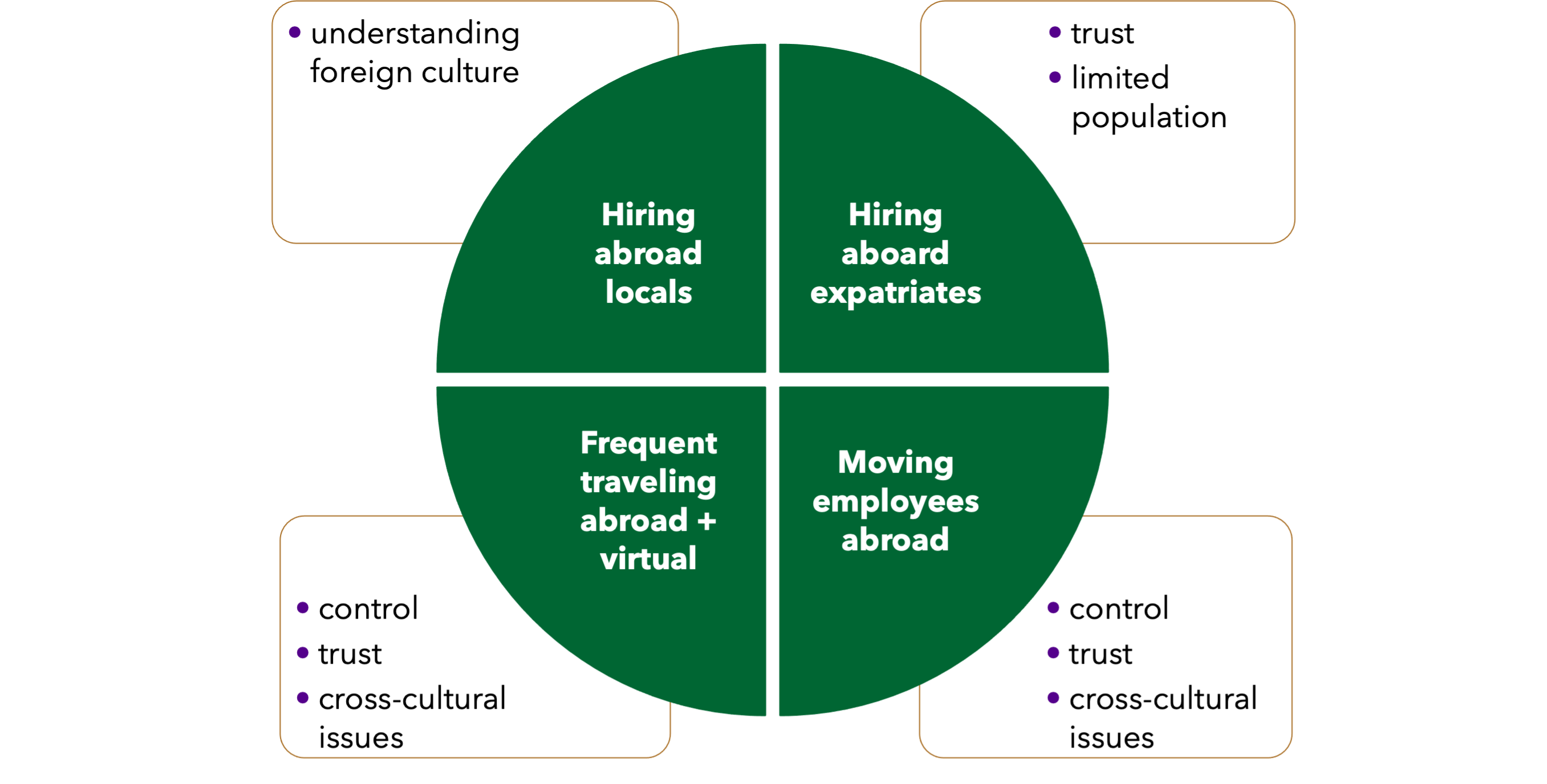
Multinational organizations often have remote divisions, subsidiaries and affiliates that are located in another country, often in another cultural cluster. Managing separate branches of the organization and forming teams causes many challenges (Steers & Osland, 2019). An important issue to be resolved is related to the appointment of the chief of the branch office – it can be a local resident from the cultural cluster there, it can be an employee sent from his country, it can also be an expatriate living in another country and having accumulated experience there (Neelankavil et al. 2020).
Hiring a local resident to lead foreign branch office is reasonable because he will have the knowledge about local values, traditions and attitudes better than a non-local resident, it is easiest for him to get to know the people of that country, and to predict the most suitable candidates for employment (Iguisi, 2009). However, if the cultural dimensions of the headquarters are very different from the foreign branch, in this case, implementing a corporate culture of a uniform standard can be difficult. As the head of the branch unit himself has different cultural dimensions than the standards of the whole multinational organization, many of his or her decisions related to work organization are likely to deviate from the organization’s standard. Chiefs of multinational organizations often trust their compatriots more, or at least people from their own or a close cultural cluster, when it is necessary to ensure the same corporate culture and behavior in all the branches of an organization (Stone et al., 2007). It is not uncommon to notice when, for example, Americans, Englishmen, Germans or Swedes send their compatriot, very often an experienced employee of the same organization, to manage the factory they set up in Poland, China or Mexico.
Going to a foreign country and taking charge of another organization operating in a very different cultural cluster presents many personal challenges for a manager (Exhibit 10-9). Often this means to leave homeland for more than one year. In such cases, employees with families simply move to live in another country, but then they have to deal with issues of their spouse’s work or other employment, kindergarten or school attendance in another country and especially in another culture. There are quite a few cases when an employee chooses the practice of returning home on weekends instead of permanent emigration. After working in another country for five days, the employee in this case returns to his family for the weekend. This lifestyle is quite tiring, but due to salary and other motivational tools, there are managers who have chosen this lifestyle. However, for a branch chief working in another country, if he knows little about the culture, values, and attitudes of the people there, it can be a very big challenge to assemble a sustainable and suitable team. Thus, international organizations face one of the two difficulties – the organization will either have to sacrifice and adapt its standardized corporate culture, or the manager will have to experience constant misunderstandings, conflicts, inconsistencies of expectations due to cultural differences in the daily activities of a specific branch unit.
Ex. 10‑9 Appointing foreign branch officers
Keywords: culture, communication, teams
Source: adopted from (Steers & Osland, 2019)
The COVID-19 pandemic has forced humanity to use virtual video conferencing equipment more than before. Virtual meetings existed until 2019 as well, but they were often as an additional function, as an option, and many international team meetings took place physically. During and after the pandemic physical meetings have become additional options, when virtual meetings have become new norm and usual activity. Today, it is difficult to find an organization that does not have a special meeting room equipped with a virtual video conference; companies have begun to massively implement so-called virtual call rooms, where an employee can communicate remotely with a member of his team without disturbing other employees. During phone conversations, especially in a multicultural environment, the influence and significance of non-verbal communication and context is often neglected. In cultures that avoid direct speech and more use contextual tools to communicate ideas, video conferencing has greatly increased the ability to maintain communication at a distance while preserving its method. Although employees like to join an international meeting with the video camera turned off, a number of multinational organizations have included in their corporate standard the need to have the video cameras on for all participants throughout the meeting.
Virtual teams experience a lot of challenges related to the use of technology, for example, someone’s internet connection freezes, the microphone does not turn on, the video camera does not work. Such technical glitches sometimes greatly extend the duration of the meeting. People who sit in front of a video screen for a long time often complain of more fatigue than if they had participated in a physical meeting for the same amount of time, is another disrupting issue. Challenges for virtual multicultural teams are presented in exhibit 10-10.
Ex. 10‑10 Challenges for virtual multicultural teams

Keywords: disturbances, issues, multicultural team
Important challenge of virtual teams is related to the interference of feedback and the transmission of emotional context. It is much easier to observe the reaction, facial expressions, and body language in a physical discussion than in a virtual discussion, where only the face is visible, or a meeting room by using online webcam from a distance where several or a dozen people are sitting behind large table in a e-conference room.
Virtual conversations require specific discipline and order, and this must be ensured by the organizer of the meeting, for example, to speak only after receiving the permission of the organizer, to ask for permission to speak by raising a hand. It is also important to agree on the duration of the planned meeting. Virtual meetings have made it possible to avoid wasting time going from meeting to meeting, but it also allows and even encouraged people to schedule one meeting after another. If an employee used to have one or two physical meetings in his calendar a day before pandemic, then 4-5 meetings a day are no longer surprising in virtual environment. However, this means that each meeting must end at the scheduled time in order to log in and participate in the next meeting. It leads to the fact that it is sometimes not possible to discuss all the planned topics during the virtual meetings, especially if the duration of the meeting has been extended due to technological interference. It creates challenges in cultures which are flexible in time dimension when they met people virtually from Germanic, as well as Anglo or Nordic cultural cluster, which are stick in time.
Ex. 10-11 Time zones affecting multinational organizations
Keywords: time zone, multinational organization
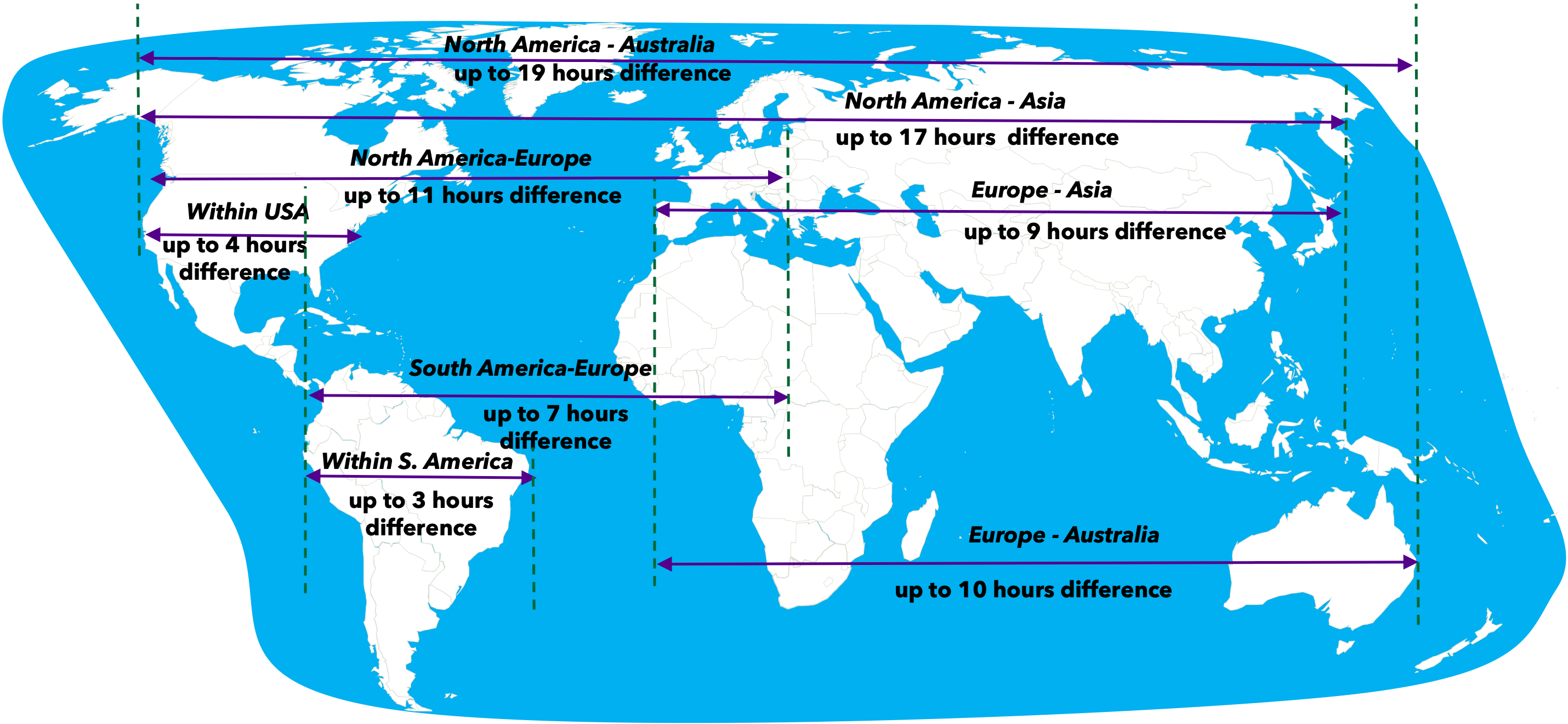
Different time zones make virtual meetings a big challenge (Exhibit 10-11). If an organization with headquarters in New York, a factory in China, and employees in a research unit in Germany has to meet, it may mean that someone will have a meeting at night. This problem of different time zones existed when phone calls were common, but such calls were more of an exception. As opposite, virtual team meetings have become the norm. In the office buildings of big cities, it is quite common to see people working at night when passing by, and this is associated with the fact that the communications are ongoing between team members in different time zones.
Beyond virtual challenges there are more generic challenges for multicultural teams. A big challenge for any multicultural team is different languages. English is considered an international business language; it is spoken by many employees of multinational organizations, especially those whose duties require them to communicate with colleagues from other countries. However, the details of knowing the language, expressions, sayings, specific terminology causing confusion, especially when the details and subtleties of the production or process are discussed. The more complex the production or service, the more specific terms are used to describe for instance the chemical substances, the physical processes involved in the processing of the products, the greater the probability of miscommunication.
Multicultural teams rarely achieve the necessary level of friendship and familiarity to get to know and understand each other better. Multicultural teams often struggle to avoid offending a person from another culture and often have to think before telling a joke that is necessary for relaxation. What is funny in one’s culture may sound like an insane or absurd in another’s culture. For example, in the USA, more jokes are made about strange or unordinary situations, which can also be seen in Hollywood comedies. Meanwhile, making jokes about race, body composition, weight, and gender can be considered an insult or even in some cases a crime or harassment. Meanwhile, such jokes may be acceptable for example in Russia. The polite gesture of opening the door for a woman can be understood as gender discrimination in Sweden. As global companies expand and dominate many industries in the world, multicultural teams are on the rise, and to avoid misbehavior, multicultural teams are becoming more popular with neutral behavior and suppressing their culture’s habits, especially when joking or relaxing. Team building in corporate events also requires caution and consideration of differences and is a much more complex process than in a monoculture team.
In multicultural teams, when employees of the same level in the organization’s hierarchy communicate, it is much more difficult to find a consensus. More often, a compromise has to be used when the participants adjust initial ideas to find common agreement. Finding a compromise when differences of opinion are determined by cultural differences is much more time-consuming.
Cultural differences in attitudes to time and punctuality pose many challenges. Most often, this manifests itself in lateness to scheduled virtual meetings. For example, representatives from Southern European and South American cultural clusters, due to their more relaxed approach to time, often join later when the meeting is halfway through, but are surprised that their team members from the German or Nordic cultural cluster log out of the meeting when the meeting’s time is up, even if or when the issues raised during the meeting are still not resolved.
However, global teams also have many positive aspects for global organizations. First of all, they help to better understand the needs of different markets, which allow adapting the produced products to the needs of a specific market. For example, an Indian team member might wisely advise that hamburgers for the Indian market should be significantly spicier than in USA or Europe. Thus, although standardization, specialization and economies of scale are considered to be the inspirations and catalysts of globalization, flexibility and adaptability are still necessary when serving markets of different cultural clusters.
When formulating tasks, managers in a multicultural environment face the challenge posed by the cultural dimension of the context. A direct instruction and instruction on how to carry out a process or behave in a specific situation will not be enough for employees of a high context cultural cluster. In this case, in order to perform the task properly, additionally it is also necessary to provide the employee with information about the context, not only what needs to be done, but also why is it needed, how this process is related to other processes, because otherwise, without understanding the circumstances and surrounding of the process, the employee will not be able to perform the process efficiently and with quality. Specific instructions are sufficient for low-context culture employees. Challenges arise when the same task has to be given to several employees who are from different cultural clusters, simply because one of them needs contextual information and the other does not. For an employee of a low-context culture, providing additional context along with the task can even be harmful, as it can create so-called informational overload and make the task unclear to the employee.
In cultures where it is customary to hire a man for position of manager, they may find it difficult to accept a situation where their direct supervisor is a woman. In order to get and hold a job, employees often accept it because it is required by the multinational organization’s management, gender equality and ethical standards, but polite and kind behavior often remains only an external mask, which hides an inner belief, attitude, values and traditions that have not disappeared anywhere. Internal conflicts for an employee between internal beliefs and required behavior are bad motivators for effective work.
Challenges also arise in areas related to work organization and regulation. The Netflix film “American Factory” reveals the situation when a large Chinese car glass manufacturer invests in the United States and opens plant in Dayton, Ohio. The idea that US workers are protected by trade unions and that the fire alarm panel hangs prominently in the main lobby was unacceptable to the Chinese firm’s owner in that documentary film. So just as Chinese entrepreneurs find what is normal in the US work environment inappropriate, similarly US entrepreneurs may find some actions inappropriate in Chinese work environment. Heads of multinational enterprises are forced to adapt to the traditions, norms and even more legal acts of the country where the branch is based. While most Western European and US companies invested in Asia, the values of these cultures were considered as universal and only correct, but when Chinese companies have begun to invest in the US and Europe the unanswered question remains about the supremacy of values. This question will not be answered in this textbook either, because in the environment of multicultural teams sometimes need just to say, “let’s agree to disagree”, instead to pushing own culture as supreme.
Share or comment this information on your social media:
Fundamentals of global business
First edition
For citation:
Jarzemskis A. (2025). Fundamentals of global business, Litibero publishing, 496 p.

Full scope of the book is available in various formats
C.10. Communication in intercultural environment
- Communication in intercultural environment
- Theories of motivation and motivators in various cultures
- Intercultural differences in attitude towards work and career
- Intercultural management challenges
- Variety of labor relations and compensation
- Multicultural teams and communication in them
- Negotiations in multicultural environment
- Questions for chapter review
- Chapter bibliography
About author
The author has been teaching at several universities since 2005. 40+ scientific publications, 10+ international research projects. More about author.