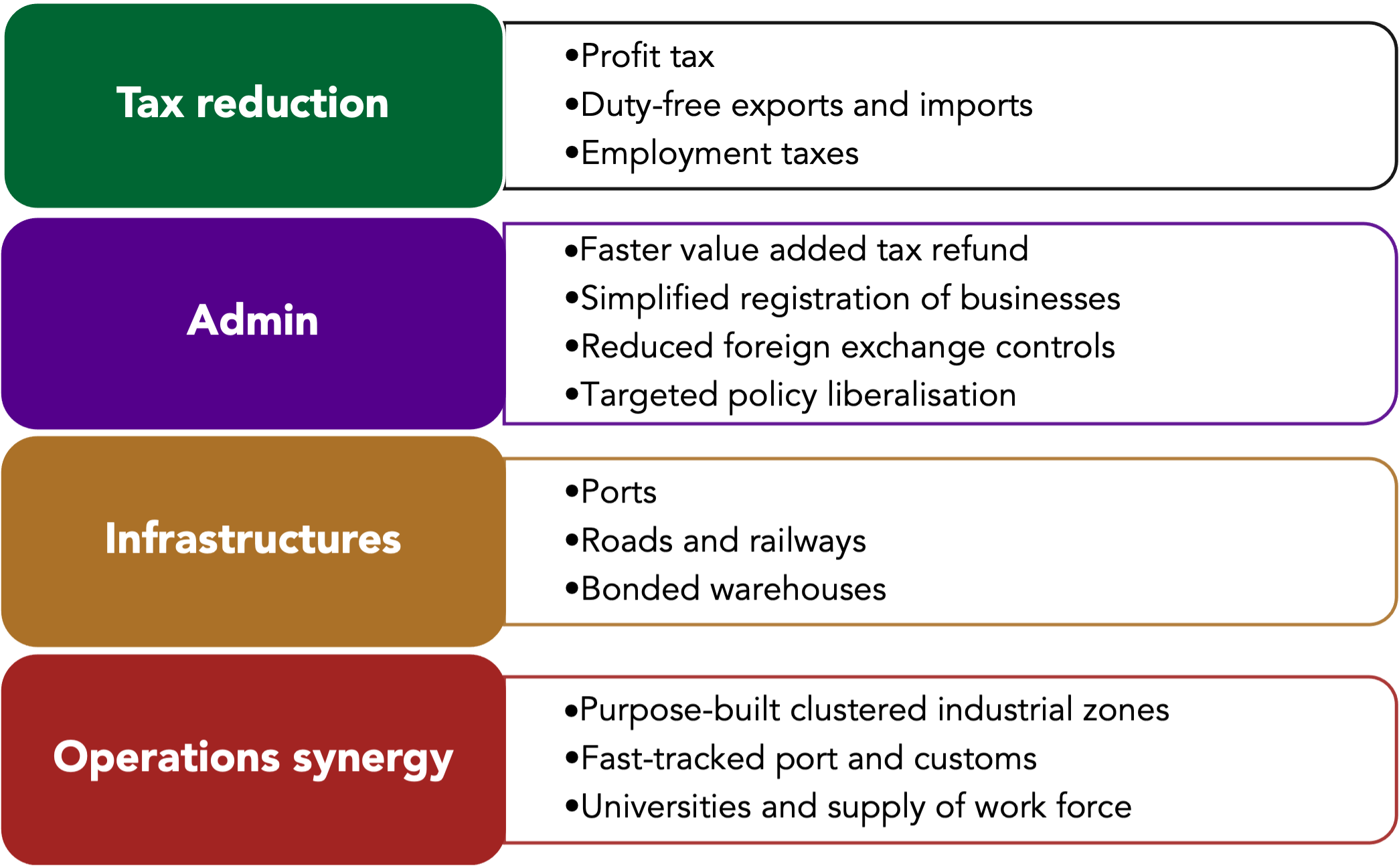
A government policy is very important for the movement of capital and especially for foreign direct investment. The fact that today a very large part of the production for the global market in various industries is produced or at least assembled in China is largely determined by the active decisions of the Chinese government. The most general government decision that is important to an investor is investment security. Free economics zone benefits are presented in exhibit 6-9.
Ex. 6‑9 Free economics zone benefits
Keywords: FEZ, benefits
The biggest risk to the security of investments is the possibility that the investments can be simply taken away by the local government, which is usually called nationalization. Although nationalization was common in the 20th century, it continues to be a concern in the 21st century as well. Unlike democracies, autocratic or dictatorial countries do not shy away from taking over companies of foreign investors simply for the needs of their state. China, being a Communist Party country, is considered by western democracies to be essentially an autocratic state, however, since the 1980s, it has shown actions to assure US and European investors that it is safe to invest in their country and they keep this promise. Due to the abundance and cost of labor resources, many organizations from western democracies have invested in China.
Example of China can be quoted when discussing the next important step for attracting investments after security, which is the creation of favorable tax environment. One way to create a favorable tax environment is known as free economic zones.
A Free Economic Zone – FEZ, a Free Economic Territory – FET, a Free Zone or a Free Port are all as area perceived as Special Economic Zone – SEZ. Such status is granted by a government in a host country. Although such zones are created not only to encourage foreign investment but also domestic investment, it is still a very important factor for attracting foreign investors. In these special zones, which are defined by a specific territory, different taxes are imposed than in the rest of the country.
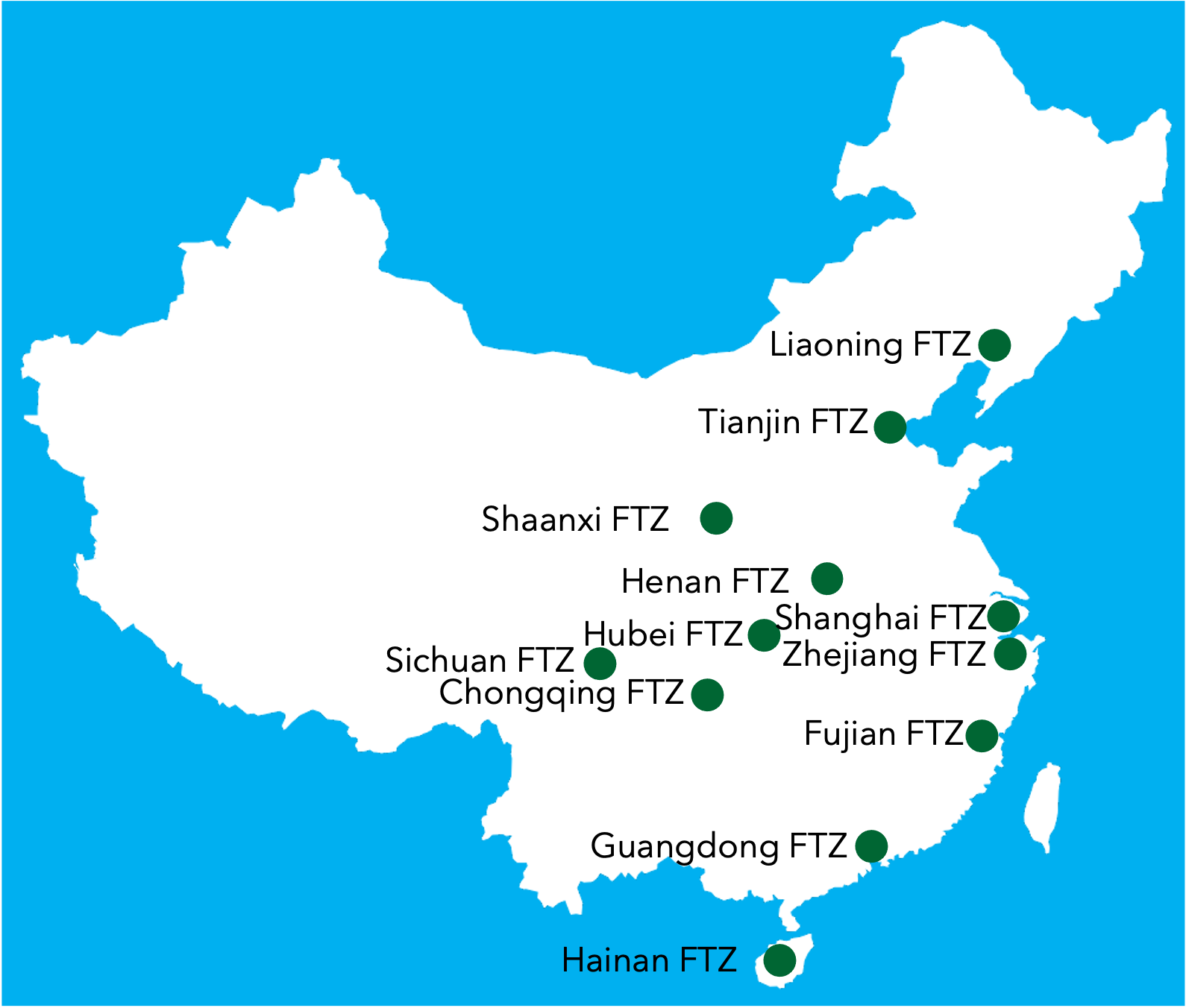
Ex. 6‑10 Free economics zones in China, 2020
Keywords: China, FEZ
Most of the free zones have a profit or corporate income tax benefit, sometimes a zero rate is applied. In these zones, benefits related to taxation of wages are also established. These zones often act as duty-free zones. Thus, an investor will invest in another country in production capacity, either by creating it or by acquiring the existing one, if this capacity is in a free zone, then the business operating there will be able to reduce production costs due to lower taxes.
In China, a very large concentration of port cities with highly developed logistics and transport infrastructures, within or very close to the free economic zones which are created by the government (Exhibit 6-10). Thus, in this case, two very important criteria – the distance to the international transport hub and the tax incentives – led to the emergence of a whole chain of industrial megacities in the southern part of China right along the coast. Benefits to locate investment into China’s free economic zones include such as:
- Favorable administrative measures.
- Reduced profit tax for organization located in a zone.
- Duty-free imports and exports and bonded warehouse service.
- Fast-tracked port and customs operations.
- Simplified registration of new entity.
- Faster value added tax refund.
- Reduced foreign exchange controls.
- Targeted policy liberalization in specific industries.
- Purpose-built clustered industrial zones.
- State subsidies and tax benefits for recruitment of highly skilled workers.
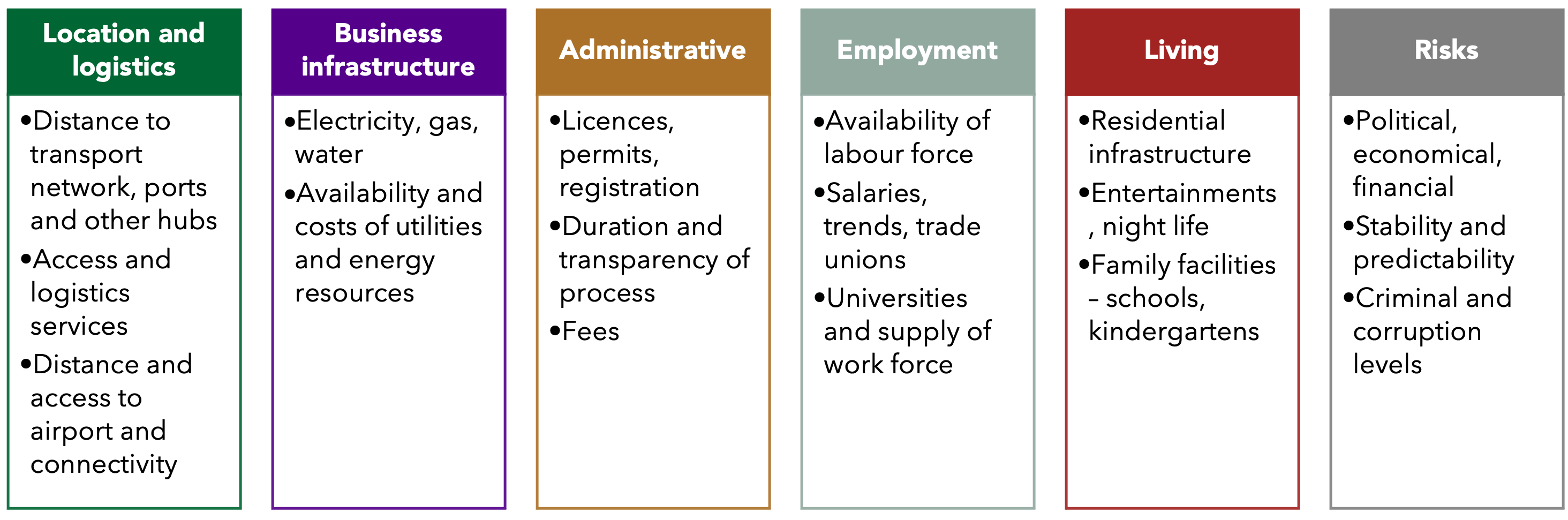
Ex. 6‑11 Criteria influencing foreign investor decision
Keywords: location selection, FDI
In order to attract foreign investors, local governments often finance the creation of infrastructure in free zones – plots are formed, roads and railways are built right up to the plot, electricity and gas supply infrastructure is brought in, and this encourages the investor to build a factory from scratch, but not quite in a green field, but already with a prepared plot and all necessary engineering infrastructures (Dong et al. 2024). This encourages investors to choose more carefully the countries and cities in which to invest, and these proposed investment attraction measures are often noticed and considered by investors (Fazaalloh, 2024).
Some governments even offer financial subsidies for a defined amount and time to encourage foreign investment by higher value-added businesses. Subsidies as a means of attracting investors are offered for such activities as the creation of a research and technological development base (Kalotay, 2016).
In order to attract investments, governments often establish specialized agencies, such as Select USA, Invest in Finland, Invest in Afghanistan, Invest in Israel, Invest Lithuania. Many countries have similar agencies, and the staff of these agencies perform very important functions, among which the main ones are information and counselling, legal assistance and advocacy, organization of visits and organization of meetings with local entrepreneurs (Ciobanu, 2015). Each country’s agency aims to promote its country’s attractiveness for investments, participates in exhibitions and business conferences. Agencies help free economic zones, cities and regions to attract foreign investors. When choosing a location for investment, investors usually consider the following factors, which are taken into consideration by investment attraction agencies (Exhibit 6-11):
- Location: distance/duration to airport, rail access (depends on industry), road access, distance to port.
- Infrastructure: availability/price of utility services – electricity, gas, internet.
- Administrative procedures: permit/license restrictions, cost and speed.
- Employment: enough people, skills, experience, education.
- Labor costs: salaries, trends.
- Residential infrastructure: capacity of housing, rent/cost of housing, English speaking schools and kindergartens, general cost of living.
- Entertainment: restaurants, bars, nightlife.
- Risk: political, financial, economic, corruption, crime.
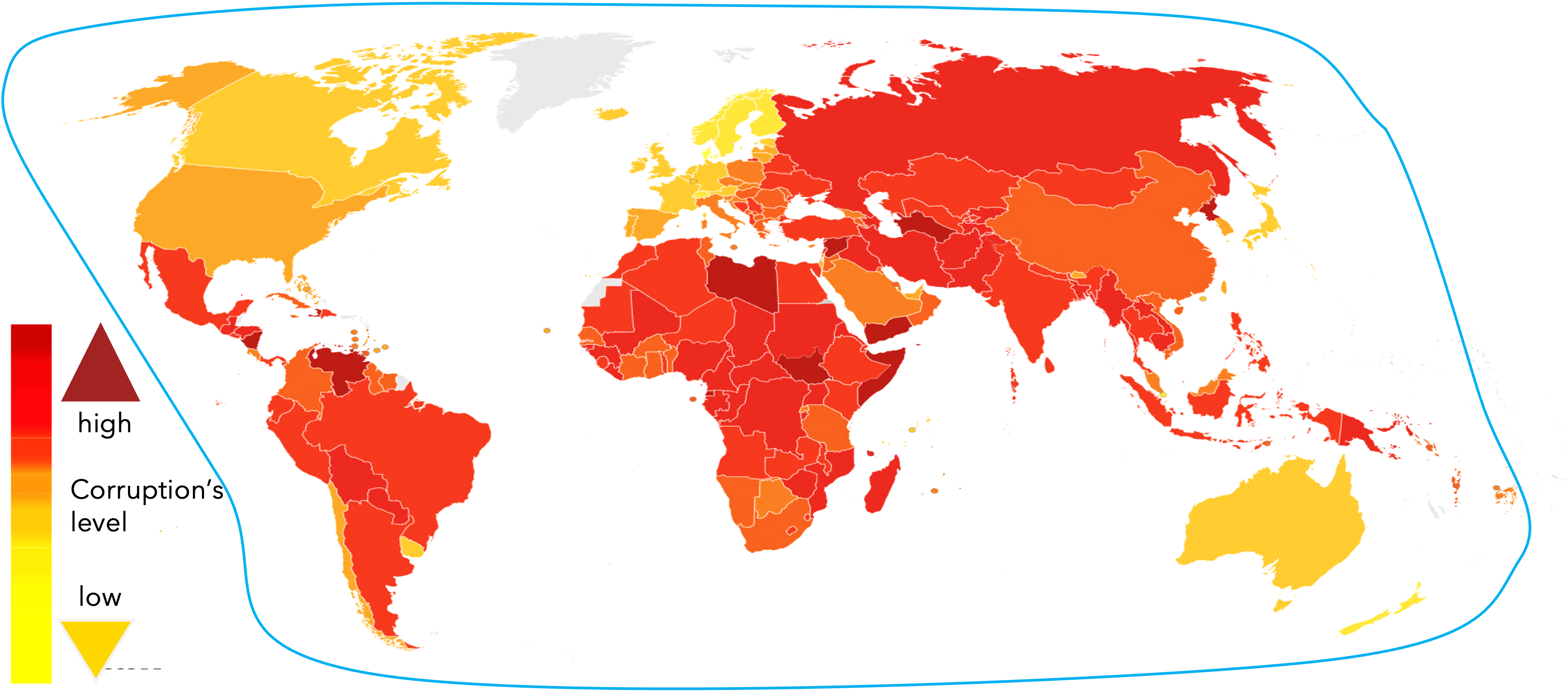
International rating agencies are also important institutions that enable investors to make well-informed decisions. There are more than 200 countries in the world, because of which investors really do not have the time and opportunity to get to know the investment environment of each country individually. International rating agencies evaluate the credibility and risks of countries according to many criteria, and this allows investors to have an initial assessment and select up to several potential locations. International ratings can be found according to many criteria, for example corruption index and crime are quite relevant for investors (Exhibit 6-12).
Various reports can be found, where each criterion for attracting foreign investment is ranked according to importance. However various sources provide different results on importance of those criteria.
For example, the United Nations systematized the diversity of investor decision-making into four groups of criteria, which are related to the legal environment, financial environment, business practices and culture. Such independent criteria are very important as political and economic security, supply and distribution logistics and distance factors, and local markets size and profitability, if the investment motive is market access.
As part of the legal environment, the most important are taxes and their volumes, tax benefits, employment regulations, the benefits of investment promotion, and the protection of intellectual property. As part of the financial environment, the possibilities and limitations of transferring funds, access to financing, investment costs, the effect of exchange rate fluctuations and criteria for determining credit worthiness are distinguished.
Ex. 6‑12 Corruption level, 2023
Keywords: corruption, FDI
Source: adopted from Transparency international, www.transparency.org
The influence of large banks operating in the country, the influence of large companies operating in the country, business culture, attitude to profit in the country, preferences for forming relationships in the country are considered important (Schoenmaker & Schramade, 2023). A cultural environment depends significantly on people’s behavior, religion, attitude to work, attitude towards foreigners.
Share or comment this information on your social media:
Fundamentals of global business
First edition
For citation:
Jarzemskis A. (2025). Fundamentals of global business, Litibero publishing, 496 p.

Full scope of the book is available in various formats
B.6. Foreign investments
- International resource movements
- Foreign direct investments
- Foreign portfolio investments
- Pros and cons for investing abroad
- Incoming foreign investments
- Management and design of foreign investments
- Attraction of foreign investments and free economic zones
- Mergers and acquisitions
- Questions for chapter review
- Chapter bibliography
About author
The author has been teaching at several universities since 2005. 40+ scientific publications, 10+ international research projects. More about author.