Depending on the cultural cluster and the dominance of cultural dimensions, employees have to be motivated to work in different ways (Nwankwo et al., 2024). Multinational organizations that have branches in different countries often face the situation that corporate standards do not work in the same way in Japan, Russia, USA and Sweden. What works well in Japan may be a disaster in Russia, or what is common in the US may be widely condemned and opposed in Sweden. It is shame to write in this book about the fact that in the 21st century there are still countries where corporal punishment is used to motivate workers. In some countries, forced labor may also be observed. For example, in the Soviet Union in the eighties of the 20th century, it used to be common to see how the police, then it was called the militia is caching vagrant unemployed people on the streets, is arresting them and taking them away towards the mandatory work assignment office. The question remains as to how productive such forced labor was and how much added value was created, but in official statistics of the then Soviet Union the absence of unemployment was declared, that is, so everyone used to work there in that period of time.
One of the important cultural dimensions on which the choice of appropriate leadership and motivation methods depends is the dimension of power distance and hierarchy (Müller-Seitz, 2012). In cultural clusters with relatively high-power distance and clear hierarchy, employees expect clear orders and specific instructions from the manager. A leader in these clusters is respected, often worshiped, considered to be superior. This is very evident and technically obvious in such simple things as the clothes, office room, car of the firm’s director or owner. The chief in this case shows the distance between himself and the employees. The fact that a leader in a hierarchical culture shakes a subordinate’s hand or asks how the employee’s family is doing is considered a sign of a good tone and a show of attention, but it actually means that a person of a higher hierarchical level showed attention to a person of a lower level.
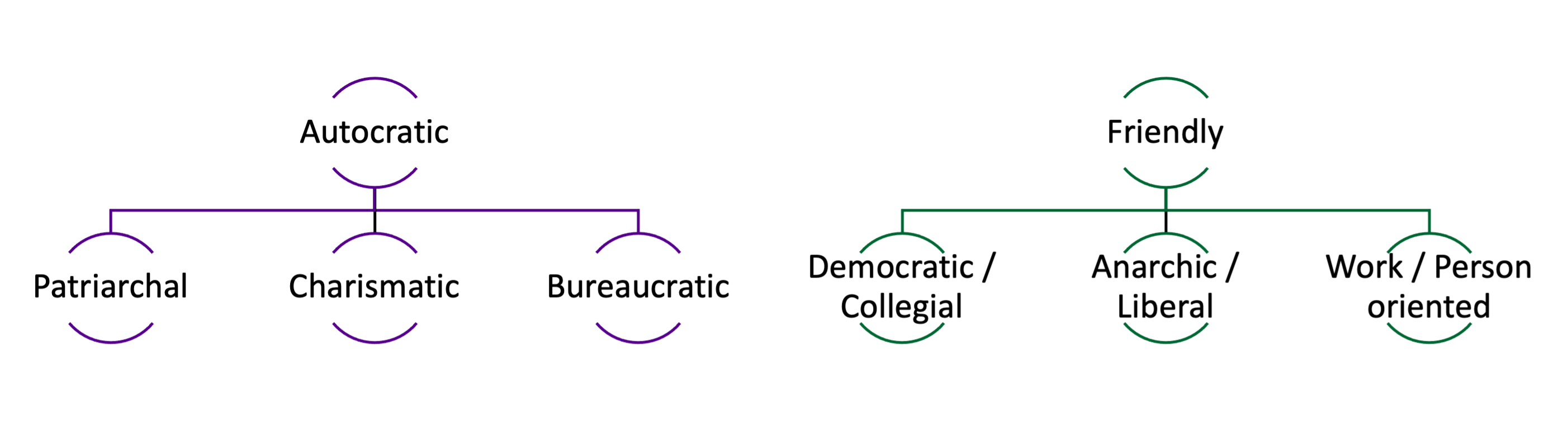
The same chief’s handshake for every employee or inquiry about family in an egalitarian and low-power-distance culture may simply mean a really friendly relationship, for instance in Nordic cultural cluster. In this type of culture, it is even difficult to tell which employee is the boss, often the chief officers sit in the same open space room with the employees, wear a jeans and T-shirt. Thus, depending on the culture, leadership has two opposites – autocratic or friendly. Friendly leadership in a hierarchical high power distance cultural cluster could be seen as a weakness of the leader, and subordinates will simply ignore the leader’s instructions given as a form of advice. Attempting to use an autocratic leadership style in an egalitarian low power distance society structure can also have negative consequences, employees will simply leave such organization in search of a friendly leadership style in another one, or employees will otherwise resist such a leadership style. A good illustration of that would be a Mexican coming to run a firm in Sweden or a Swede going to run an organization in Mexico. The two extremes of leadership styles described above were chosen because they best illustrate the differences that result from cultural clusters (Exhibit 10-6).
Ex. 10‑6Leadership styles
Keywords: leadership, autocratic
However, there are more than two types of leadership, and individual nations have mastered the ability to combine the advantages of these extremes to create unique leadership systems. For example, in Japan, where the hierarchy level is very high, the power distance is high, and the tradition of respect and loyalty to the elder prevails, it is well understood that although the chief is at a higher level of social status in the hierarchy, but the chief must descend to the process performed by subordinate. The Lean management philosophy developed by the Japanese has one of the instruments for ensuring management efficiency called “Gemba”. “Gemba” in Japanese means the place where the production process itself takes place, be it in a factory where metal is cut, a screw is turned, or cloth is sewn. In Japanese management, “Gemba walk” means that the chief comes to observe the production process by getting involved, interviewing the worker. To ensure quality and continuously improve quality, Japanese understands that quality lies in small details, and specific of those details and the differences between them are best known by the worker, directly working hands-on. In Japan, a subordinate is usually encouraged to make suggestions for process, equipment, and other improvements. Since, according to the Japanese tradition and value system, looking into the boss eyes and talking directly can be considered a sign of bad tone, the Kaizen system is used in Japan, which means that employees can write suggestions on pieces of paper and put this piece in special Kaizen dashboard with their observations on how to improve the work being done, simplify, cheapen the process and increase the work performance and quality. The reason that this management system originated in Japan is the hierarchical structure of society and the high power distance, and at the same time the need to control and know all the details of production for the top management. Such kind of management style has successfully spread to other world cultures and is widely even used in Anglo, Germanic, Nordic culture clusters.
Basically, leadership styles are divided into:
- Democratic or collegial.
- Liberal or anarchic.
- Work- and person-oriented.
Which of these management methods is the most appropriate is determined by the cultural cluster (Exhibit 10-7), and also by the type of industry. For example, in a metalworking factory or a sewing factory, where processes are highly standardized and repeated millions of times, discipline, order, process precision and uniformity are essential, so it is not surprising that often an autocratic management style is acceptable in many cultures in such industries. On the other hand, it should be noted that this type of industry has moved to those countries where the autocratic management style is culturally and traditionally more acceptable, namely to Asia. Multinational organizations from the Anglo, Germanic, and Nordic cultural clusters moved textile production mostly to India, Bangladesh, Vietnam, Pakistan, and metal and wood processing industry to China in very large volumes.
Ex. 10‑7 Dominant management styles in cultural dimensions

Keywords: leadership style, cultural dimension
Source: Adopted from (House at all., 2004)
Such industries do not require creativity, long discussion about the process, but require precise implementation. So, in addition to the fact that labor is cheaper in these countries, an autocratic style of leadership is acceptable in society. Process discussion is important to the extent that its effectiveness can be increased, as in the case of the Kaizen management system in Japan. Industries that require creativity, such as the creation of new products, research and development, invention of new technologies, materials and methods, the design and introduction of brands, marketing – are mainly concentrated in those countries where a democratic management style with a high orientation towards work and people is acceptable, sometimes even where a liberal management style is acceptable. Autocratic leadership style is further divided into charismatic, patriarchal and bureaucratic. The charismatic way of management is understood when subordinates obey him voluntarily due to the leader’s charisma and personal qualities.
In the case of patriarchal management, the behavior of the leader in the organization is similar to the behavior of the head of the family where experience and age are very important. The bureaucratic management method is based on precise law-compliant rules-based regulation, strict subordination and obedience of organizational members, depersonalization of employee relations.
Democratic leadership style is based on power sharing by involving subordinates in leadership and decision making. The chief tends to solve most issues collegially, reserving the right to make a decision after the issue has been discussed by the team. Democratic management emphasizes respect for employees and their abilities. The boss promotes the initiative and independence of subordinates, controls the work results, not the process. Instructions are provided to subordinates in the form of suggestions and advice. The chief is not afraid to admit that he was wrong, he responds constructively to criticism. Democratic leadership style is often considered the most appropriate, but it can affect the speed of decision-making, the leader sometimes avoids responsibility by handing it over to the team. Although Japan is considered a hierarchical country, this democratic way is still very common, especially listening to the advice of specialists on improving the quality of the process, but after making a decision, a boss usually gives instructions in the form of strict orders and instructions.
The liberal leadership style is characterized by the manager’s minimal interference in the activities of subordinates. The leader does not emphasize his position, avoids controlling subordinates, avoids ordering them, is passive, sometimes inconsistent, and is easily influenced from outside. Having great freedom of action, subordinates set tasks for themselves at their own discretion and implement them. It is said that this leadership style is most suitable when the work is individual and creative, but not suitable in complex dynamic conditions.
Work- and people-oriented leadership style is characterized by systematization of problems, planning and organization of subordinates’ work, and caring for employees. The relationship between chief and subordinates is based on trust, mutual assistance, and direct communication.
Leadership styles are also divided according to the dominant function of the leader into instructing, teaching, participating and delegating. In the directive leadership style, the manager provides all details and instructions, sets specific goals and tasks for employees, often checks their work, and shows how it should be done. In the teaching leadership style, the manager conveys his position, encourages, persuades employees, and discusses their work together. In the participative leadership style, the leader involves employees in the search for solutions, encourages them to ask questions, helps, does not criticize. In the delegating leadership style, the manager transfers responsibility to subordinates, allows to search for innovations and delegation of responsibility.
Share or comment this information on your social media:
Fundamentals of global business
First edition
For citation:
Jarzemskis A. (2025). Fundamentals of global business, Litibero publishing, 496 p.

Full scope of the book is available in various formats
C.10. Communication in intercultural environment
- Communication in intercultural environment
- Theories of motivation and motivators in various cultures
- Intercultural differences in attitude towards work and career
- Intercultural management challenges
- Variety of labor relations and compensation
- Multicultural teams and communication in them
- Negotiations in multicultural environment
- Questions for chapter review
- Chapter bibliography
About author
The author has been teaching at several universities since 2005. 40+ scientific publications, 10+ international research projects. More about author.