This section describes the Heckscher-Ohlin theory, which explains the importance of a country’s resource endowment and quantity for international trade. The theory is more hypothetical, as it has many limitations in its practical application, but it explains general principles on the importance of different resource intensities in different industries.
Ex. 1‑18 Heckscher–Ohlin theorem in the context of other historical events
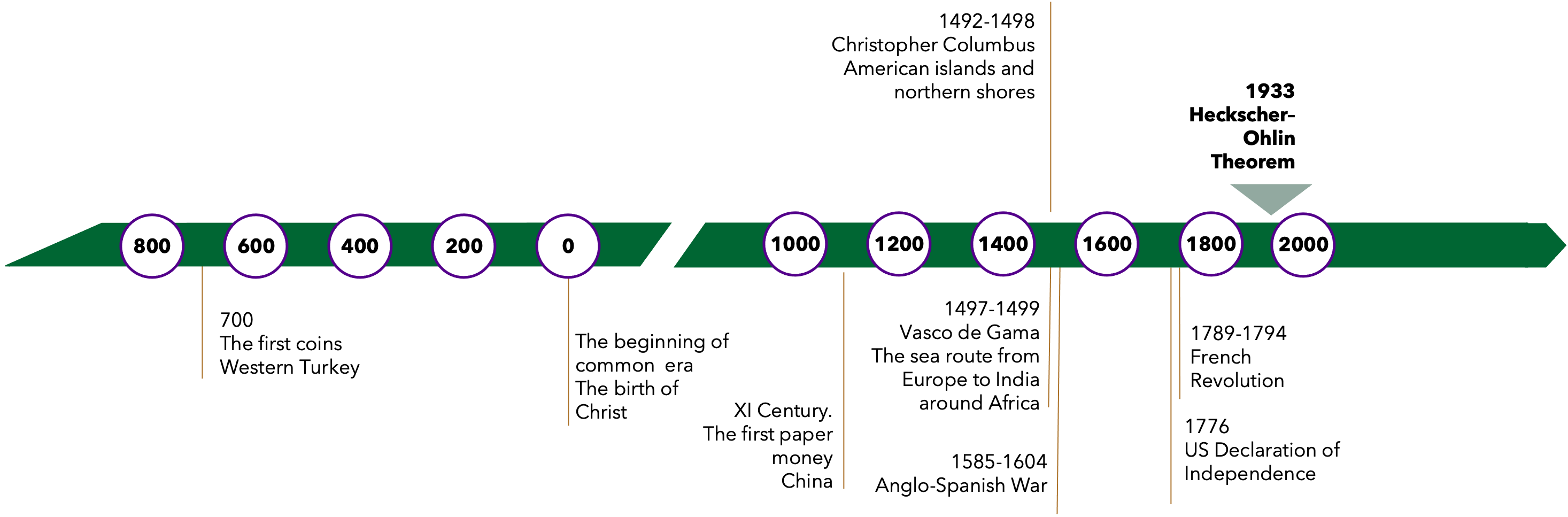
Keywords: I world war, II world war, Heckscher-Ohlin
In 1919, the Swedish economist Eli Heckscher published a paper titled “The Effects of Foreign Trade on the Distribution of Income” (Heckscher, 1919), in which he outlined his ideas on international trade, and 14 years later, his student Bertil Ohlin refined and expanded on these ideas and, in 1933, published a work titled “Inter-regional and International Trade” (Ohlin, 1933), for which he was awarded the Nobel Prize in Economics in 1977 (Exhibit 1-18).
The Heckscher-Ohlin theorem states that a country will export a commodity that demands extensive utilization of resources that are readily available in abundance and that is inexpensive for the country to produce. In opposite case if the country has scarcity of resources and productions costs are high for the particular product, it might prefer to import such product from other countries.
The Heckscher-Ohlin theorem incorporates the abundance and price of those resources as key factors (Fajrin et al 2022). Resources can be assumed as farmland, other natural resources, minerals, metals, and petroleum products, labor with specific skills and quantity, and capital. Different types of industries are differently resource intensive.
For example, agricultural production – cereals – requires abundant and fertile arable land. For example, textiles, clothing, low-value-added manufacturing, and household goods require a large, low-skilled labor. The automotive, iron, steel, agrochemical, and fertilizer industries require abundant capital. The chemical, pharmaceutical, information technology, aircraft, electronics and machinery industries require a skilled labor.
Suppose to have two countries (1 and 2), two goods (X and Y) and two resources – labor L and capital K (Exhibit 1-19). According to the Heckscher-Ohlin theorem, what matters is how much it costs to produce the product in terms of labor resources and how much it costs in terms of capital in each country. It is also important that the cost of capital and labor is not measured in absolute terms but as the ratio of the cost of capital to the cost of labor in each country. The Heckscher-Ohlin theorem allows for the possibility of changing the capital-labor cost ratio in both countries.
Ex. 1‑19 The mathematical expression of the Heckscher-Ohlin theorem
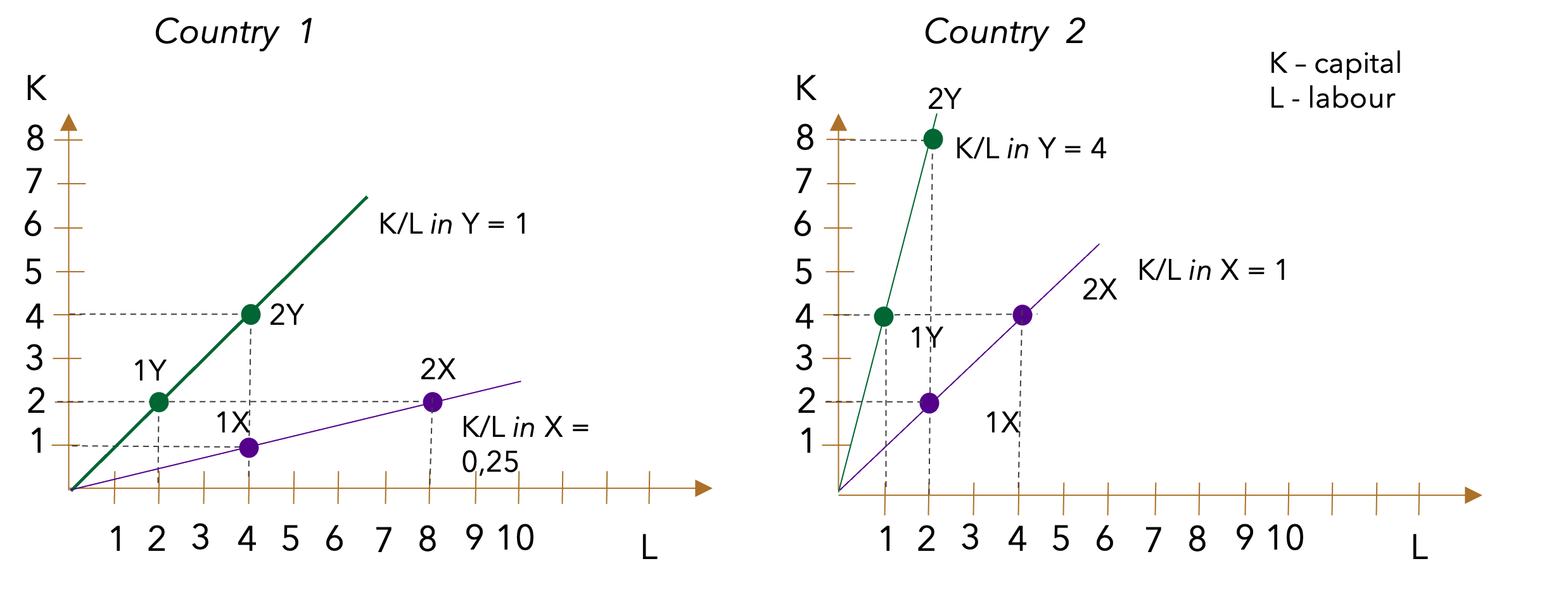
If the production of product Y requires capital worth two conditional units and labor worth two conditional units, the capital/labor ratio (K/L) is assumed to be equal to one. If, at the same time, product X requires labor valued at four conditional units and capital valued at one conditional unit, then the capital-labor ratio for product X is ¼. In this case, if the K/L ratio for product Y is equal to one and the K/L ratio for product X is ¼, then is need consider product Y more capital-intensive and product X more labor-intensive.
Since the ratio of the cost of capital to the cost of labor is the same, the straight lines drawn in the exhibit imply that although more labor and capital will be needed to produce either two products Y or two products X, this will not change the capital-labor ratio, which will always remain equal to one for product Y and ¼ for product X in the first country. Correspondingly, in the second country, the capital/labor ratio for the production of product Y will be 4 and for product X will be 1.
The first country can produce 1Y product with 2K and 2L, 2Y products with 4K and 4L and so on. The second country can produce a 1Y product with 4K and 1L, 2Y products with 8K and 2L and so on.
The first country can produce a 1X product with 1K and 4L, a 2X product with 2K and 8L and so on. The second country can produce a 1X product with 2K and 2L, 2X products with 4K and 4L and so on. Thus, in the first country, product Y is more K-intensive, and product X is more L-intensive. In the second country – likewise – product Y is more K-intensive, and product X is more L-intensive. Comparing the two countries shows that both products are more capital-intensive in the second country than in the first. Product X has a K/L ratio of ¼ in the first country and 1 in the second country, while product Y has a K/L ratio of 1 in the first country and 4 in the second. The reason why this happens is the relative cost of capital to labor. It is relatively four times lower in the first country than in the second. In order to explain why the cost of capital is lower in the first country than in the second country, it is necessary to relate the cost of capital to its quantity.
Producers will exchange labor for capital if capital prices fall because of their abundance. In this case, let’s take the example of snacks. Suppose capital is expensive and scarce, and labor is abundant and cheap relative to capital. In that case, it is likely that in many cases, a customer will find many catering establishments, buffets, or kiosks where a worker will sell snacks. On the other hand, in a country where labor is scarce and expensive, a customer will find more automated food vending machines replacing workers. In other words, in the first case, it will be beneficial for the entrepreneur to hire a worker to sell the snacks, and in the second case, it will be better to invest in an automated food vending machine because it is cheaper than paying a monthly salary to a salesperson.
The Heckscher-Ohlin theorem explains why countries with rapidly rising living standards, abundant foreign investment, and rising wages are forced to divest some of their labor-intensive businesses or change their business models by replacing labor with machines or robots (Fajrin et all. 2022).
For example, USA, Japan, Germany, UK and France have significantly less skilled workers compared to the world’s total unskilled labor force. At the same time, India and China account for nearly one third of the world’s unskilled labor force. Because of the abundance of this resource, India and China have developed industries that use this unskilled labor – textiles, low value-added manufacturing. On the other hand, the USA, Japan, Germany, the UK, and France have a very high concentration of the world’s highly skilled labor force and have developed industries that require this kind of labor (Keesing, 1966). The USA, Japan, Germany, the UK, and France are also capital-rich countries and therefore have the same types of business opportunities as India and China, but with the substitution of capital for labor in the form of high- and medium-technology equipment (Keller, 2004). Thus, with the abundance of highly skilled labor and accumulated capital, these countries are producers and exporters of these factor-intensive products to the whole world. The automotive, computer and pharmaceutical industries are concentrated in these countries.
It is very important to note that the Heckscher-Ohlin theorem works with the following limitations (Salvatore, 2011; Baldwin, 2008):
• There are only countries (country 1 and country 2), only two commodities (commodity X and commodity Y) and two factors of production (labor and capital).
• Both countries use the same technology in production.
• Commodity X is labor-intensive, and commodity Y is capital-intensive in both countries.
• Both goods are produced continuously under certain fixed conditions of economies of scale.
• In both countries, there is incomplete specialization in production.
• Tastes are the same in both countries.
• Competition in the markets for goods and resources in both countries is perfect.
• Each country has excellent internal resource mobility but no international resource mobility.
• There are no transport costs, tariffs or other barriers to the free flow of international trade.
• All resources are fully utilized in both nations.
• International trade between the two nations is balanced.
In reality, all these limitations manifest rare. Globalization has led to the mobility of capital and labor, especially within economic and political blocs. For example, in the European Union of over 27 countries, the four basic principles are the free movement of capital, people (labor) and goods and services within the community.
While it is difficult to find this theorem fully operational in the real world, it does explain the underlying patterns and the dominance of particular forms of economic activity in particular countries.
Share or comment this information on your social media:
Fundamentals of global business
First edition
For citation:
Jarzemskis A. (2025). Fundamentals of global business, Litibero publishing, 496 p.

Full scope of the book is available in various formats
A.1 Theories of international economics
- Mercantilism
- Adam Smith and absolute advantage
- David Ricardo and Comparative advantage
- Standard theory of International trade
- Karl Marx and communism
- Hekscher – Ohlin theory
- Paul A Samuelson theory
- Leontief paradox
- Rybczynski theory
- John Hicks and progress
- Economies of scale theory
- Contemporary business internationalisation theories
- Questions for chapter review
- Chapter bibliography
About author
The author has been teaching at several universities since 2005. 40+ scientific publications, 10+ international research projects. More about author.