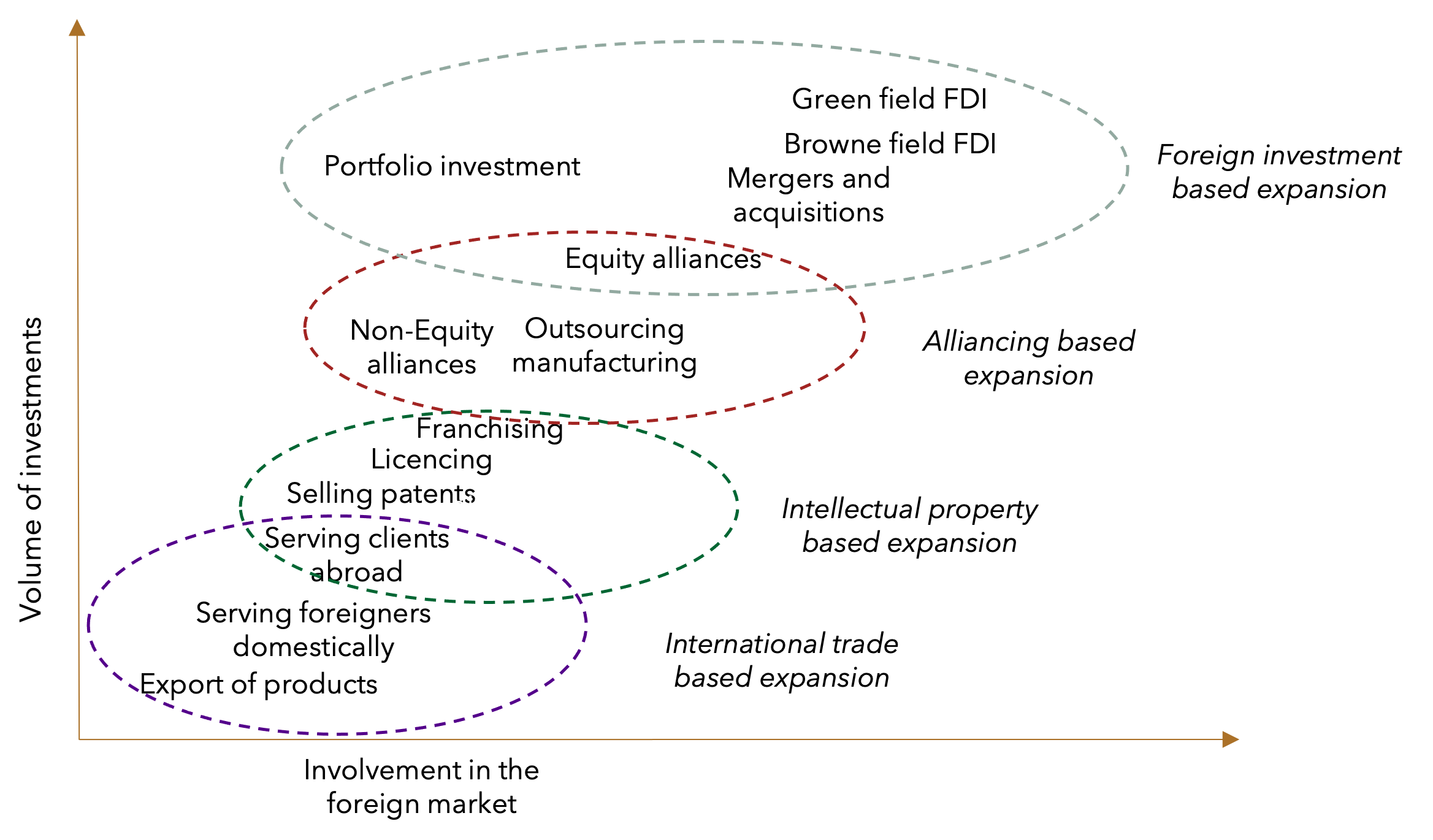
Diversity of international business practices is explained in detail in Part B of this book. Chapters 3 to 6 describe four basic international business types. Dependence of the volume of investments and involvement in the foreign market on the way of international business is presented in Exhibit 7-1 (Benito et al. 2009; García-Álvarez de Perea et al. 2019).
Ex. 7‑1 Dependence of the volume of investments and involvement in the foreign market on the way of international business
Keywords: export, FDI, alliance, franchising
Exporting is not a complex task to commence, as the goods which were being produced for domestic market in general with little adjustments can be sold in another country as well effectively transforming the enterprise into international business. Another type is a business model based on renting or selling intellectual property rights. This type is usually more expensive than the export and requires more time to move from a local business to an international one. The formation of alliances with horizontal or vertical partners abroad is more time-consuming, the costs of creating non-equity alliances are lower than those with equity relations, but in both cases this business type requires long-term commitments. Investing abroad is the most complicated, expensive and time-consuming method of international business, but at the same time it provides the greatest involvement in the foreign market.
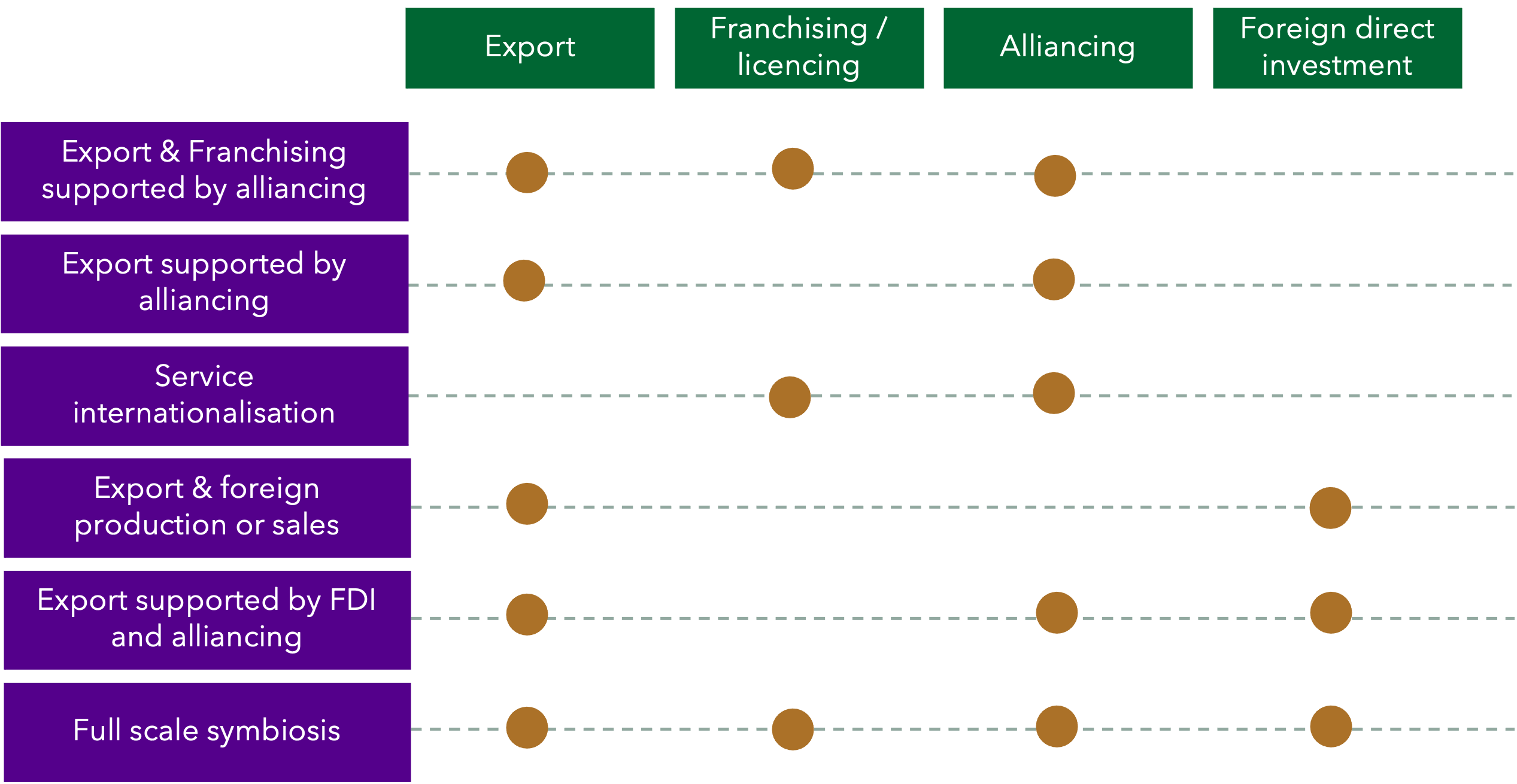
Each method of doing international business may be appropriate in a specific industry and situation. It is very important to note that these four types of doing business are not mutually exclusive and synergies often happens (Exhibit 7-2). Depending on the company’s international vision and operational strategy, the organization can apply several methods simultaneously or in sequence to meet its specific industry or market requirements. For example, a firm which exports goods can be a franchisor at the same time, if a firm delivers abroad to a franchise certain raw materials or equipment. Simultaneously, the franchisor may have an alliance with certain strategic supplier or manufacturer which supplies equipment to a franchisor in in many countries. For example, a restaurant franchisor can sign a strategic long-term alliance agreement with a specific pizza oven manufacturer, and these ovens to be manufactured and distributed exclusively to franchisees worldwide.
Ex. 7‑2 A most common symbiosis of types of business internationalization
Keywords: symbiosis, synergy, internationalization of business
An exporter can produce part of its output in its own country and move part of its production capacity to a country with cheaper labor by investing in the creation of that capacity in that country. Thus, in such cases, its business model is based on both exports and foreign direct investment. Another example can be an international chain of hotels, which in some countries establishes and fully controls its own hotels, but in other countries a decision can be made to carry out expansion using a franchise only. Thus, in this case, FDI and franchise types would be combined.
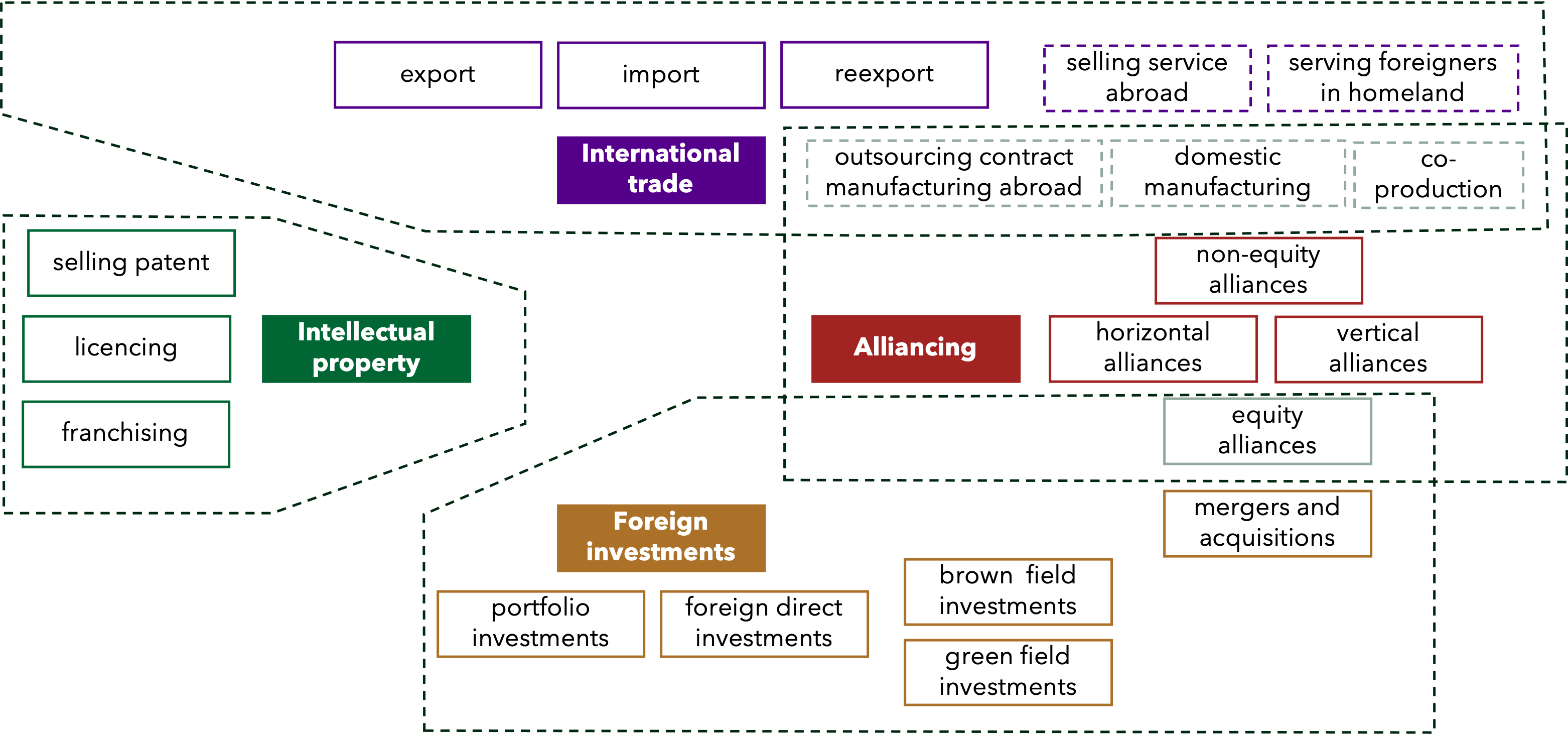
Another important aspect to be highlighted is that there are multiple variations within each of the four types of international business. Variations of each type and subtype of doing international business is presented in exhibit 7-3. When exporting, an exporter can achieve both economies of scale or scope, or scale and scope. Intellectual property business has several variations – franchising, licensing, patent selling, and within each of them there are still possible variations depending on the revenue collection model and the level of involvement and control. Alliances can be horizontal and vertical, equity and non-equity. Foreign investments can be direct or strategic, portfolio, green field or brown field, thus also possible various modifications of mergers and acquisitions. Each of the four types of doing business has its own specific conditions in which it is suitable, and each method entails varying time and expenses.
Thus, if to combine all the variations of these four different types of doing international business, there is 14 ways of doing international business, and if to take into consideration that simultaneously business can be done in multiple ways and their variations, then any could count nearly 50 different ways of doing business.
Ex. 7‑3 Variations of each type of doing international business
Keywords: business internationalization, international trade, FDI, alliance
Various authors group the types of doing international business in their own way, and probably all of them are right in one way or another, because the number of types and subtypes of doing international business is really large, and the attempt to group them into certain categories according to certain criteria is due to the desire to introduce a certain logical structure, which would help to look at whole diversity systematically. In this case, the four types and their variations, which are presented in part B of the book, are like pizza ingredients, all of which are suitable and can be used both individually and in a certain combination with other ingredients. And the taste of the pizza will purely depend on the specific needs and circumstances.
The decision on choosing the type of doing business and which option or combination of options to choose depends on the company’s strategy and vision, but there are still certain limitations that determine which option or combination of options is best (Berry, 2013). These limitations are associated with the company’s financial capabilities, with the company’s brand awareness, with the ability to attract financing. Industry itself plays a crucial role, additionally choices may vary depending on whether business is a service or manufacturing. The following section discusses the specifics of some ways of doing business internationally and focuses on difference of alternatives and possible synergies among them. The intention is do not repeat descriptions, pros and cons of four major types of business internationalization as it is described in chapters 3 to 6 of the book.
Share or comment this information on your social media:
Fundamentals of global business
First edition
For citation:
Jarzemskis A. (2025). Fundamentals of global business, Litibero publishing, 496 p.

Full scope of the book is available in various formats
B.7. Comparison and selection of business internationalization
- Summary of business models for business internationalization
- Export comparison with investment abroad
- Intellectual property internationalization comparison with foreign investment
- Synergies of export and non-equity vertical alliancing
- Variety of foreign manufacturing
- Case of service-based business internationalization
- Important aspect to select the business internationalization model
- Questions for chapter review
- Chapter bibliography
About author
The author has been teaching at several universities since 2005. 40+ scientific publications, 10+ international research projects. More about author.