The period in which globalization emerged has been interpreted in different ways, as one could argue that human history itself is a process leading to globalization. Rodrigue (Rodrigue, 2020) suggests the three main periods into which we can divide the development of globalization are the Ancient and Medieval periods, the modern period, and the post-modern period that followed the World War II (Exhibit 2-1). Held with peers argued that the main stages of globalization are four: pre-modern globalization during 9th-11th century, early modern globalization during 1500-1850, modern globalization during 1850-1945, and contemporary globalization after 1945 (Held, 1999). Globalization is in intense debates among the groups who support it – the hyper-globalists, the sceptics and those who seek alternative solutions – the alter-globalists and to those who strictly reject and deny the process – the anti-globalists (Rodrik, 2011). Globalization is a historical process not only economic but multidimensional phenomena that includes economic, political and environmental dimensions (Baten, 2016). István Benczes characterizes economic globalization as a phenomenon with several inter-connected dimensions, such as the globalization of trade of goods and services; the globalization of financial and capital markets; the globalization of technology and communication and the globalization of production (Benczes, 2014).
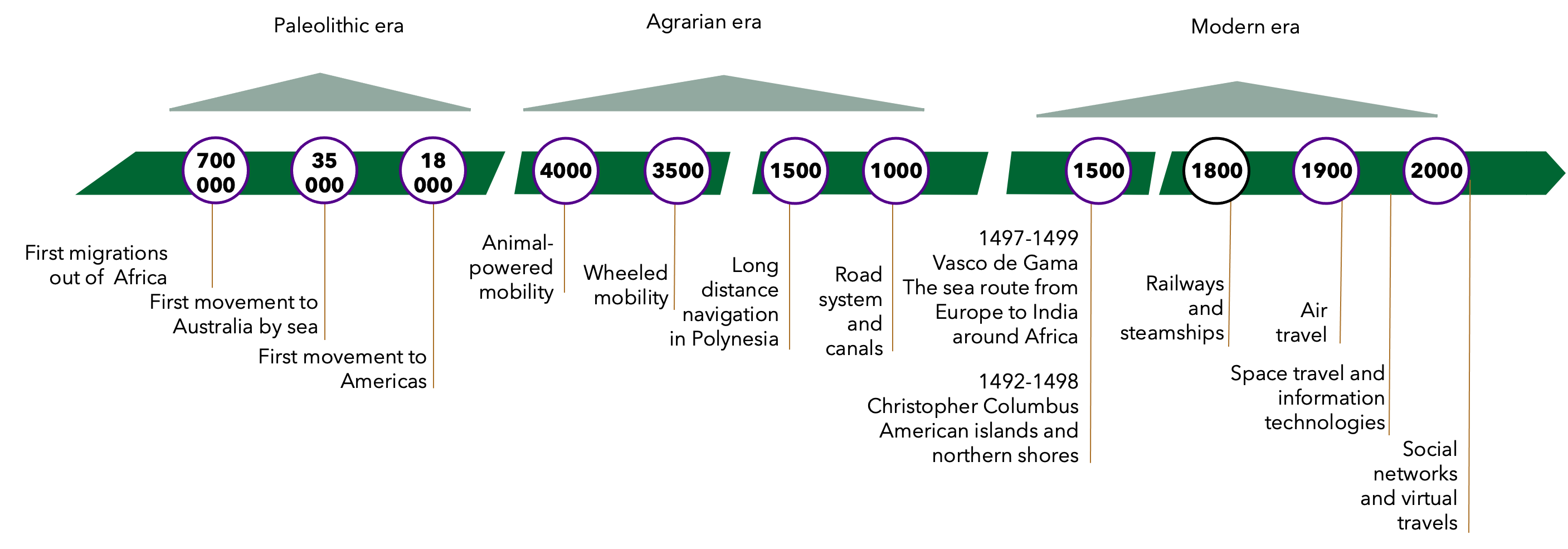
Ex. 2‑1 Human movement in different eras
Keywords: human movement, travel
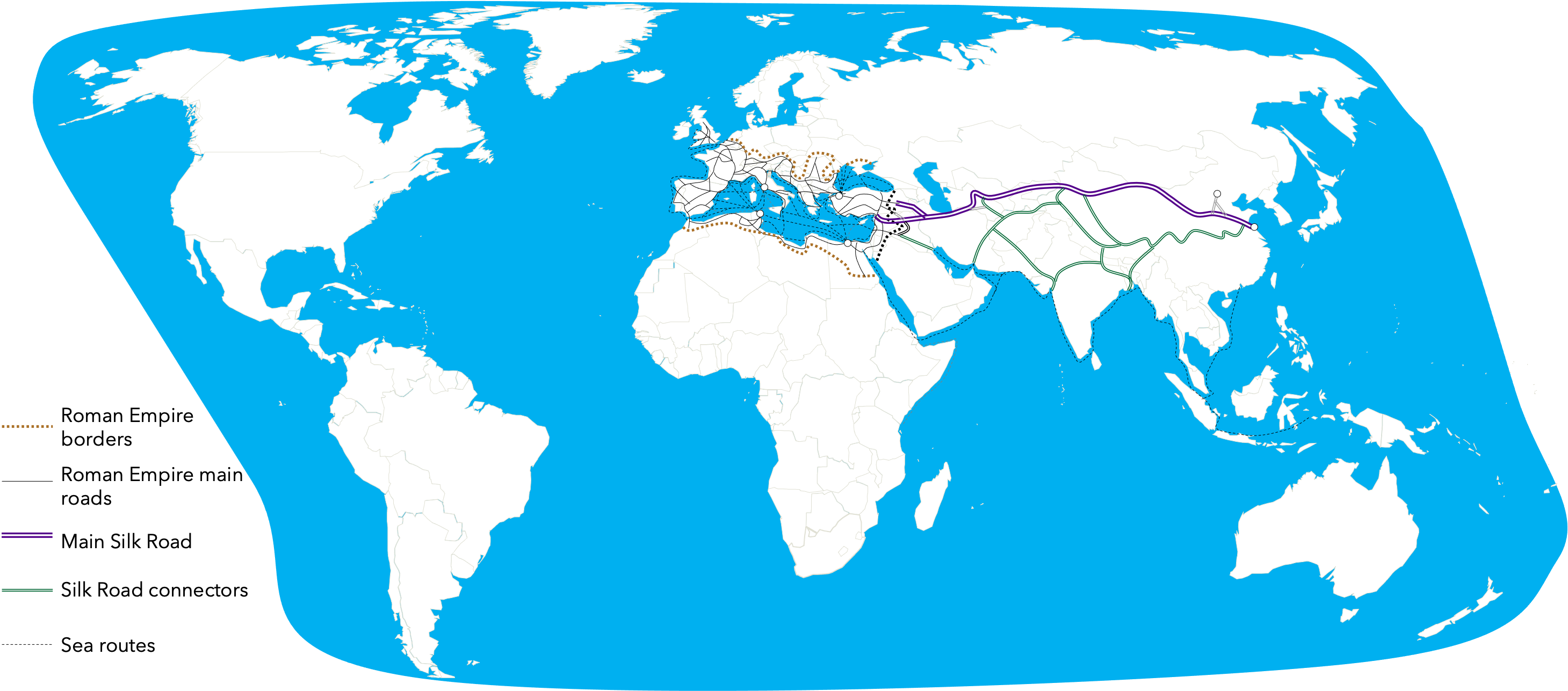
Humans’ first attempts to leave the territory in which they lived, to explore other lands and meet new people date back to the Paleolithic, when the first human migrations from Africa began seven hundred thousand years ago. It reached what is now Australia three hundred and fifty thousand years ago and present-day Americas eighteen thousand years ago. Historians have been able to study and describe these facts, supported by excavations carried out by paleontologists. As humans started acquiring skills to master the instruments and evolved from nomadic hunters to more sedentary farmers, agriculture started picking up pace and began to develop. Around four thousand years ago before common era – BCE, animals such as horses, camels, and elephants began to be used as a means of transport. This enabled faster and more efficient access to distant regions and more efficient transport of materials and goods. The invention of the wheel approximately three and a half thousand-year BCE further accelerated the transport system. It made possible to transport larger quantities of goods over long distances by land. It significantly accelerated the willingness and ability of mankind to trade with each other, even for people far from each other. Animal-drawn carts, rivers, and coastal short-sea vessels were the first means of transport in international trade. The first long-distance seagoing vessels built and deployed in Polynesia in 1500 BCE were the first stirrings of intercontinental trade. To speed up land transport using the wheel, the first roads were built in 1000 BCE (Exhibit 2-2). The first canals were dug to shorten routes by water. The most significant advances took place in the Eurasia (Clarc, 2008). The next major technological leap that accelerated globalization took place in Europe in the late Middle Ages. With the onset of the modern era, the perfection of ship building in the 15th century made it possible for maritime powers to carry out the first expeditions to explore other territories overseas, to discover continents unknown at the time, and to draw the first maps of the world, which presented territories in reasonable detail.
Ex. 2‑2 Silk, Arab trade and the Roman Empire routes
Keywords: Roman empire, Silk road
The development of ocean shipping greatly stimulated international trade with the nations of distant continents. Scientific advances in northern Europe in the early 19th century led to the development of rail transport and steamships. It significantly accelerated the speed and volume of trade. The invention of the internal combustion engine at the end of the 19th century accelerated the frequency of trade by using the already dense network of roads. The development of aviation in the 20th century turned the globe into a global village where people could reach any place in a day. Advances in telecommunications, the creation of the internet at the end of the 20th century, and the emergence of social networks and modern electronic data interchange systems in the 21st century have made it possible to communicate, negotiate and trade across the planet in real time.
Advances in transport and communications technology have driven globalization. The most significant breakthroughs that have accelerated globalization have occurred over the last 100 years. Earlier periods between spikes in technological progress numbered in the tens of millennia. When those periods were long, mankind used to have time to adjust culturally, learning from other peoples, adopting certain traits, and, over time, converging in their attitudes and perceptions of the world. Still, as the periods between the leaps of progress began to shorten, mankind began to run out of time to adapt. The desire to trade, to engage in economic activity, and to obtain the goods that other peoples and countries have to offer and the technological enablers of that brought people closer but have not been able to change their perceptions of the world, their customs, beliefs, attitudes, and values. These differences are still very much reflected in and influence relations between nations today. The differences are manifested in political and religious systems, economic structures of states, legal systems, communication cultures, and attitudes towards money, work, and material values. Part C of the book is devoted to these differences because they have a major impact on global business, and acknowledging these differences is essential for any businessperson or employee of any multinational organization.
The desire to know and use the goods of other countries has always been the driving force behind globalization, but technical and socio-economic constraints and barriers have prevented its full realization. The history of Egypt and Ancient Greece shows the desire and potential of these countries to expand their influence, followed by the creation of empires.
Ex. 2‑3 Stages of globalisation

Keywords: stages of globalisation
The Roman Empire is symbolizing the first attempt by different nations to create a common political and economic system. Imperialist and mercantilist systems were based on the search for new lands and territories, conquest, plunder, and ultimately, trade.
Although long-distance connections were limited, entities such as the Roman Empire, the Mongol Empire, or the Chinese Empire are considered early examples of globalization. The modern era, which began in the 15th century, brought the creation of large colonial empires that spread across the globe. The empires of England, France, Netherlands, Spain, and Portugal are the best examples and manifestations of this form of globalization. Globalization, as it is understood today, took its early form with the emergence of powerful nation-states in Europe, each formally or informally controlling dependent territories on other continents. The industrial revolution that happened later allowed capitalism to expand, especially through mass production and the growth of consumption. Inventions in transport – especially the maritime and railways – greatly increased the capacity and efficiency of international trade (Milward et al., 1973). This process accelerated at the end of the 19th century, especially after Berlin Conference of 1884, which marked the partition of Africa between the colonial powers. Looking at a map of Africa today, we see that national boundaries are not drawn along ethnic cultural lines, nor according to terrain, but in straight lines. So, this period of time can be called the era of colonial capitalism.
The post-modern era is associated with the world after World War II. After that war, globalization took a more distinct form and structure, which is still recognizable in the 21st century. After the World War II, trade liberalization, the creation and growth of multinational corporations, and the increasing returns and benefits of capitalism for the owners of capital, transcending national and continental boundaries, began to develop (Exhibit 2-3).
Organizations that contribute strongly the globalization process are United Nations established in 1945, World bank and International Monetary Fund – both were established in 1944. World bank’s role is to reduce poverty by lending money to the governments of its poorer members to improve their economies and to improve the standard of living of their people. International Monetary Fund work of accelerating the global monetary cooperation and secure financial stability of worlds nations. Members or stakeholders of those organizations are significant majority of all world countries, the total number of which is close to two hundred. In year 1995 was founded World Trade Organization, but half century before that, since 1948 General Agreement on Tariffs and Trade was organization designing and supervising international trading regulations. Chapter 3 describes trade regulations much deeper.
The end of the era of colonial capitalism actually was the end of colonial expansion, but it also strengthened capitalism and maintained trade relations between former colonial powers and their colonies. These trade relations were based mainly on the principles of comparative advantage (see more in Chapter 1) rather than political imperatives. After the World War II, economic blocs began to emerge, which were based mainly on free trade agreements. The collapse of the Soviet Union and the opening of China has led to even greater use of the principles of comparative advantage in world trade. The past three decades have witnessed a rapid tendency toward globalization in the world economy (Salvatore, 2010).
Share or comment this information on your social media:
Fundamentals of global business
First edition
For citation:
Jarzemskis A. (2025). Fundamentals of global business, Litibero publishing, 496 p.

Full scope of the book is available in various formats
A.2 History and trends of business globalisation
- The origins and genesis of globalisation in different eras
- Evolutions and shift of world economic powers and trade
- Evolution of money as unit of exchange
- The first international companies
- Mobility and communication technologies as key enablers of globalisation
- Industrial revolutions
- Differences of international business in Fordism and post-Fordism
- Questions for Chapter Review
- Chapter Bibliography
About author
The author has been teaching at several universities since 2005. 40+ scientific publications, 10+ international research projects. More about author.