Several types of FDI can be distinguished depending on the motivation of the investor (Exhibit 6-5). Natural resource seekers are investors who invest in resource industries in other countries. The best example would be investors who invested in oil and metal mines in foreign countries. Although in the case of international trade between countries, export and import statistics are recorded according to the country of origin or production of the product or raw material, but in fact the exporter may be an organization from another country. For example, if a US capital organization extracts oil in Iraq, although the oil exports are attributed to Iraq, the income for the sold oil is received by the US organizations, after paying the appropriate taxes to the country that operates the oil platform. International companies are sometimes accused of extracting and trading resources from other countries arguing that their own local entrepreneurs could do that and keep profit. However, resource extraction requires large investments, advanced technologies, efficient distribution channels and logistics, and developed relationships with oil refineries, so international organizations often have an advantage over local businesses. Some resource-rich countries even require foreign investors that part of the company’s shares, or even the entire controlling part of the share package, belong to local entrepreneurs who are citizens of that country, or belong to the state. Oil has long been and is one of the most important resources, often called strategic resources. Oil products are used widely in energy, transport, and plastic production. However, with the development of electric cars, there is a need for new chemical elements, such as lithium, are needed for batteries. In this sense, lithium may become the “new oil”, just as oil replaced coal as a strategic resource in the 20th century.
Labor seekers is another type of investors abroad. Human resources are very important in any business in three dimensions – quantity, competence and cost. Access to the human resources of another country is very important for international companies (Tatoglu & Glaister, 1998). Cheaper labor and its abundance in China encouraged Western European and US companies to set up their companies in China in the late 20th century, which essentially led to a mass migration of manufacturing capacity and accelerated globalization, making China one of the world’s leading economies in terms of GDP. Although China’s GDP per capita lags far behind the United States and European countries, it competes with the United States for the first position in the world in terms of total GDP.
The abundance of human resources is also important, because when opening a factory in another country, it is often necessary to find and employ several thousand employees of a certain specialization at the same time. Thus, those countries with a large population become much more attractive to investors. It is not only the population of the country, but also the demographic situation of the region or city in that country, which is equally important. Thus, investors choose not only a country, but also a specific city in which to invest. Some countries are simply too small in population to attract large investors.

Competence of the workforce, education, schools and universities that can train specialists are also important factors in the investor’s decision. Although investors who seek abundant and cheap labor usually set up factories where products or components are assembled, and which usually have enough labor of a medium technological level, semiconductor factories, for example, require higher-skilled workers (Lampón et al. 2017). Therefore, the production of semiconductors is concentrated in those countries where the required number of specialists of the relevant specialization and competence is trained – in Taiwan, Singapore. In such a case, when foreign investment flows into the country only because of cheaper labor and abundance of labor, low value-added industries spread in the country. If the host country gets richer and the living standards of its people rise, eventually wages and prices in that country start rising. Salary growth in the country basically means human resources becoming more expensive. If the reason why the investor came was only the cost of labor, then its increase may force the investor to close the factory in that country and look for a new country for establishing new one factory where the cost of labor is low. A good and recent example of this is the eastern countries of the European Union. After the Baltic countries left the Soviet Union at the end of the 20th century, their standard of living and labor force were many times lower than that of the Western European countries and the United States. The countries received foreign investment, and the main motive was the cost of labor in these countries in the beginning. Over the past 30 years, the country’s standard of living and salary level in Lithuania, Latvia and Estonia have approached the EU averages, which have led some investors to withdraw from these countries. In these Baltic countries, a considerable part of foreign investments was not only in factories but also in service centres – remote IT services, accounting and tax services, call centres. Due to the high cost of labor, some foreign investors, including manufacturers of famous international brands of food products, famous international banks, have moved from Baltic countries their businesses to countries with cheaper labor, to India and other Asian countries.
Investors seeking suppliers. The abundance of local suppliers of specific services, energy resources or component manufacturers is also an important motivator for choosing countries for investment. For example, it is quite important for a car assembler that the main car components supplied regularly and at attractive prices. Although the importance of distance decreases with the development of international logistics (more in part D of the book), a closer located supplier still means lower costs and more resilient supply. The availability and cost of electricity is also an important factor, especially for energy-intensive manufacturers.
Another investment motivation is based on the desire to be closer to the buyers’ market. For certain products with a short life span, such as food products, it is very important for the manufacturer to shorten the supply chain. International organizations invest in production capacity in other countries to serve that country’s market. Here, market size is one of the most important criteria. However, there is another aspect that is associated with the circumvention of import restrictions. If a country restricts imports with tariffs or non-tariff barriers, in that case, a better solution for an international organization is to open a factory in that particular country and sell its own products, which will already be considered local products and not as imported goods. Such an action was carried out by Japanese car manufacturers when the USA applied measures to limit the import of Japanese cars in the second half of the 20th century.
Investors seeking a logistical efficiency. For international organizations that serve the markets of many countries around the world, the efficiency of the distribution of their products is very important. Having a factory near a port with direct shipping to major distribution centres or having a factory near an airport from which cargo is transported by air to other distribution centres is very attractive because of the reduction of logistics costs and the reduction of delivery time. For this reason, port cities receive the largest investment in China. International companies even set up their distribution warehouses in certain countries, near major seaports and airports, just for logistical efficiency.
Investors seeking strategic assets and competitiveness. Some investors are unable to create or master a strategically important resource for them, such as technology, purchase an organization that has that resource. It is not uncommon for a competitor’s organization to be acquired, so this motive often has even a double benefit. Market concentration and monopolies are often limited by national legislation in m any countries. There are antitrust laws in the United States and the European Union that prohibit companies to merge or acquiring each other if they significantly dominate the market. The percentage of significance varies from country to country, but governments aim to maintain competition in the market. Unfortunately, it is difficult for governments to do the same on a global scale, because in the absence of a global agreement between countries and a unified legal and legal supervision system, basically nothing prevents corporations from acquiring companies with strategic assets, acquiring competitors and not only dominating the world in a certain industry, but almost to be a monopolist.
Although there has been a lot of discussion about the benefits and motives for organizations to invest in other countries, they were systematized by John Harry Dunning in 1979, and his theory is also known as the eclectic OLI theory, its name has been derived from the three words – Ownership, Location, Internalization (Dunning, 1993, 2001, 2006; Dunning & Lundan 2008).
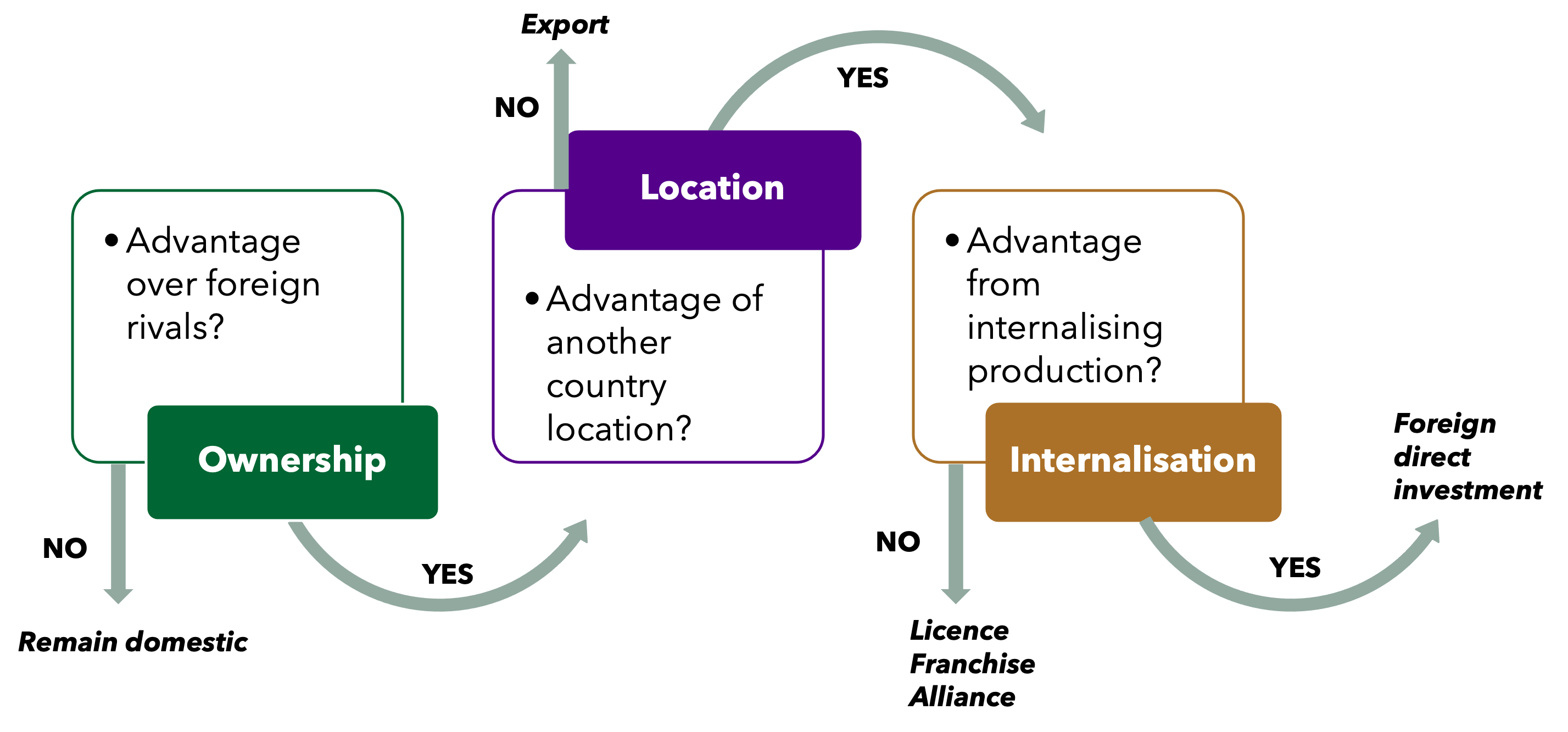
OLI theory is based on a consistent answer to three questions (Exhibit 6-6). The first question is concerning an advantage of one’s own product, service, and process or production method over foreign competitors. If there is no advantage, it is recommended to stay in the domestic market and strengthen position there. If there is an advantage, then the question of location is raised. If there are no reasons why doing business in another country gives a competitive advantage over competitors, then it is best to manufacture domestically and export. If being in another country provides an advantage, and then the question of internalization arises. If there are no reasons to carry out activities within own organization, then it is better to lease a license, sell franchise, or even enter an alliance for contract manufacturing or and fully control distribution and retail partners. If there are reasons to carry out the production, distribution or sales activity independently, then the method of direct foreign investment should be considered (Lundan, 2010).
Proprietary gives organizations the ability to control and protect their knowledge, technology and brands (You & Katayama, 2005). Thus, companies carry out scientific research, technological development projects, and inventions in their own countries, but they use the already created knowledge in production in other countries.
Thus, the protection of knowledge against theft becomes a very important instrument to protect against competitors who, after copying the technology, can offer the market an analogous product only at a lower price. So instead of outsourcing production to an independent manufacturer in China, a so-called contract manufacturer, organizations often set up their own capital factories in China. It is believed that full control of capital ensures all procedures and standards, respectively, in hiring personnel, implementing information and physical security systems, thus the probability of theft of intellectual property is reduced. Of course, a competitor can buy a product, tear it apart and make a similar one, but there are often small details hidden in the manufacturing process that have a major impact on the quality and functionality of the product, which is much more difficult to copy unless organization have access to the manufacturing process.
Foreign direct investment ensure control to prevent leaking and illegally copying technologies and know-how abroad. The term industrial espionage is due to the prevalence of this phenomenon. So even when investing in another country, the local legislation and law enforcement approach to intellectual property protection is still very important.
Ex. 6‑6 Dunning’s OLI paradigm
Keywords: OLI, ownership, internalisation, location
Source: (Dunning, 1977)
Location advantage in OLI theory is based on market size, resource costs and business climate. Market size is understood here as population, income per capita. Resource costs are mainly determined by the price of labor as well as the prices and availability of natural and energy resources in that country. The business climate is understood as the level of protection of property rights, intellectual property, corruption, application of the rule of law principle, labor and profit taxation, environmental standards. For example, a country with high environmental standards may not be attractive to the investor, because some activities in that country may be restricted, or their performance will require huge additional investments for environmental protection – for example, filters, cleaning agents, CO2 and other pollutant collection systems, etc. All this increases production costs, so it is not uncommon for foreign direct investment to choose countries that are less demanding in terms of pollution or CO2 emissions and other standards. The advantage of internalization is based on the benefits of economies of scale and efficiency gains by moving the largest mass production processes to countries where the resources to perform these processes are most abundant and cheapest.
The benefits and motivations for portfolio investment are much simpler and narrower. The main motivation behind international portfolio investments is to earn higher returns abroad, to what can be obtained domestically. Thus, residents of one country buy bonds or shares of organizations in another country if the return is higher in that domestically. Everyone should pay attention to the fact that as this type of investment increases in the world, in the long run, the difference in investment returns between the investing and investment receiving countries disappear and the factor equalization law is triggered as it is discussed in chapter 1 of the book.
This motive is associated both with the current return on investment, but not the least important are the expectations and confidence of investors. Residents of one country seek to purchase shares in a corporation of another country if they believe that the foreign corporation’s future profitability will be higher than that of domestic corporations.
Another motive is related to risk diversification and uncertainty. After all, no one really knows which corporation will do well and which will not. Diversification allows organizations to reduce risk, because if unfavorable situation arises in one country and the return on investors’ shares decreases there, it is likely that the return will increase in some other country, and thus the investor will compensate for unexpected losses in one country by unexpected gains in another country. According to the theory of probability, as the number of trials increases, the overall result always approaches the average, so, it encourages a fairly wide diversification of investments in different foreign countries and markets.
Dunning’s OLI basic construct is expanded by including defined asset-specific “Oa” advantages, transaction cost-minimizing “Ot” advantages, and finally institutional “Oi” advantages. Actually, there is important to mention, that in this area still exists a competing trend of concepts, i.e. primarily to the theory of Hwy-Chang Moon and Thomas W. Roehl on asset/competence-exploiting orientation vs. asset/competence creating or augmenting orientation (Moon & Roehl, 1993, 2001).
Share or comment this information on your social media:
Fundamentals of global business
First edition
For citation:
Jarzemskis A. (2025). Fundamentals of global business, Litibero publishing, 496 p.

Full scope of the book is available in various formats
B.6. Foreign investments
- International resource movements
- Foreign direct investments
- Foreign portfolio investments
- Pros and cons for investing abroad
- Incoming foreign investments
- Management and design of foreign investments
- Attraction of foreign investments and free economic zones
- Mergers and acquisitions
- Questions for chapter review
- Chapter bibliography
About author
The author has been teaching at several universities since 2005. 40+ scientific publications, 10+ international research projects. More about author.