The sections before describing a rather wide variety of cultural dimensions. Various authors partially overlapped, partially complemented each other and formed a strong theoretical classification of differences. Various researchers began to attribute the manifestation of a specific cultural dimension to a specific country and to group countries into clusters. There is no unified classification of countries by strictly divided cultural clusters in the literature. For instance, Ajami divided the countries into six cultural clusters (Ajami & Goddard, 2014):
- Nordic countries – Denmark, Finland, Norway, Sweden.
- Germanic countries – Germany, Austria, Switzerland.
- Anglo cluster countries – Australia, Canada, USA, UK, Ireland, South Africa Republic.
- Latin American countries – Argentina, Chile, Colombia, Mexico, Peru.
- Arab countries – Saudi Arabia, Bahrain, Kuwait, Oman.
- East Asian countries – China, Hong Kong, Indonesia, Philippines.
In addition to these six clusters, it is also worth distinguishing such additional clusters as:
- Central-Eastern Europe, countries such as Lithuania, Latvia, Estonia, Poland, Hungary, Czech Republic, Slovakia.
- East Europe-Asian countries in Far-Eastern Europe and Middle Asia including Russia, Belarus, Ukraine and post-Soviet Muslim countries such as Kazakhstan, Tajikistan, Uzbekistan, Kirgizstan, Azerbaijan, Turkmenistan.
- Southern Europe, sometimes called Latin Europe by American scientists – Italy, Spain, Greece, Romania, Bulgaria, France, Balkan countries.
- African countries, which differences are not researched enough.
Ex. 9‑8 Cultural clusters mapping

Keywords: cultural cluster, anglo, germanic
Regarding the cultural clusters of countries, it is important to mention that even countries located in the same region can have quite different social structures (Exhibit 9-8). For example, people in South America do not have exactly the same values, attitudes, traditions and behavior patterns. After the Spanish and Portuguese conquests in South America in the 16th century, few indigenous populations remained. In countries where there were mountains, the natives hid from the invaders in the mountains, and in those countries, there remained a part of the population that is native to South America – for example, Peru. In Argentina, the largest part of the population consists of emigrants from Spain, as well as France and Germany. Therefore, it can be said that Argentina can be considered the most similar to Europe in terms of its cultural dimensions. In Brazil, where the land was fertile and labor was needed, the Portuguese enslaved millions of people captured in Africa and brought them to work on cotton plantations. Thus, today’s Brazil is closer to African nations in its cultural dimensions. In North America, the United States and Canada also have few indigenous populations left. In the USA, there are mainly immigrants from European countries such as England, Ireland, and a large diaspora of Italians, Germans, Dutch, and Poles. Even individual cities in the United States are characterized by the dominance of certain Diasporas. To the United States, as well as to Brazil, European colonists brought a lot of labor from Africa, especially to the southern states, where labor was needed for the cotton growing industry. Black descendants make up a fairly large portion of the US population today.
Australia is very strongly influenced by Anglo cluster culture, as the majority of its population are expatriates from the United Kingdom. In Europe, most of nations formed nation-states and are formed of population who lived there before 15th-16th centuries. However, immigrants also do influence, in France, Belgium there are many immigrants from Africa, the former colonies of these countries, in the United Kingdom there are many people whose parents or ancestors came from Pakistan, India. During World War II Germany lost a lot of working age men and became quite open to immigration from Turkey, so Turkish Diasporas can be found there.
India and China, the most populous, remained the least affected by European colonists, although the English language and culture are relatively common in India, and English language teaching is included in the school education. China is very little influenced by outside cultures, but many Chinese have emigrated to the United States, some European countries. In some cities in the United States, anyone can find so-called Chinatowns – entire urban areas populated by Chinese. Although migration and integration policies strongly unify people of different ethnic and national groups living in the same country, cultural inertia is still quite high, and when people live in closed diasporas, cultural identity, values, traditions, attitudes and ultimately behavior remain unchanged.
Very strong individualism and moderate egalitarianism dominates in countries belonging to the Anglo cultural cluster. These people avoid uncertainty, they are rather frugal and careful with time, they are very punctual, focus on doing one specific job at a time, and give high priority to mastery and quality of work.
The set of these characteristics is strengthened by the Protestant religion, which considers work as one of the values and even goals of human life. The countries of this cultural cluster are successful in the field of doing business; many great scientists and creators were born or educated in those countries. Most of the multinational organizations originate from the countries of this cultural cluster. The dominance of this cultural cluster in international business and science has determined that English is considered the international language in business and science in the 20th and 21st centuries, and the standards of behavior and business processes created by the English are often considered international. At the same time, the countries of this cultural cluster have the greatest military power, the latest military technologies; their significance is very high in the world to maintain the established order and rules that other nations follow. The USA representing Anglo cultural cluster, became stronger in the global economy in the 20th century, and after the World War II devastated Europe, the USA is the unequivocally economically strongest country in the entire cultural cluster.
The Arab cultural cluster is characterized by a very strong hierarchy and a very collectivist society. Unlike the English cluster, Arabs are more oriented towards harmony than harmony and process quality, and relationships are valued much more than rules. If in the Anglo cluster culture, it is acceptable to go straight to the point at a business meeting and talk about the details of business deal immediately, saving each other’s time, then in the Arab cluster, people first get to know each other, spend a lot of time together, and only with a sufficient degree of familiarity and mutual trust they get into agreement. In Arab culture, who to do business with is much more important than what business to do. This is largely due to tradition, but a significant reason is a preconceived distrust of strangers. When going to the first business meeting with potential partner of the Arab cluster, it is hard to expect to sign a business deal right away.
Arabs are characterized as polychronic in their approach to time, they can work on several different jobs at the same time and are quite unpunctual. To people of the English cultural cluster, this Arab behavior may appear disrespectful and a waste of time, but it is an Arab tradition to take a time. The countries of the Arab cluster became very rich, when the need for oil began to increase due to the development of industry and transport technologies in the world. Oil is still one of the most demanded energy products today, and the countries of the Arab cluster have the largest reserves of this raw material and are among the largest exporters of oil. Due to their strict hierarchical structures, the very strong influence of the Muslim religion, the Arab countries were able to become very rich in a relatively short period of time in the 20th century. Oil companies are owned by local Arabs, the involvement of foreigners in this business is limited. Arab states are essentially monarchical autocracies, states are ruled by families, and the ruler’s throne is passed down to an heir. However, the leaders of these countries ensure that the accumulated wealth for oil export can be used by the local population. Saudi Arabia, the United Arab Emirates, and Qatar are countries that have built peaceful cities, even surpassing the USA or Western European cities in terms of cleanness, architecture and modern skyscrapers. Today, Dubai, Doha, Abu Dhabi are considered to be one of the most beautiful, safest, most expensive and richest cities that tourists rush to visit, and a lot of rich businesspeople of the world seek to purchase real estate in these cities. Arabs also strive to look modern, to impress Western European and American politicians and businesspeople. For example, Qatar won the right to host the World Cup in 2022. In preparation for the World Cup, football stadiums, sports complexes and luxury hotels were built there, and Qatar spent over 200 billion US dollars on all of this. However, the labor force for these huge constructions was brought in, short-term immigrants from various countries worked. After the World Cup, much of this infrastructure remained unused. However, the Arabs seek to adopt many values that they consider positive from the United States and Western Europe – sports, skyscrapers, luxury, huge airports. The aim is for the airport-cities of Arabic cluster to become transit point connecting the “East” and the “West”. Affluent guests are lured by the top-class luxury golf courses. Despite these “Western” attributes, Arabs remain very conservative in matters of religion, women’s rights, alcohol restrictions, and the freedoms for the LGBT community or transgenderizm.
Nordic countries – Finland, Sweden, Norway, and Denmark have very specific cultural dimensions, which are based on the so-called “Nordic” or “Scandinavian” values. These are very strongly egalitarian countries that have a hard time tolerating hierarchy in society and business. Human equality, women’s rights, the rights of the LGBT community, the freedom of free expression of thought are what originate from the Scandinavian countries and continue to be developed in the world. Radical egalitarianism can even be observed in Scandinavian countries. For example, letting a woman go through the door first, which is considered the norm in many other cultural clusters, can cause a great scandal and in the Scandinavian country, it can even be called harassment. Scandinavians are very rule-oriented; they absolutely do not tolerate uncertainty, while they do not pay much attention to relationships between people. However, in the relationship with the environment, Scandinavians continue to strive for harmony, especially in the field of sustainability, nature conservation, and pollution reduction. Scandinavia has a dominant individualistic culture and values, although at the same time it has introduced a socialist model of state governance, very high taxes and a fairly even distribution of wealth among members of society. In the Scandinavian countries, the gap between the highest and lowest earners is one of the smallest in the world.
The post-Soviet countries of Eastern Europe are quite heterogeneous, and their behavior varies. After the World War II, countries in the zone of former Russian influence had a great and forced influence of Russian culture and behavioral patterns, but in 1990 many countries freed themselves from Russian influence and went culturally on different paths. For example, the Baltic countries regained their sovereignty as it was before the World War II. Lithuania, Latvia, and Estonia at the end of the 20th century and in the 21st century experienced a very strong influence of Scandinavian culture due to trade relations with Finland and Sweden. In these countries, Scandinavian banks and brands began to dominate very strongly, and Scandinavian architecture and lifestyle began to develop. The hierarchical structure of society and business, which was dominated by Russian influence, began to become more egalitarian, similar to that of Scandinavia. The collectivist society that existed for many years before the Russian influence gradually became more individualistic. The representatives of this cultural cluster maintained the monochrome use and valuation of time and further strengthened the business organization model focused on excellence and quality. However, relations between people have remained more relationship-based and tolerant to uncertainty, although the Scandinavian influence has pushed the cultural cluster towards a rule-based society.
The Baltic countries are a very good example of how culture influenced by external factors can change when the political and economic structure of the state changes. The transition from a planned economy to a market economy, from Soviet authoritarianism to liberal democracy managed to change the cultural dimensions of the three countries in thirty years. Those who visited these countries in the last decade of the 20th century and the third decade of the 21st century very often express surprise at the radically changed society. It can be said that it took one generation to change the behavior and to form a different society.
Other Eastern European countries also experienced the influence of the Soviet Union after the World War II, but they were not occupied and included in the composition of the Soviet Union, as Lithuania, Latvia and Estonia were. Although countries such as Poland, the Czech Republic, Slovakia, and Hungary retained their political sovereignty from Moscow’s regime, the Soviet influence was enormous in shaping these countries in the direction of a planned economy and in order to destroy the structures of capitalism in them. These countries did not experience the influence of Scandinavian culture after the collapse of the Soviet Union and retained their own cultural dimensions.
The countries of the Germanic cluster – Austria, Germany, and Switzerland – have a lot of similarities with the Anglo cluster. It is an egalitarian culture, with strongly expressed individualism, monochronic behavior, punctuality, adherence to rules, and pursuit of excellence and quality. Countries in this cluster are considered global leaders in engineering and natural sciences. Germany has been famous for its automobile industry since the 20th century, Switzerland for watches, pharmaceuticals, and this is a consequence of the cultural combination of dimensions that prevails in the cluster.
The countries of the Anglo-Germanic cluster were those in which the industrial revolution and industrialization were first implemented and led to the growth of the economic and military potential of these countries. In the 18th and 19th centuries, the countries of this cluster were far behind the rest of the world in terms of gross domestic product. In these countries, as well as in Scandinavia, a very strong middle class has formed, which allows us to combine egalitarian culture with individualism. In business in these clusters, the professionalism and excellence of each employee is highly valued and rewarded, which allows workers and middle managers in these countries to earn one of the highest salaries compared to countries in other cultural clusters.
The cultural cluster of southern Europe, which is called Latin Europe, is also sometimes called the Mediterranean cultural cluster. The southern European cluster includes Spain, Portugal, Italy, Greece, and the southern part of France is fundamentally different from the northern European, English and Germanic clusters, as they are dominated by collectivist culture. In Southern Europe, uncertainty is much better tolerated, relationships between people are often seen as more important than rules, and time is viewed without stress and haste. In the structure of society and business, there is significantly more hierarchy, and greater wage differences between managers and workers than in the Anglo, Germanic and Scandinavian cultural clusters.
The Asian cultural cluster includes India, China, Japan, and other East and South Asian countries. In Asia, societies are characterized by a relatively strong hierarchical structure. This is also reflected in business. Very clear and strict subordinate relations exist in many companies, subordinates obey the management unconditionally, show respect to the management. Career progression is mostly done within the same organization, showing loyalty and faithfulness towards the manager and the organization are highly valued.
To encourage lower-level employees to get involved in making suggestions for improving the work process, the Lean management system and the special technique Kaizen were invented in Japan. Kaizen means constant improvement, according to this system, employees get the opportunity to give suggestions for improvement into a box in a written form or write them on sticky notes and stick them on a special board. The reluctance to go against the boss and to express an opposing opinion is a rather strongly encouraged culture of writing, and due to which Kaizen method has become popular not only in Asia but also beyond Asia, and it has also been adopted by businesses in other countries. As careers are mostly made within the same organization, due to which the age of a chief executive officer is relatively old in Asian organizations compared to the rest of the world.
Social relations in the Asian cultural cluster are highly collectivistic. Community values, goals, and benefits are above to personal ones. Many employees work selflessly for their organization, and it is common to work overtime. In some Asian countries, workers are even provided with a nap room. In a common company, an employee does not dare to leave work before his manager.
This collectivist way of social relations has greatly contributed to the fact that Asian countries have become very attractive to investors from Western Europe and the United States, because workers in those countries agree to work a lot, for a relatively small salary, and work and sacrifice for the organization is considered a great value. On the other hand, it created opportunities for abuse, in Asian countries, companies are sometimes condemned for exploiting employees, in rare cases even for exploitative child labor. Still, India and China, with 1.4 billion people each, are home to more than a third of the world’s population, and when to add countries like Pakistan with 231 million inhabitants, Bangladesh with 170 million, Vietnam with 97 million and other Asian countries, the population is approaching 3.5 billion, out of a total world’s population of 8 billion. It is no coincidence that many objects, clothes, furniture, electronics and other products are made or assembled precisely in the countries of the Asian cultural cluster. The tendency to work hard is also associated with prevailing religious attitudes, for example Confucianism in China considers work as very important factor that makes human life meaningful. However, it must be recognized that people in the Asian cultural cluster agree to work a lot and hard because they have no other choice. Due to the very large population, the demand and supply of labor force in this cultural cluster is at the disadvantage of the employees, so the bargaining positions towards the employers are very weak, and the legal systems of the countries in this cultural cluster provide relatively low standards and requirements regarding the balance of work and rest. Due to highly developed collectivism, the Asian cultural cluster maintains a very strong bond between family members. For this reason, many family businesses dominate. Many relatives often work in organizations; parents employ their children who have just grown up.
The Latin American cluster includes the countries of South and Central America. All countries have quite different history and cultural roots, the influence of European colonizers manifested itself in different ways. In most of the countries in this cultural cluster, Spanish is the official language. That’s almost 500 million people in this cultural cluster who consider Spanish as their first language. 215 million people in this cultural cluster, namely Brazil, speak Portuguese as their mother tongue. The influence of Spanish and Portuguese culture on this cultural cluster’s values was enormous. Some countries located in the Andes have partially retained their original roots. It was quite difficult for the conquerors from Europe to exterminate the natives in the mountains. In the lower altitudes, the local population almost did not remain after the European invasion in the 15th-16th centuries. So, countries in the plains are mostly from immigrants from Europe. Meanwhile, in Brazil, Europeans imported millions of slaves from Africa due to the need to work in the agricultural sector, which explains why there are many cultural differences between the largest economies in South America, Brazil and Argentina. Due to the influence of Southern Europeans, the dimensions of the Latin American cultural cluster manifest themselves very similarly to those of the Southern European cultural cluster. Thus, in Latin America, uncertainty is much better tolerated, relationships between people are often valued as more important than rules, and time is viewed without stress and haste. In the structure of society and business, there is significantly more hierarchy, greater differences in wages between managers and workers. Society is very collectivist, people value family, belonging to a social group, group values are considered higher than individual values.
However, if we compare collectivism in Latin America and Southern Europe with Asian countries, collectivism is much more prevalent in Asia than in Southern Europe and South America.
The African cultural cluster is perhaps the most diverse. It was only in the second decade of the twenty-first century that the attention and investments of global corporations in African countries began to accelerate. Due to different economic development, due to different literacy, these countries have different potential to attract foreign investments, create infrastructure and develop. In many African countries, the political situation is not stable, there are often armed clashes and conflicts between by local ethnic groups.
Some African countries are considered insecure due to rampant crime and paramilitary groups. Europeans greatly influenced the African cultural cluster, but this influence was different than in South America. If many Europeans migrated to South America and formed local populations, this did not happen in Africa. If to look at the political map of Africa, there are the borders of many countries drawn as a straight line by those who divided continent into artificial territories which are actually states now.
The colonization and partition of Africa was carried out by Belgium, France, the British Empire, Spain, Portugal, Italy and Germany over much of the African continent during the short period between 1881 and 1914. 1870 Europeans formally controlled 10 percent of the African continent, and almost 90 percent in 1914. The beginning of the division of Africa is generally considered to be in 1884, during so called Berlin Conference that regulated European colonization and trade in Africa. France dominated the colonization of North-West Africa, the British – North-East and South, Belgium the central part. European nations divided Africa into states without following the ethnic-cultural criteria of the local population, so often the territory inhabited by the same tribe was divided in a straight line into two parts and ended up in different states.
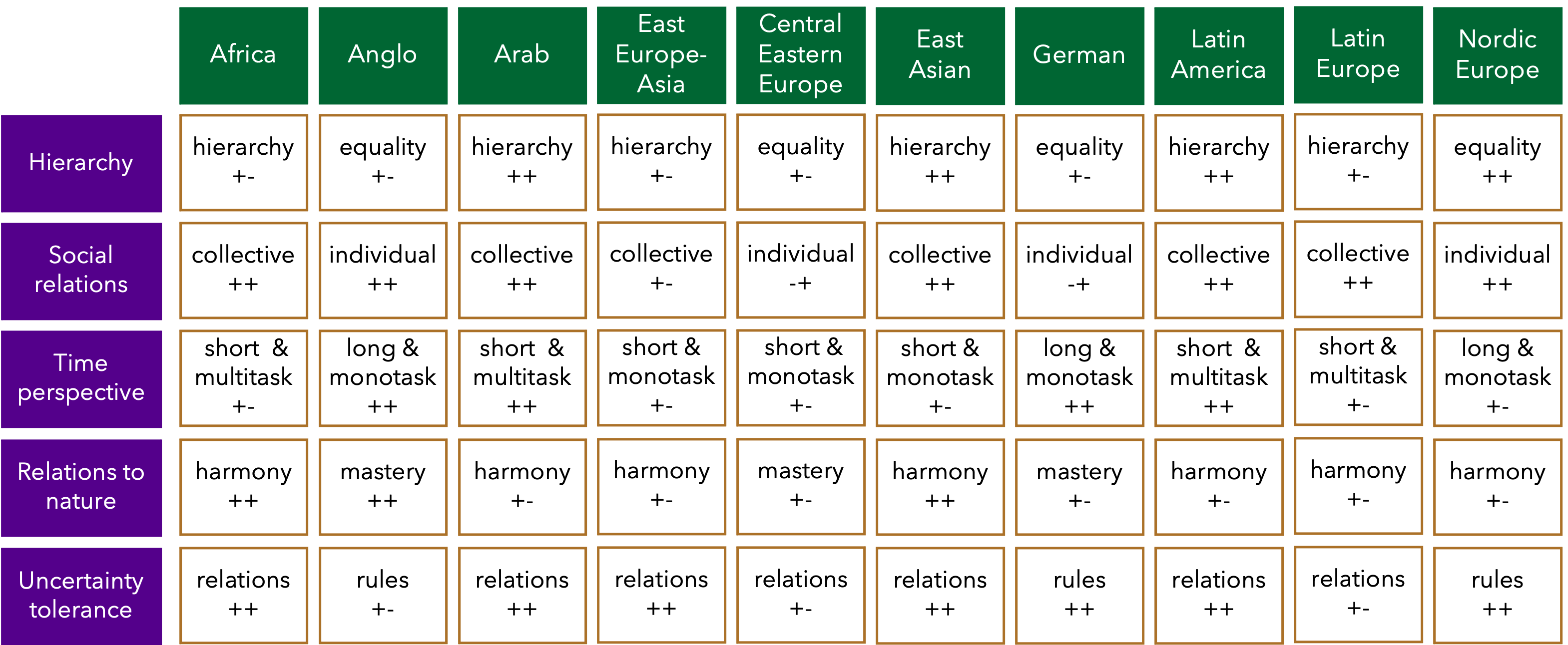
Ex. 9‑9 . Cultural clusters’ attributes
Keywords: cultural cluster, cultural dimension
Tribes living in the same countries and not necessarily getting along well were united. Thus, these 150-year-old events greatly determined the current political, economic and cultural situation on the African continent. Thus, the attempt to define Africa as a homogenous cultural cluster is challenging and always subject to criticism. However, in the African cultural cluster one can see a very strongly expressed collectivism, similar to the Asian cultural cluster, a very high orientation towards harmony in the relationship with the environment, highly valued relationships between people and little attention to things like rules, mastery and the pursuit of quality. Societies in Africa are quite hierarchical, authority is valued and respected, and respect is shown very strongly to older people.
In the time dimension, the people of this cultural cluster are similar to the South American and European clusters, the value of time is not high, planning is short-term and very uncertain. People of this cultural cluster are comfortable with uncertainty. Strictness, punctuality and rules are not acceptable there. Attributes of all described above cultural clusters are summarized in the exhibit 9-9.
Share or comment this information on your social media:
Fundamentals of global business
First edition
For citation:
Jarzemskis A. (2025). Fundamentals of global business, Litibero publishing, 496 p.

Full scope of the book is available in various formats
C.9. Theories and elements of cross-cultural business environment
- Culture and behavior relations
- Cultural dimension by Hall
- Cultural dimension by Hofstede
- Cultural clusters by Trompenaars
- Cultural dimension by Kluckhohn and Strodtbeck
- Variety of cultural clusters and its impact on business
- Cross cultural differences in business processes
- Questions for chapter review
- Chapter bibliography
About author
The author has been teaching at several universities since 2005. 40+ scientific publications, 10+ international research projects. More about author.