Before the use of containers, cargo used to be loaded onto ships in boxes, bags, and barrels. Loading the ship was very time consuming and labor intensive. At the beginning of the 20th century, the search for ways to reduce the need for labor and mechanize the loading of ships began. The first containers were used in 1920. Containerization gained a wider scale since 1963, when the US organization Sea Land opened a shipping line between Baltimore and Puerto Rico. The line was launched successfully with two ships, Mobil and New Orleans. The successful start led to the construction of the first container terminal in Baltimore. The pioneer of containers is Malcom McLean, who created the design of the first containers and in 1956 docked one of his own ships. The indisputable convenience of door-to-door container transportation has resulted in ship manufacturers, ports, loading equipment manufacturers, railway and road vehicle manufacturers, railway companies, road carriers and other participants in the transport system gradually adapting to serving containers (Bernhofen et al., 2016). New methods of cargo flow management and service have been developed.
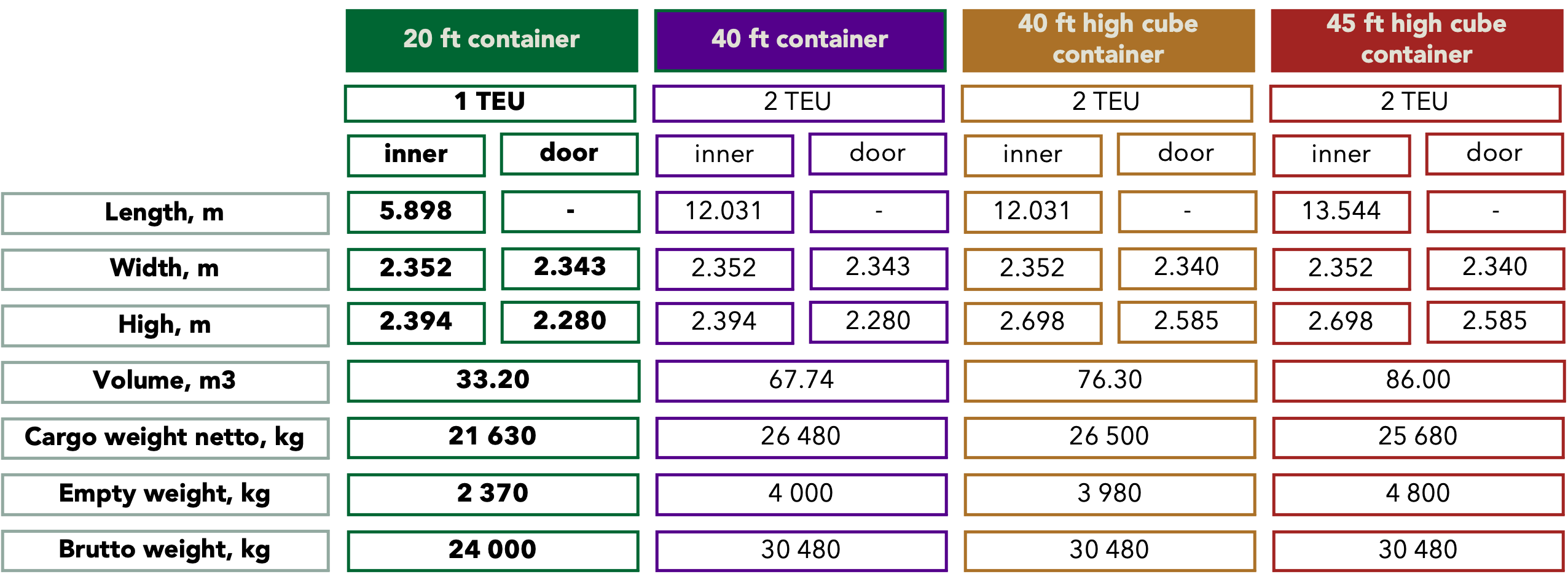
A container is a reusable steel box, designed in such a way that it is convenient to load, unload and reload cargo. Container doors are locked and can be sealed to prevent cargo theft. The container’s size, strength and self-loading capabilities are strictly standardized. The first official container standard, accepted and defined in 1965 by the International Standards Organization (ISO), was based on the previous American standard. In the US, 20-foot and 40-foot-long containers were used. ISO standards for containers were approved on this basis. The most widely known ISO standards are ISO 1496 and ISO 668. About 17 million containers are currently used in the world. From 2010 to 2020, this number doubled. Only a few percent of all containers do not meet ISO standards. The most used are 20-foot and 40-foot containers (Exhibit 14-16).
In the USA, 40-foot containers of higher volume, the so-called high cube containers, are increasingly used. Their height is increased by 30 centimeters, i.e. about 13 percent. The area and length remain the same than the standard 40”. Due to the increased mass of the tare, it is feasible to carry a smaller weight of cargo, although the loading volume is larger. Ideal for transporting lightweight but bulky cargo. The reason for the expected increased market share of high cube is the tendency of load capacity to “cube-out” before “weighing-out” when filling a container, so that a very small share of total containers is effectively fully loaded by weight. The limitation of it is that stacking 30 centimeters of goods on top of the existing amount is not always possible, due to material resistance and the size of shipment units. The capacity of 20-foot ISO containers is half that of a 40-foot container, but due to its lighter tare weight, the allowable loading mass is even slightly greater than that of a 40-foot container. 20-foot container perfect for transporting relatively heavy but less space-consuming cargo (Bohlman, 2001).
To simplify the accounting and statistics of cargo transported in containers a decision was made to include the count of transported or reloaded containers in addition to measuring tons, to add the number of. Since containers are of various sizes as a benchmark and unit for calculation a 20-foot ISO container was chosen, the unit of which is named as TEU – Twenty Foot Container Equivalent Unit. In this case, one forty-foot container is counted as two TEU. Based on the number of TEUs served, official container flow statistics are kept, as well as terminal equipment capacities or container ship capacities are calculated. For port statistics, each time one TEU is loaded or unloaded, it is counting as one TEU movement. Therefore, as an example, an unloading of 1,000 TEUs followed by a loading of 1,000 TEUs during a container vessel port call, gives a port statistics result of 2,000 TEUs, while the container vessel capacity impacted is only 1,000 TEUs.
The structural strength of ISO containers is calculated to withstand stacking about six stories on top of each other. This loading method is common in intercontinental container ships and terminals. For example, in the USA, even containers transported by rail are stacked two stories high.
Ex. 14‑16 ISO Container specifications
Keywords: container, TEU, ISO
Since many railways in Europe are electrified, double-decker containers are not transported in Europe due to train high limitations, as well as limited high of tunnels, viaducts and bridges. Although the prospect of double-decker container loading on trains is already being evaluated in the new lines being designed in Netherlands and France.
The main advantages of containers:
- Containers can combine many small shipments or packaged cargoes to form a single shipment.
- When transporting in containers, the packaging requirements are reduced, there is no need for wooden boxes to protect the goods. Simpler packaging allows for more cargo to be placed in the same area than when accommodating more complexly packed cargo.
- Since closed containers protect cargo from atmospheric impact, the need for covered warehouses is reduced and storage costs are reduced.
- They are adapted to transport cargo without transshipping the cargo itself, but by transshipping containers from one type of vehicle to another type of vehicle and making use of the best features of all modes of transport.
- In them, the cargo is protected from the effects of the atmosphere, from theft, during transportation and during intermediate operations.
- Since most containers are standardized and spread all over the world, vehicles, terminals, loading equipment in many countries of the world on different continents are adapted to transport and process containers. So, they are suitable for global intercontinental trade.
- Ensures efficient transportation on long international routes.
- Strong and able to withstand a heavy load, they can be placed on top of each other.
- Due to standardization, containers are easy to service, easy to get.
- Relatively cheap.
- Protects cargo from theft or damage.
- Insurance costs are reduced, because individual shipments do not need to be individually insured, and the entire contents of the container are insured against damage or theft.
Disadvantages of containers:
- Not suitable for euro pallets.
- Relatively high weight of empty container.
- Often too heavy for road transport.
- Unbalanced cargo flows imply a high proportion of empty trips.
- Ownership by sea shipping organizations implies empty return to ports after use by import companies, ownership structure conditioning a high ratio of empty containers, in most countries and shipping lines serving Europe on average about 40 percent.
- When loaded, the capacity is often limited by volume rather than weight, which implies a rather low load factor by weight, in UK for example around 7 tons per loaded TEU.
Until 2000, cargo in containers used to move loaded mainly between the so-called economic triad America-Europe-Asia and Middle Eastern countries with a significant number of empty containers (Tapaninen & Andelin, 2020). The main reverse flow from the Middle East was oil, moved to Europe and the US in tankers. Although these trends partly persist even now, the even greater imbalance of full and empty container flows in the last two decades is due to further globalization trends, especially with the rapid growth of China’s economy and exports (Monios & Bergqvist, 2017). Cargo in containers moves from China both to the West coast of America and to Western Europe, namely towards the North Sea Range and the Mediterranean Sea ports. In order to avoid uneconomic transportation of empty containers as much as possible, logistics and forwarding organizations solve the tasks of rational distribution of containers (Levinson, 2006).
Containerization also caused a breakthrough in huge capital investments in ports, terminals, piers, and ships (Nopparit & Saenchaiyathon, 2024). The existing transport infrastructure and superstructure needed to be adapted for containers, and these needs were met by basically reconstructing the entire ports. It was necessary to change both technological and organizational aspects, such as documentation, and data exchange system. The transportation and loading of containers itself are not a high-tech object but considering that more than 17 million containers are used in the transportation process in the world every day, flow management really requires high technology, especially in the field of electronic data interchange.
In addition to ISO containers, manufacturers can supply different types of containers. Depending on the construction of the wall, which is very important for some cargoes, containers are divided into three main types:
- Thin-walled containers. They do not create any heat-insulating effect and only protect the cargo from the effects of the atmosphere and from theft.
- Insulating containers. They do not have a temperature regulation system but are made with thick walls of material that reduces heat loss, so that the cargo remains dry and fresh or does not freeze at low temperatures.
- Container refrigerators with or without a refrigeration unit or an atmosphere control technology. Some containers are connected to the ship’s refrigeration system, and on land to small refrigeration units. Other containers have self-contained refrigeration equipment and must be connected to electrical sources in order to operate. Special plugs for reefer containers are installed in ships, trains or land terminals, container yards. Refrigerated equipment reduces the internal dimensions of the container and can cause additional problems in the placement of cargo. Within the load, special conducts are created to enable a good air ventilation in the container. The exteriors are usually white in order to better reflect the sun’s rays and heat up less. The refrigeration equipment is designed at the front in such a way that it is possible to maintain a constant required temperature. The temperature range is quite wide.
Share or comment this information on your social media:
Fundamentals of global business
First edition
For citation:
Jarzemskis A. (2025). Fundamentals of global business, Litibero publishing, 496 p.

Full scope of the book is available in various formats
D.14. Packaging and international freight operations
About author
The author has been teaching at several universities since 2005. 40+ scientific publications, 10+ international research projects. More about author.