The concept and significance of alliances are explained by theories of specialization and competitive advantage. The benefits of specialization described by Adam Smith provide a basis not only for economies of scale and productivity, but also for the idea of focusing on core competencies. Every business, irrespective of their nature, usually has one core product or service that delivers value to their customers (Ribau et al., 2018). For example, the main product manufactured in the automotive industry is a car, in the computer industry it is a computer, in the clothing industry it is clothes. However, a lot of activities are required to make a car, computer or clothes. Certainly, each firm has the ability to outsource or perform all the activities on its own, but this would contradict the benefits described by the theories of specialization and economies of scale. Every organization has limited resources, so it tries to direct resources to where its core activities are and outsources non-core activities. This philosophy is based on the paradigm that everyone should focus on what they are best at to excel in the area of their expertise (Kaplan et al., 2010). It doesn’t make sense for a car manufacturer to make tires and car-glass and a thousand other parts by itself. An airline can offer its customers the widest possible range of flight destinations without any need make a direct flight to all those cities. In business, it is also difficult to find an organization that does not need partners or suppliers.
Collaborating with other organizations makes it possible for a business to focus its resources on where its competences are strongest, and where its lacks expertise, while outsourcing services or components from other organizations (Arregle et al., 2017). For example, in an organization that develops apps, and the main competence is programming performed by the programmers, it does not make sense for the programmers to spend their time in cleaning of their desks every day, on their own. Cleaning tables is necessary for people’s hygiene, dust is so harmful to computers, so it is necessary to clean them, but this can be done by an organization specializing in cleaning services. Thus, a cooperative relationship is formed between the programming organization and the cleaning organization. This is a very simplified example, but all global business functions as a system based on cooperation between a large number of specialized organizations.
Competitive advantage depends both on the advantage of the organization’s main specialization and competencies over other similar businesses, and on the ability to choose appropriate forms of cooperation with partners and the ability to choose the right partners (Day, 1995). The suitability of the partners depends on many factors, on the competences of the partners, on the mutual harmony of the partners’ interests and motivation for cooperation (Coşkun et al., 2022).
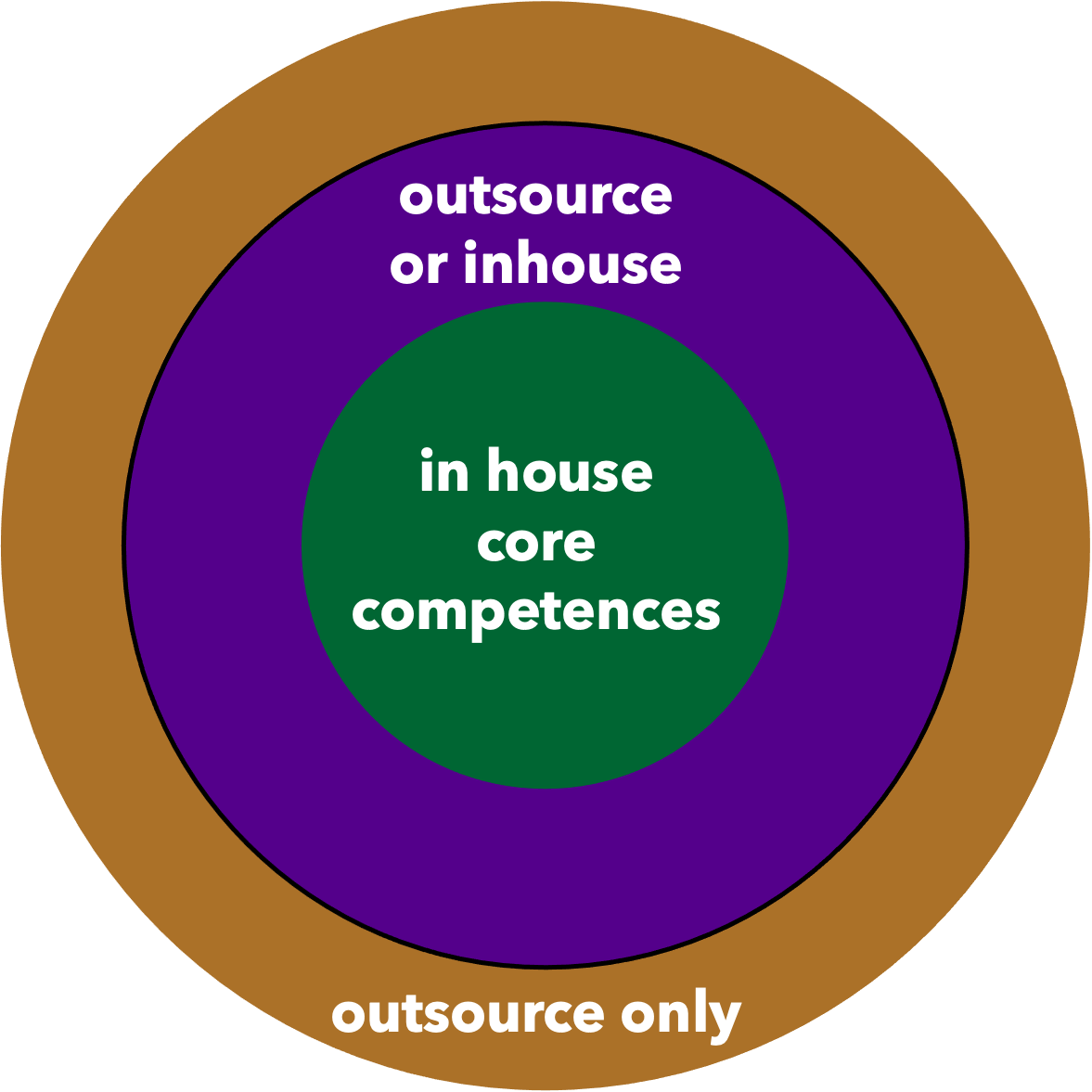
A core competency can be described even better as is primary organization’s activity rather than just product or service (Exhibit 5-1).
Ex. 5‑1 Types of activities explaining the roots of alliance
Keywords: core competence, outsourcing, agreements
For example, some companies that are famous as pharmaceutical or electronics companies usually have their core competence in the ability to create a technology or other innovation, the ability to popularize a brand, or simply the ability to sell and promote a product. Often, the organization views the production process itself as a non-core activity. Globalization made it possible for companies located in different countries to cooperate in the world, transport services became relatively cheaper, and it became possible to order production from a specialized independent contract manufacturer. Just like the simplified example provided about a desk cleaning service for an app development organization. There are many specialized manufacturing organizations in the market that are strategic partners for organizations with established brands or those that pioneer innovations.
The spheres of activity in the exhibit 5-1 represent the three types of activities that are necessary for any organization to create a product or service for its customers. Core competences of the organization are present at the core, which organization ensures to maintain with their own resources. A part of the activities, often related to the activities of the core competence, can be performed by the organization internally and in each case, it is decided whether to buy the activity from the outside or whether it is better to do it independently. The third, farthest sphere is the activities that the organization does not do itself, as it might be lacking in competences and resources. All activities, even those for which there are no competences and resources, are important. Therefore, the organization needs such partners who have core competences in those activities. Competences can be associated not only with knowledge and experience, but also with geographical location, with the market they service or other factors.
There are four common scenarios of collaboration (Exhibit 5-2). In the first case, there is a very high probability of partnership and alliance between organizations, when the activities of one organization, which it does not do, are performed by another organization as activities of its core competence. In the second case, those activities that the organization can do itself, but it is not its competence, can be transferred to another organization.
Ex. 5‑2 Outsourcing criteria

Keywords: core competence, outsourcing, alliance, cooperation agreements
It is important that when transferring these activities, a partner will be sought, which will have the main competencies of those transferred activities. In the third case, the organization would transfer the activities that it does not process to a partner, for whom those activities are also not the main competence. The third case is less favorable to cooperation and is rarely encountered. The fourth case, when an organization transfers activities that it does not do itself, to another organization that also does not do these activities, is only hypothetical and it means cooperation is unachievable.
There are various forms of partnership. Partners can be suppliers, customers, banks, governments and even competitors. Alliances can be domestic, but most of them are international. Typically, organizations are looking for companies whose main activities would best complement the organization’s main activities and where the partners would experience synergy together. Organizations, regardless of countries or continents, are looking for partners who best align with the partnership criteria. Organizations can use the services, products or other assistance of other organizations only once, and this type of cooperation is not considered as an alliance, but if the cooperation takes on a multiple nature, it can be considered an alliance. Some alliances are based simply on cooperation agreements and are not even called alliances. When agreements are of a long-term nature and of strategic importance, this collaboration falls within the definition of an alliance.
Some alliances are highly structured, sometimes involving more than two contracting parties, and the alliances even have their specific names. For example, in aviation there are well-known airline alliances with the names “Star Alliance”, “One world”, “Sky team”. In the field of information technology, there have been signs of alliances between computer processor manufacturers and specific brands of computers or between computer manufacturers and software manufacturers, although they have had no formal name, such as airline alliances.
Ex. 5‑3 Three dimensions of alliance varieties

Keywords: equity, purpose, direction, agreements
The governments of some countries, such as the European Union, apply a very strict anti-monopoly policy and consider could consider agreements between possible competitors as competition law violations. Competition violations are subject to fines sometimes reaching hundreds of millions of euros, so it is not surprising why some alliances of long-term cooperation do not go public, do not create names and keep cooperation as confidential as possible, thus protecting alliance partners from possible fines. In summary, the definition of an alliance can be formed as the desire of business companies to cooperate for the purpose of increasing profits and gaining a competitive advantage, providing long-term cooperation and including decisions related to cooperation in the organization’s strategy.
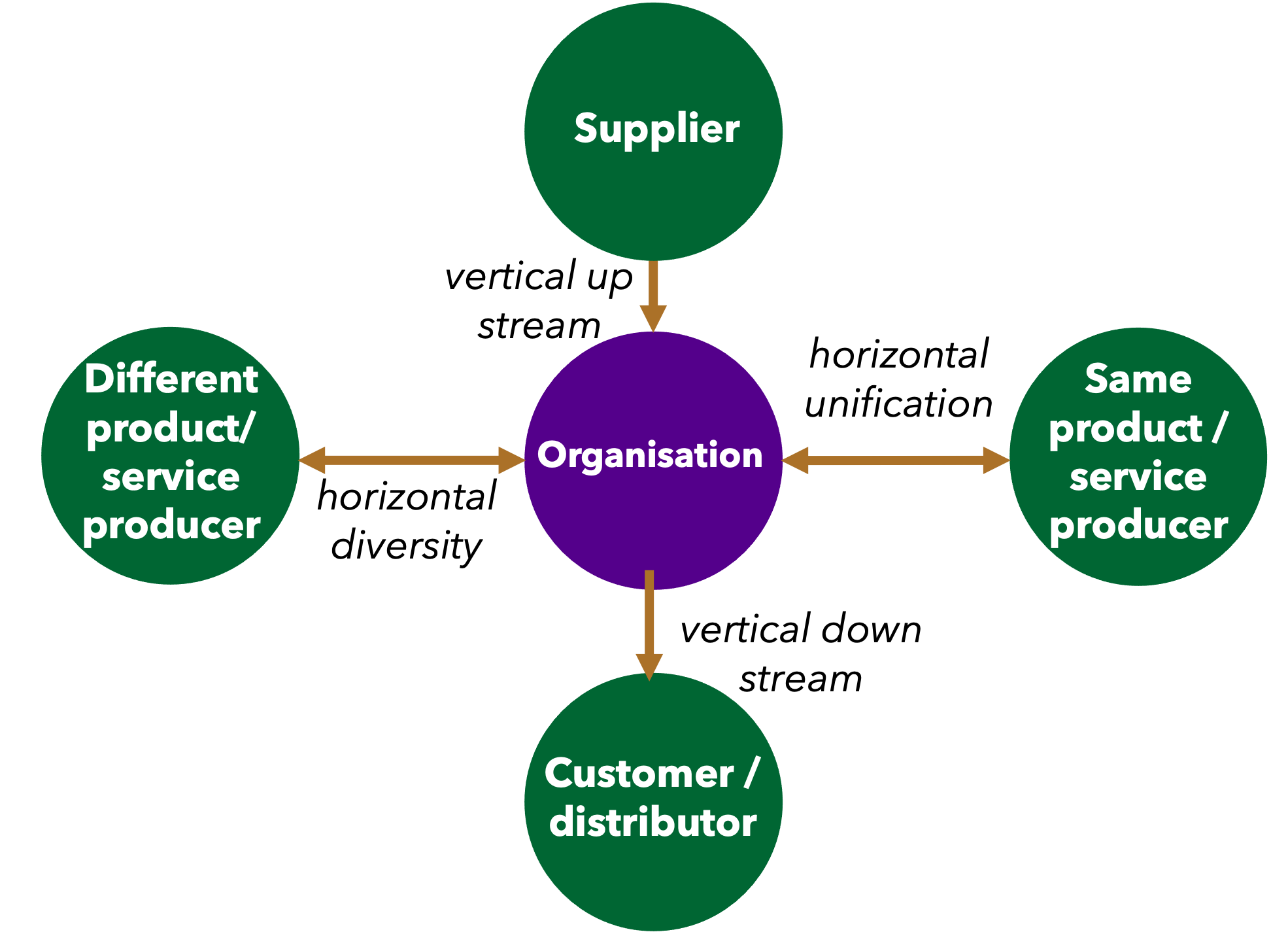
Alliances are different and are usually classified according to the direction of cooperation, ownership relationships, form and purpose (Exhibit 5-3). Different forms of cooperation can be discovered in these three dimensions. According to the direction of cooperation, alliances are divided into horizontal and vertical.
Ex. 5‑4 Variety of direction of cooperation in alliances
Keywords: supplier, distributor, agreements
Horizontal alliances are between organizations with the same core activity but differing in the specifics or territory of that activity, or different core activities, but achieving synergy from creating value for customers together. Vertical alliances are based on the relationship between an organization and suppliers or an organization and its customers or distributors (Exhibit 5-4).
According to ownership ties, alliances are divided into those whose members are mutually unrelated organizations and alliances whose members are related by ownership ties. According to the purpose, alliances are divided into R&D, production and marketing. The following subchapters introduce and describe in detail all types of alliances.
agreements
Share or comment this information on your social media:
Fundamentals of global business
First edition
For citation:
Jarzemskis A. (2025). Fundamentals of global business, Litibero publishing, 496 p.

Full scope of the book is available in various formats
About author
The author has been teaching at several universities since 2005. 40+ scientific publications, 10+ international research projects. More about author.