Henry Ford, who was the first to apply the principles of economies of scale and specialization in the mass production of cars, started the so-called Fordist stage of business globalization (Rae, 1969). Serial production of the Ford T model, in 1913, is a symbol of this stage. At this stage, the main focus was on increasing production efficiency and volumes. This was greatly boosted by export volumes. Export has become the most popular form of doing international business. The scale of export growth of industrialized countries led to the growth of the gross domestic product of these countries. Globally, the differences in the size of the gross domestic product between the leading countries – the US, the UK, France, Germany, Italy, and the rest of the world – began to expand. At that time, there was a great demand for industrial products in the world. Industrial production was needed for agriculture, the construction sector, and even individual consumers. Manufacturers focused on the affordability of products. Mass production of homogeneous products led to lower production costs for lowering prices. Automobiles, household appliances, and other personal consumption goods have become affordable for middle-income residents in the United States and many Western European countries.
As total production and exports increased in the 20th century in the world, supply became saturated. Consumers could now to choose which manufacturer’s product to buy. Global competition between manufacturers has begun. Many manufacturers in the USA, Germany, Italy, and France began to compete, but in the Fordist society competitive advantage was mainly sought through cost of production. Product quality was also important, but it was mostly perceived through functional properties, reliability, and durability. The global business was dominated by the so-called ‘push’ paradigm, which meant that the manufacturer produces goods and places them in warehouses, and the further sale of these goods is already the concern of salespeople as well as and marketing and distribution specialists. The so-called make-to-stock approach prevailed in many markets. Outbound warehouses usually were full of stock.
In the second half of the 20th century, beginning in the 1970s, consumers became increasingly picky about their products, and manufacturers realized that no matter how efficiently a product was produced if the product did not sell, it would mean a loss (Christopher, 2011). This idea fundamentally turned the concept of global business upside down. The conformity of the product to the specific needs of the customer and the speed of availability of the product has become as important as the price and tangible characteristics. Manufacturers had to change the concept of mass production to stock to production on demand, or the so-called ‘pull’ concept. The concepts of ‘pull’ and ‘push’ are detailed in Part D Chapter 12 of the Book, where the significance of warehousing, transportation, planning, materials and order management for global business is revealed.
The concept of “pull” is basically based on the diversity of the assortment and the economy of scope. As long as the manufacturer produced a single product according to the Fordist paradigm, the probability of selling all products from the warehouse was high, but when manufacturers began to produce a wide range of products, it became risky to manufacture to fill the warehouse. For example, even a car of the same brand and model can have different body colors, different engine characteristics, different interior details, tires, rims, and even different gearboxes.
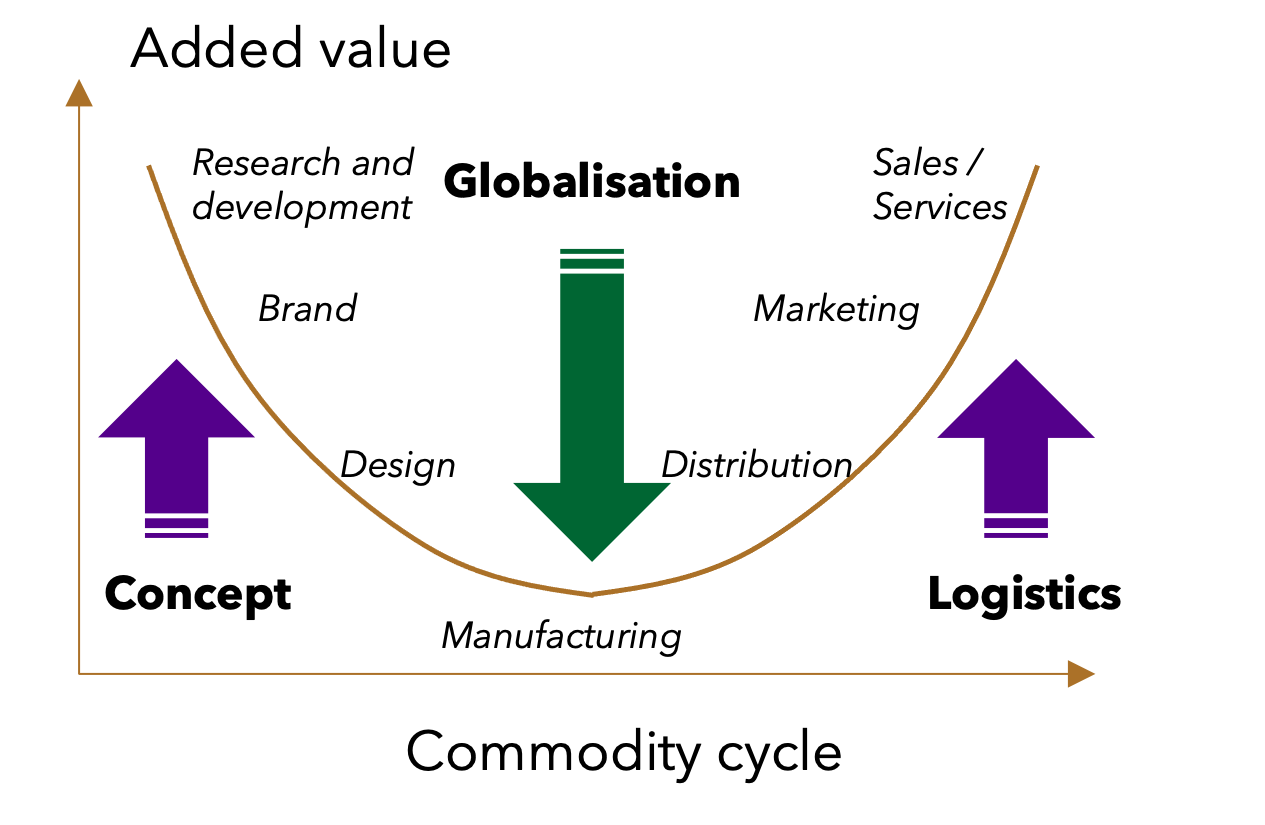
Ex. 2‑19 Shih’s “Smile Curve”: The decline of production added value in a post–Fordist society
Keywords: logistics, manufacturing, globalisation, smiling curve
There may be several hundred variations of the product, and it is risky for the manufacturer to produce cars of all variations to fill the stock because not all of them will find their buyer. It is even more difficult to plan the required inventory level for each variation. Therefore, more manufacturers have moved to a different business paradigm, where the customer’s order comes before the start the final assembling.
The user is allowed to choose all car parameters from the set offered by the manufacturer. The assembly of the car begins only after the order is placed by the user. This make-to-order paradigm eliminates economies of scale in final product assembly, but economies of scale remain in component manufacturing of parts and components. Although different components may be fitted to the same car, the components themselves are the same. Thus, economies of scale shifted from final assembly to component manufacturing, and assortment diversity began to dominate final product assembly. This paradigm is called post-Fordist or demand driven (Jessop, 1992).
The two examples described above on production driven or demand driven business models are marginal, in practice in the 21st century, many intermediate paradigms between pure Fordist and post-Fordist can often be found in various industries. The emergence of the post-Fordism paradigm was greatly helped by the progress of transport and communication technologies, particularly the liberalization of international trade and the opening of China and other Asian countries to foreign investments (Hampson et al. 1999). The progress of trade liberalization is described in more detail in Chapter 3 in Part B of the book.
In the post-Fordist paradigm, the value of production efficiency has become relatively lower. The USA and Western European countries have outsourced both the production of components and the assembly of the final product to Asian countries, where labor is cheaper.
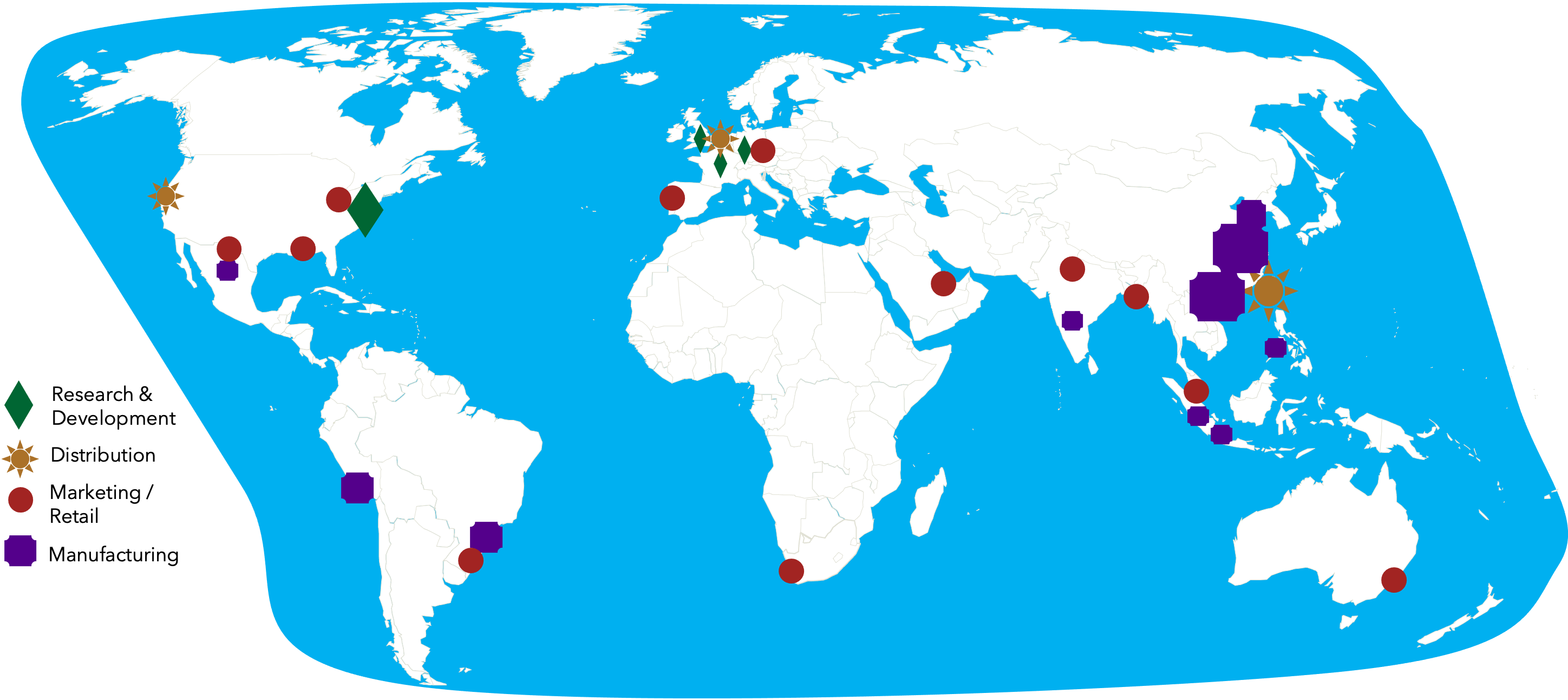
pav. 2‑20 Distance of production, R&D and distribution
Keywords: logistics, manufacturing, globalisation economic development
The greatest value in post-Fordism goes to the product brand, product development R&D activities, and innovations, as well as product distribution, marketing, and after-sales service. This is visualized by the “smile curve” proposed by Acer founder Stan Shih in 1992 (Exhibit 2-16).
R&D activities are mostly concentrated in the United States. Key players in logistics and distribution have facilities located in the Mediterranean and North Sea regions of Western Europe, in coastal China, and in coasts of United States (Exhibit 2-17). Manufacturing and assembling are concentrated on the coasts and islands of Southern Asia, and partly in the eastern and western coasts of Central and South America. Areas near the sea and the largest port cities were chosen as production sites, as this greatly reduces both the delivery of raw materials to factories and the logistics costs of exporting finished products.
Some multinational organizations have moved their production units to cheaper production locations in Asia or South America, some have bought existing factories there, and some have invested and built factories from scratch. Detailed description is given in Chapter 6 in Part in B of the book. Multinational organizations shifted production to independent manufacturers.
So-called private label manufacturers have emerged. These are the manufacturers which produce or assemble in a certain type of industry to order. For example, in the pharmaceutical or computer industry, the brand owner can choose which factory to manufacture its product or its individual component. The name of that factory is not even known to the end users. Goods became produced in the same factory for different brands, who are often competitors in the market. The production of components or the assembly of the final product is perceived here as outsourcing.
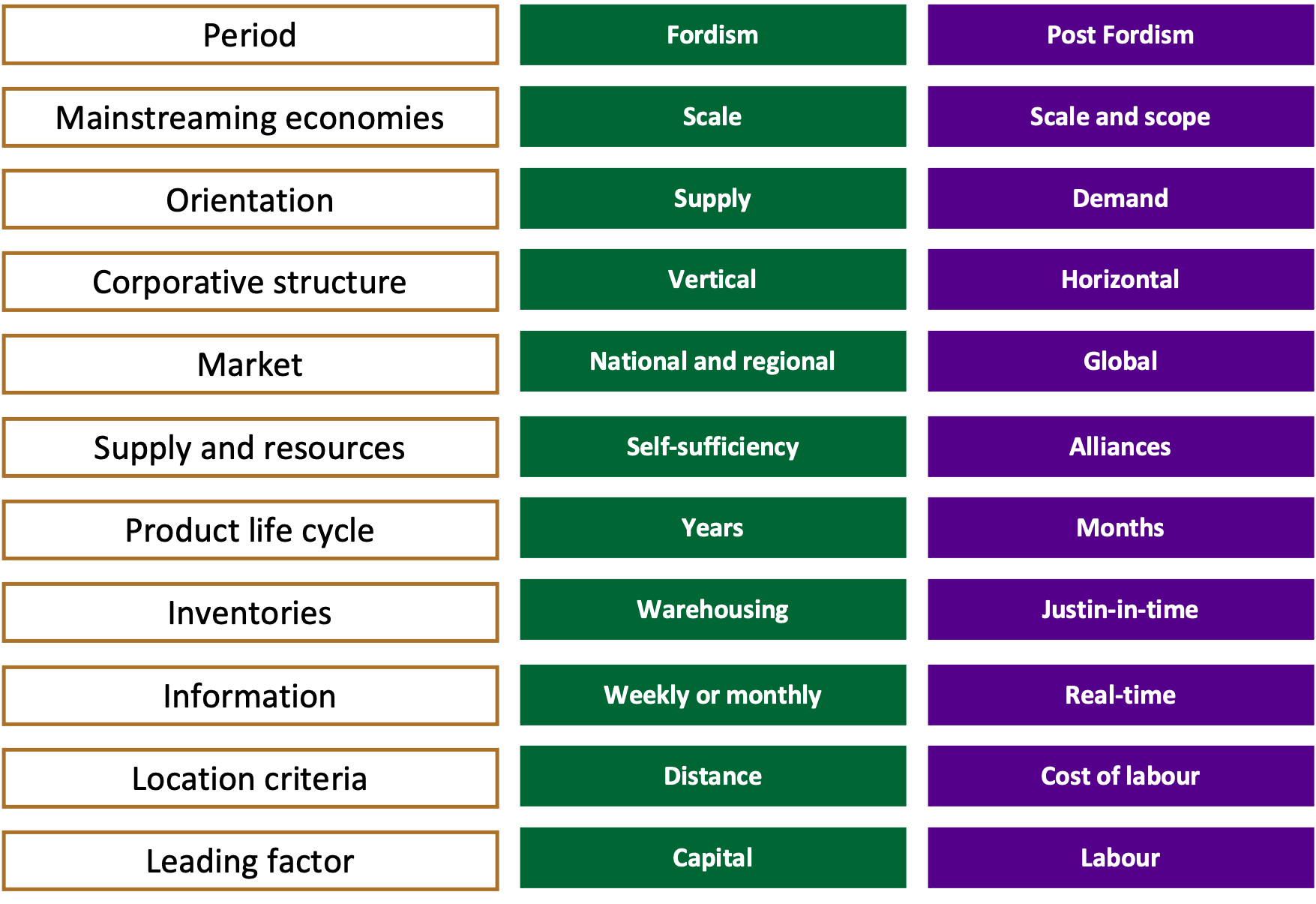
Ex. 2‑21 Differences in the principles of international business in the periods of Fordism and post–Fordism
Keywords: logistics, manufacturing, globalisation, international business in Fordism and post–Fordism
In essence, it can be said that independent manufacturers have emerged that only provide a physical manufacturing service to brand owners. In this case, the question arises as to who should be considered a manufacturer, because the brand owner often has no manufacturing or assembling capacity at all, but only controls R&D activities, intellectual property of the product, and marketing tools and channels. However, the highest added value and profit in this case corresponds to the brand owner. This is happening because brand owner control sales, pricing and is known and accepted by customer’s market. So, brand owner decides to what manufacturer outsource physical production or assembly and what material to use. Having power given by trust of final customer, brand owner seeks optimization profit by selling product so expensive as possible and by making product so cheap as possible.
It is currently tough for a consumer to know where the product he bought is made at. A brand may say it’s a designed in USA, but a “made in China” label on the product might make to think it’s a Chinese product, when in fact individual components may be made in a very large number of countries. The real answer is that the individual components of the product are made where they can be made most efficiently, assembled where it is most efficient, and the brand is one that the consumer trusts. In a post-Fordist society, in global business, brand and delivery has become the more important for the consumer than the product tangible characteristics. In the 2020s, brands were increasingly challenged by new brands from Asia, especially in electronic or electric vehicle market. Some consumers remain less loyal to brands and are determined to choose a product based on price.
This makes it possible for actual independent manufacturers to start producing goods by creating own brands instead of working only for other well-known brands. Although in many cases this is restricted by intellectual property protection, control, and legal protection are still quite difficult to implement in practice is some countries.
The era of Fordism and post-Fordism fundamentally led to many differences in the structure of the global business landscape (Exhibit 2-18). During the Fordism period, organizations had more vertical hierarchical relationships based on ownership and control, and during the post-Fordism period, organizations began to communicate more through horizontal relationships (more in Chapter 5 of Part B of the book) and intra-industrial networks. During the period of Fordism, the focus was more on the production of the product and its components in-house, while post-Fordism aims to produce in-house as little as possible. In Fordism, the main task of logistics was to take care of supply expansion network of controlled distribution, in post-Fordism, it is more oriented towards demand and stock reduction. In the period of Fordism, international business relations were often limited to bilateral relations and exporting a product to another specific country or a specific region, but in the post-Fordism period, the market became global. In the period of Fordism, the most important resources were physical production capacities, in the period of post-Fordism it became knowledge and intellectual property, human capital, and information systems. The product life cycle and inventory storage time have been greatly reduced. If during Fordism, stocks were accumulated for months, and production lasted for years, then in post-Fordism, they were shortened to days and months, respectively.
The past three decades have witnessed a rapid tendency toward globalization in the world economy. A great deal of controversy exists, however, as to whether and to what extent globalization has increased nations’ international competitiveness and growth (Salvatore, 2010). The third decade of 21st Century has brought many disruptions for global business landscape. The COVID-19 pandemic has caused major supply disruptions, and geopolitical tensions between the USA and China force corporations to reassess and calculate production locations. Today, it is difficult to say whether production will remain in Asia or whether the owners of the USA and Western Europa based brands will seek to have factories closer to them or even domestically for safer and more secure, sustainable and resilient production. This is caused by threat that is related to a political, legal, and cultural environment which is man-made or is caused by natural disasters. Much bigger geopolitical tension has appeared between Western thinking driven countries and the opposing countries after Russian invasion into Ukraine in 2022. There is a beginning of new phase in globalization, and nobody yet knows how the world be shaped in coming decades. Such countries as Russia, China, Iran challenging the global order which was set by North Americans and Western Europeans after World War II. Having support from BRICS partners, including newly joined countries, block of so-called global South countries are challenging the values and principles on which world was runed more than 80 years. It surely will imply new paradigms of business internationalizations and relations between countries, especially having in mind size population and growth potential of countries which challenging Western order.
Share or comment this information on your social media:
Fundamentals of global business
First edition
For citation:
Jarzemskis A. (2025). Fundamentals of global business, Litibero publishing, 496 p.

Full scope of the book is available in various formats
A.2 History and trends of business globalisation
- The origins and genesis of globalisation in different eras
- Evolutions and shift of world economic powers and trade
- Evolution of money as unit of exchange
- The first international companies
- Mobility and communication technologies as key enablers of globalisation
- Industrial revolutions
- Differences of international business in Fordism and post-Fordism
- Questions for Chapter Review
- Chapter Bibliography
About author
The author has been teaching at several universities since 2005. 40+ scientific publications, 10+ international research projects. More about author.