In international trade, in addition to tariff or non-tariff restrictions, which aim at specific state goals, other ways of distorting the free market through discriminatory pricing can be found. Discriminatory pricing in domestic trade is prohibited in many countries, and agreements to adjust terms and prices between competitors is punishable. For example, in the EU country Lithuania, business can be fined 10 percent of their annual turnover for a cartel agreement.
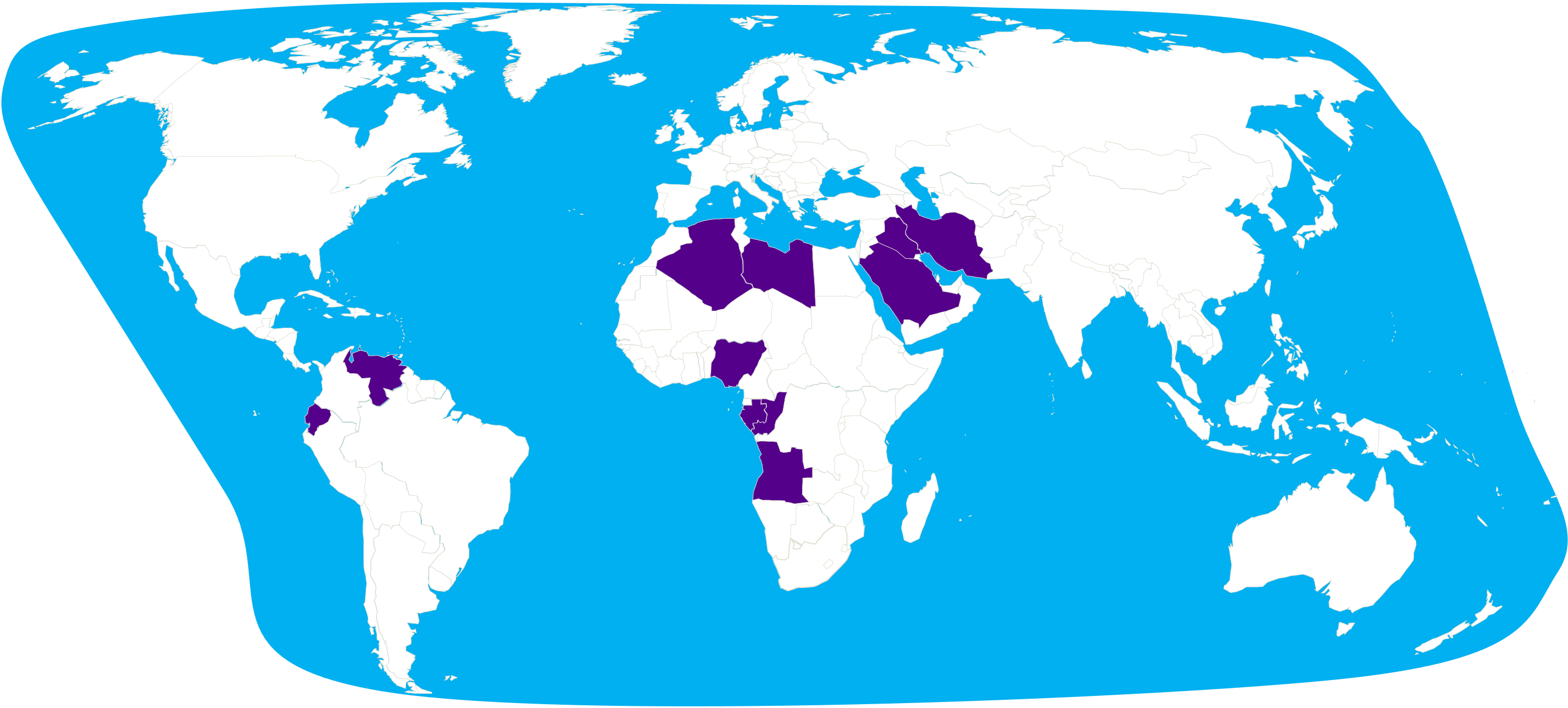
Ex. 3-18 OPEC members
Keywords: OPEC, oil, cartel, international dumping, cartels
Competition supervisory authorities of many states monitor the market, collect evidence of potential competition violations, and severely punish competing companies if those agree on prices.
Moreover, the situation becomes a little different when shift to the case of international trade. Although non-compete agreements are prohibited in America, Australia and Oceania, Europe, but some countries a ignore these rules. In the world, there is no single government, no single police that can regulate the market mechanisms, the countries, having a sovereign, choose their own methods of economic activity.
An international cartel is an association of suppliers of goods or services from different countries which coordinate their actions in such a manner that the suppliers earn more profit. Coordinating operations involves coordinating the production output volumes and prices.
The well-known international cartel today is OPEC – Organization of the Petroleum Exporting Countries, headquartered in Vienna. This organization has its own statute, secretariat, and operates essentially as an international corporation. OPEC was founded in 1960 in Baghdad by Iran, Iraq, Kuwait, Saudi Arabia and Venezuela. Currently, the number of cartel members has expanded to 13 members (Exhibit 3-18). Algeria, Angola, the Democratic Republic of Congo, Equatorial Guinea, Gabon, Libya, Nigeria, and the United Arab Emirates joined the cartel.
Ex. 3-19 Variety of international dumping

Keywords: dumping, international dumping, cartels
The cartel controls about 3/4 of the world’s oil reserves and produces more than 1/3 of the world’s oil. Only about 6 percent of world’s population live in OPEC countries. Saudi Arabia produces the most oil in the cartel, but similar volumes are also produced by Russia and the United States of America. Although the cartel does not have a complete oil monopoly, when the cartel decides to reduce oil production, it affects the reduction of oil supply in the global context. As the cartel agrees to increase the production of oil, the price of oil decreases in the markets. For example, after the cartel stopped oil production in 1974, the price of oil doubled in a short time.
Another example could be IATA – International Air Transport Association – a cartel of major international airlines. Until the liberalization of airline business, airlines operated international flights according to bilateral agreements, when it was decided on the basis of parity how many times a week or a day a flight would be organized. There was no opportunity for new airlines to emerge, and air transport were difficult to afford for a large number of consumers. IATA regulated flight prices during annual member meetings. After the countries liberalized the aviation market in 2007, new airlines began to be established one after another, some of the IATA members became bankrupt. As consequence and the number of passengers on international flights doubled by 2020 with increased number of low-cost newcomers.
Another form of discriminatory pricing is dumping. Dumping is the sale of a product or service at a lower price than the costs of its production. International dumping is also considered to be the sale of a product to a foreign country at a lower price than in domestic market. Like competition limiting agreements or cartels, dumping is prohibited by law in many countries around the world, but it is much more difficult to do so internationally.
Dumping in international trade is applied for different reasons. It can be persistent, predatory or sporadic depending on the cause (Exhibit 3-19). Cases of persistent dumping can be found when an organization exports to a country where there is more competition than those organizations in their domestic market. Due to weak competition, in the domestic market, an organization usually increases prices, while in foreign markets, the exported products are sold at a lower price due to the pressure of competitors there. For example, in Poland with a population of 38 million, there are many milk producers and there is a lot of competition between them.
Milk product prices in Poland are lower than in Lithuania with a population of 2.8 million, where there are only five dairy producers and little competition. Therefore, Lithuanian milk product producers sell milk products in Poland cheaper than in the local market. This form of dumping is explained by free market, and in the absence of prohibited agreements between competitors, this type of dumping is not even limited by legislation. Actually, it is hard to prove and get evidence of illegal agreements between competitors. However, when an organization exports a product to another country and sells it at a lower price than the prevailing prices of competitors in that market, one can suspect a form of predatory dumping. The purpose of predatory dumping is to push another country’s producers out of business. It is important to note here that continuous dumping can also work for this. If a producer receives a large profit in his country and uses it to subsidize exported products, this is already a case of predatory dumping. The distinguishing feature of predatory dumping is a combination of two features – selling a product abroad at a lower price than the product’s production costs and an effort to push competitors abroad from the market. By forcing competitors out of the market, the exporter gains the power of monopoly and raises prices to a level acceptable to him. Returning back to the market after is usually difficult, which requires a lot of investment and time.
Accidental or sporadic dumping is similar to predatory dumping in that it is sold to the foreign market at a price lower than the cost of production. It differs from predatory dumping in that it does not aim to displace competitors and has a non-systematic nature. An example would be excess production, such as an unexpectedly large harvest of tomatoes. In order not to depress the price in the local market, the surplus harvest is sold very cheaply in the export markets or simply destroyed. A surplus harvest has greatly reduced the price in the local market, which is then more difficult to bear, even if the next harvest is much poorer. Therefore, a decision is made to get rid of the surplus crop at any cost, even if it means selling very cheaply to foreign markets.
There is another type of dumping that can be classified as either persistent or predatory depending on the cause. It is the use of state aid in the production of goods. In the United States, the European Union and other developed countries, state aid to business is limited having just few exceptions. However, state subsidies are still widely used in agriculture in Europe. The purpose of these subsidies is to maintain agriculture as a strategically important sector of the economy and ensure food supply security for the country. Often, increased state aid schemes are applied to encourage organic farming and reduce the use of fertilizers. Another example would be the electronics and information technology industry. One of the largest manufacturers of computers, smartphones and 5G communication technologies is a Chinese state-owned organization. The production of this organization is exported to many countries of the world and competes with products made by manufacturers of other countries who do not have state aid or at least the back. There is very limited ability to verify whether the Chinese government is subsidizing production costs for exported products, but pricing and targets show signs of predatory dumping.
Situations when the state rescues organizations from bankruptcy and covers losses can be found in Europe and the United States. For example, the large US based car manufacturer, unable to withstand the competition of Japanese manufacturers in the US market, in 2009 filed for bankruptcy and survived only on 49.5 billion US dollars of taxpayer money invested by the US government, giving the US government a 61 percent stake ownership of the car manufacturer. Paradoxically, same car manufacturer sold more cars in China than in the US market in 2010 after receiving US government aid.
Share or comment this information on your social media:
Fundamentals of global business
First edition
For citation:
Jarzemskis A. (2025). Fundamentals of global business, Litibero publishing, 496 p.

Full scope of the book is available in various formats
B.3. International trade and export business
- Economic rationale behind international trade
- Types of export
- Pros and cons of international trade
- Payments in international trade
- Product identification in international trade
- Tariff and non-tariff restrictions on international trade
- International dumping and cartels
- Protectionism and stages of trade liberalization
- Blocks of states to facilitate international trade
- Questions for Chapter Review
- Chapter Bibliography
About author
The author has been teaching at several universities since 2005. 40+ scientific publications, 10+ international research projects. More about author.