Economies of scale in logistics provide a competitive advantage, because the same amount of the same product can be transported between two same points at several or even tens of times different prices. The first reason is that larger transportation order allows use a larger capacity transportation mode and mean. If a larger transport mean is fully loaded, then the cost of transporting a load unit will be lower than the price with a smaller one. The core definition of efficiency in logistics or supply chains is to deliver the same service with fewer resources. This law applies to all modes of transport, and especially to the key concepts of consolidation, load factor and empty runs. The main problem at the origin of logistics constraints and inefficiencies is that an individual customer can rarely prepare a shipment that will completely fill a ship or, for example, a train, but as opposite fully loaded truck is quite common. However, if manufacturers and traders order a very large shipment, it means that they will incur more costs in storing the goods, and they will also face the problem of frozen resources. Chapter 12 describes how and why just-in-time ordering is becoming popular. Manufacturers and traders avoid having excess inventory and tend to order transportation more often but in small shipments, leading to reduced turnover time for storage and thereby reducing inventory costs. Thus, the question arises as to how to achieve economies of scale in transportation, when cargo owners tend to transport smaller and smaller shipments, but with higher frequencies. The logistics service providers themselves found the answer and solution. One of the main solutions is the assembling and disassembling of shipments. Cargo assembling or grouping, also called “consolidation” in practice, is a process where many small shipments of goods are combined into a larger shipment by logistics service providers. In the field of cargo transportation, grouping is understood as a complex of operations that combines cargo shipments of different clients to achieve greater economies of scale. Cargo grouping is one of the main logistics efficiency solutions that can be done to fill a full ship with containers, a train with wagons or load a full trailer or a container, to reach its maximum capacity by volume unit, expressed in TEU or cubic meter, floor surface in square meters, or weight in tons. With the popularity of small parcel transport, especially due to e-commerce, more and more parcels are needed to fill a container or semi-trailer. The only way to achieve economies of scale and keep shipping costs low is to consolidate shipments of different consignees and consignors. Necessary criteria for a shipment grouping are adjusting departure time and combination of origins and destinations. Upon arrival of a container or vehicle containing grouped shipments from different owners, the entire cargo must be deconsolidated, i.e., ungrouped and distributed to various recipients. As product life cycles shorten, manufacturers often use just-in-time logistics and avoid stockpiling. Deliveries in relatively small shipments that do not fill an entire vehicle or container are becoming increasingly required (Dennis, 2011).
Ex. 13‑4 Hub and spoke principle
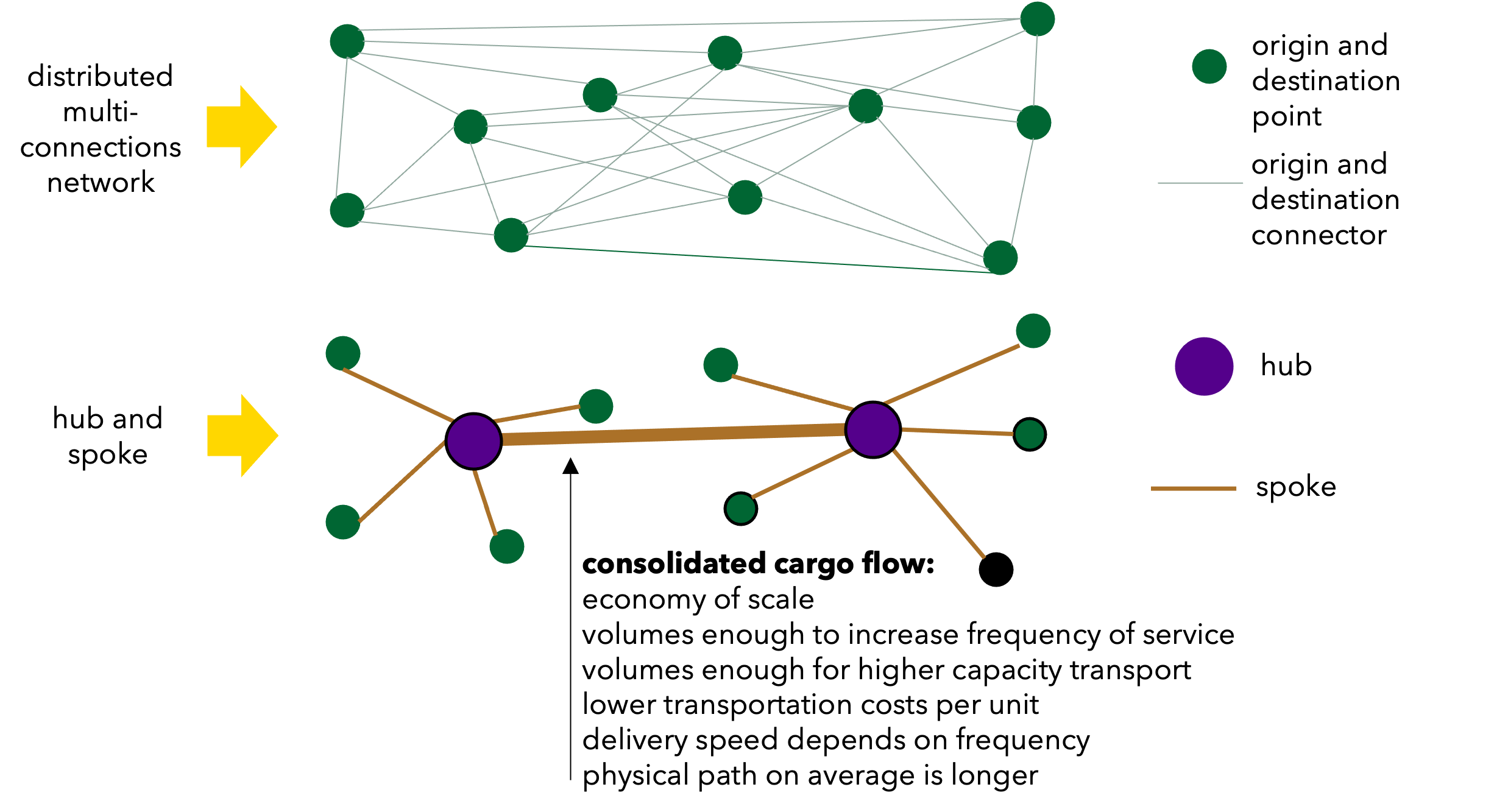
Keywords: hub and spoke, consolidation of goods
For the cargo consolidation and distribution model to work, it is very important to apply another principle, which is called the principle of “hub and spoke” (Exhibit 13-4). This leads to the fact that the principle of grouping and distribution becomes very widely applied.
Aviation can be considered the pioneer of the principle of hub and spoke. As commercial air transport has faced 4 phases of evolution. Phase 1 was between the 1930s and 1940s, when the airlines were established. The aircraft produced at that time were of relatively low capacity, both in terms of their carrying capacity and flight range, as they had to land to refuel. Thus, certain routes were formed – lines with intermediate points where aircraft landed to refuel, unload and reload. In Phase 2, from the 1940s to the 1960s, manufacturers offered larger-capacity aircraft that could already fly without intermediate landings. Line routes remained between major airports, but smaller airports were gradually eliminated from core business schemes. In Phase 3, from 1960 to 1980, aircraft manufacturers introduced long-haul aircraft to the market and strongly affected air transport business models. The hub and spoke principle started to take shape in its initial phases. Airports, between which high-capacity and long-range aircraft flew, became hubs. And other, smaller airports have become branches “feeding” the large airports. From the periphery to the large airports, connecting short-distance branch lines or sol called “feeder lines” began to be created. Large focal airports have become hubs or consolidators of cargo and passenger flows. In stage 4, 1980-1990, the hub and spoke principle was finally formed. Flying through transit hub airports has become normal practice as economies of scale have given connecting flights a cost advantage over non-stop flights. Airlines have also divided markets, some focusing on inter-hub transport, others on regional services to feed a hub (Bowen, 2010).
Transatlantic or trans-Pacific flights use large aircraft that can hold large amounts of fuel and passengers. Aircraft fly from the departure airport to the arrival airport. However, gathering 500 passengers on one flight on the same day is a big challenge. Even getting 200 passengers from one city to another on the same day is difficult. Thus, a scheme has been used in aviation when passengers fly with a transfer. The airport from which aircraft take off across the ocean to another continent becomes a hub to which passengers are flown by smaller planes. This is how the principles of hub and spoke were formed. The largest airports became the hubs, and the connections that “feed” them with passengers became the spokes. This principle has also been applied in cargo aviation.
The beginnings of the technological scheme of hub and spoke in aviation existed before the deregulation in the US in 1978. Before deregulation, however, each state had its own national carrier based at a national airport. The permit system and the rule of parity prevailed between the countries. That is, if permits were issued to the carrier of country A for regular flights to fly commercial flights from country A to country B and back, then corresponding permits were issued to the carrier of country B for these flights. Even in the late 1970s and early 1980s, the multi-connector model dominated the market. Many of the flights were point-to-point and served city-specific connections. The large number and frequency of flights resulted in inefficient use of the aircraft capacity. These low load factors led to high prices for air transport services or the need for state subsidies.
After deregulation, the number of direct connections decreased, but the frequency of flights increased. Transfers at transit airports have become an additional inconvenience. For the cargo market, this resulted in more transfers at transit airports.
In parallel to aviation, the principle of hub and spoke has been applied in waterborne transport as well. Among the main trade regions, between Asia, Europe, and the United States, goods in containers are usually transported by the principles of hub and spoke. The largest ships are engaged in operations between the largest ports, and these containers are transported to smaller ports by local shipping lines with smaller ships, commonly referred to as feeder lines (Ducruet & Notteboom, 2012). The hub and spoke principle requires additional transshipment, which is time-consuming and expensive, but the cost of the entire transport chain remains competitive when compared to the situation of transporting the cargo from the origin to the destination port directly (Exhibit 13-5). The efficiency and cost reduction gains are mainly obtained because there are fewer port calls on the way for each shipping line, and so the overall maritime transport chain duration for multiple lines linking for example Klaipeda in Lithuania with Busan in South Korea, unloading in Rotterdam and Shanghai hubs, is reduced.
The largest ports eventually became trade gateways. Industry and trade services began to gather around the largest ports, because everyone wanted to have the shortest possible radius, i.e. spoke distance from hub to final destination for the supply of their goods. The smaller the radius and the closer the industry is to the hub, the cheaper the overall transportation chain becomes (Mangan et al., 2020).
Ex. 3‑5 Hub and spoke price advantage example
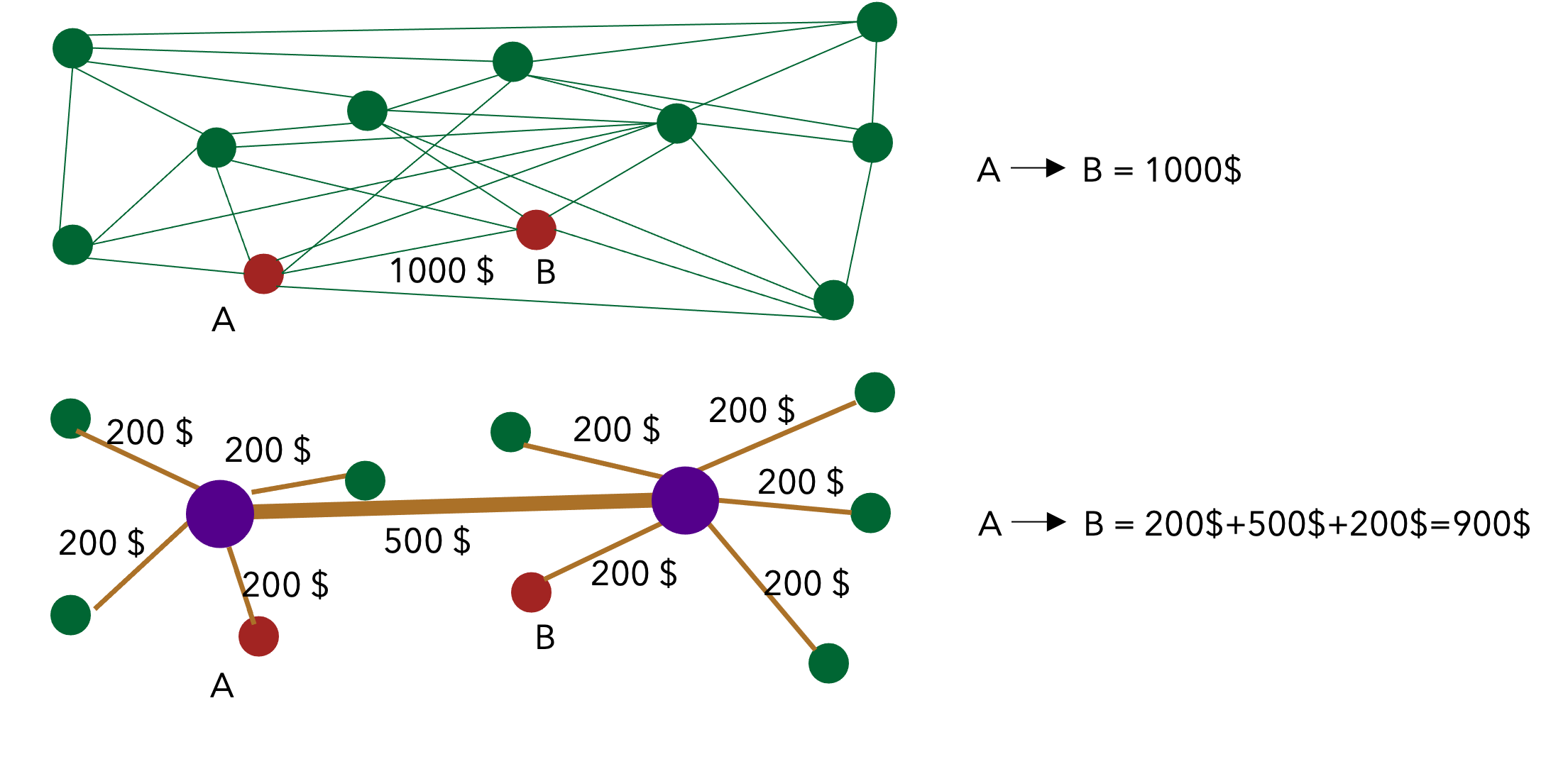
Keywords: shared price, consolidation
To become a hub and remain so, the largest hub-ports, i.e., gateways seek to invest in the deepening and lengthening of quays, the deepening and widening of port canals and the necessary infrastructure in order to keep pace with the ever-increasing number of ships and their demands. The bigger the ship, the deeper the pier and the port entryway must be. For example, ultra-large container ships arrive at the port of Rotterdam but cannot enter the ports of the Baltic Sea when fully loaded. It is not worthwhile to partially load the vessel and reduce its draft, as this would fail to utilize the ship’s carrying capacity and the consequent loos an economy of scale. The cost of the transport chain is lower when transporting cargo by the largest ships due to economies of scale. Even including price for the transshipment on associated spoke lines, it is often still more cost-efficient than attempting to directly organize transport from the point of origin to the final destination while bypassing the hub.
Ex. 13‑6 Consolidation of goods for corridor
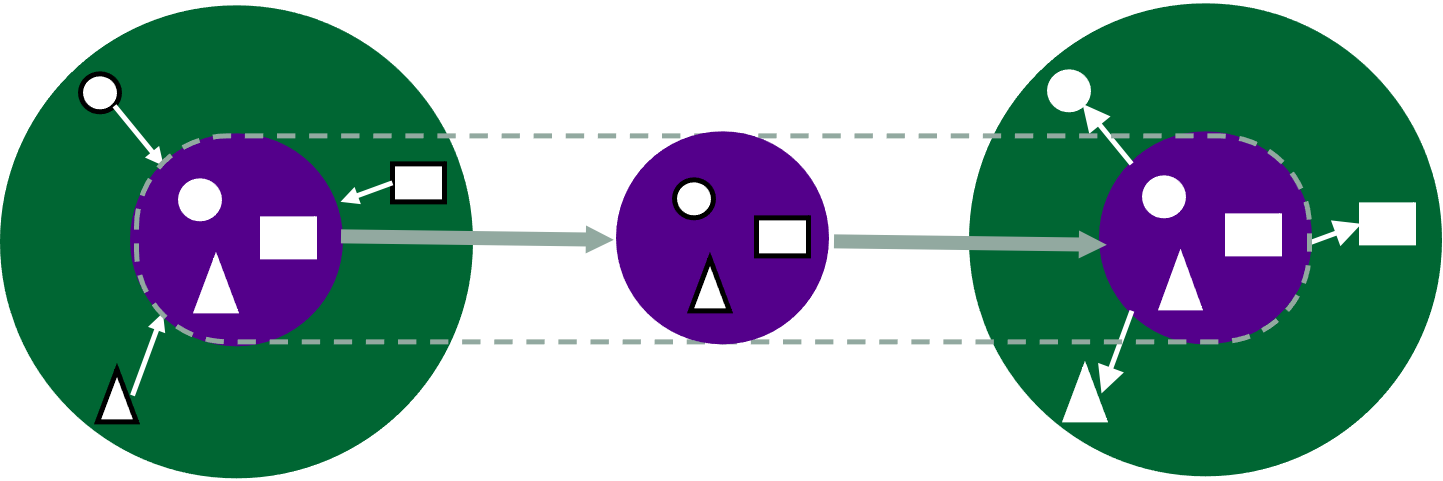
Keywords: consolidation, grouping cargo, distribution
Source: Adopted from (Rodrigue, 2020)
In the long run, a network of efficient, consolidated logistics and transport infrastructure was formed in the world, which essentially determines how freight flows are moving. So-called transport corridors are formed. For example, it doesn’t matter which city in China the manufacturer is located, but the goods arriving in Poland will most likely go through the hub-port of Rotterdam, and the goods arriving in Madrid will go through the port of Barcelona. Thus, the physical flows of goods essentially become clearly laid out within the existing transport network architecture.
The architecture of the transport network consists not only of ports or airports, but also of established shipping operators or airlines providing regular services, and the associated road haulage and railway operators supporting the corresponding radial hinterland connections. Thus, each transport chain is not only a defined by its infrastructure network, ports, terminals, transport service providers operating in the network, but also by the capacities and limitations of each of them.
When planning new supply chains, it is very important to explore and analyze the existing transport corridors to consolidate goods (Exhibit 13-6) and their alternatives, and to compare the prices and durations of freight transportation.
Share or comment this information on your social media:
Fundamentals of global business
First edition
For citation:
Jarzemskis A. (2025). Fundamentals of global business, Litibero publishing, 496 p.

Full scope of the book is available in various formats
D.13. Global supply chains and distribution networks
About author
The author has been teaching at several universities since 2005. 40+ scientific publications, 10+ international research projects. More about author.