Trade restriction. Although free trade between states, according to Paul A. Samuelson’s resource price equalization theory, should encourage countries to trade without restrictions, individual states and blocks of states still limit free trade (Samuelson, 1962). Such trade restriction is perceived as tool of protectionist policy, the purpose of which is to protect one’s country’s companies, workers from import or protect local natural resources from export.
Ex. 3-16 Directions, reasons and barriers in international trade

Keywords: import tarrif, export, tariff, quota
There are several directions, reasons and methods of trade restrictions (Exhibit 3-16). One of the most common types of trade restrictions is the restriction of imports or the entry of certain products into a country.
Import restriction is when a state, by its legislation, establishes obstacles to bring certain goods into it. The main reason why countries restrict the import of goods is connected with the desire to protect their country’s producers.
If a product made in another country is cheaper, and the same product is also produced by local producers, there is a high probability that the imported product will eventually drive the domestic product out of the market. If a state government is focusing to protect local manufacturers, the desire to restrict imports from abroad is understandable. It is also about protecting jobs in the country. If local businesses cannot withstand competition from foreign goods, they will close and lay off workers. The political benefits of restricting imports can be found on the agendas of many political parties around the world.
Proponents of free trade advocate the fact that it makes no sense to support local producers by protecting them from imported goods, as this creates conditions for non-competitive companies to operate and does not create incentives for innovation and changing business specialization. However, the removal of the import restriction in the short term clearly benefits the countries from which the goods will be imported, because from the point of view of those countries, their export market will increase. For the importing country, the benefits due to innovation and change in business specialization will likely appear only in the long term. In the short term, this will indeed mean the collapse of local businesses and an increase in unemployment.
Another direction of trade limitation is export restriction. This is a less common form of trade restriction and is more associated with restricting the export of strategic resources. For example, if a country wants to restrict deforestation for commercial purposes, limiting the export of wood is one way to reduce deforestation. A country that produces technologies that are of strategic importance, for example applicable in the military industry, can also seek to ensure that these technologies are not taken out of the country and do not reach other countries, especially unfriendly.
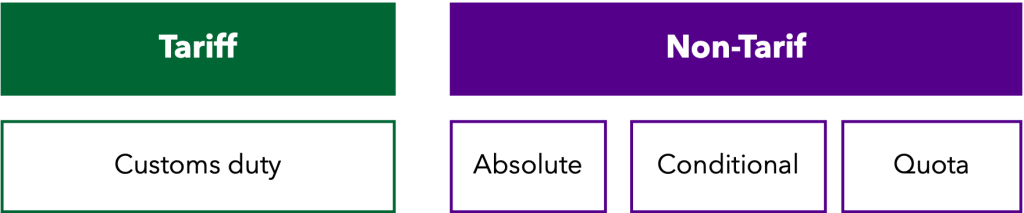
The extent and effectiveness of trade restrictions may vary. There are two types of restrictions that can apply to both imports and exports (OECD, 1996). These are tariff and non-tariff restrictions (Exhibit 3-17). Tariff restrictions are understood as the taxation of imported or exported goods, which makes the purchased goods more expensive for the buyer. Such taxation is called import or export tariff or customs duty. Determining the amount of duty depends on many circumstances and has several methods: proportional, unit based or mixed. The proportional method of determining the duty is also called ad valorem and is linked to the value of the goods. With these methods, a percentage is determined for a specific group of goods, according to which the customs tax is calculated for each trade transaction. On average, in economically developed countries, customs duties amount to 3 percent of the value of the goods. In developing countries, customs duties reach double-digit percentages. The proportional method of determining the duty has certain disadvantages, which are mainly related to the honesty of traders. Although state tax authorities and customs authorities monitor the correctness of the calculation of customs duties, fraud on the part of businesses or corruption on the part of customs officials do occur. Paradoxically, such frauds and the corruption index are higher in countries that are less developed and where customs duties are higher. A common fraud scheme is based on the artificial reduction of the value of the product, when the declared value of the product is lower than it really is. In this case, the customs duty is paid as a percentage of the lower value. The second method of calculating customs duty is called unit based. According to this method, the customs tax is assigned by the state for a unit of a specific product – volume, weight or simply a unit. In this case, the duty does not depend on the declared value of the goods at the time of the trade transaction. The third method is mixed – in this case, both a unit duty and a certain proportion of the declared value of the goods at the time of the trade transaction are applied.
Enforcement of customs duties remains a very important function of governments, however, as there are cases of corruption on the part of customs officials or a business declaring a different product in a trade transaction than what is actually being bought and transported to another country. Different product groups have different tariffs, for example fresh peas and pickled peas are different products and are subject to different rates of duty. After the business declares the product name and code, the goods are taxed at a lower duty rate, and when the goods are actually sold and transported at a higher duty rate, it is a case of violation, which can only be determined by a customs officer by matching the cargo loaded into the vehicle with the bill of lading of this cargo and other sales information, such as an invoice.
Economically advanced countries such as USA, EU, Canada, Japan apply high tariffs on clothes, textiles, leather, footwear. Customs duties range from 4 to 17 percent of the value of the goods. These product industries are very labor intensive, so these countries protect their industry against similar goods from much cheaper labor countries. However, the overall level of customs tariffs in these countries is relatively low compared to the import duties applied by Brazil, China, India, Russia, or Mexico. The free trade negotiations, known as the Uruguay Round, reduced tariffs. To compare customs duties before the Uruguay round of negotiations to those in 1993 Uruguay Round, they decreased almost twice for raw materials, about 40 percent for semi-finished products, and about 9 percent for finished products.
Tariff restrictions are an attempt to influence the price of the product, because the customs duty makes it more expensive for the end user, but tariff restrictions do not always succeed in ensuring that the product does not enter the market (Irwin, 2009). Another way to restrict international trade is through non-tariff restrictions.
Ex. 3-17 Variety of international trade restriction
Keywords: customs duty, import tarrif, tarrif trade restriction, non-tariff trade restriction
Non-tariff restrictions have different reasons and methods of application. Non-tariff restrictions can be absolute, conditional or quota. One of the reasons for non-tariff restrictions is the same as for tariff restrictions – the reluctance of countries to admit products made in another country to protect domestic producers. However, non-tariff restrictions are also used when there is a need to protect consumers from goods manufactured in another country because of various reasons. For example, in the US, genetically modified foods are not acceptable in some European countries. Due to different traditions and legal restrictions, the same products may be widely used in some countries, but on the contrary, it may be prohibited by law in other countries. Another reason for restricting trade is the imposition of sanctions on a country due to geopolitical disagreements or conflicts, support for terrorism, or other reasons. Non-tariff export restrictions are applied to goods of strategic importance, such as military technology or weapons. Absolute restrictions are mainly related to sanctions, when one country or a bloc of countries decides not to import or export certain products or groups of products to a specific country. The concept of embargo is often used for absolute restrictions. Conditional non-tariff restrictions are associated with product compliance with specific requirements for composition, production method, safety of use, label, and packaging. For example, to import food into some countries, cosmetic products must meet the requirements of that country. Even goods that are manufactured and consumed in the European Union must go through quality control procedures before being imported into the United States, as required by US law. A certificate of conformity is required to import goods to the market of European Union countries. Although China produces many cars, yet many of its manufacturers do not have a certificate of conformity and cannot be imported into the European Union. However, if the goods meet the conditions of the country to which it is intended to be imported, it can be imported. Admittedly, meeting compliance conditions is often a disincentive to imports, as meeting these conditions is too expensive, too time-consuming, or requires a fundamental change in the product concept or production method. The most used non-tariff trade restriction is a quota. Quotas limit the amount of imported or exported production. Quotas are often set for a specific period, such as annual quotas. Import quotas were common in Western Europe after World War II. Quotas have been widely applied to imports of agricultural products to protect local farmers. For the farmers in the country to be able to sell a local production, the allowed amount of imported production per year was calculated in such a way as to meet the needs of consumers, which are not enough to be met by local producers. For example, the USA applied sugar import quotas in 2005. However, this example of a sugar quota illustrates the harm caused by quotas to consumers. After the introduction of sugar quotas in the US, the price of sugar increased by more than double due to limited supply. Although sugar was imported less, importers and local producers earned more due to increased prices. So, an average American have spent more on sugar per year. The American domestic sugar industry actively lobbied to keep the sugar quotas in place, allowing them to operate under conditions of limited supply and dictate high prices. In principle, import quotas are more harmful than import duties because quotas eliminate the market mechanism by artificially creating deficits and creating near-monopoly conditions (Panagarya, 2002). In the Uruguayan negotiations, this argument was employed to change quotas to tariffs.
Most of the time, trade restrictions are applied unilaterally, that is, the country that has decided to apply restrictions on imports determines the amounts of customs duties, quotas or conditional restrictions by itself, under such conditions as it deems suitable and useful. However, there are cases where a country imposes trade restrictions that are counterproductive. These are voluntary export restrictions. Of course, the word “volunteer” is open to debate, as volunteering is often forced. A concrete example can be the voluntary restrictions on the export of Japanese cars to the USA and Europe. Between 1977 and 1981, car production fell by about a third in USA, imports rose from 18 percent to 29 percent, and nearly 300,000 auto workers lost their jobs, and the big three American automakers losses amounted to several billion dollars. This happened because cars made in the USA began to be pushed out of the market by Japanese car manufacturers, which were more attractive to Americans in terms of price and quality. To save local auto industry, the US government started negotiations with Japan, according to which Japan was offered a voluntary reduction in the volume of exports to the US. Without Japan’s consent, the United States could have imposed stricter import restrictions, so Japan agreed to a voluntary reduction in export volumes and imposed restrictions on exports from Japan to the United States for its own manufacturers. Since the late 1980s, Japanese manufacturers themselves have invested heavily in US auto production by setting up their own factories. Until 2010 the share of Japanese car manufacturers in the US market has already exceeded 1/3. There was a similar kind of voluntary export restriction of Japanese cars to the European market.
Share or comment this information on your social media:
Fundamentals of global business
First edition
For citation:
Jarzemskis A. (2025). Fundamentals of global business, Litibero publishing, 496 p.

Full scope of the book is available in various formats
B.3. International trade and export business
- Economic rationale behind international trade
- Types of export
- Pros and cons of international trade
- Payments in international trade
- Product identification in international trade
- Tariff and non-tariff restrictions on international trade
- International dumping and cartels
- Protectionism and stages of trade liberalization
- Blocks of states to facilitate international trade
- Questions for Chapter Review
- Chapter Bibliography
About author
The author has been teaching at several universities since 2005. 40+ scientific publications, 10+ international research projects. More about author.