When planning investments in a foreign country, and after choosing a location according to the OLI paradigm, there are still some important questions that the investor must answer: “buy or build” and “how to ensure remote control?”.
The possibilities of ensuring control only partially depend on the investor. If the country receiving investments requires its citizens or the state itself to be co-shareholders of such a company, in that case the investor will only get partial control, but the actual levers of control may remain in the receiving country. In addition to formal control, which is determined by the part of shares controlled by the investor and the rights granted, for example, to appoint the manager of the organization soft control measures are also very important. Often, companies send well-recommended and reliable and time-tested employees from the organization in their country to other countries for top and middle management positions. It is believed that it is very important for the knowledge of the company’s control and processes to be managed by people who have experience in that particular company, at least at the beginning. Of course, in such cases it means changing the way of life and the country for the employees, is not uncommon for employees to move to another country to manage the organization or its division established there, with the whole family. Often the top and middle managers of the organization are rotated between different countries; they have shown good results in the management of remote companies and their processes in a foreign country, they are often transferred to a newly established organization in a new foreign country. Loyalty and know how factors are both equally important as they reduce the likelihood of industrial espionage. Employees who move to foreign countries for managerial work often face many challenges due to cultural, legal and other differences found in other countries.
In another country, not only the formal legal acts regulating the search for employees, hiring, operational safety standards, but also the soft differences, which are determined by the traditions, values and even prevailing religious beliefs of the foreign country, may be fundamentally different.
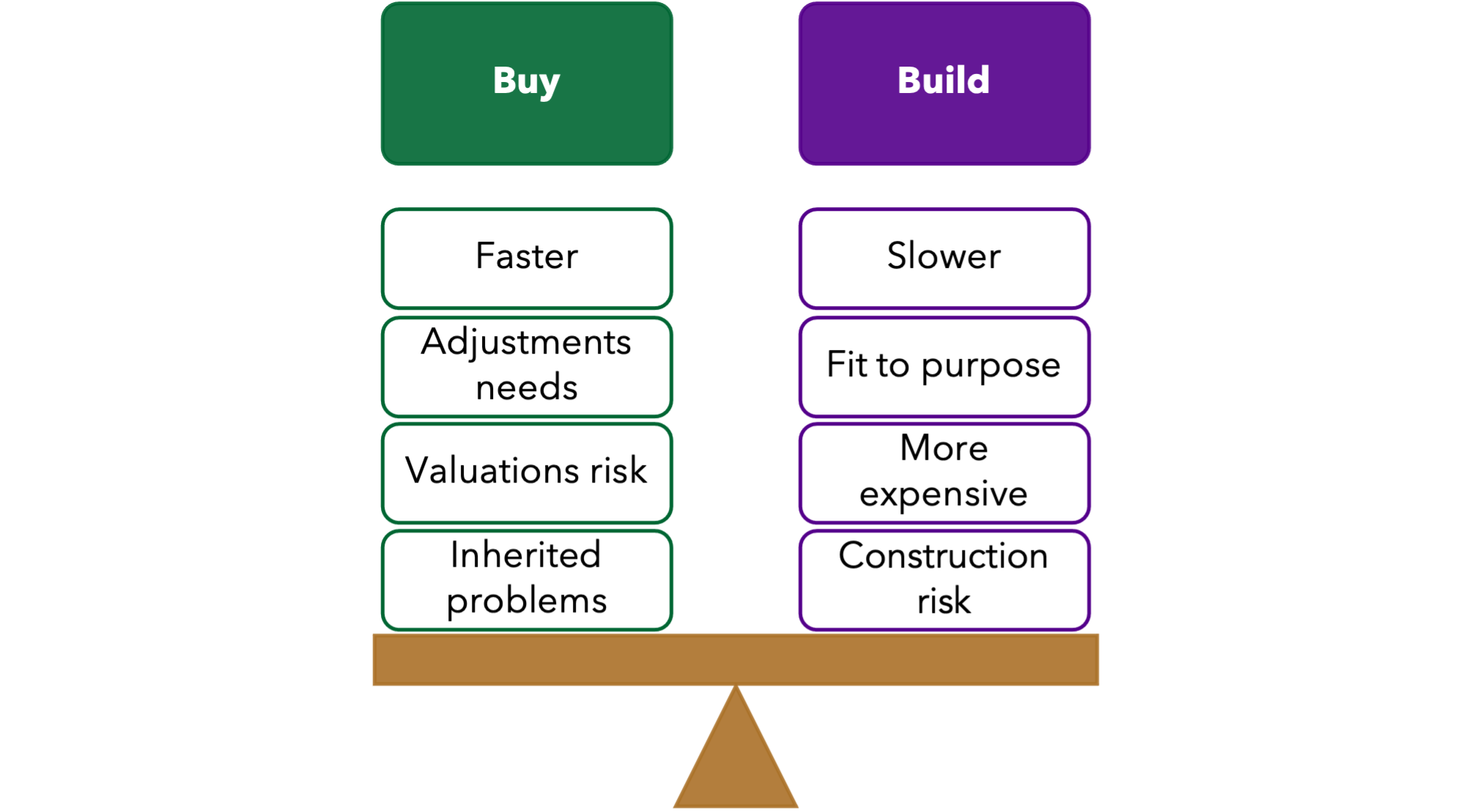
The question “buy or build” is relevant not only for international business, but also for local investments (Exhibit 6-8). However, in the case of foreign direct investment, the issue is complicated by the control factor. An organization intending to invest in another country basically has two choices – to purchase the shares of an already operating organization or a part of them, or to establish a new organization itself. When establishing a new company, production capacity is usually started in a foreign country and all the necessary resources have to be provided, so to speak, from scratch. Such investments are called “green field” investments. The term “green field” basically comes from the situation where the entire infrastructure is created which is necessary, buildings are built and equipment is purchased, and all the work starts when the bulldozers arrive, and the green field is prepared for construction.
Ex. 6‑8 Buy or build dilemma
Keywords: green field investments, brown field investments
The word green is also synonymous with the word new, which can refer to new organization construction projects. The term “green field” refers to buildings built in fields that were literally green. Acquiring an existing organization includes existing production capacity and resources, so in this case is needed to adapt, modernize or otherwise upgrade an existing infrastructure, buildings, facilities and capacity. As a contrast to greenfield, investments in an existing facility are called “brownfield investments”. “Brownfield investments” are often referred to as investments in sites, abandoned defunct factories, or where the initial infrastructure has already been created by someone before.
Greenfield and brownfield investments have both advantages and disadvantages, and the choice depends on the needs and capabilities of the investor. When it comes to the distinction between greenfield and brownfield investments, it should be noted that the basic dilemma for investors is whether to undertake investments from scratch or take over all or part of the existing assets. Therefore, it essentially comes down to a comparison of the greenfield variant and cross-border mergers and acquisitions, considering that brownfield investments – as emphasized by Klaus E Meyer and Saul Estrin and which is widely accepted by international business researchers – are a variant of M&A transactions (Meyer and Estrin 2005). Brownfields concern the situation in which the scope of investment is not only limited to the acquisition of shares (or a part of equity stake), but it also includes significant changes implemented in the acquired entity such as restructuring, modernization, expansion, etc., which may result in an activity similar to greenfield FDI.
There are several reasons why an organization may decide to build a new facility rather than buy or lease an existing one. The main reason is that the new facility provides design flexibility and efficiency to fully meet the needs of the project. The existing facility forces the organization to adjust the current design. It is often cheaper to build a new building and equipment than to adapt an old one. International companies often have even proven standard designs of their buildings and facilities. Investing companies seek economies of scale even when setting up businesses in new countries. For example, some German multinational food retailers have a standardized building design with all standardized equipment. Such an international organization aims to have uniformity in all its stores all over the world, because the cost of their construction and the purchase of equipment is much cheaper than trying to open a store in an existing building every time, which would mean that all the equipment will have to be individually adapted and designed separately, because any random commercial building usually has different interior length, width, height, number of floors and other things differ too. When an international organization has its investments directed to many countries and many cities, the number of identical stores starts to reach hundreds or even thousands, which is already a serious argument when negotiating price with suppliers for building materials or equipment. In the case of a manufacturing business, it is usually not possible to ensure such economies of scale as in the case of a chain of stores. Manufacturer’s production capacity often has certain specifications in advance regarding the length, width, design of the building, the raw material warehouse, the finished product warehouse, the size of the service personnel’s offices and other important details. Thus, the design of the building from scratch meets all the needs of the investor. For investors in an existing plant with equipment, an important focus is the novelty and depreciation of that equipment. New equipment is generally much cheaper to maintain than used equipment. Often, international companies aim to use standardized equipment in all their branches in different countries, because this ensures the supply of spare parts and finally lower service prices can be negotiated with suppliers. When investing in an existing plant with existing facilities, these facilities may not be suitable. Thus, once the investor has paid for the equipment, he may be forced to dismantle it and invest again in the purchase of suitable or standardized equipment.
If an organization that has invested in another country wants to promote its new activities or attract employees, new premises are also more favorable. This is especially relevant in those countries where the demand for workers is greater than the supply. In higher value-added businesses, especially in the service sector, foreign investors often build new modern office buildings to convey a message to the local labor market. When investing in other countries, banks and insurance companies seek to attract one of the most important resources of this type of business – employees, so brand new of even luxurious offices are often a way to attract employees. However, green field investments also have disadvantages compared to investments in already operating or abandoned production capacities. First, it is the duration until the start of the business. To build new buildings in new territories, it is usually necessary to prepare a lot of documents according to the legislation of that country. These can also be spatial planning documents, such as a general or special plan. These documents often need to be approved by local authorities, which can take months to years. Other important procedures that are mandatory for a new facility in most European countries, America, Australia, and some Asian countries are environmental impact assessment procedures. Such procedures also take from several to a dozen months. Another important stage is the procedure for coordinating the construction project and obtaining a building permit in accordance with local legislation. The design procedures may range from several months to a year, and the procedures for obtaining a construction permit can also take a similar amount of time. Thus, from the idea of investing to the start of construction, it can take from a twelve to several dozen months. Including about a year for construction and installation, the total duration from idea to start of operations is at least several years. Depending on the local law and procedures in which the investment is made, these periods can differ greatly, for this a prior excellent knowledge of the local legal acts and procedures is necessary. When investing in an already company, this period is usually saved, as it avoids both the construction of the buildings themselves, as well as all related territory planning, environmental impact assessment and construction permit procedures. Besides the longer term, building from scratch can bring more risks, and contingencies. One of these is higher than costs planned for construction and installation. It often happens that if the process of preparing documents takes time, the situation in the country changes within a few years, due to inflation or other factors, the price of construction raw materials and construction work can become more expensive than expected. There might be a possibility that problems arise with the productivity and quality of local labor during the construction phase.
“Brownfield investments” occur when the timeframe until the commencement of operations is important to the investor. Waiting several years for a factory, built from scratch often goes against the company’s strategy, and even such a deadline is too late, and costs are less predictable. Some investors see “brownfield investments” as a great time and money saver because they don’t have to build a whole new building. When investing in brownfield, investors usually search for buildings in the host country that are compatible with their business models and production processes. However, when investing in existing or abandoned production capacity, organizations face certain risks due to hidden issues. For example, the land on which the facility is located may be contaminated by the previous owner’s activities, and the new owner may have to bear cleanup costs or even pay pollution fines. Before investing in existing production capacities, organizations aim to perform deep detailed inspection as much as possible, called due diligence, which covers financial and operational features (Meyer & Estrin, 2001).
“Green field investment” is the most expensive and time-consuming method of international expansion. This method is applied when the organization has and seeks long-term commitments, the investment is in line with a long-term strategy, the nature of the investment and the requirements for the production or trading capacity to be created are quite specific or unique. On the other hand, if the organization expands to many countries and uses its own infrastructure and equipment for development, then there is an effect of economies of scale, and in certain cases, building a new but standardized facility in another country can be cheaper than adapting an old facility. This is very typical of retail chains that have their own standardized stores, and they will be identical in every country. However, it is rare for an organization to have such a scale of development that it can apply the principles of economy of scale even to the objects in which it invests in its construction. However, green field investment is more typical for those cases where, due to the specificity of production, it can be very difficult to adapt the old one, for example, an area of a certain size is required, a service infrastructure of a certain capacity, such as railway lines, an area that would be dedicated to a storage of raw materials or manufactured products.
Advantages of green field investments abroad:
- This method makes it possible to best adapt the investment object to the specific needs of the company.
- In certain cases, if expanding to many countries, economies of scale can be achieved due to standardization of design, construction and equipment.
- When companies establish a new organization abroad and make greenfield investments, they retain full control of the organization from the day one.
Disadvantages of greenfield investment abroad:
- This is the most expensive way of expanding abroad.
- This is the slowest way of expanding abroad due to construction and due the search and hiring of employees.
Since foreign direct investment is beneficial not only for the investor, but also for the countries in which the investment is done, especially for the governments of those countries that seek to solve the issues of unemployment, industrial composition, and technology attraction, the government makes efforts to promote such incoming investments. This is a bit opposite direction than in the case of export promotion. In the case of export promotion, as discussed in Chapter 3 of the book, governments seek to promote their own country’s exporter, while in the case of FDI, governments encourage foreign investors. There are various methods of promotion and their significance as the arrival of investors is very high.
From strategic management point of view, it is reasonable to mention that here is important the perspective of building the international structure of interorganizational relation. Those aspects are not included in the current chapter as alliance type business models are described in chapter 5. The structures of organizations and emerging on state-owned or state-shared enterprises, so called state-owned multinationals are described in chapter 11.
Share or comment this information on your social media:
Fundamentals of global business
First edition
For citation:
Jarzemskis A. (2025). Fundamentals of global business, Litibero publishing, 496 p.

Full scope of the book is available in various formats
B.6. Foreign investments
- International resource movements
- Foreign direct investments
- Foreign portfolio investments
- Pros and cons for investing abroad
- Incoming foreign investments
- Management and design of foreign investments
- Attraction of foreign investments and free economic zones
- Mergers and acquisitions
- Questions for chapter review
- Chapter bibliography
About author
The author has been teaching at several universities since 2005. 40+ scientific publications, 10+ international research projects. More about author.