Logistics has been defined differently by various authors. There is probably no single accurate definition of logistics. One option to define logistics is the integrated management and control of physical and informational flows of goods between economic entities, in time and space, starting with raw materials, production components, and final products, including suppliers, manufacturers and end users. The word “logistics” and the principles applied by modern logistics date back to ancient times.
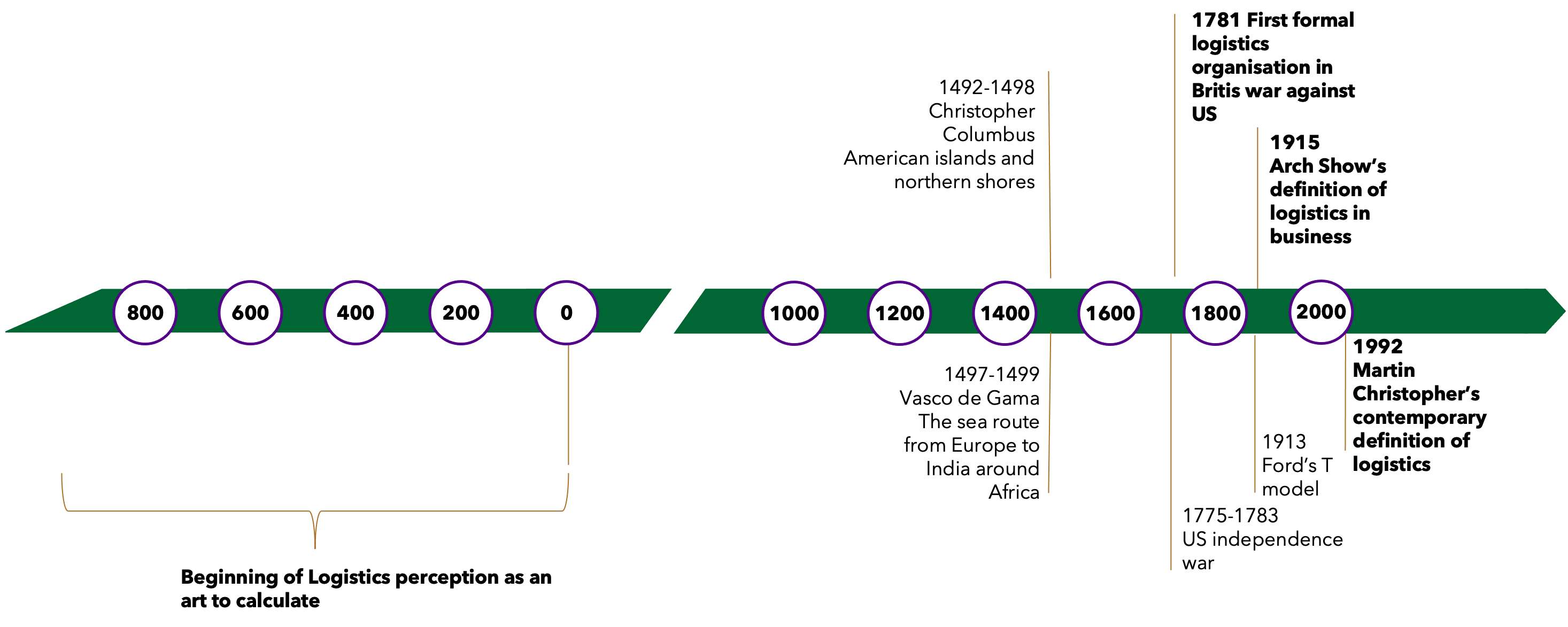
In ancient Greece, logistics specialists monitored the demand, forecasted harvests, planned and purchased the harvest, stored it, then distributed it according to the needs of the population. Greek word “Logistike” means the art of calculating. Logistics specialists have determined what part of the harvested stock should be kept by the country that grew it, and what part could be sold to other countries or exchanged for other goods. Logistics specialists also calculated how much stock should be kept, what size warehouses are needed to store the stock. Thus, logistics was primarily associated with the storage and distribution of agricultural products and food, securing and allocating enough supplies for the population.
Another historical significance of the use of logistics was in warfare (Christopher 2011). Throughout human history, wars have been determined by technological superiority, army size, motivation, and logistics. Logistical solutions made it possible for even smaller armies to win against larger ones. For example, Britain’s defeat in the American Independence War is caused by logistics (Bowler, 1975). The British Army in America was almost entirely dependent on the supply of arms, ammunition, and food from Great Britain. Even six years into the war, resupply was chaotic, unsystematic and poorly organized, leaving the 12,000 troops overseas inadequately supplied with vital supplies at the height of the war. This affected both the course of military operations and the morale of the army. The deficits were reduced in 1781, when the British created a formal organizational structure to ensure a better performing logistics, but it was too late. So, poor supply logistics contributed to the independence of the United States of America and the end of the war. Another war in which logistics was very important was World War II.
Ex. 12‑1 Logistics from ancient history to contemporary trends
Keywords: agriculture logistics, business logistics, military logistics
On the one hand, well-organized logistics were demonstrated at the beginning of the war by the Nazi forces, which quickly transferred their military equipment, weapons, ammunition, and human resources to conquered territories in many countries in Europe with efficient transport solutions, thus making it possible to further conquer new territories from conquered territories.
Railways were used very efficiently to transport tanks, cannons, military equipment in large volumes, at large distances. However, in the World War II, the Allies also demonstrated high mastery in logistics. The Allied invasion of Europe via Normandy was a highly skilled logistical operation, both in its scale and speed. Gathering a large number of resources at the same time and transferring them across the sea to land was quite difficult. It was necessary to synchronize port, loading, land transport, sea transport, and storage operations. Especially, it had to be done in such a way that the enemy’s intelligence could not track and prepare for defense.
Despite the undeniable significance of logistics in warfare, logistics as a strategic tool in its modern form only came to business world in the twentieth century. One of the first theorists of logistics can be considered Arch Show, who in 1915 identified the importance of logistics in business (Shaw, 1915). He found that many problems arise when there is a mismatch between the increasing demand for products and the physical ability to make the products available, and that these problems can be solved through synchronized planning of both demand and supply, and that it is very important to coordinate this between different organizations cooperating in business.
About 80 years later, in 1992, Martin Christopher (Christopher, 1992). defined logistics as follows: “Logistics is the process of strategically managing the procurement, movement and storage of materials, parts and finished inventory (and the related information flows) through the organization and its marketing channels in such a way that current and future profitability are maximized through the cost-effective fulfilment of orders” (Exhibit 12-1).
Ex. 12‑2 Logistics integration in second part of 20th Century

Keywords: integration logistics, transportation, warehousing
Until 1960, logistics was understood and organized in a very fragmented way (Exhibit 12-2). Each individual logistics function was performed with little or no coordination with other functions. For example, product packaging was highly individualized; it was understood as a separate function. The size and method of packaging was customized individually, with little thought given to how this packaging would fit with the dimensions of the vehicle and the dimensions of the warehouse. Transportation was also understood as a separate function and was understood simply as the transportation of goods that must be carried out to get them from the factory to the warehouse or store. Packaged goods used to be loaded into vehicles either manually or with the help of mechanized equipment, and each loading operation was quite individual and depended on the traditions of the transport company and workers. For example, it took more than a week to load the goods onto the ships, and every port involved a lot of manual efforts by labor. A very large variety of cranes and packages made each loading of ship, train, or truck almost unique. Warehousing was also understood as a separate function of accumulating raw materials for production or storing newly produced products. Each warehouse was equipped differently, and storekeepers were concerned with the protection of goods against theft and the accounting and adequate replenishment of goods or raw materials stored in the warehouse.
Raw material supply plans, stock forecasting, production distribution planning, and demand forecasting were also performed by different specialists who failed to coordinate their activities with each other on regular basis, as these were understood as separate functions. These functions were not considered as logistics related and were rarely combined with the organizational aspects of transportation, storage or packaging. If individual logistics functions were performed by the organization itself then there was more coordination, but often various functions were outsourced. For example, a trucking operator was hired to transport goods, if there was a need to store products or raw materials, warehouse owners were approached. If goods needed to be transported to another continent, maritime operators were contacted. The beginning of logistics integration could be considered the 1960s. In 1956, Malcom McLean was the first to start organizing logistics services by applying standardization and the principles of economies of scale. A significant boost was the introduction of a standardized container for shipping cargo. In the 1950s and 1970s, important changes took place in the organization and standardization of logistics services. Such fragmentary functions as demand forecasting, raw material order planning, production planning, and raw material inventory management were understood as a unified system, which acquired the name of materials management. Under this name, specialists are trained in universities and colleges till now. Functions such as warehousing of finished products, production distribution planning, sales order management and physical transportation of goods were understood as physical distribution.
Ex. 12‑3 Micro and macro logistics
Keywords: supply, distribution, micro logistics, macro logistics
In the last decade of the 20th century, the integration of materials management, physical distribution, along with warehousing and packaging, it was eventually perceived as a unified system, which came to be called logistics. With the rapid development of information technologies, the internet, real-time data exchange, logistics has become an equivalent function to the organization’s strategic planning and marketing. In the 21st century, the concept of supply chain management is increasingly used (Mangan et al. 2020).
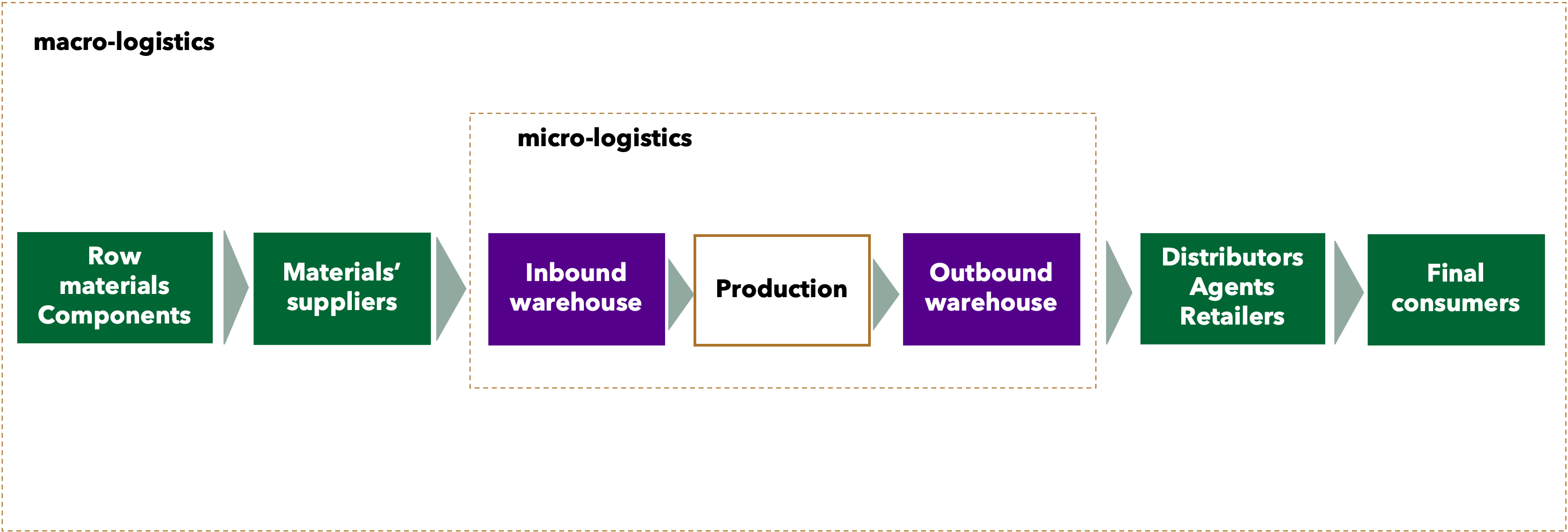
In a manufacturing industry, it is common to examine logistics at the micro level and at the macro level (Exhibit 12-3). The micro level is understood as the organization’s internal processes in its territory – starting with the planning of the quantity of raw materials needed for production, including warehouse for accumulation of raw materials and ending with the storage of recently finished products. Micro-logistics includes the processes that take place in the delivery of raw materials or components to the organization’s production process, as well as the packaging and placement of finished products in the warehouse of finished products. Macro-logistics includes the entire supply chain (Bookbinder, 2012), from the selection of raw material locations, selection of suppliers, the selection of optimal supply routes, even selection of the production location, all the way to the retail sector with distribution to consumer markets, the delivery of goods to the end user, and eventual collection and returns if needed. Basically, in global business, the selection of a production location, which is often related to the choice of a continent or country for investments or other forms of cooperation, is very often solved as a complex task in which macro-logistics plays an important role. Location is one of business internationalization factors in OLI paradigm which is described in Chapter 6.
Logistics also can be divided into “inbound” logistics and “outbound” logistics. “Inbound” logistics is understood as the producer’s supply of raw materials, components or semi-finished products. “Inbound” logistics is also called supply logistics or simply supply. “Outbound” logistics is understood as the organization of the path of the finished product to the end user, it is also called distribution.
Opposite to the tendency of integrating more activities into the supply chain management and logistics planning, in the last decades, it is observed an increase in complexity. Specialized logistics activities have been developed along the supply chain partners, with complementary flow of goods and information, from the raw material supply specialists in manufacturing logistics, the warehousing and retail logistics, up to customer home delivery, creating a vast variety of markets and business models, often leading to so-called niche markets for specialized logistics companies.
Further specialized activities occur in maritime logistics and in air cargo, with ports and airports serving as hubs in global logistics transportation chains.
Share or comment this information on your social media:
Fundamentals of global business
First edition
For citation:
Jarzemskis A. (2025). Fundamentals of global business, Litibero publishing, 496 p.

Full scope of the book is available in various formats
About author
The author has been teaching at several universities since 2005. 40+ scientific publications, 10+ international research projects. More about author.