The section describes the latest theories explaining global business characteristics, which are based on a company’s or products international competitiveness. The section also introduces Raymond Vernon’s theory of the product life cycle, Steffan Linder’s theory of country similarity (Linder, 1961), Paul Krugman and Kelvin Lancaster’s theory of global strategic competition, and Michael Porter’s theory of competitive advantage (Porter, 1990).
All of the economic theories explaining international trade described in Chapter 1 above are based on approach of the relations and interaction between nations or countries. Those theories explain and describe the trade relations that is happening between countries. The acceleration of globalization brings the fact that many organizations, brands and products in the world are very difficult to identify as belonging to any one country. Many organizations that operate under same brand are established in different countries. Only the country where a headquarter located is usually considered as the home country of the organization. However, organizations often relocate their headquarters to the countries with more favorable taxes to obtain tax benefits, so the country where a headquarter is located is not necessarily indicate the actual origin country. For products and their components also is hard or impossible to describe the country of origin accurately. The country of origin of a product is usually considered to be either the country of assembly and packaging of the final product or the country in which owner of the product’s intellectual property and brand is located. This complexity in attributing products and organizations to a particular country makes collecting statistics and calculating trade statistics between countries very challenging. For example, China is growing significantly in computer industry export industry because a large number of computers are assembled in the country, but before they are assembled in China, the component parts are manufactured in the USA, Germany and Japan and imported into China. Thus, China imports a large number of components for assembling them and exporting them as the final product later. This effect, which gained extreme popularity at the end of the 20th century and at the beginning of the 21st century, greatly distorts the traditional application of classical international economics. Countries’ exports and imports are no longer dependent on a particular country but on the organization and the product itself.
Ex. 1‑30 Classical economic theories and company/product-based theories
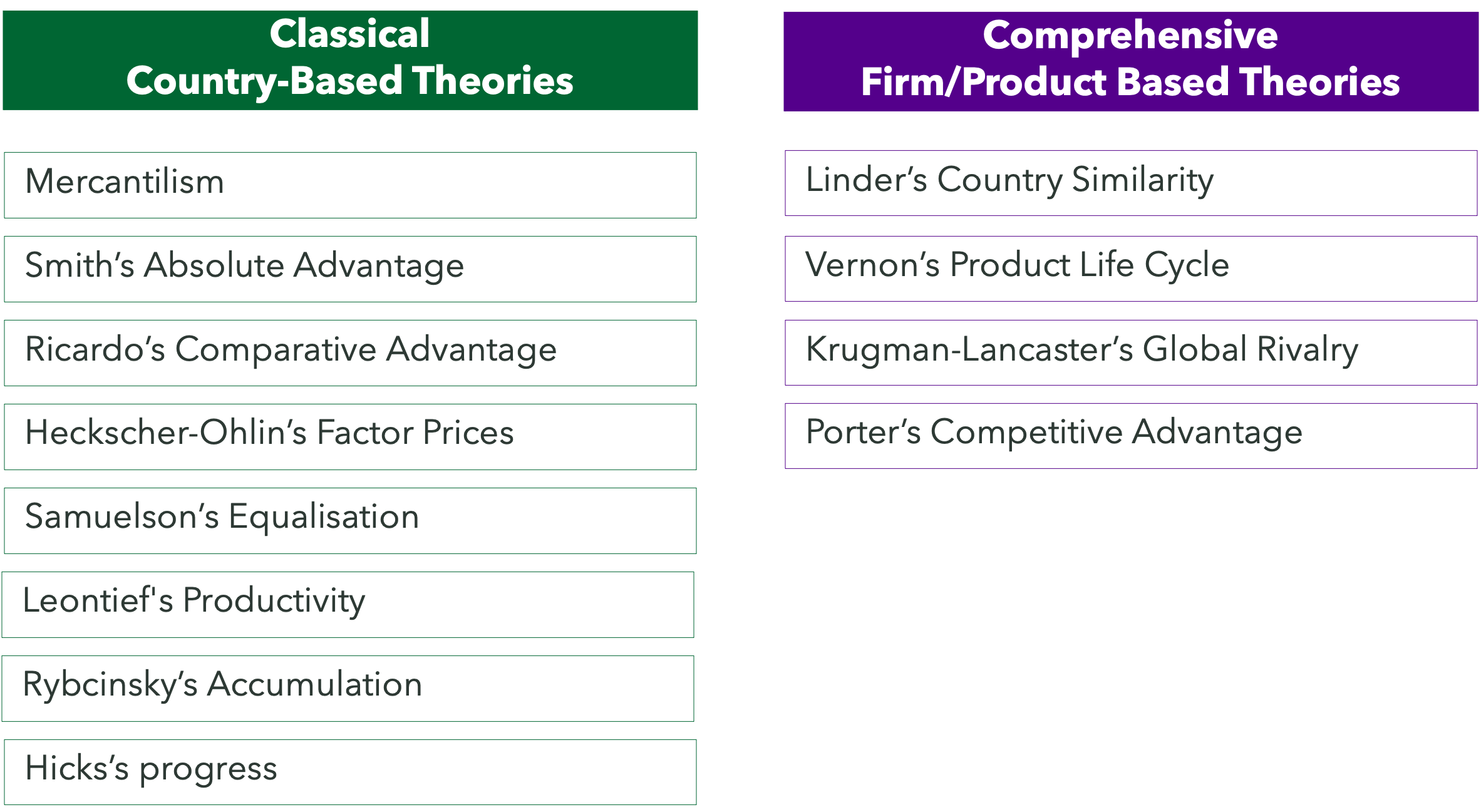
Keywords: contemporary business internationalisation theories
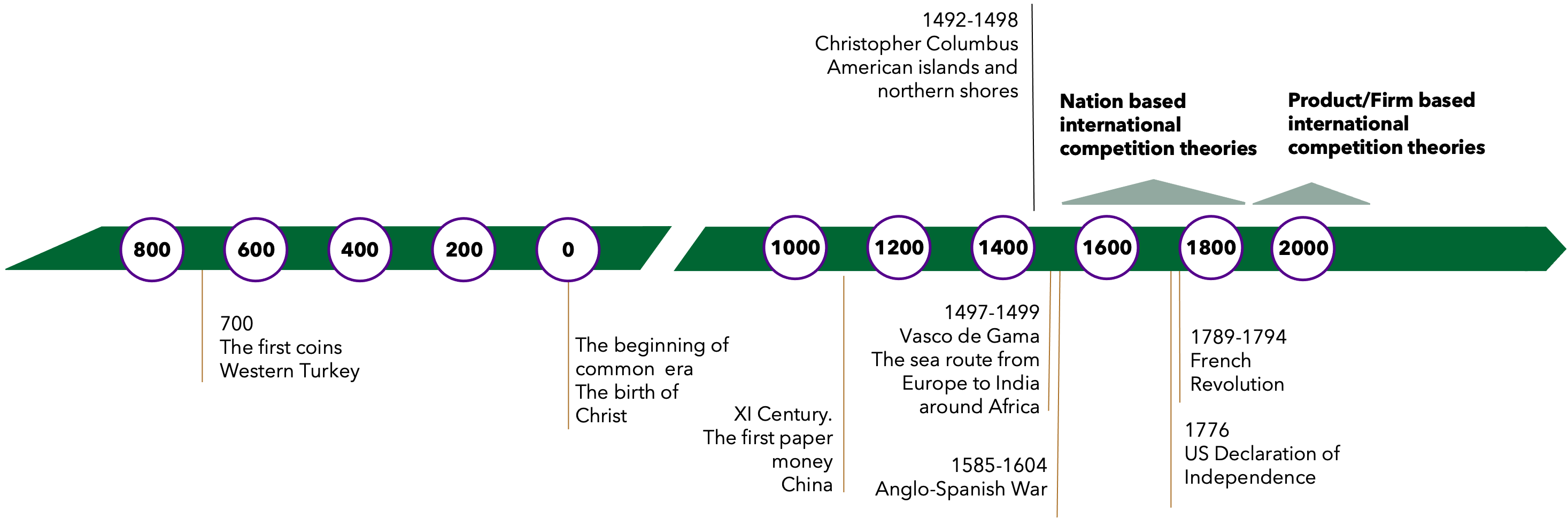
Therefore, international economic theories based on country relations can be considered insufficient to understand the global business today. Comprehensive theories do not contradict but complement and refine classical theories of international economics and business and make them relevant for the 21st century (Exhibit 1-31).
Ex. 1‑31 Nation-based and product/firm-based theories in the context of other significant events
Keywords: business internationalisationThe main theories explaining product- and company-based global business could be the following (Exhibit 1-30):
• Similarity between countries.
• Product’s international lifecycle.
• Global strategic rivalry.
• Nation’s competitive advantage.
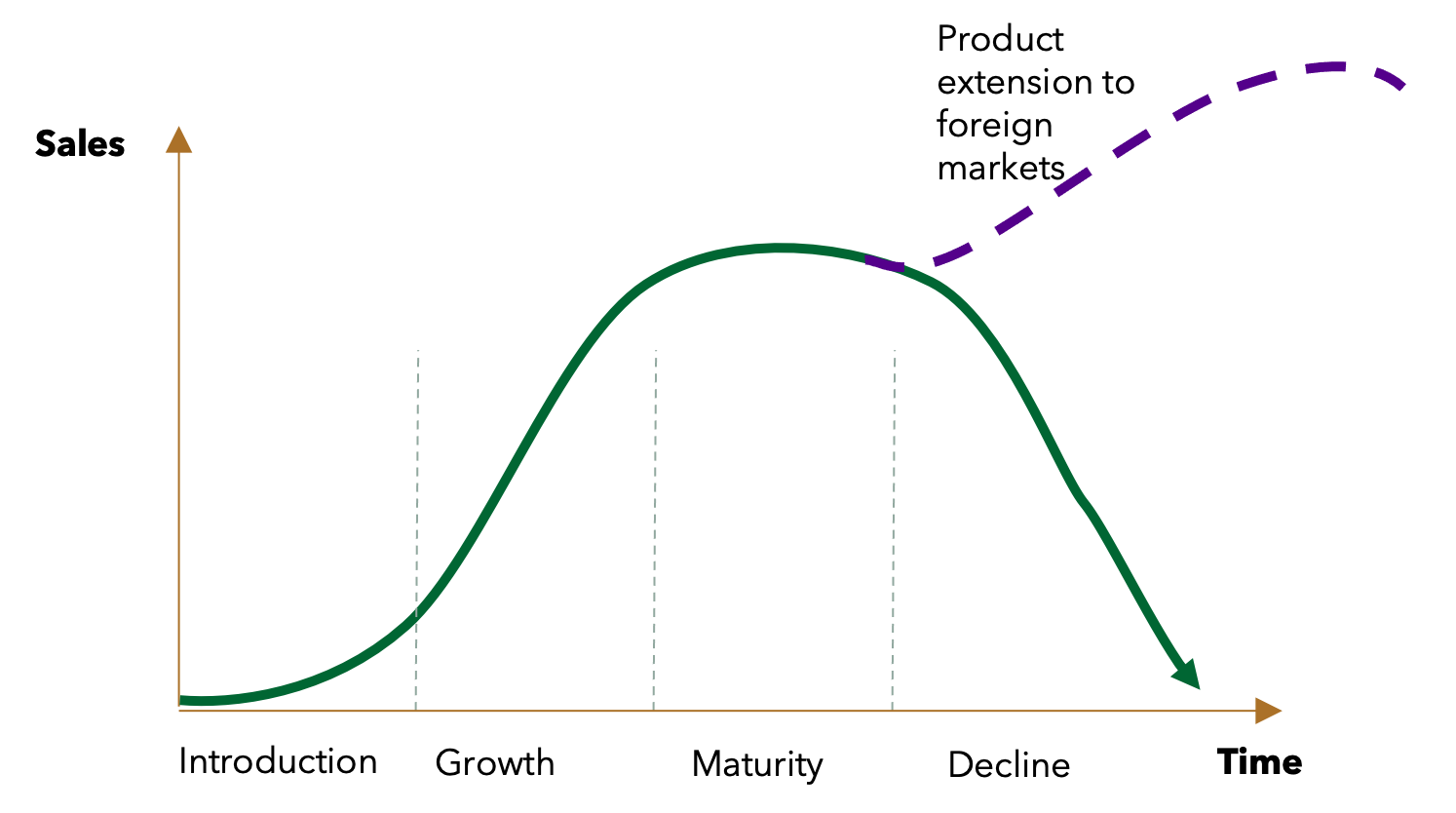
Product life cycle theory was developed by Raymond Vernon in the 1960s. Raymond Vernon observed that every product has a life cycle consisting of three phases – new product development and introduction, product growth and maturity, and phase of standardized product (Vernon, 1966).
Ex. 1‑32 Vernon’s product lifecycle
Keywords:growth, maturity, decline, product cycle
The theory stated that a product launch would take place in the same country in which the product was developed. In other words, the theory argued that innovation is first tested in its ‘home country’. This theory worked well and could explain the strong industrial growth in the USA in the 1960s and the introduction of new products in the USA market which were never been seen before. If the products were successful in the domestic market, they were exported to other countries. After the World War II, the US was the place where new products were developed and introduced to the market.
In the maturity phase, competitors enter the market to develop an analogue of a product, while in the standardization phase, the number of competitors is so high that the original producer must find an innovation and introduce it into the market (Exhibit 1-32). Whereas in the introduction and maturity phase, the competition based on characteristics of the product, in the standardized product phase, the competition is only in price. As consequence in this phase profit margins reducing to compare with earlier phases. When local market is saturated, the foreign markets is the new opportunity to jump again into growth phase. It explains motivation export after the demand of a local market is satisfied.
In the 1970s, a first personal computer was manufactured and sold in the USA. The product reached maturity in the late 1980s and 1990s, after which the scale of computer production expanded dramatically, computers became standardized, and manufacturing and assembling were shifted in lower cost countries. Research and development – R&D – is needed to invent and bring a new product to market. R&D is not needed anymore at the maturity phase and in the mass production of a standardized product. However, multinational organizations have realized to reduce costs by using cheaper labor abroad at the production and assembly stage. A large part of the components for computers, although assembled in China, are still designed and some manufactured in the USA, Singapore, Germany and Japan. Thus, each product life cycle requires different competitive advantages and different strategies to employ resources and identify international markets.
Ex. 1‑33 Linder’s Similarity between countries

Keywords: clusters, similarity
The theory of country similarity was developed by Swedish economist Steffan Linder in 1961. He explained the concept and causes of intra-industry trade. Intra-industrial trade is considered when countries import and export very similar products between themselves (Linder, 1961). Linder observed that when firms start producing products, they first produce them for their domestic market, and when the domestic market becomes saturated, exports are sought to countries that are similar to their own (Exhibit 1-33). Some of the most important similarities are consumer tastes and preferences and the population’s income level. Brands and product reputation have become important criteria in determining the decision of buyers to choose a product.
The similarity of countries is further explored in Part C of the book, which describes cultural clusters – countries and cultures that share many similarities. Similar countries are often geographically close to each other. This may also explain why trade relations or even blocks of states are established between these countries.
The theory of global strategic competition was developed in the 1980s by Paul Krugman (Krugman, 1980, 1991) and Kelvin Lancaster (Lancaster 1980). They argued that multinational organizations seek a competitive advantage over other global organizations in a particular industry. Since multinationals often have equal access to capital and human resources or can seek equal access (see more in Part B, chapters 5 and 6), these scholars considered barriers to entry a critical competitive advantage. This can be explained as a drive to do something, what a competitor cannot do for some reason. Examples of barriers could be the protection of intellectual property rights (more in Part B, Chapter 4), low-cost pricing based on economies of scale, restrictions on access to raw materials, exclusive rights to component suppliers or know-how. These competitive constraints are often country-independent, although exceptions can sometimes be found. Some countries seek to prevent the transfer of their technology, especially know-how, to other countries by intervening in the free market. This is particularly the case for advanced technologies in the information technology, semiconductor, and defense industries. For example, the R&D and production of microprocessors and the semiconductors needed are concentrated in Singapore and Taiwan. Even private organizations are constrained in transferring technology to other organizations or countries by law or by contracts with core business partners. The low-cost advantage in international trade is also sometimes limited by countries (see more in Part B, Chapter 3) through the imposition of customs duties on imported goods. This makes the goods more expensive on the domestic market than the producer is actually able and willing to sell them.
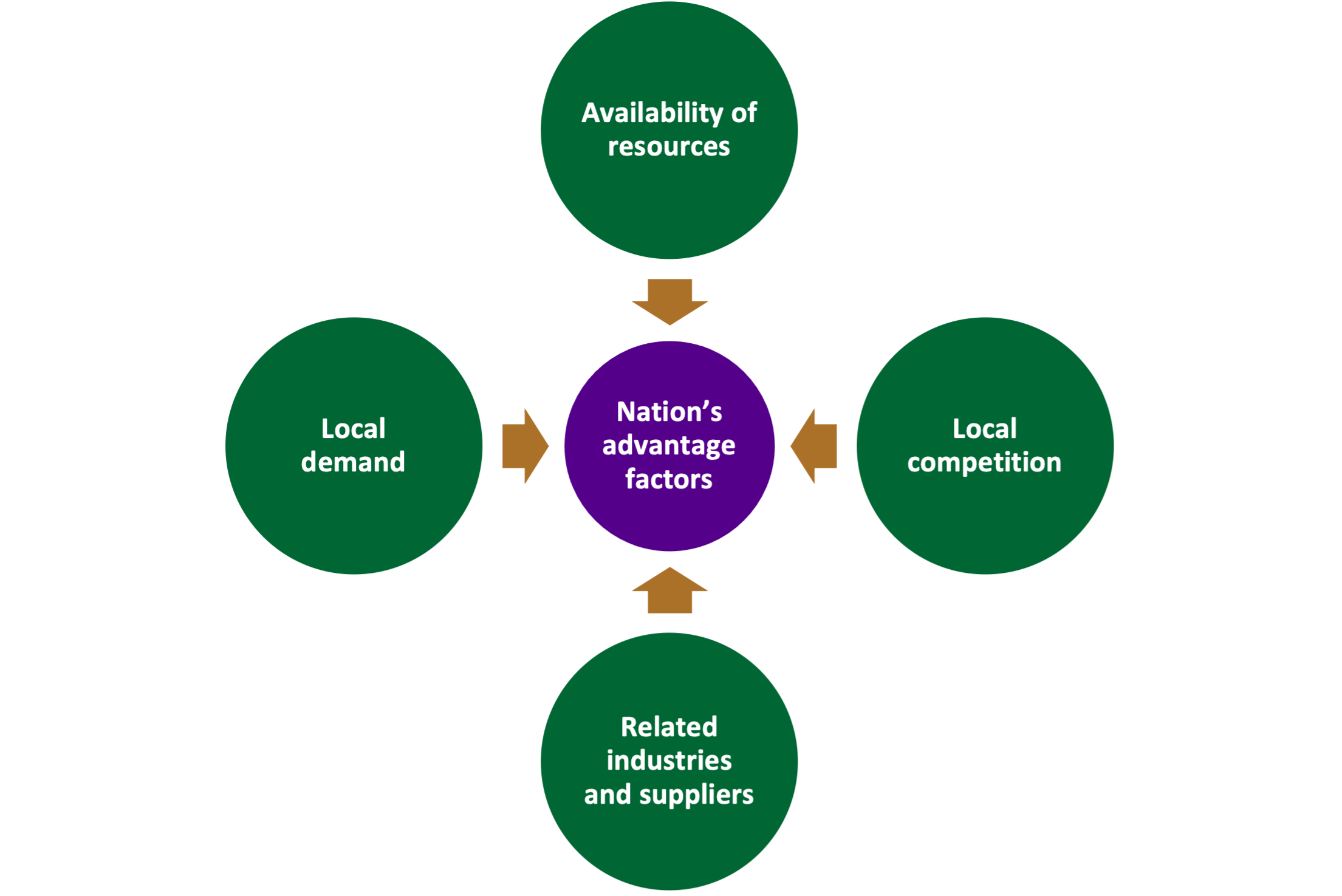
The theory of the competitive advantage of nations was developed by Michael Porter in his 1990 book “The Competitive Advantage of Nations”. Porter proposed a rhombus-like structure representing four components: availability of resources, local demand, related industries and suppliers, and organization strategy, structure, and competitive pressures (Exhibit 1-34).
Ex. 1‑34 Porter’s diamond of the nations advantage
Keywords: resources, demand, suppliers, competitors
The availability of basic resources such as natural materials, climatic conditions, location, demographics, and the labor is important. The basic factors are difficult to change, but they create just the initial conditions for competitiveness. Equally important are the factors that can be influenced by national governments, such as transport and communications infrastructure, the skills of labor, the research base. For example, in Switzerland, labor have been scarce, so the country has developed an industry that requires a small but highly skilled workforce – watch making and precision machinery. In Sweden, the climate and geology are very unfavorable for heavy construction, so the country developed a method of building pre-framed wooden houses. Many countries in Europe are lacking raw materials, so they have built prosperity based on R&D and innovations, as well achieved mastery in distribution.
Local demand is essential for creating competitiveness. Local demand allows products to be tested, consumer needs and expectations to be better understood, feedback is given more quickly, and product improvements to be made. For example, Italy and Spain are leaders in the production of ceramic tiles on international markets. This is due to the hot climate and the relatively large number of consumers who wanted cool floors. In France, the dominance of the wine industry is because the French people like a wine. The local market becomes a testing ground for many organizations. The larger the local market and the more purchasing power it has, the more opportunities organizations must test and discover products that can then be sold on the global market later.
Related industries and suppliers. Suppliers of raw materials and components are important for the functioning of each industry. Having domestic suppliers of raw materials and components and investing in that sector’s innovations makes it easier to have better quality raw materials and components. On the other hand, even domestic competitors in same industry or in similar are important if they use the same components or raw materials. For example, the pharmaceutical industry will be better placed in a country where the food supplement industry is also developed because both industries use similarly or equally skilled human resources and similar or same chemical components. Furthermore, the presence of several similar related industries in the same country allows for greater specialization by the suppliers of those industries, such as universities as suppliers of skilled labor, producers of components or miners of raw materials. For example, if a country has a well-developed information technology industry and a large number of programmers, there is a high probability that a strong university with very strong mathematics and electronics engineering faculties is established in that country. Such university strengthen its training and research base in these specialties because of the local market demand for programmers. Such specialized university also enables more electronic industries to operate in the country, as it uses mathematics and electronics engineering skills. Thus, if there are industries making software in the same country, the general conditions are much better for a hardware manufacturer to operate in that country too, because both industries will use the same high qualified labor, the quantity and quality of which will grow because the two industries create a market and demand for it.
Organization’s strategy, structure, and competitive pressures. If an organization has competitors in a country, it is constantly competing and is forced to build up its capacity to withstand local competition. This makes the organization stronger in international competition. Similarly, in sports, in football, in countries where there are strong internal leagues – Italy, Spain, England, Germany, France – those countries have very good performances in international competition between countries, for instance in the world championship. In business, if an organization has to compete and improve its products in the local market having pressure from local competitors, it must continuously invest in innovation, product improvement, and cost reduction. This makes its product more competitive in the domestic market but also more competitive in the international market. In contrast to this, take the example of communism. In the Soviet Union, between 1917 and 1991, the introduction of communism led to the abolition of the market economy and competition. A planned economy meant that the state planned how much output would be needed and ordered to the state-owned manufacturers to produce it. In the absence of competition, products were produced at low quality because there was no motivation to improve. Although the authorities heavily restricted the export of products in the Soviet Union, these products were not competitive in world markets. This was particularly evident with the collapse of the Soviet Union after 1991. The quality of the products was deplorable, and post-Soviet Russia was able to export raw oil, gas and metals, as nobody bought the finished products on the world markets because of their low quality. The same thing happened with all the post-Soviet countries. It took some 20 to 30 years for the post-Soviet countries to transform their industries, create local competition, and export finished products or components to global markets.
Share or comment this information on your social media:
Fundamentals of global business
First edition
For citation:
Jarzemskis A. (2025). Fundamentals of global business, Litibero publishing, 496 p.

Full scope of the book is available in various formats
A.1 Theories of international economics
- Mercantilism
- Adam Smith and absolute advantage
- David Ricardo and Comparative advantage
- Standard theory of International trade
- Karl Marx and communism
- Hekscher – Ohlin theory
- Paul A Samuelson theory
- Leontief paradox
- Rybczynski theory
- John Hicks and progress
- Economies of scale theory
- Contemporary business internationalisation theories
- Questions for chapter review
- Chapter bibliography
About author
The author has been teaching at several universities since 2005. 40+ scientific publications, 10+ international research projects. More about author.