Mercantilism is the dominant state ideology governing trade relations with other states and the mainstream of economic relations in the 17th and 18th centuries (Exhibit 1-1). This section presents the reasons for the emergence of mercantilism, the economic policy and the way of thinking that prevailed in Europe at that time. The section describes mercantilism’s main propositions and beliefs, guided by which states began to promote their country’s production and exports.
In the world, individual nations traded even before of writing. Allusions to the exchange of goods can be found in the Sumerian annals, which are considered the first written sources discovered on the planet Earth. Sumerian chronicles contain references to the exchange of goods, food and other goods with foreigners. The exchange of goods between different peoples and cultures is also mentioned in Ancient Egypt and Antiquity. References to trade relations and exchanges between nations abound in the Bible, where one can find the first business plans of that time, even the application of the principles of economies of scale. Writers who lived in Europe, especially in the first port cities, in present-day England, Spain, France, Portugal, and the Netherlands, for a long-time systematized knowledge about the causality of business relations between various cultures and nations. Thanks to developed fleets and explorers, these ancient kingdoms made it possible to discover and learn about other nations, cultures and even continents.
Ex. 1‑1 The spread of mercantilism in the 17-18 centuries among the colonial maritime states of Europe
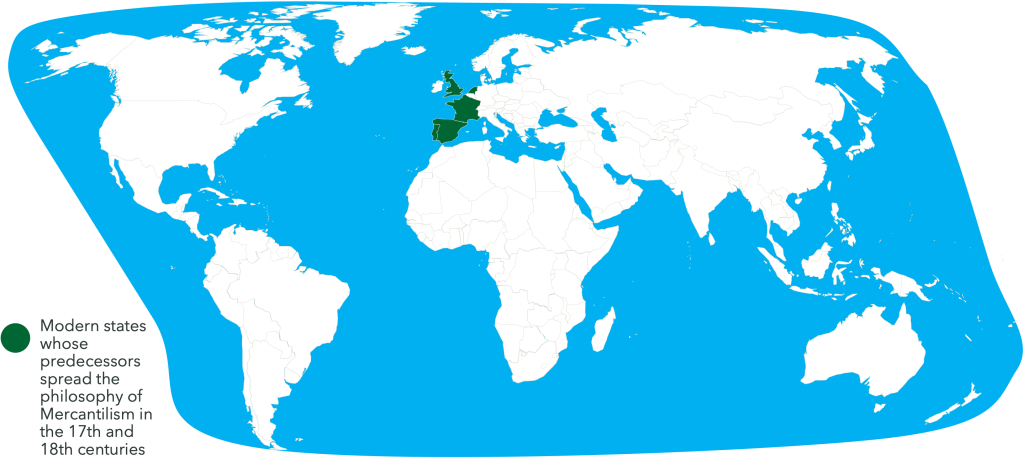
Keywords: Netherlands, France, Spain, Portugal, United Kingdom
Exploration has long been driven by economic interest in strengthening kingdoms, gaining new resources for economic prosperity and competing with other kingdoms. Nowadays, many recognized world economic and business theoreticians consider Adam Smith’s book “The Wealth of Nations”, published in 1776, as the first widely known scientific publication that examines the peculiarities of international business (Smith, 1776). Even before this book published, various merchants, bankers, government officials, and even philosophers wrote publications and essays in the 17th and 18th centuries that gave birth to an economic philosophy called mercantilism (Exhibit 1-2).
Ex. 1‑2 The mercantilist period in the context of other significant events
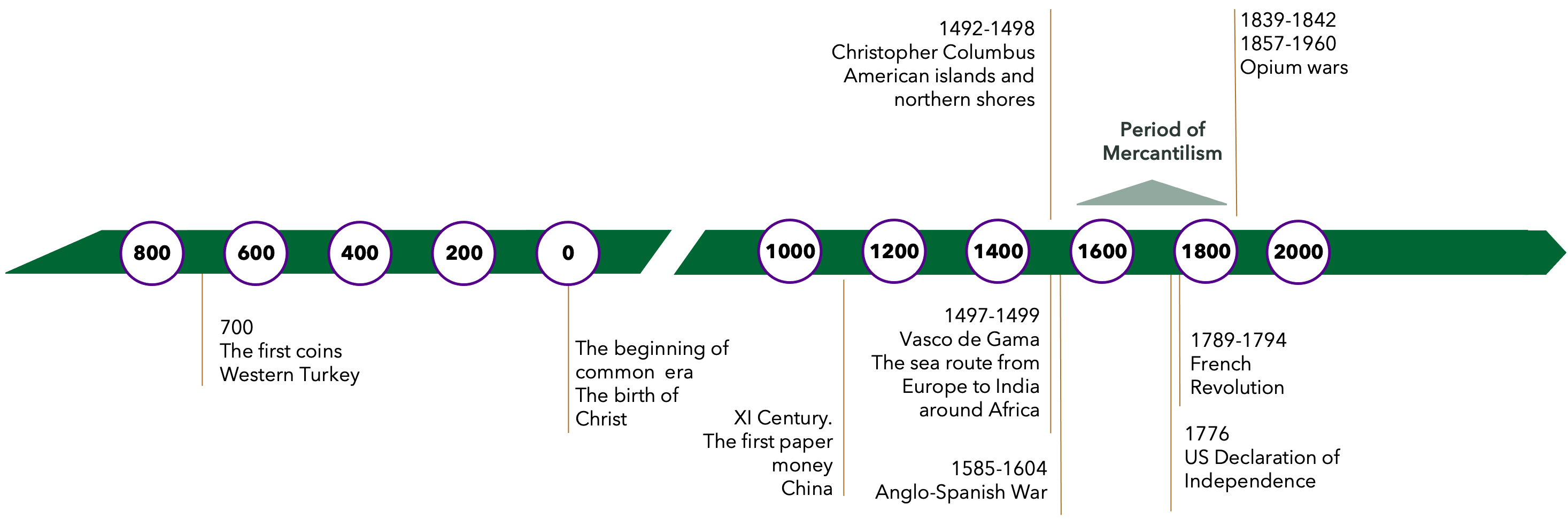
Keywords: Mercantilism, Columbus, Vasco de Gama, US declaration of independence, Anglo-Spanish War
Mercantilism was essentially based on the belief that possessing gold and other precious metals was the source and measure of power for a state or kingdom of the era (Exhibit 1-3). The earliest historical evidence of gold mining and reserve filling in the old European kingdoms is linked to colonization era and plundering. Much of the gold was brought to Europe from South America. Later the cruel competition for gold was replaced by the possibility of obtaining gold not by robing but by trading. As per today’s terminology, that means exporting. Mercantilists believed that a perfect way for a country to get gold was to export more than it is imported from other countries. In this way, gold reserves were replenished. Conversely, it was believed that if a country bought more, i.e., imported more, its gold resources would decrease until eventually run out. Some rulers of that time even pursued a policy restricting imports, especially of the luxury goods. One might wonder why gold, silver and other precious metals were needed. The answer proposed by mercantilists seems to be quite simple and practical – the country with more gold could hire soldiers or entire armies to invade other nations’ territories and protect own land. Soldiers were recruited from both within their kingdom and other nations. However, it is essential to note that the theorists of the time who described the benefits of mercantilism were working for the rulers of the time who were concerned with maintaining their power. Gold and silver then proved to be a convenient way for nations to measure their power. Mercantilists believed that the total amount of gold and silver available at a given time was limited. This dragged humanity towards the principle of zero-sum games, which meant that one nation’s gain was equal to another’s loss.
Ex. 1‑3 The essence of mercantilism

Keywords: Imperialism, mercantilism, export, gold, import
Today humans think very differently our perceptions have changed significantly. Knowledge, human capital, values, attitudes, and skills are considered essential nowadays, but three hundred years ago, it was seen differently with different perspectives (Chapman, 2002).
However, there were positive aspects to mercantilism (Barth, 2016). Nations that encouraged more exports and fewer imports thus stimulated jobs and employment in their territories, creating more output and value, growing agriculture, and strengthening the industry. Another consequence of gold accumulation is an increase in the internal market and circulation of money. Gold converted into gold coins was a common practice during those times, with the kings’ faces minted on them, to increase faith in their king as a guarantor of economic stability, which boosted commercial activities.
Jacob Viner in his book “Studies in the Theory of International Trade”, in 1973 characterizes the English ideas regarding trade before Adam Smith (Viner, 1973). He argued that mercantilism was an economic system represented especially by both, the “bullionist” doctrines of the earlier period that appeared around 1560, the “balance-of-trade” doctrines of the later period that appeared after 1620. The literature on mercantilism describes three chronological stages in the evolution of the balance-of-trade doctrine: first, the individual bargain; second, the notion of the balance of trade with countries, but not the total balance of trade; and, finally, the implementation of the concept of the national or aggregate balance.
Mercantilism can also be found in the 21st century. This is best illustrated by the “America First” slogan, the economic policy that emerged during the election campaign and presidency of Donald Trump, the 43rd President of the United States of America. In current times, it is possible to see a resurgence of mercantilism in the form of neo-mercantilism as nations seek to restrict imports to promote domestic production and employment (Crowley, 1990).
Share or comment this information on your social media:
Fundamentals of global business
First edition
For citation:
Jarzemskis A. (2025). Fundamentals of global business, Litibero publishing, 496 p.

Full scope of the book is available in various formats
A.1 Theories of international economics
- Mercantilism
- Adam Smith and absolute advantage
- David Ricardo and Comparative advantage
- Standard theory of International trade
- Karl Marx and communism
- Hekscher – Ohlin theory
- Paul A Samuelson theory
- Leontief paradox
- Rybczynski theory
- John Hicks and progress
- Economies of scale theory
- Contemporary business internationalisation theories
- Questions for chapter review
- Chapter bibliography
About author
The author has been teaching at several universities since 2005. 40+ scientific publications, 10+ international research projects. More about author.