The main reasons why countries join various blocs and unions are market size and security. For the sake of security, countries have been joining military alliances since the beginning of the 20th century, such as the Entente 1907-1917 or NATO, created in 1949 and remaining the most powerful military alliance uniting 30 countries. Military alliances are created to protect all partners from external military aggression, especially relevant for small states that do not have the capacity to resist much larger opponents.
Analogously, as in military blocs, the size of the country’s market is very important in economic blocs. A country with more population means it will have more buyers. Many companies that even later grew into multinational corporations started their activities in the local market. For example, there are famous stories about how the founder of Apple, Steve Jobs, together with a friend, started making computers in a garage and selling them in the local market. To apply the principles of specialization and economies of scale, it is extremely important to have access to a large market.
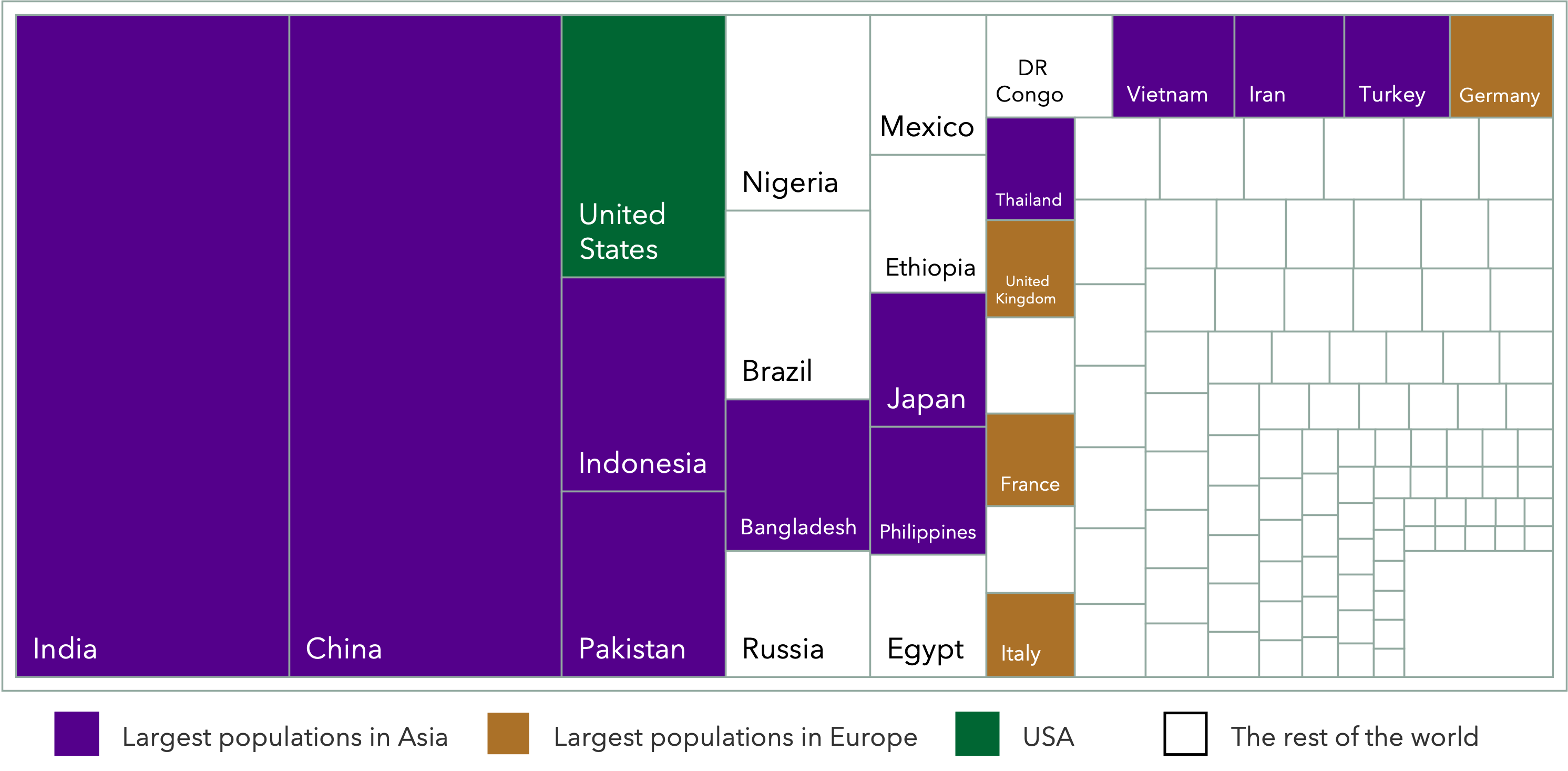
Ex. 3-22 Major foreign markets by population
Keywords: population, market size, India, China, Asia
Among the four prerequisites for international competitiveness described by Michael Porter, the size of the domestic market is important both in terms of the number of buyers and suppliers, and as a domestic playground for training one’s competitiveness. All these theoretical aspects are presented in Chapter 1 of the book. Market size is largely determined by population. In the exhibit, is clear that countries like India and China have the largest population and can be classified as the largest markets (Exhibit 3-22). These markets have a population of over one billion. Of course, it is very important to mention here that not only the number of the population, but also their purchasing power, the income of the population determines how many products the market can buy. Country differences are described in more detail in Book C, Chapter 8. At the second level there are countries with more than one hundred million inhabitants. These are USA, Indonesia, Brazil, Bangladesh, Russia, Pakistan, Nigeria, Mexico, Japan. Of these countries, only the United States and Japan have high income per capita and gross domestic product. It can be noted that the economically developed European industrial countries with high GDP, such as the UK, Germany, France, Italy, Spain, are only at the third level, and their population does not exceed 100 million, and is usually around or just over 50 million. Small countries with a population of less than 10 million can be assigned to the fourth level. Thus, the market size for an organization operating in Estonia, for example, is less than 2 million inhabitants, while Japan has 140 million inhabitants, the USA has 340 million inhabitants. Even if to compare the markets of Germany, France or the UK with the USA, there is a 4-5 times difference. Keeping in mind that trade is not free, for example pharmaceuticals, food, agricultural products cannot circulate freely between European countries and the US, and so the US has significantly larger domestic markets than their respective competitors in Europe. In the absence of free trade, it would be very difficult or impossible for countries in the fourth and even third level to compete alone and independently with other countries. Since universal free trade agreements have not been achieved for many centuries, countries have decided to join economic blocs and thereby increase their markets without losing their sovereignty and independence. There are several types of such blocs: free trade blocs, customs unions, common markets, economic unions and political unions. All these types of blocks do not contradict each other but complement each other with new elements of mutual integration.
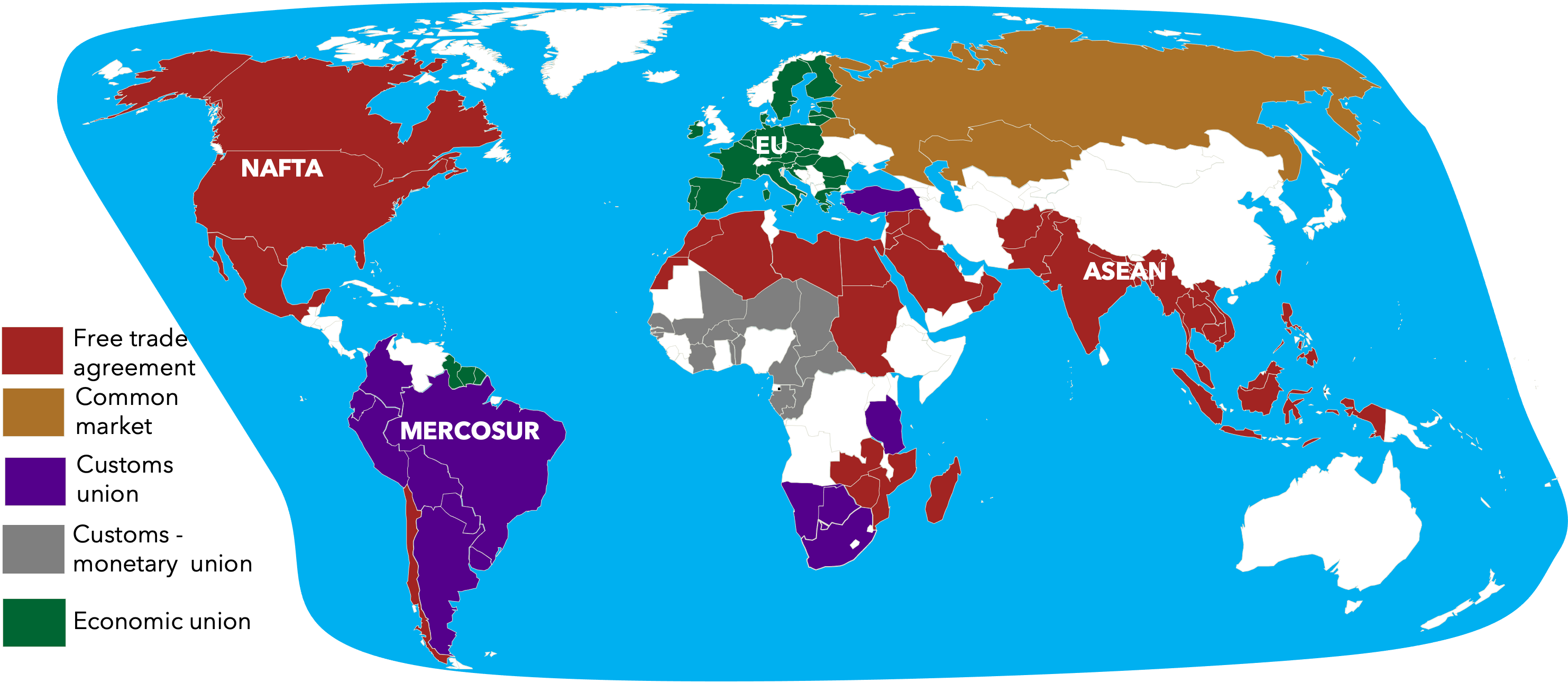
NAFTA, USMCA, Mercosur, ASEAN can be considered as free trade blocs (Exhibit 3-23). Countries in these blocs have agreed among themselves to reduce customs duties on import of goods. In relation to third countries, these countries apply import duties at their own discretion. North American Free Trade Agreement – NAFTA, 1993 consisted of the United States, Canada and Mexico. Mercosur – Mercado de Sur was established in 1991 comprising of Argentina, Brazil, Paraguay, and Uruguay. Mercosur has a greater degree of evolution than a free trade area but does not become a customs union, since although it has a common external tariff and a statistical rate for imports.
Ex. 3-23 Blocks of states
Keywords: Mercantilism, Columbus, Vasco de Gama, US declaration of independence, Anglo-Spanish War
However, the rest of the extra- zone import taxes on products vary in each country in Mercosur. Likewise, it has developed a system of block-level agreements that regulate and certify the Mercosur origin of merchandise and with associated countries, as well as has agreed on common documentation for the transfer of merchandise. Although the original objective was to become a Common Market, the free movement of merchandise/services lacks development and even more so of capital and there has been no attempt to unite legal regulations and regulations on products. For this reason, Mercosur is spoken of as an imperfect Customs Union.
A customs union works in a similar way to a free trade bloc, but it is characterized by the fact that countries in the bloc apply the same customs duties to third countries. An example of a customs union can be the Zollverein or the customs union, which in 1834 established a number of sovereign German states that proved significant in Bismarck’s unification of Germany in 1870.
The common market can be considered a completely free movement of goods, services and capital within the block, but in the common market each country carries out legal regulation and standards of its own products. The most famous example of a common market is the European Union (EU) or the European Common Market, which was established in 1957, developed by West Germany, France, Italy, Belgium, the Netherlands and Luxembourg. Later, in 1993, the European common market evolved into a single market or an economic union. An economic union can be considered an even closer level of integration, including unified legislation regulating trade and product standards, a single currency, and free movement of labor. Basically, the European Union can be considered an economic union, which also has the characteristics of a political union, the common legislator is the European Parliament, and the common government is the European Commission. However, the European Union has not reached an absolute political union, although political debates about granting greater powers to the central EU government and reducing the decision-making powers of individual states can be heard in political debates since the second decade of the 21st century.
EU members increased to 15 after 1973 joined by the United Kingdom, Denmark and Ireland, Greece in 1981, Spain and Portugal in 1986, Austria, Finland and Sweden in 1995. In 2004, 10 countries joined the European Union – Estonia, Latvia, Lithuania, Poland, the Czech Republic, Slovakia, Hungary, Slovenia, Cyprus and Malta, Romania and Bulgaria joined in 2008, Croatia in 2013. The EU later left the UK after the BREXIT referendum in 2016. The EU currently has 27 members. Ukraine and Moldova have expressed their wish to become EU members.
The United States can be viewed as a purely political union, which is made up of individual states, and it is one of the oldest and most stable political unions that have survived to this day. Another political union was the USSR, which was founded in 1917 and lasted until 1991, when it dissolved. As history shows, a political union created by forced mechanisms to join smaller nations is more like an imperialist state model, and due to the desire of individual nations to be independent, such unions fall apart. The USSR united 15 states inhabited by different peoples, speaking different languages, practicing different cultures and religions. These differences were stronger than Moscow’s power to maintain the Soviet Union. After the collapse of the Soviet Union after 14 years, several countries joined another Common Market bloc, the European Union. All levels of international integration are presented in Exhibit 3-24.
There is much of free trade, customs or economic blocs in the world. It can be said that most of the world’s countries are connected to a certain type of block. Countries not affiliated to any blocs are exceptions.
Ex. 3-24 International integration levels

Keywords: free trade, customs union, single market, economic union, political union
The new cooperation trend based on efforts to outweigh political and economic domination of so called “Collective West” is countries BRICS comprising nine countries – Brazil, Russia, India, China, South Africa, Iran, Egypt, Ethiopia, and the United Arab Emirates was created in 2009. Four further countries joined the group in 2024: Egypt, Ethiopia, Iran and the United Arab Emirates. Argentina and Saudi Arabia were both invited to join, Argentina later declined the invitation, and Saudi Arabia has yet to formally accept. The expanded group is sometimes referred to as the “BRICS+”. The new term as “Global south” is emerging when talking about this group.
Share or comment this information on your social media:
Fundamentals of global business
First edition
For citation:
Jarzemskis A. (2025). Fundamentals of global business, Litibero publishing, 496 p.

Full scope of the book is available in various formats
B.3 International trade and export business
- Economic rationale behind international trade
- Types of export
- Pros and cons of international trade
- Payments in international trade
- Product identification in international trade
- Tariff and non-tariff restrictions on international trade
- International dumping and cartels
- Protectionism and stages of trade liberalization
- Blocks of states to facilitate international trade
- Questions for Chapter Review
- Chapter Bibliography
About author
The author has been teaching at several universities since 2005. 40+ scientific publications, 10+ international research projects. More about author.