Cargo types. Within the business world, it is customary to categorize goods based on the methods of transportation and storage. There are three ways and forms of transporting cargo: dry bulk, liquid bulk and general cargo (Stroh, 2006), United Nations. In international trade, global manufacturing supply, and in national wholesale trade, commodities and raw materials is often transported as dry bulk products or as liquid bulk products (Lundgren, 1996). A transport unit, or in other words a general cargo unit, is the main way to transport components, parts, or finished products. Some authors and practitioners distinguish sea container transportation as a separate way of transportation, but it is still classified as general cargo, as container is also a unitized packaging method to transport goods. The specifics of the transportation and packaging of each type of cargo are detailed below.
Dry bulk cargo consists of a large number of homogeneous segments or particles with the same properties. The characteristic of such loads is that they consist of dry particles and pieces of various sizes. Such loads are characterized by natural faction, moisture, and weight. Bulk cargoes – ore, coal, grains, soy, salt, fertilizers, ores of various metals – are transported in large quantities unpacked. The same bulk products can be transported packaged, but then they will be considered as general cargo and will be transported in bags, packages, pallets or containers.
In most cases, bulk cargo is a raw material – fossils or agricultural crops, or products that are bulk in nature (for example, manufactured fertilizers). The quantities and prices of such cargoes in international trade are calculated according to their volume or mass. Measurement units for quantities, for instance in cubic meters or tons, are used for pricing, accounting and transactions in contracting for logistics and transport services.
Ex. 14‑1 Dry bulk examples

Keywords: dry bulk, ores, construction materials, cargo types
The bulk cargo groups are classified as follows (Exhibit 14-1):
- Food products, such as cereals, flour, salt, vegetables, raw sugar.
- Solid fuel, for instance coal, peat.
- Building materials, for instance sand, gravel, crushed stones, chalk, cement).
- Wood products, for instance logs, timber, pulp wood, round wood, wood pellets.
- Metal ores, for instance iron ore and concentrates, non-ferrous metal ores and concentrates.
- Fertilizers, for instance phosphates, nitrates.
- Mineral and chemical substances, for instance apatite, salt.
Ex. 14‑2 Transportation modes of dry bulk

Keywords: dry bulk, transport modes, cargo types
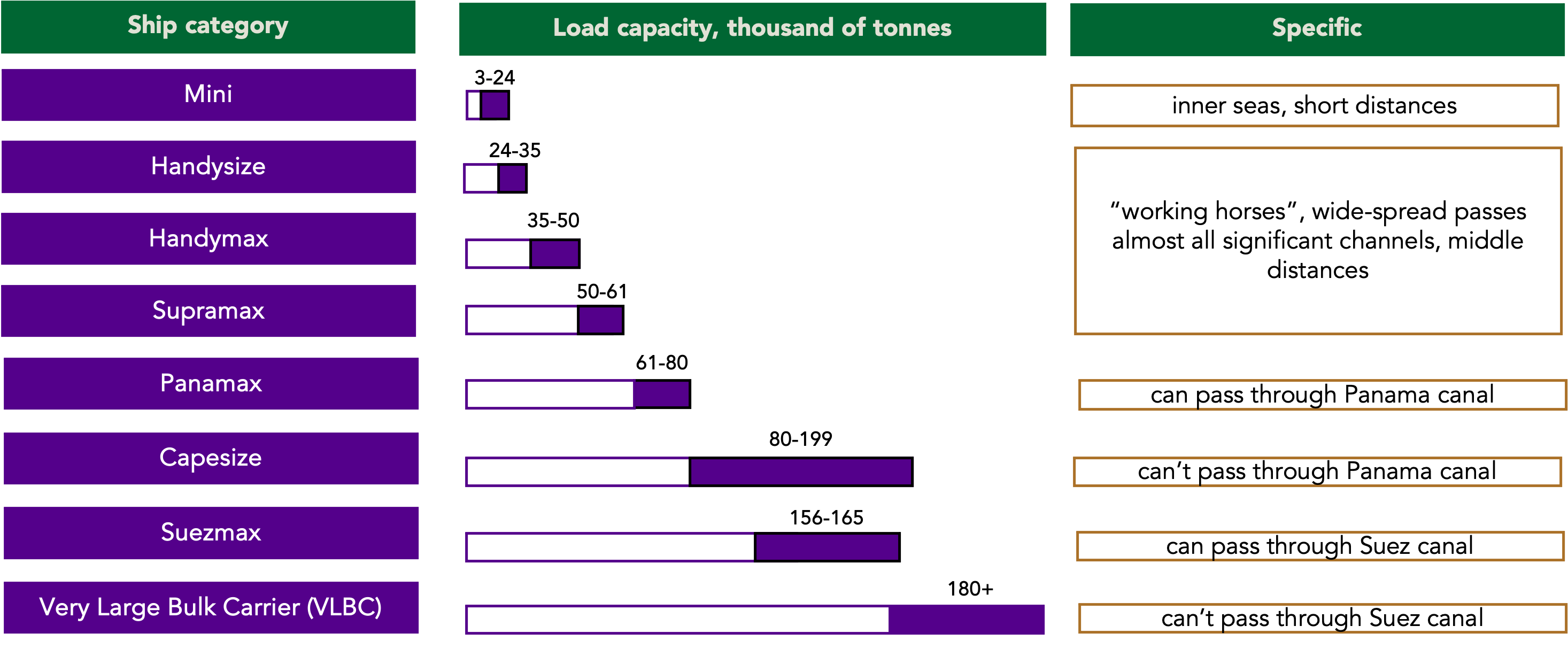
The minimum amount for transporting dry bulk cargo by road is about 10 tons, which is the capacity of a small truck or container (Exhibit 14-2). If the weight of one consignment of dry bulk cargo is at least 60 tons, it is possible to consider transport it by rail transport, because it will correspond to a fully loaded wagon. The net weight of the cargo in the truck or trailer is limited to 20-25 tons worldwide, and for instance up to 24 tons in Europe, and the railway tank of a single carriage can hold up to 60 tons of cargo. For example, if a freight train consists of 60 wagons, then one single shipment size can amount up to 3,600 tons of product on one train. Such a full train of 60 wagons would be enough to fill the smallest type of dry cargo sea ship, as ships carrying dry bulk have a load capacity starting from 3 thousand up to 185 thousand tons, some ships even more. However, Panamax and Suezmax type ships are limited to 80 thousand tons capacity (Exhibit 14-3). To load a full ship of this type requires more than twenty fully loaded freight trains, assuming 60 wagons in each train. In different regions of the world, the permitted weight of cargo for road or rail transport varies slightly.
Dry bulk ships are used for deep sea shipping, short sea, coast-to-coast, international, and global transport. The ship’s size is usually limited by the capacity of the canal to be navigated, and by the length and depth of quays in ports and of their access canals.
The Panama Canal provides a shipping route to connect the western and eastern sides of the Americas, avoiding the need to circumnavigate the entire continent. The Suez Canal makes it possible to connect Europe with Asia via the Red Sea. These canals significantly shortened shipping routes (more in Chapter 2), which accelerated international trade, but limiting the size of ships also put an upper limit to the economies of scale when trading raw materials via Panama or Suez.
Ex. 14‑3 Classes and sizes of dry bulk ocean ships
Keywords: dry bulk carrier, Panamax, Suezmax, cargo types
The goods or raw materials can be transported as dry bulk cargo, only if it is in sufficient volume, for example a full truck, full container, full railway wagon or ship. If the volumes are smaller, the same goods or raw materials are no longer transported as dry bulk cargoes as described above, but as general cargoes, which are subject to completely different principles, packaging and means of transport. For example, if an organization only needs 2 tons of salt, then it will be transported as general cargo and not as dry bulk cargo. However, if the organization needs 2,000 tons of salt, then transportation as dry bulk should be considered. The most complex solutions are when the cargo can be delivered both as general and dry bulk. For example, 20 tons of salt can be delivered both as dry bulk cargo – by dump truck and as general cargo, after packing the salt in packages. In such cases, it is decided according to the cost of transportation and to the available unloading infrastructure at the client’s premises. In any case, the same amount of goods or raw materials will always be transported many times cheaper as dry bulk cargo than as general packaged cargo.
Ex. 14-4 Liquid bulk examples
Keywords: liquid bulk, gas, oil, cargo types
Liquid bulk is another type of cargo, which requires special tanks for transportation and storage of liquids or gases. These can be glass tanks, metal tanks, and various balloons. The quantities and prices of such cargoes in international trade are calculated according to their volume or mass.
The volume of liquids often changes depending on the temperature, they expand when they heat up and contract when they cool down. Therefore, the more commonly is to express size of shipment in tons, kilograms or pounds instead of volume in cubic meters or litters.
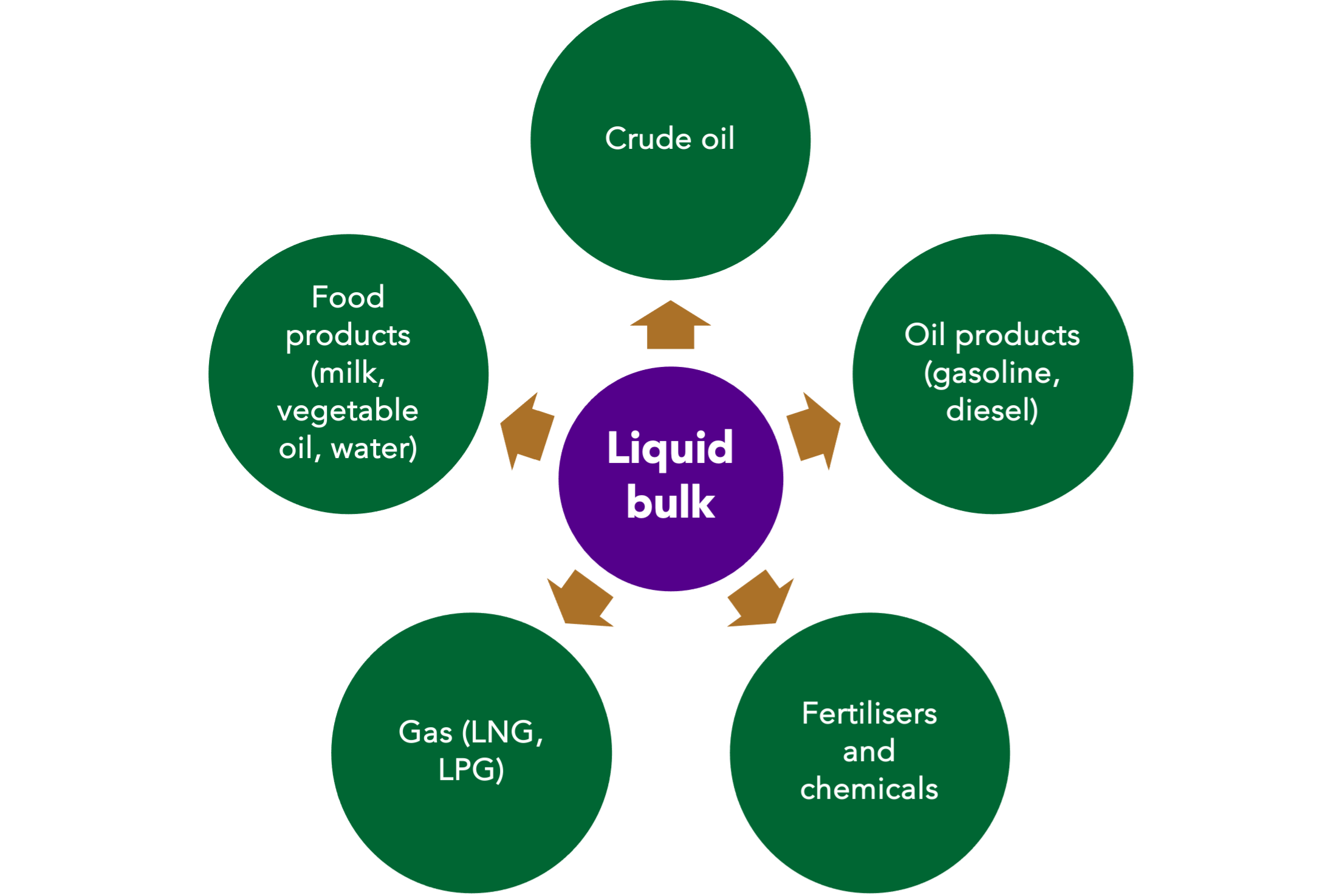
Liquid products can be classified as follows (Exhibit 14-4):
- Oil and oil products, for instance crude oil, diesel, gasoline, heavy fuel oil, kerosene, alternative fuels such as biodiesel or ethanol.
- Liquefied gas, for instance liquid natural gas – LNG, liquid petroleum gas – LPG.
- Fertilizers and other chemical products, for instance nitrogen fertilizers, phosphates, salt solutions, acids or alkalis.
- Food products, for instance drinking water, milk, vegetable oil.
Ex. 14-5 Modes of transportation adapted for liquid bulk

Keywords: road, rail sea, liquid bulk, cargo types
Unpackaged liquid cargoes are usually transported in large consignments by rail transport using tank-wagons, by road transport using tank-trailers or tank-containers, and via pipelines for gas, oil or water transportation. In sea transport, liquid bulk cargoes are usually transported by specialized ships – tankers (Exhibit 14-5). The same product can be considered as liquid bulk cargo and as general cargo. For example, if oil or milk is bottled, boxed, and loaded on a pallet, in this case it will be considered as general cargo, because its quantity can be counted in units such as 10 bottles, 30 boxes, or 20 pallets. If the same quantity of oil or milk is not bottled, but transported in tanks, it is considered a liquid bulk cargo. It is very important to understand that both the price of the product and the cost of transporting the product depend greatly on the form in which it is transported. If the same product is transported as liquid bulk cargo, its transportation cost will be many times lower than transporting the same product, the same amount, as general cargo. The same applies to the purchase price of the product.
Ex. 14-6 Transportation of liquid bulk by tanker

Keywords: VLCC, ULCC, Panamax, Suezmax, cargo types
In a wholesale trade usually aims to buy products as liquid bulk cargoes, as this is cheaper than buying already bottled products. Wholesalers often bottle products in smaller units and thus their earnings increase when selling goods in the retail market. The same applies to gas, oil products and chemical products. The reason why it is cheaper to transport bulk cargo than packaged cargo is twofold. First, bulk cargoes are transported in large quantities, so there is an economy of scale effect in production and trade. Second, relatively less human and energy resources are needed to transport a large quantity at once than to transport the same quantity divided into many small shipments. An important aspect is more efficient technological solutions for higher volumes transportation. However, economies of scale cannot be achieved in all industries. For example, wine was mainly transported as a unit load, mostly bottled, but recently it has become possible to use reusable bulk containers or truck tanks for wine.
Ex. 14-7 Annual world’s oil consumption
Keywords: oil consumption, cargo types
Similar to the dry-bulk cargo, the logistics manager has to fit the size of shipment with the size of the vehicle fleet, thus influencing the practicalities, efficiency, and costs of the transportation chain. The minimum quantity for transporting liquid bulk cargo efficiently by road is about 10 tons; if the weight of one shipment of liquid bulk cargo is at least 60 tons, it can be transported by rail. A railway tank can hold up to 60 tons of product. For example, if a train consists of 60 wagons, then one shipment can contain 3,600 tons of product. Meanwhile, ships – tankers are used from 10 thousand tons of product. Filling the smallest tanker requires at least three fully loaded freight trains with 60 wagons in each. Tankers can carry cargo from 10 to 550 thousand tons. To fill the largest tanker, as many as 150 fully loaded freight trains would be needed, so pipeline transport is a better alternative to transport such quantities. The length of the longest super-tankers reaches up to 400-500 meters. In terms of global trade, about 1/3 of the world’s cargo mass is transported by tankers, most of the cargo consists of crude oil and petroleum products.
Very Large Crude Carriers – VLCC and Ultra Large Crude Carriers – ULCC are types of tankers used only for crude oil (Exhibit 14-6). Considering that the capacity of the largest tanker reaches up to 550 thousand tons, and the price of oil is varying by a factor 6 in the last decade, in 2023 around 70-100 US dollars per barrel, the total value of the cargo can reach up to 400 million US dollars.
The capacity of the largest tanker is up to 4 million barrels. For comparison, the US alone consumes about 18-20 million barrels per day of petroleum products in the years 2000-2020, according to the U.S. Energy Information Administration. Thus, the US daily consumption of petroleum products is equivalent to 4-5 ULCC type tankers.
For an example of price efficiency, according to Gyasi (2022), the cost of transporting oil by AFRAMAX tanker from the shores of North America to Europe in 2020 was approximately 5,000 US dollars per day. An AFRAMAX tanker being able to transport up to 880 thousand barrels or 120 thousand tons. In this case, the cost of transporting oil from America to Europe was only 0.4 US dollars per ton. Considering the trends in oil prices, there is a factor 1/1000 as difference between transportation price and value of the product itself. Even greater economies of scale are achieved if the oil is transported by VLCC or ULCC type vessels. Technologies that have enabled the transportation of liquid bulk cargoes are considered one of the most important catalysts of globalization.
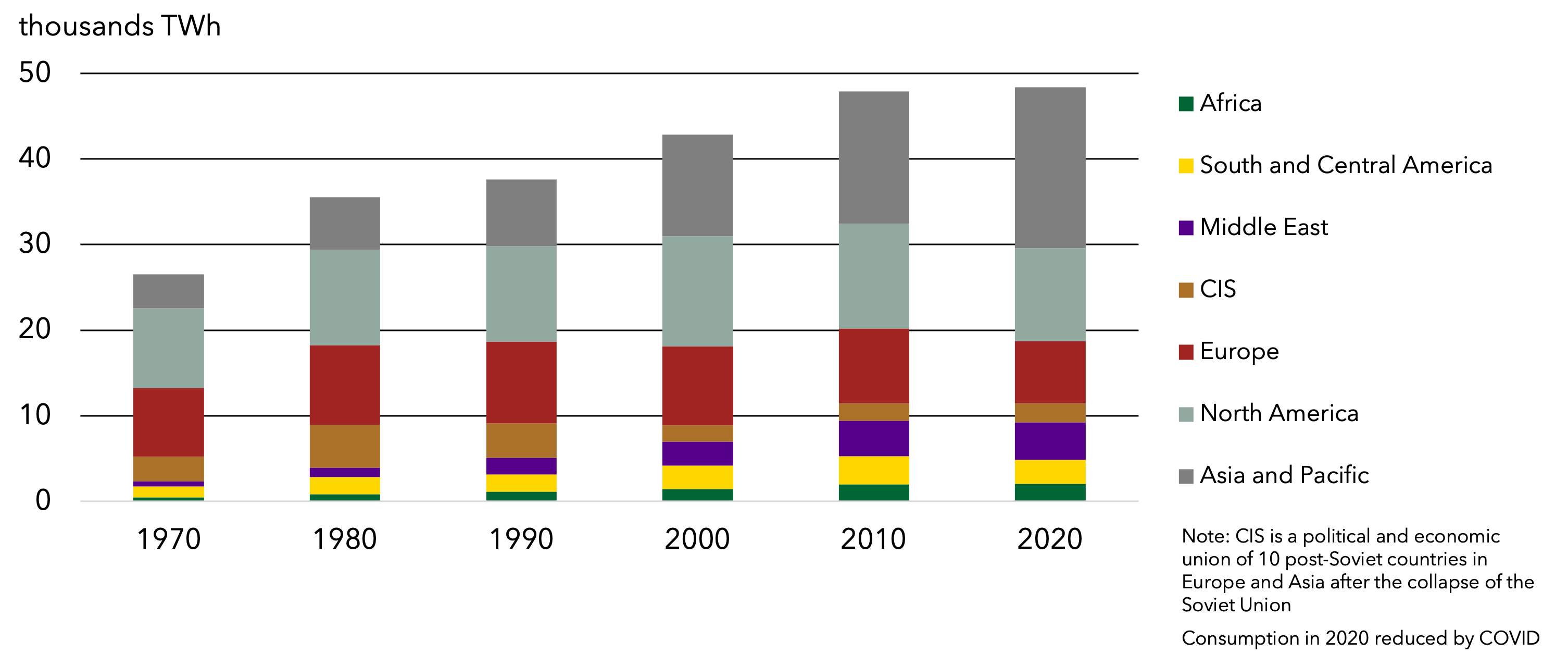
In the world, from 1970 to 2020, the consumption of oil products increased by 1.83 times, which led to the need for more and more oil production (Exhibit 14-7). This also led to the construction of ever larger tankers. On the other hand, increasingly larger tankers allowed reducing crude oil logistics costs. In 2020, the USA and China consumed the most oil – between 7500-10000 TWh, India in the range of 2500-5000 TWh, Russia, Canada, Brazil, Saudi Arabia, Germany – 1000-2500 TWh, European countries France, Spain, the UK, as well as Mexico – 600-800 TWh. The growing economies of China and India may become major consumers of petroleum products in the future. Most of the oil is consumed as an energy resource. Gasoline, diesel, aviation fuel, and fuel oil are produced from it. These products are used in transport, building heating, electricity production. When comparing all cargoes transported in the world, oil remains the largest market product both by weight and volume. Oil is not only an energy resource, but also the main raw material in the plastic and chemical industry.
Although the transportation of liquid bulk cargoes by ships is very efficient due to the large capacity of ships and economies of scale, pipelines are still considered an even more efficient mode of transportation, especially for oil and its products and gas. However, pipeline transportation has its own challenges.
Ex. 14-8 Largest pipeline networks in the world
Keywords: oil, gas, cargo types
The main challenge is the large investment in infrastructure. For example, a tanker or ship designed to transport liquefied gas is flexible, it can serve different markets as needed. Meanwhile, the pipelines are built from the areas of oil or gas production to the areas of consumption or to the oil terminals of ports for the shipment of these products, or from the ports to the oil refineries located in the hinterland. Challenges come if geopolitical crises arise and countries decide not to trade with each other, if embargoes, quotas or other mechanisms restricting free trade are in place. An example would be the Nord Stream gas pipeline from Russia to Germany under the Baltic Sea, facing a stop of operations.
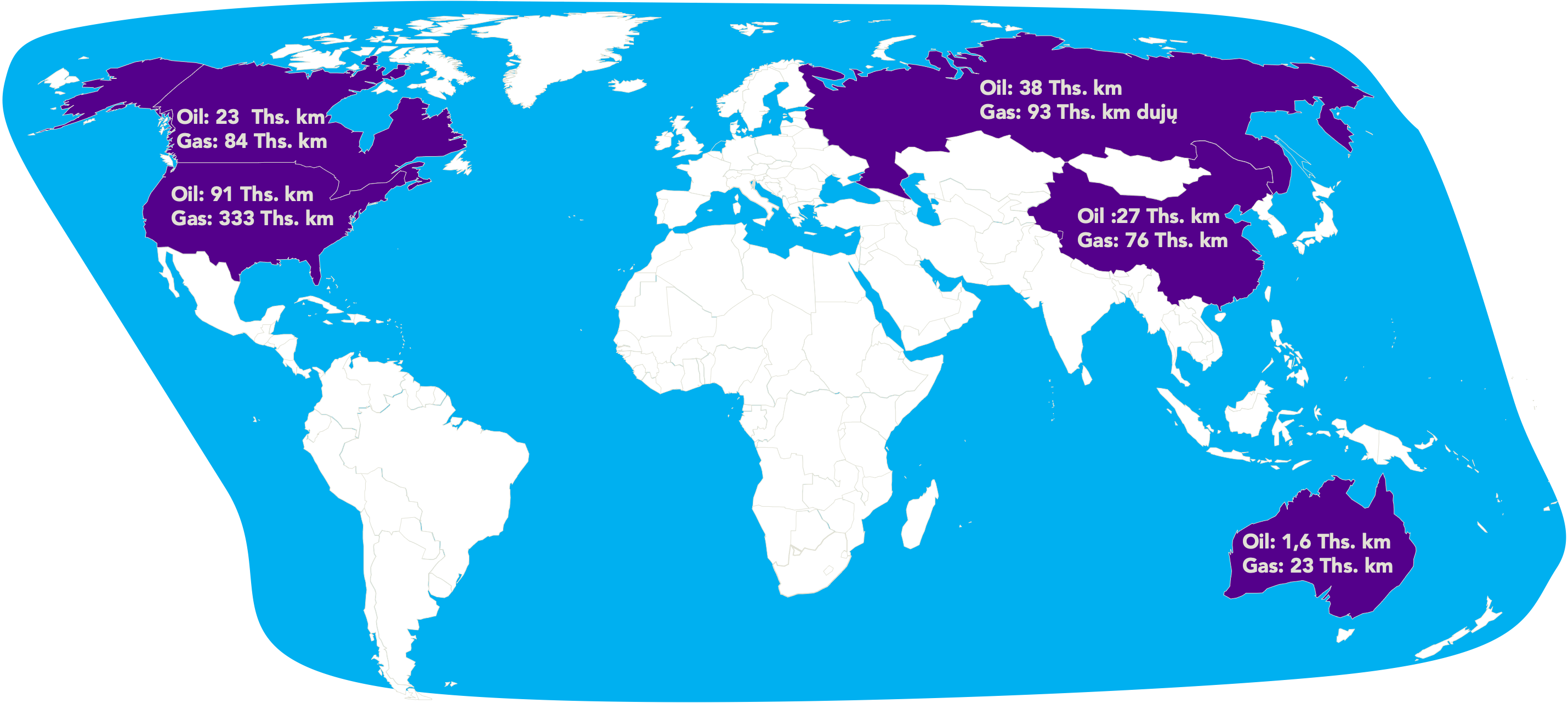
Pipeline transport can also be and is used to strengthen geopolitical influence, when some countries finance the construction of pipelines and provide energy resources for both economic and geopolitical benefits. Most gas and oil pipelines are located in North America and Europe. According to Global Energy Monitor 2020 data, there are 1.2 million km of pipelines. 2/3 of the world’s oil and gas pipelines are located in 5 countries – USA, Canada, Russia, China and Australia (Exhibit 14-8).
The largest oil pipelines in the world are owned by the following organizations:
- Transneft, Russia – 42,383 km, 15 percent of global pipeline length.
- Enbridge, Canada – 33,750 km, 12 percent of Global pipeline length.
- PipeChina, China – 15,947 km, 5 percent of global pipeline length.
The largest gas pipelines in the world belong to the following organizations:
- Gazprom, Russia – 103,212 km – 11.2 percent of global pipeline length.
- TC Energy, Canada – 99,440 km – 10.8 percent of global pipeline length.
- Kinder Morgan, USA – 82,075 km – 9 percent of global pipeline length.
General cargo are solid loads of appropriate geometric shapes or packaged loads, the individual units of which can be transported, reloaded, and stored. Such loads have the following characteristics: their shape, linear dimensions, volume, and weight. Such cargoes can include metal, wood products, bricks, vehicles, machines and devices, containers, etc. General cargo differs from dry or liquid bulk in that it is packaged and counted in units.
Depending on the packaging and the weight of the cargo unit, general cargo can be transported (Exhibit 14-9):
- In bags, for instance grains, sugar, salt, chemicals.
- In special packets, for instance fertilizer, peat.
- In boxes or parcels, for instance electronics, textiles, footwear, food, pharmaceutical products.
- In bundles, for instance cellulose, cotton.
- In containers, for instance food and chemical products.
- In rolls, for instance paper.
- In packages, for instance wood products.
- Hanging, for instance clothes, textile.
- Unpackaged, for instance devices, auto equipment, metal structures.
Logistics managers use general cargo as their usual form of transportation for parts, components or finished products, final products intended for sale in the retail market or for components in production. Unit loads are mainly transported stacked on pallets, which in turn are loaded into a container, semi-trailer or, in rare cases, a rail car. However, it is possible to find cases when unit loads are transported unpackaged. For example, a car or heavy machinery is transported unpackaged as a unit. Heavy unit loads are usually not packed. A distinctive feature of unit cargo is the ability to count it not only by weight and volume, but also by units. In cargo documentation, this number of units is usually indicated next to the weight, for instance “120 boxes, 20 pallets, 4.5 tons”, which means that the goods are packed in 120 boxes, which are placed on 20 pallets, they weigh 4.5 tons.
Ex. 14-9 General cargo

Keywords: pallet, container, box, cargo types
When the carrier or warehouse workers admit the goods, the number of units is often counted and checked to see if they correspond to the documentation. It is important to understand that the term “loading unit” describes the method of packaging, not the product itself. Fertilizers can be transported in bags on pallets, and this will be considered as a general cargo unit load. If the fertilizer will be transported unpackaged in a railway wagon or ship, then this type of transportation will be considered as bulk cargo transportation.
General cargo is transported by road, rail, water, and air transport. In road transport, general cargo is mainly transported by semi-trailers pulled by trucks for long distance, and by smaller trucks or vans for urban short deliveries (Exhibit 14-10). One semi-trailer can hold up to 24 tons of cargo in Europe. In a semi-trailer, loads are transported mostly on pallets. More detailed information on pallet sizes and packaging features are described in the next section. In Germany, the biggest logistics market in Europe for road transportation, is only 3 percent of road cargo transported in containers.
Ex. 14-10 Types of transportation of general cargo

Keywords: sea, rail, road, air, cargo types
The most used vehicle for long distance is the classical semi-trailer with curtain sider. The most used vehicle for short distance is the 3.5 tons netto capacity delivery van. General cargo is also transported in containers by road transport. Containers are placed on specially adapted platform trailers. General cargo in containers is also transported by rail transport, after the containers are loaded onto platform wagons. Rarely in railway is transport, but general cargo also transported in covered wagons. Due to trans-shipment efficiency, in most cases general cargo is transported by rail in containers. General cargo is transported by sea and river transport only in containers. Due to the importance of containers in the transportation of general cargo, a whole separate section of this book is dedicated to them. By air, cargo is transported on pallets specially fitted for the belly or cargo deck dimensions, or in specialized small-capacity aviation containers.
General cargo is often more expensive per same weight than bulk cargo. General cargo, which is extremely urgent and often very expensive, is transported often by air. As consequence, general cargo transported by air is estimated at 35 percent of the total value of all world trade.
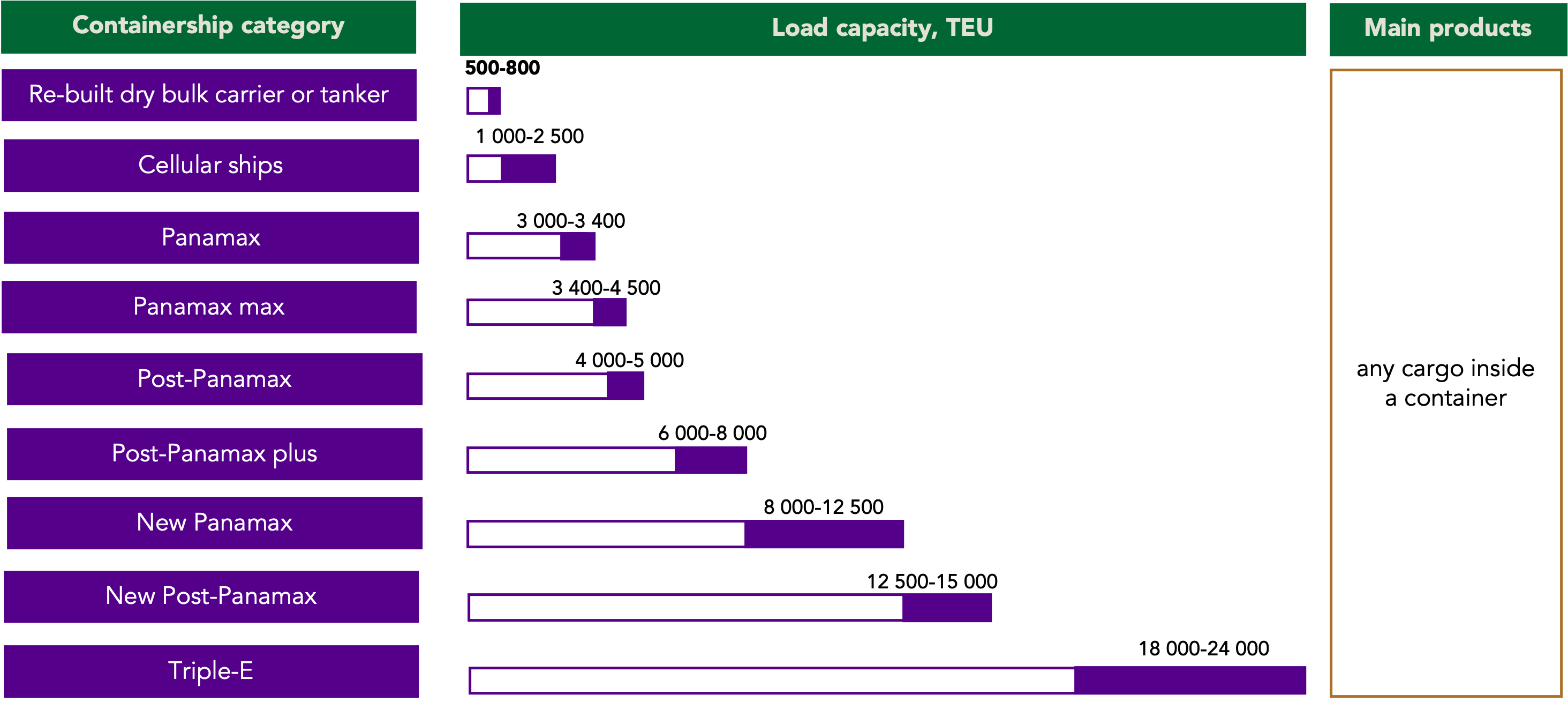
Ex. 14-11 Transportation of containers by containership
Keywords: containership, Panamax, TEU, cago types.
As globalization has made it possible to produce in countries with low labor cost, maritime transport has become an integral part of international trade. More precisely, affordable maritime transport has become one of the main enablers of international trade growth and globalization. Raw materials are delivered to production regions by tankers and bulk carriers, but finished products are transported as general cargo in almost all cases.
Containerships are specialized ships for transporting containers. Their size is adapted to the dimensions of the containers. For goods to be moved safely from origin to destination, often with a few transshipment points on the way, a freight container has to meet certain safety conditions. It has to be sturdy and safe to withstand the handling, passage by road or rail as well as sea, and the weight of the cargo.
The strength of the container is specified in the safety approval of the Convention for Safe Container plate, allowing it to withstand a load of about five or six containers stacked on top; thus, loading part in the holds and part on the deck can achieve a high overall height. Because containers come in different sizes, 40 feet long, 20 feet long, or smaller, for ease of calculation, a Twenty-foot Equivalent Unit, in short, a TEU, is used for expressing the vessel capacity. The first container carriers carried between 1 and 2.5 thousand TEU, and the capacity of biggest ships put into service in 2023 exceeds 24 thousand TEU.
Depending on the size of the vessels, they are used on different routes. The largest container ships cannot pass through the Panama and Suez canals, but the amount of containers they transport allows reducing the cost and price of transporting one container. In UK maritime containers, the average loaded container weight is 7 tons per TEU. In Antwerp it is about 10 tons per TEU of loaded containers. Due to imbalance of trade, high empty rate, and low load factor by weight, the average real load per TEU transported is below 5 tons.
Share or comment this information on your social media:
Fundamentals of global business
First edition
For citation:
Jarzemskis A. (2025). Fundamentals of global business, Litibero publishing, 496 p.

Full scope of the book is available in various formats
D.14. Packaging and international freight operations
About author
The author has been teaching at several universities since 2005. 40+ scientific publications, 10+ international research projects. More about author.