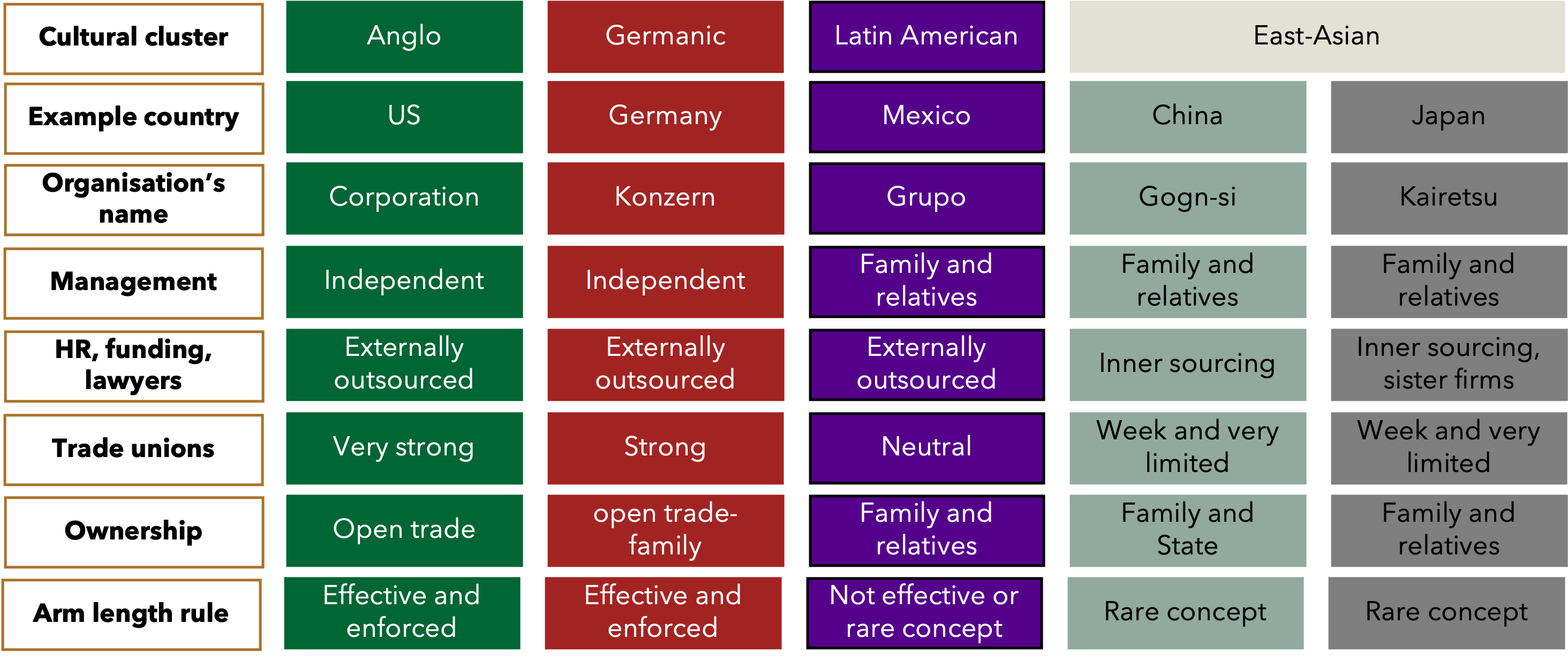
The cultural differences described in 9th chapter have a significant impact on the variety of organizational structures (Bloom & Van Reenen, 2007). Examples include the structures of organizations in the United States, Germany, Mexico, Japan, and China. In the United States these business structures are called “corporation”, in Germany “konzern”, in Mexico “grupo”, in Japan “keiretsu”, in China “gong-si” (Exhibit 11-6).
In the case of a US corporation, shareholders usually exercise their rights by appointing a board of directors, which elects or appoints the corporation’s chief executive officer. The CEO makes decisions about hiring employees, execute implementation of strategy and is responsible for all daily operations. In any organization, power is usually exercised by an independent labor union that negotiates with management on behalf of workers for better working conditions. Lawyers and financial advisors are usually outsourced from independent providers. Not surprisingly, the four largest international financial consulting and accounting firms, known as the Big4, are all based in the United States, so the US corporate ecosystem represented an excellent economic environment and market for their growth.
In the case of a US corporation, banks and other financial institutions, in other words, the capital market providing finances to the corporation are independent from the corporation. Corporations use the services of independent suppliers and distributors. However, corporations usually try to carry out research and development activities, along with branding and marketing with their own resources.
In China, gong-si, which means incorporate business, has a different network model of affiliated organizations than in the United States. China’s state-controlled capitalism in the 21st century is enabling the emergence of businesses that are equal to, or even surpass, US or European organizations in terms of size and market coverage (Guan & Yam, 2015). Formally, many organization’s networks in China are family-owned and thus have many characteristics of a family business, but the owners of the organization tend to be very closely connected or serve the state or are simply related to the Chinese Communist Party. This hybrid model of public and private capital is quite unique in China (Chantasasawat et al., 2008).
Similar manifestations can be found, for example, in Russia, in Central Asian countries where the owners of the largest organization are closely connected with the authorities or even are authorities themselves – governors or members of parliament or even families of presidents.
Ex. 11‑6 Dependency of corporate structures and functions on cultural differences
Keywords: cultural cluster, network structure, suppliers
In essence, the state management system with oligarchic features creates opportunities for the emergence of such corporate structures, which are generally prohibited by law in the United States and European Union countries. In China, “gong-si” have pyramid-shaped structures (Cooke et al. 2019). The owners and their family members are usually in positions of a chief executive officer or head of subsidiaries, affiliated branches or divisional units. Close or distant family members are often given responsibilities to manage functions such as marketing, research and development, sourcing, accounting and control (Gong & Wang, 2009). Very often, the oldest relatives hold leadership positions depending on their age. To carry out international activities in other countries, a Chinese organization often uses expatriate Chinese, often representatives of the same family. Non-family members are often used to work in foreign countries, but they are mostly Chinese emigrants using a network of well-known contacts. Such a network of non-family Chinese overseas is called “guanxi”. The arm’s length rule does not apply to transactions between related companies in China as it does in the United States and Europe. The network of related companies operates in a scheme of close mutual relations and strong assistance, which has a pyramid structure, and the equity interrelated firms in the network serve the interests of the parent organization (Liu & Anbumozhi, 2009). The strategies of each individual member of such network are usually developed as an integral part of the overall pyramid strategy (Yiu, 2011). This type of organization is largely determined by cultural differences, which are described in the 9th chapter of the book. Collectivism, hierarchical relationships in society, trust strongly oriented towards family members or relatives influence shapes of corporate cultures and structures (Das, 2015). Such structures would be accepted as discriminatory in the Anglo, Nordic or German cultural clusters, because they have many features of nepotism. Nepotism is understood as a phenomenon when people are accepted into positions not based on their competences and skills but based on close connections and family ties. What is considered unacceptable in the Western cultures is a norm or even almost mandatory in the East (Kahle & Stulz, 2017). From this point of view, trust and closeness of relationships are more significant than professionalism in Eastern philosophy. Trade unions are very weak or non-existent there.
Although private ownership exists in China, and so do organizations having private shareholders, state-owned organizations are becoming more important (Tang et al., 2020), and they also create pyramid-like networks of related firms. At the top of the pyramid is the parent organization, and below are the subsidiaries working for its interests and common strategy implementation (Luo, 2000). Organizations of this type enter global markets, invest in foreign countries and become multinational organization seriously competing in the global market with rivals originated from western countries which faces serious challenges (Kahle & Stulz, 2017).
Another eastern culture, Japan, has a similar model to China, but with much less government intervention in business and property. The history of “keiretsu” in Japan dates back to the 17th century, when conducting business, it was necessary to have very close relations with business partners – suppliers, financiers, distributors (Brouthers et al., 2014). During the industrial revolution of the 19th century, these relations only strengthened and took forms that remain to this day. The bank is very important in the keiretsu network of firms. Very often the bank is the owner of the parent organization. The corporate network includes many of the necessary suppliers and distributors who are also owned by the same bank or parent organization (Tomeczek, 2022). Companies that belong to the same owner, or often owned by a bank, are called sister-firms, or “kaisha” in Japanese. Sister firms provide services such as legal, accounting, engineering, research and development and other necessary services (Dyer, 1996). Trade unions are very weak or non-existent in Japan. Banks, being the owners of corporate networks, invest the earned profit in further development, very often investments are made in expensive real estate projects (Yoshida e al., 2022). Also, banks establish insurance firms that provide these services to the entire network of organization. The core of the “keiretsu” is formed by banks, real estate management and insurance companies connected by capital ties, which manage and control the entire network of associated companies, providing them with the necessary financial and infrastructural resources (Lincoln et al., 1996). However, decision-making in the high-level management council, in so called “kinyo-kai”, of the entire corporate network, is carried out with the involvement of the heads of “kaisha”, i.e. of all sister organizations (Helmold et al., 2022).
A hierarchical family-based network of organization similar to that of China and Japan is also being developed in India. Comparing the Western model, which is best represented by US corporations, with the Eastern “gong-si” and “kairetsu”, it is obvious difference in the choice of business partners – suppliers, distributors, financial institutions (McGuire & Dow, 2009). In the USA and Europe, purchases are made by so-called “procurement departments”, which, in order to purchase materials, components, production equipment, and distribution services, usually announce public tenders. These tenders for the procurement of goods and services are subject to high transparency requirements, especially in a public owned and stock exchange listed organization. Requirements for the goods and services to be purchased are drawn up, and the rules according to which the supplier to be selected, are published in advance to ensure equal rights of potential suppliers. So many businesses in the Western cultures have the opportunity to submit a proposal and even win a supply contract, but in the East, things work differently. Strategic purchases should be made privately and where possible from subsidiaries or sister firms. On the contrary, Westerners attempted to secure supplies typically through the establishment of vertical non-equity alliances and supply chains, which are described in chapter 5 of the book, and later in some cases even through the acquisition of alliance partners.
The countries of the European Union began to adopt many of the principles of business transparency applied to publicly listed corporations from the United States after the II World War. In Germany, networks of related companies are called “konzern”. In Germany, there are labor councils that monitor the implementation of state requirements related to labor relations – salaries, working hours, duration of paid vacations are strictly regulated by law, and this is a big difference from the US corporations, where these issues are mostly left to the agreement of the employee and the employer. German “konzern” owners are mostly private. The difference from the US is that banks in Germany are involved in the ownership and management of stocks and corporate networks. Purchases between related companies are governed by the arm’s length rule, so in Germany is very complicated to purchase services, goods, components or raw materials only from companies in its network, as it is in Asia.
In Mexico, the network of “group”-type related companies is usually controlled by private owners, very often they are related by family ties. Thus, in this respect, the “group” is more similar to Chinese and Japanese traditions. Family businesses that are well-known global companies often come from Southern Europe – Spain, Italy, and Southern France. The collectivist culture of South European or Central-South American countries is similar to the collectivism of Asian countries, and this is very well reflected in the structures of international companies. In Mexican “group” companies, it is very common for interrelated owners to form a board of directors that appoints the chief executive officer. However, the manager in a “group” type network of companies is usually the owner which holds majority of shares, or at least a family member having minority of shares. Lower-level management is also hired from outside the family, but loyalty to the family is considered one of the most important criteria. Loyalty to the direct manager is also very strictly required from ordinary employees. In Mexico, there is a dominant group of companies in every industry, which occupies a near-monopoly position in the market. Very often, shareholders are closely linked to politicians and the executive government of a country or region of a country.
This section does not seek to assess which form, Northern and Western or Eastern or Southern, is more efficient. However, it is worth noting that the largest corporations by market capitalization are headquartered in the United States. However, the aggregate capitalization value of Asian multinationals is higher than that of the European Union. Culture has powerful influence on how people think and behave, so if the American model of a transparent and family-free corporation were to be blindly copied into Asia or South America, the business efficiency would likely be significantly lower than in a Western culture of English, German or Scandinavian.
English, German and Scandinavian cultural clusters provide equal opportunities for people to occupy high or even top-level positions in companies in order to earn and accumulate more money. The main criteria for hiring employees are related to competence and education. In 21st century while sending a CV, omitting one’s age or photos is getting common. Additionally, belonging to a family, age, gender, appearance, race, height, weight and other human attributes are not used as criteria for selecting employees. Failure to hire an employee in violation of equal opportunity laws may even lead to administrative or criminal accountability in some English, German, Scandinavian and even currently East-Central European cultural cluster countries. Thus, in these cultural clusters, regardless of the family in which a person is born, there are opportunities for him to reach the heights of business or professional career. Meanwhile, in southern and eastern cultures, there is less equality of opportunity for a person, and professional career, income and wealth are determined by birth in a lot of cases. Of course, there are always exceptions when families hire educated, skilled and talented unrelated people to run their companies in China, Japan or Asia, but the dominant trend is based on family or relative ownership. This forms highly defined societies, divided into so-called castes, which is especially evident in India. When a child is born in a rich family they are assured a professional career in family-run business networks, while those born in poor families rarely have the same opportunity. Nevertheless, it is still important to acknowledge the prevailing pattern that the children belonging to family members who manage international business networks in Asian countries are most often enrolled in universities within the English cultural cluster countries – like in the USA, the United Kingdom, after acquiring comprehensive knowledge of management they return to manage one of the organization or its departments in their family business network. Consequently, the latest knowledge about management, economics, psychology, marketing, productivity and technology created and developed by the Anglo or even other Western cultural cluster is integrated in the companies of Asian countries, as well as cultural aspects that promote loyalty and dedication to the interests of their team, in this case, family interests. Together, these two aspects create a relatively strong competitive advantage that allows the economies of China, Japan, and India to be among the ten largest economies in the world, and for Asian global companies to successfully compete with Americans and Europeans (Dyer & Chu, 2003).
Share or comment this information on your social media:
Fundamentals of global business
First edition
For citation:
Jarzemskis A. (2025). Fundamentals of global business, Litibero publishing, 496 p.

Full scope of the book is available in various formats
C.11. Structures of multinational organizations
About author
The author has been teaching at several universities since 2005. 40+ scientific publications, 10+ international research projects. More about author.