The question often arises as to what distinguishes a multinational organization from a global organization. There is probably no unequivocal answer; a multinational organization is understood as a firm operating in more than one country, and a global organization operating worldwide (Dunning & Lundan, 2008). However, this issue deserves a separate section of this chapter, and its examination includes aspects such as headquarters, corporate networks, subsidiaries and parent companies, and affiliates. Although the movement of goods, services, information, human and capital resources between the countries has become much freer in the last forty years, still every entity must be registered in a specific country and operate according to the laws of that specific country, also hire employees and pay taxes in that country. So, for example, if an organization in the USA or Spain or another country wants to expand into the market of another country or transfer its production resources there, it is necessary to register its activities in that country.
So, an entity registered in the US or Spain cannot simply set up a factory or open a store in, for example, Mexico or India or any other country. To operate in a specific country, it is necessary to register a legal entity in that country. If it is just an export to a specific country, then this requirement is not mandatory. So, if the organization sells its products to a wholesale partner, distributor or retailer operating in another country, then no registration is required.
Ex. 11‑3 The circumstances for obligatory registration of firm’s activity in a foreign country

Keywords: export, FDI
Registration is not required if the organization sells a product, for example, online to an individual based in another country. In the case of export, there is an obligation to pay taxes such as import VAT, customs duties or other applicable taxes, but in most cases this obligation lies with the buyer himself (Exhibit 11-3). However, if the organization intends to open its own outlet in another country, registration of activities in another country is usually mandatory.
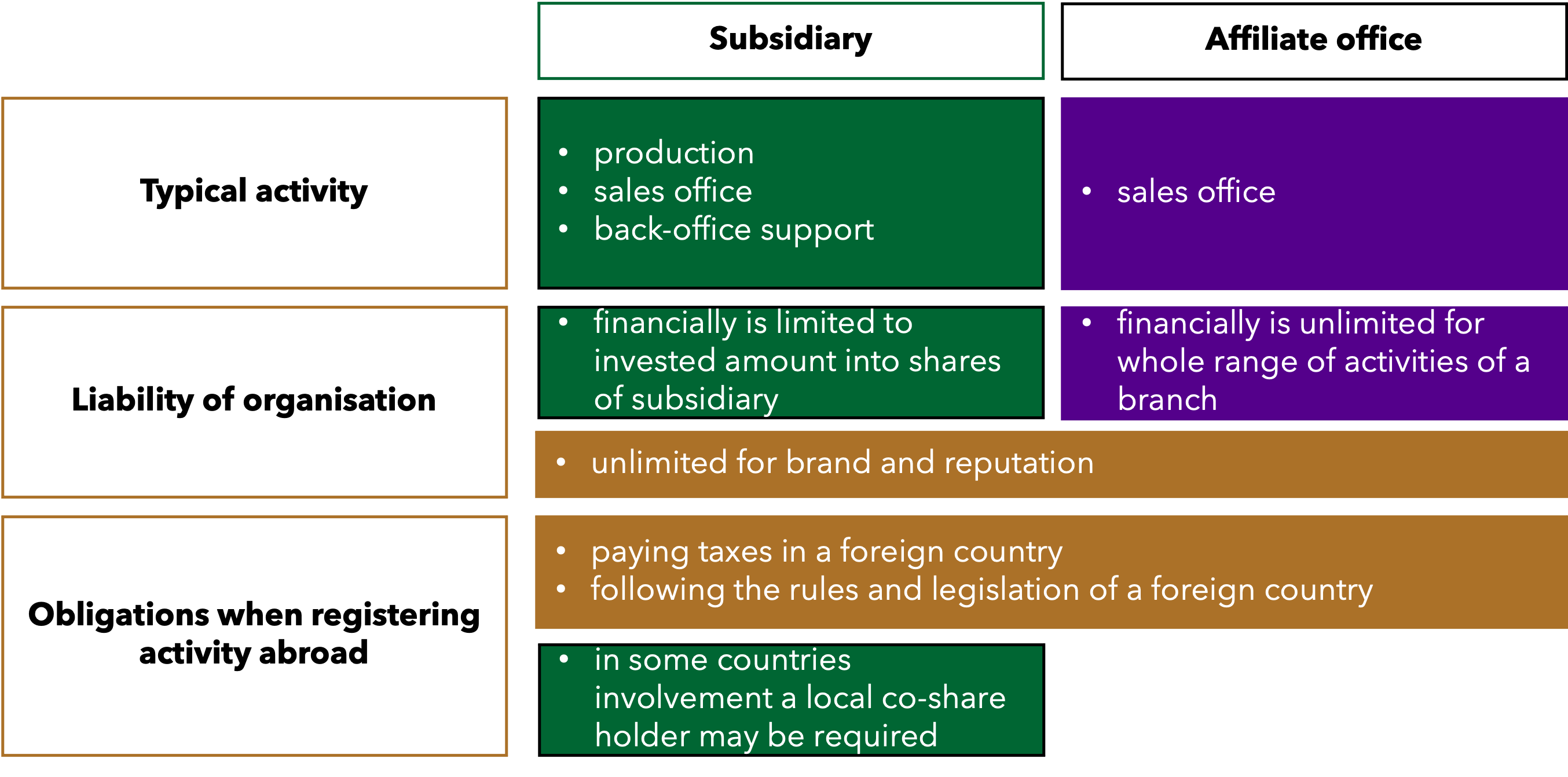
If there is an obligation to register the activity in another country, then there are two ways for a multinational organization to operate in another country. One of the possible forms is the establishment of a subsidiary organization; another form is to open an affiliated branch office (Exhibit 11-4). Both of these forms involve registration of activity in another country and lead to different tax obligations and liabilities.
Establishment of a subsidiary firm in another country is usually carried out by establishing a limited liability legal entity. Very often, such a legal entity is given the name of the multinational organization or brand used by multinational organization, adding the name of the country or the abbreviation of the country to the name. For example, a multinational organization in the USA called “Famous Brand” sets up another firm in, for example in Mexico, which will be called ” Famous Brand Mexico” or “Famous Brand ME”. In this case, a newly established limited liability entity in Mexico is liable to its creditors, customers, and suppliers only with its own assets. Thus, in this case, the parent organization, based in the USA, does not bear the financial liability and risk for damages caused by the subsidiary organization or unpaid debts. The parent organization, like any other shareholder of a limited liability entity, is liable only for the assets that it contributes to the authorized capital of the subsidiary. In this case, when an organization becomes a shareholder in another legal entity, they are called parent and subsidiary respectively, and this concept is used worldwide.
Ex. 11-4 Differences and similarities of subsidiary firm and affiliated branch office
Keywords: registering, establishment, firm, office
The responsibility for the activities of the subsidiary is limited to financial aspects, but reputation and intangible assists such as brand equity are very important for parent company in global business. When a subsidiary engages in activities that have a negative impact, and negatively influence the reactions of the public, customers, creditors and/or shareholders, the parent organization suffers major reputational damage. Brands are perceived and valued as intangible assets, the most famous brands worth billions of US dollars, so reputational damage can very quickly turn into financial damage as brand equity can depreciate very quickly. Therefore, in order to protect the brand and its reputation, the parent organization pays great attention to the control and management of its subsidiaries.
The second way to register activities in another country is to open an affiliated branch. Unlike a subsidiary, such kind of branch office creates direct financial liability, because the parent organization, i.e. founder of the branch is fully responsible for the obligations and debts of the branch with its own assets. An affiliated branch office is registered in another country, receives a taxpayer code of another country and generally functions similarly to a separate legal entity with its own management, but the parent organization is fully and directly responsible and liable for its activities.
Another difference between a foreign subsidiary and an affiliated branch is the inclusion of other shareholders. The legislation of some countries prohibits the establishment of entities that are 100 percent owned by a foreign entity or a foreigner, so the establishment of a subsidiary therefore makes to attract a local partner to be a co-shareholder in the subsidiary. Such requirements exist in some Arab countries, India. On the other hand, the inclusion of an additional local partner in the subsidiary’s shareholder structure can sometimes ensure better control over the branch, and better adaptation of the multinational organization to local culture and traditions of locals (Müller-Seitz, 2012).
Ex. 11‑5 Variety of branch office structures
Keywords: branch office, subsidiary
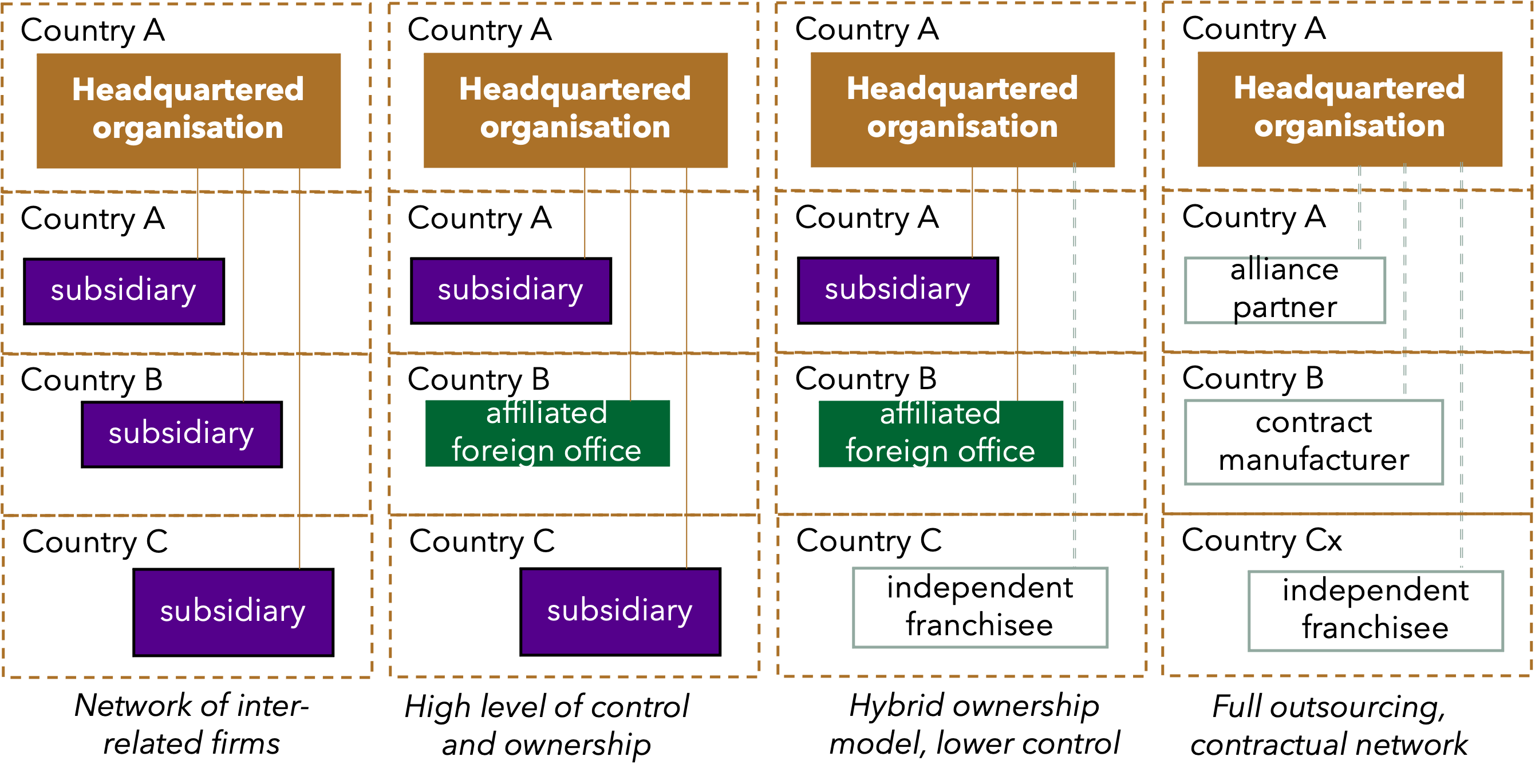
The same multinational organization may have different forms of its branches in different countries, for example, opening an affiliated branch office in one country and establishing a subsidiary in another (Exhibit 11-5). Combined form of internationalization business is common. Some organizations combine expanding by opening new branches and franchising model. This means that several companies with the same name can operate in foreign countries, but their shareholder structure and legal form and liability structure could differ in essence. The selection criteria between FDI and franchising are discussed in more detail in Chapter 7 of the book.
Multinational organizations often announce that they operate in dozens of countries around the world and present themselves as a global organization. However, every multinational organization has so-called headquarters. The headquarters are usually located in the country where the parent organization is located, which controls the shares of the subsidiaries whose branches are located in other countries (Baaij et al., 2015).
Multinational organizations often present themselves as a group of firms. Cross-border double taxation agreements between countries allow organizations to choose the country in which country they pay taxes if they operate in more than one country. However, in the case of a subsidiary, the legal entity pays taxes according to the country in which it is registered, regardless of who owns the shares of the entity. Thus, a multinational organization is essentially a group or network of entities linked together by ownership and using the same brand name. The owner of the brand or trademark is usually the parent organization.
The profit earned in the subsidiary, although taxed in the country of registration, goes to the shareholder and therefore to the parent organization. It is not uncommon for multinational organization to try using legitimate tools to reduce the amount of taxes they pay. If the taxes in the country of registration of the parent organization are lower, then usually the parent organization provides management services and marketing services to the subsidiaries, thereby increasing the costs and thus reducing the profit of subsidiary, but revenue and profit of the parent organization increases at the same time. For this reason, it is common to listen politicians and non-governmental organizations of various countries when speaking out against multinational organization and globalization itself.
In fact, there are almost always some competing multinational organizations in every industry. Multinational organization, which effectively function as networks of interrelated companies under the same brand strongly dominate many industries over local independent businesses. These days hardly anyone can name more than two or three brands of sportswear, mobile phones or refreshing drinks if asked. This makes it possible for global companies to have a certain market concentration and operate in artificial oligopoly conditions created by brand marketing and economies of scale in production, distribution and logistics. Some international companies operate under conditions that are even close to monopoly. As a result, some countries, such as the European Union and the United States, have imposed fines on these companies for violations of competition law, especially in software or social networking industries.
Due to the very large resources allocated to brand building, advertising and public relations, international brands easily beat local companies that are not known at the international level. Since it is very difficult for small local organization to compete with global ones, they have to either choose very narrow niche market segments with customized products and respond to the needs of those customers who are not satisfied by the standardized production and service of multinational organization. So, local business finally become suppliers to multinational organizations and work with them in the form of vertical alliances instead of competing with them.
A paradoxical situation arises when business textbooks and leading strategy professors and coaches help multinational organization become so strong and dominant in the market that dominance eventually reaches the limit of legal permissibility. Business education paradigms that include sustainability and social responsibility are exploring more narratives. One can also find opinions that multinational organizations, while allocating abundant resources to publish and disseminate their sustainability policies and environment saving ideologies including social responsibility, by doing this mask such unpleasant things as the exploitation of cheap labor and tax evasion by legal tools.
It is important to acknowledge, that multinational organizations establish and manage subsidiaries in foreign countries that may not necessarily have the same name. Sometimes, in order to gain a competitive advantage, factories are acquired or established to ensure supply of components or raw materials that are required by the multinational organizations. This form of international business is also called a vertical equity alliance which is described more in detail in the fifth chapter of this book. Some multinational organizations not only own manufacturers and suppliers but also banks and scientific institutes. In such a case, multinational organizations form a network of capital-related entities, and their main goal is to increase the value or sales and market share or the profit of the entire network (Garcia-Bernardo & Janský, 2024).
It is important to mention the arm’s length rule, according to which some countries, such as in the European Union, and the United States, impose certain restrictions on transactions between affiliated companies (Janský, 2021). The arm’s length rule requires that transactions between affiliated entities occur at market price and on the same terms as they would have if the companies were not related. However, this rule is not a part of legislation in all countries around the world. For example, in Russia, gas and oil businesses establish subsidiary banks that finance the international development projects of these companies at interest rates below market price. In Asian countries, multinational organizations try to integrate and link the capital ownership of as many members as possible in the vertical supply chain – from raw materials to banks. These organizations in Asia own banks that lend to subsidiaries or sister firms at better interest rates than they could borrow in the financial market, giving them an important economic advantage over competitors. Although the advantage gained in this way affiliated entities by helping each other obtain exceptional price or conditions, might be considered as a criminal offense for instance in many countries in Europe, and can be prosecuted.
Even greater competitive inequality results from differences in legislation that allow or restrict market concentration and the formation of monopolies or networks of monopolistic organizations. State-owned Asian entities are increasing their participation in global business (Bruton et al. 2015). For example, a Chinese state owned and subsidized manufacturer of smartphones and other electronics challenging the largest American and South Corean smartphone manufacturers. Something similar, is happening in emerging and promising production markets for solar energy panels and electric vehicles. Thus, the state, acting as shareholder of a multinational organization, has very large monetary resources through taxpayers for the development and subsidize its industry does not really make global competition fair (Lin et al., 2020). The oil and energy industry often features lot of government owned organizations, specifically those owned by Arabic cultural cluster or for instance Russia, which are competing in the industry with the private or public listed United States and European multinational enterprises.
Share or comment this information on your social media:
Fundamentals of global business
First edition
For citation:
Jarzemskis A. (2025). Fundamentals of global business, Litibero publishing, 496 p.

Full scope of the book is available in various formats
C.11. Structures of multinational organizations
About author
The author has been teaching at several universities since 2005. 40+ scientific publications, 10+ international research projects. More about author.