The second chapter of the book describes the historical events of the first international organization which was established at the beginning of the 17th century.
Ex. 11‑1 The principle of separation of responsibility of owner and organization

Keywords: limited liability, GmBh, LLC
At that time the foundations were laid, which allowed risky businesses to develop, as the ownership and liability of business owners were separated from that of the entity. Thus, the organization then acquired the status of a legal entity and so organization itself was liable to its customers, lenders, and suppliers with its own assets. The principle that the owner is responsible for the organization only for the amount contributed to the initial capital has greatly encouraged entrepreneurs to create more organizations. According to this principle, creditors cannot claim personal liability of the founder of the organization even if the organization fails (Exhibit11-1). This principle still exists today, and the limited liability organization is one of the most popular legal forms for many local or multinational companies. In addition to this form, there are other legal forms of organizations, which are described below.
Limited liability organizations are called differently in different countries. Limited Liability Company, abbreviated as LLC, is a recognized form of organization in many countries where the official language is English. In Spanish-speaking countries the term Sociedad Limitad, abbreviated as S.L., is used which can be directly translated as “limited community”. In German-speaking countries, the term Gesellschaft mit beschränkter Haftung, abbreviated as GmbH is used, which means “limited liability community”. In Italian, the term Società a responsabilita limitata is used, abbreviated as s.r.l. In almost all countries, legal entities with limited liability are allowed in one form or another, the only differences are the requirements for the shareholders structure, shareholder rights, authorized capital, as well as the taxes paid.
There are several types of legal entities with limited liability. It could be just one owner or several owners, who have the exclusive right to make a joint decision or to sell or not to sell shares to other person. Also, it is possible form with many owners, each of whom can freely sell shares to other people, and they can be freely acquired by any other person.
All the three cases are about organizational shares, which are called in differently different languages – Aktien (in German), Acciones (in Spanish), Stock, Shares or Securities in English.
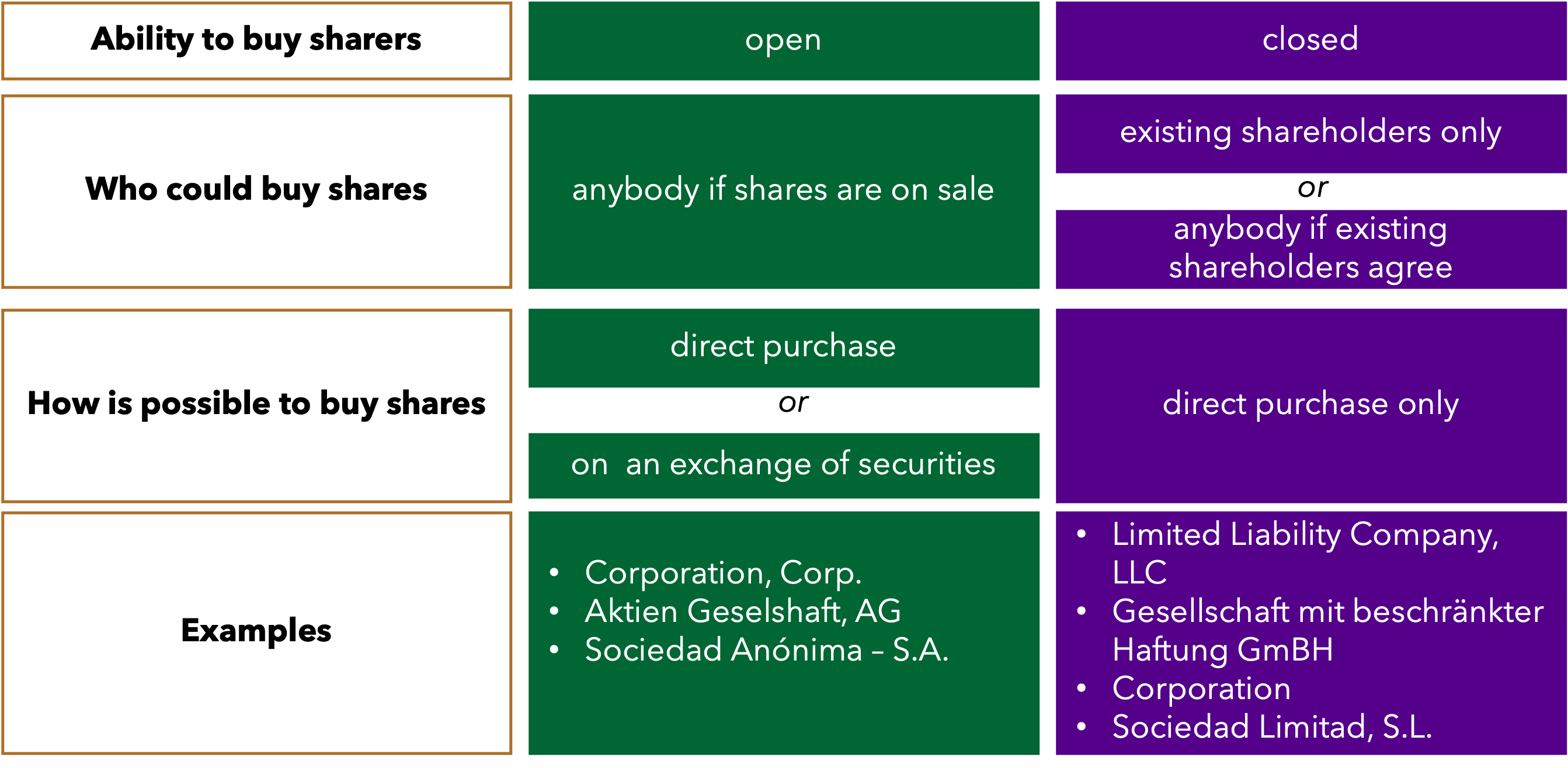
Ex. 11‑2 Organizations’ variety by establishment structure and openness
Keywords: open type organization, shares
Thus, in this type of organization, the owner owns the shares of the organization rather than the organization assets directly. In some countries, organizations that have a single shareholder use a legal term indicating that the shares are owned by one person, for example in Spanish-speaking countries S.L.U., which means Sociedad Limitad Unipersonal, an organization with limited liability of a single person. In some countries, such organizations receive special benefits regarding taxes, accounting, management. For example, in such an organization in Spain, there may be no managing director under an employment contract, and the sole shareholder himself can perform the functions of the chief executive officer, abbreviated as CEO. If the organization has several shareholders, it is necessary to make employment contract with selected person for role of CEO. In some countries, for instance in Germany, there is obligatory to have at least two CEOs with the right to represent GmBH and sign all document behalf of it.
Some legal forms of organizations provide that the owners of the business organization are fully responsible for the organization’s activities and debts. Those organizations hold legal titles with different designations in different countries, such as sole proprietorship, partnership, cooperative, personal firm, individual firm, or simply as operating individuals under a specific business permit or license. In this case, the personal and often family assets of the business owner or owners are inextricably linked to the organization’s assets. In this case, the owner of the organization must pay the damage, or debts caused by the organization from his personal assets. This form of organization is often found in small business, when a person or a group of people provide their own services to their clients – for example, hairdressers, lawyers, but it can also be a construction or transport service firm. This form is chosen because of the tax benefits, but it is difficult to find a case of multinational organization that has this form of unlimited liability.
Thus, multinational organizations usually have limited liability but can be both, closed and open type (Exhibit 11-2). Closed type organizations are often family businesses, which means that the shares of the organization are owned by the same family members. There are many well-known multinational organizations in the world that are family businesses. Family businesses often have the founder’s last name in their name, but this is of course not mandatory. In a family business, after the death of a shareholder, his shares are usually inherited by family members. There are many multinational organizations with second or third generation family members as shareholders and managers. So, the fact that the organization is a family business does not at all mean that it is a small local firm operating in one country.
There is a difference between closed type organizations and open type organizations. In closed type organizations, shareholders who decide to sell shares must first offer them to existing shareholders. If they do not agree the purchase, the shareholder can offer to sell shares to an external person who is not a shareholder of the organization. This principle is necessary to protect oneself so that in the event of a conflict between existing shareholders, one of the shareholders does not sell the shares he holds to, for example a competitor. There is no such limitation to whom tom sale a shares of open type organization. Open type organizations are called as “Corporations” in Anglo cluster, “Sociedad Anonima” in Spanish and Latino American cluster countries, “Aktien Gesellschaft” in Germanic cluster countries.
To grow and establish the world’s leading position in a specific industry, multinational organizations need financial resources for expansion over the world, so even rich families who own multinational organizations for several generations could face challenge or even issue to earn, attract or borrow such huge financial resources. Thus, even family organizations that are closed-type are forced to make difficult decisions from a closed-type organization to become an open-type. In other words, this basically means that organization start offering their shares to the public. Shares are publicly distributed on international stock exchanges that operate on the Asian, European or American continents. The owners of the organization decide on which exchange the shares will be distributed, but usually the country in which the organization’s headquarters are located is chosen. There are more differences between an open and a closed organization than the rights to purchase shares. A closed-type organization submits its activity reports to government institutions in accordance with the requirements of a particular country. In some countries this private information is available to the public, but in some countries even the financial reports are confidential. An open-type listed organization is required to provide public reports on its activities in accordance with legal regulations and the rules established by the stock exchange. The amount publicly available information about the organization’s activities is quite large, so anyone who wants to buy shares of these companies on the stock exchange has an equal chance of getting acquainted with the organization’s activity monthly, quarterly or annual reports and even with the organization’s business plans for the future. However, the purchase of shares of open organizations is strictly regulated; for example, the shares of an organization listed on stock exchange cannot be bought by a person who has more information than is publicly available about this organization. This type of stock trading, in which the stock is purchased by someone who has access to additional internal information about the organization’s operations that is not made available to the public, is called “insider trading” and is considered a criminal behavior. In the United States and many European countries, law enforcement agencies are very active in preventing of insider trading in stocks and prosecute traders and leakers of information about organization’s activities. The standards of publicity, transparency and accountability to shareholders and the society for multinational organization listed on open stock exchanges are much stricter than in closed-type not-listed multinational organization.
The reasons why closed international family businesses become open- listed companies are basically two – raising funds through the sale of shares and the desire of family members to withdraw from active management of the organization. It often happens that the founders of a multinational organization manage their organization themselves, but their children and grandchildren are no longer willing or able to get involved in the business, like their parents and grandparents, and after attracting investors, they retain a share in the organization for themselves and live on constant profits, they are not directly involved in earning. Some countries tax this type of inheritance of share from one generation to the next quite heavily.
Share or comment this information on your social media:
Fundamentals of global business
First edition
For citation:
Jarzemskis A. (2025). Fundamentals of global business, Litibero publishing, 496 p.

Full scope of the book is available in various formats
C.11. Structures of multinational organizations
About author
The author has been teaching at several universities since 2005. 40+ scientific publications, 10+ international research projects. More about author.