Edward Twitchell Hall, an American anthropologist studied human behavior in different cultures. The elements that Adler presented as a cycle are arranged by Hall in 1976.
Imagine an iceberg floating in the ocean. The hidden and the invisible part of the iceberg under ocean’s water is the largest and that is like human’s values and beliefs. The observer can only see that part of person’s behavior that he publicly displays, through his clothes, symbols he wears or by means of his words he expresses. The part of the iceberg above the water that one can see is the human’s behavior. The allegory of the iceberg assumes that when we see a person’s behavior, we may not understand it, because the values that determine such behavior are deep under water and invisible to the outsider (Exhibit 9-3). It can be very difficult for people who grew up in different cultures to understand another person with completely different core values (Hall, 1981). Value in one’s culture may not be a value in another’s culture.
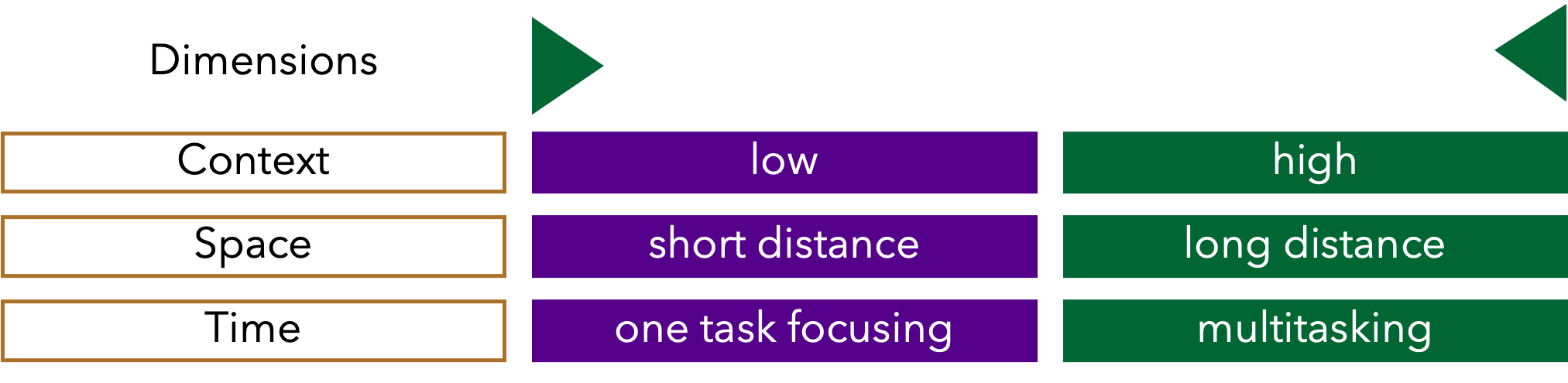
Hall conducted and published much of his research in the second half of the 20th century (Steve et al., 2022) which laid fundamentals on dimensioning cultures. Hall, even before the publication of the cultural iceberg in 1966, described three dimensions, which are important factors that determine many details of cultural differences (Hall & Hall, 1990) – these are the context dimension, the time dimension and the space dimension (Exhibit 9-4).
The significance of context varies among different cultures. For example, when communicating with words, a person expresses a thought, but without the verbal expression of the thought, apart from what is said, it is also important how and under what circumstances it is said.
Ex. 9‑3 Hall’s cultural iceberg

Keywords: Hall, culture
However, different cultures have different emphasis and meaning depending on the given context. In cultures where freedom of speech is not a value, or where it is considered rude to say something unpleasant to the interlocutor, context is highly valued. In Eastern cultures, expressing an unpleasant thought or dissatisfaction with words is not acceptable, while many people in “Western” culture are straightforward, they speak what they think. Therefore, if a person of “Eastern” culture says in words that he is satisfied with a business deal or business relationship, he does not necessarily mean it, and here a person of “Western” culture can be misled. In “Eastern” culture, it is common to send the main message through context, symbolism, rituals, rather than words. For example, giving a valuable business gift, showing exceptional attention to the decoration of meeting rooms, or the arrival of a top-level manager at a meeting are signals that are more important in “Eastern” culture than expressing the text in words. If the head of another organization did not come to the meeting with the top manager of a company, but sent a lower-level manager, it means much more than what is said in words in that meeting. The need to convey messages with the help of context, ritual or symbol was formed precisely from the centuries-old behavior and culture of not verbalizing bad thoughts and bad messages. It is very important for businessmen in “Western” countries to know this, as it avoids miscommunication and misunderstanding. It is said that in China, “Yes” can mean “Yes”, “Yes” can also mean “No”, and “saying No” is not used at all. Thus, a “Westerner” should not get the impression that his Chinese business partner unconditionally agrees to everything and is satisfied with all proposals, when saying “Yes”.
Ex. 9‑4 Hall’s cultural dimensions
Source: (Hall & Hall, 1990)
Keywords: context, space, time
Context is important not necessarily for understanding whether an idea will be accepted or not. Context has a different meaning in the structure of thinking. There are cultures where when delegating a task to a subordinate to it is important to provide full context and show the small task’s role for the overall goal or place in the system. However, there are cultures that may ignore context and focus only on the wording of the task, and providing context even in such cases would be assumed as informational noise. A very good example is saying or writing the date in different languages. In some languages, the day is told first, then the month, and only at the end the year is told. However, in other languages, the order is the opposite – the year is told first, then the month, and only at the end the day. Everyone can make sure of this by setting a convenient date format on their computer. When setting the date format, it is associated with the language used by the user. Thus, in some cultures the focus is on a specific core fragment, and in other cultures on the context in which that fragment is located. Cultures that pay little attention to context are more used to discipline, enforcement and not asking unnecessary questions, whereas in other cultures people tend to understand the context and possibly modify or find a creative solution to solve the problem in another way. From this point of view, context-oriented cultures are more creative, flexible, tend to achieve the same thing in their own way, but less reliable in unconditional execution. It causes huge impact of business processes standardization challenges for multinational companies.
Space is another dimension that is interpreted differently by different cultures. Each person has a certain physical distance from another person at which they feel most comfortable. In some cultures, it is perfectly acceptable to touch another person, to hug, and it is a sign of friendliness and favor. In other cultures, touching or hugging can be considered sexual harassment and even punishable by law in that country if the victim complains to law enforcement. In Southern Europe, South and Central America, hugging and touching is normal, and it doesn’t matter if it’s between people of the same sex, different sexes, or people of different ages. In Northern Europe, this is obscene and unacceptable. For example, a Spanish or Mexican professor is used to touching and patting his students on the shoulders during lectures, but such behavior would have serious and unpleasant consequences when he arrives to give a lecture in Sweden or Lithuania. So, every culture has its own private distance into which it allows the other person. In some countries, there is a so-called social kiss when people meet even little-known person, when people touch their cheeks two or three times. However, it is very important to know the culture of the person who is going to be kissed with a “social kiss”. Even a handshake in greeting is replaced by the joining of two hands in some cultures. In contrast, in other cultures, shaking hands during a meeting may not only be mandatory, but it is also common to do so with both hands and not let go for ten seconds or more.
In cultures where the need for private space is less, it is often possible to see the open door of the manager, often people work in common spaces, and it is quite well tolerated if someone interrupts the ongoing conversation during work. Meanwhile, in cultures where private space is highly valued, work in closed cell style offices is more valued, and it is considered impolite to intrude between conversation of colleagues.
Time is another dimension, and its perception varies from culture to culture. On one hand, it is related to a person’s ability to do multitasking or only one work at a time. On the other hand, it is related to punctuality. For example, Germans, British, other northern Europeans are famous for their punctuality and accuracy. Being late for a meeting is very rude and unprofessional. It is common to arrive at meetings at least a few minutes before. When scheduling meetings, the time is specified to the minute. The meeting can be indicated, for example, at 10:15. In Northern Europe and the USA, it is customary to plan the duration of the meeting as well. Meetings are prepared in advance, often even the meeting agenda and topics that will be discussed are planned. This kind of precise planning has come from the intense business of people and the planning ahead. For example, meetings in those cultures are often scheduled even several weeks in advance. After the COVID 19 pandemic, many physical meetings have been replaced by virtual meetings using online video conferencing. When meetings are organized virtually, a lot of travel time is saved, which has further increased work productivity and the number of meetings. This especially affected office workers. It has become customary to schedule a meeting very precisely, for example, on the 15th of the next month from 1:30 p.m. to 2:30 p.m. However, in other cultures, especially in South America, even in Southern Europe, people view time less strictly and plan ahead much less. For example, in Mexico, agreeing that the meeting will take place tomorrow at 10 o’clock in the morning may mean that people will arrive an hour earlier or later for the meeting. It’s okay to wait half an hour or an hour for a colleague to come to the meeting. In this culture, time is not valued as much as in Northern Europe or North America. Of course, this also leads to different work performance. As business becomes globalized, the requirements of Northern Europeans or North Americans established by multinational companies for productivity, planning and time saving have spread to many countries of the world, so it is impossible to unequivocally state that people are always late for meetings in Spain or Mexico. However, cultural characteristics and long-standing traditions are still evident in local businesses. The duration of the meeting is important for northerners, because after one meeting there will likely be another meeting or another scheduled work, while if northerners look at the clock during the meeting, it can offend the southerner, who does not understand why the business partner is in such a hurry and wants to end the meeting at a specific time. The fact that the other person spends only a limited amount of time with the other person can come across as an insult. In cultures where saving time is not a value, people and relationships with people are usually considered to be of great value. Southern cultures aim to spend as much time as possible with a person, to get to know them, and this is considered a value even in business. This is associated with need of trust, because it is customary to first get to know a person well and only then decide whether it is worth doing business with them. In such time reluctant cultures, it is customary not to strictly separate work and rest time – business and work matters are solved during rest, and personal issues are solved during work. In cultures that strictly schedule and treat time punctually, it is customary to strictly separate work time from personal life. A manager’s call to an employee after work can be received very differently depending on the culture. Cultures that do not save time usually tend to create long-term relationships, employees’ relationships are closer, they communicate more even after work, become friends, and employees are less likely to change jobs. Changing culture and habits is quite difficult, but knowing the differences beforehand takes a lot of stress away and makes it easier to tolerate someone who behaves differently.
The ability to multitask is also related to a person’s attitude towards time and, essentially, the need to save time. Cultures that sought material prosperity and pioneered international business were as demanding of themselves as entrepreneurs were of their employees. Higher productivity still means higher profits today. In labor-intensive business industries, wages constitute a significant part of the product cost. Wages in most countries are based on time worked. Thus, employers seek to perform as much work as possible and create as much added value as possible during a unit of time. Most physical work has a homogenous nature, and specialization has been used to increase labor productivity since the time of Henry Ford as it is described in chapter 2. However, when working not a physical work, but in the field of intellectual work or service, often the same employee has to perform more than one function. In those cultures, where people are not used to working on several ongoing assignments at the same time or serving several processes, the aim is to specialize employees as narrowly as possible. Meanwhile, multitasking cultures tend to have less narrow specialization. The larger the organization, the more work that is exactly the same, so multinational organizations have significantly greater chances to specialize their employees very narrowly, to the performance of one specific function. Local firm often cannot afford this, as the volume of business is not large enough to create an abundance of exactly the same work. For example, in order to have a separate employee for issuing invoices, the organization has to issue enough invoices during the day that one person will issue invoices for the whole eight hours. A small business generates fewer invoices per day, so the same employee will not be overburdened by invoicing alone. In such cases, in addition to invoicing, this employee may also perform other similar accounting functions. Thus, in cultures where people are traditionally able and accustomed to doing various jobs at the same time, it is much easier to develop local boutique-type businesses, and in cultures where people are used to repeating the same function many times, it is easier to develop large businesses, which are usually international.
In cultures where it is customary to do multitasking and perform various functions at a time, job changing is very common for employees, change specialties more often, while in cultures where narrow specialization prevails, job and profession changes are not so frequent.
Share or comment this information on your social media:
Fundamentals of global business
First edition
For citation:
Jarzemskis A. (2025). Fundamentals of global business, Litibero publishing, 496 p.

Full scope of the book is available in various formats
C.9. Theories and elements of cross-cultural business environment
- Culture and behavior relations
- Cultural dimension by Hall
- Cultural dimension by Hofstede
- Cultural clusters by Trompenaars
- Cultural dimension by Kluckhohn and Strodtbeck
- Variety of cultural clusters and its impact on business
- Cross cultural differences in business processes
- Questions for chapter review
- Chapter bibliography
About author
The author has been teaching at several universities since 2005. 40+ scientific publications, 10+ international research projects. More about author.