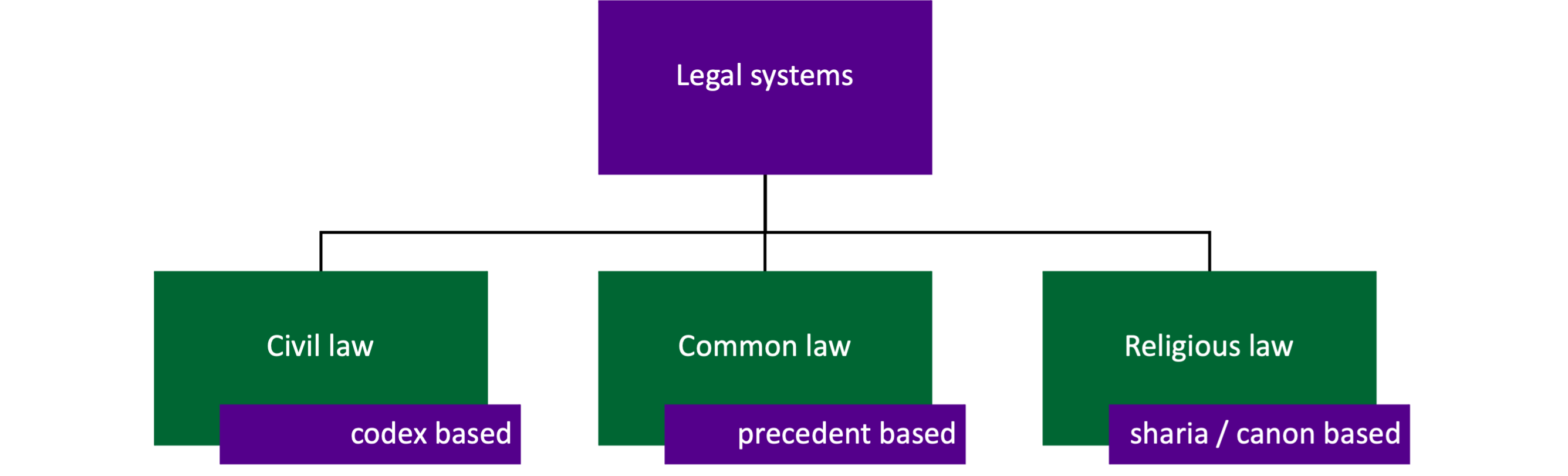
Legislation systems include the law and law enforcement system of law including application and implementation. The relevance of the legal system for international businesses can be assessed in terms of form, content and power of bureaucracy (Farazmand, 1997). In terms of form, it is very important for international businesses to distinguish between the three types of legal systems that exist. The fundamental differences are between a civil code-based system, a common law, and a religious/theocratic system.
Legal systems based on civil codes or, in other words, sets of rules, are characterized by the fact that business relations, what is allowed, what is prohibited are widely explained and regulated by existing legal acts – codes, laws, procedures, rules, principles approved by parliament and other authorities (Exhibit 8-5). So, disputes in lot of situations are usually solved by the word of written code (Merryman & Rogelio Pérez-Perdomo, 2018). This legal system is also called continental, because it is very common in continental Europe.
In the United Kingdom and the former colonies of the British Empire, including the United States, Australia, the so-called common-law system applies which is based on precedent and tradition. This system is based mainly on legislation relatively poor in written details. In such traditions based common law system, it is very important to know how a specific law o rule is interpreted and what court decisions were in a similar situation or precedent in the past.
Theocratic law is mostly applied today in Muslim countries based on Coran. It is quite relevant for multinational organization because some products and behavior are legally restricted there by religion doctrines. For example, drinking alcohol, eating pork, woman’s dress code can be restricted or defined by law.
In terms of content, for a multinational organization it is very important such a field of legislation:
- Physical property law.
- Intellectual property law.
- The regulation to establish an enterprise.
- Law of contracts and disputes.
- Labor law.
- Commercial law.
- Tax law.
- Foreign trade tariffs law.
- Anti-dumping law.
- Competition law.
- Anti-corruption law.
Ex. 8‑5 Variety of legal systems
Keywords: civil law, common law
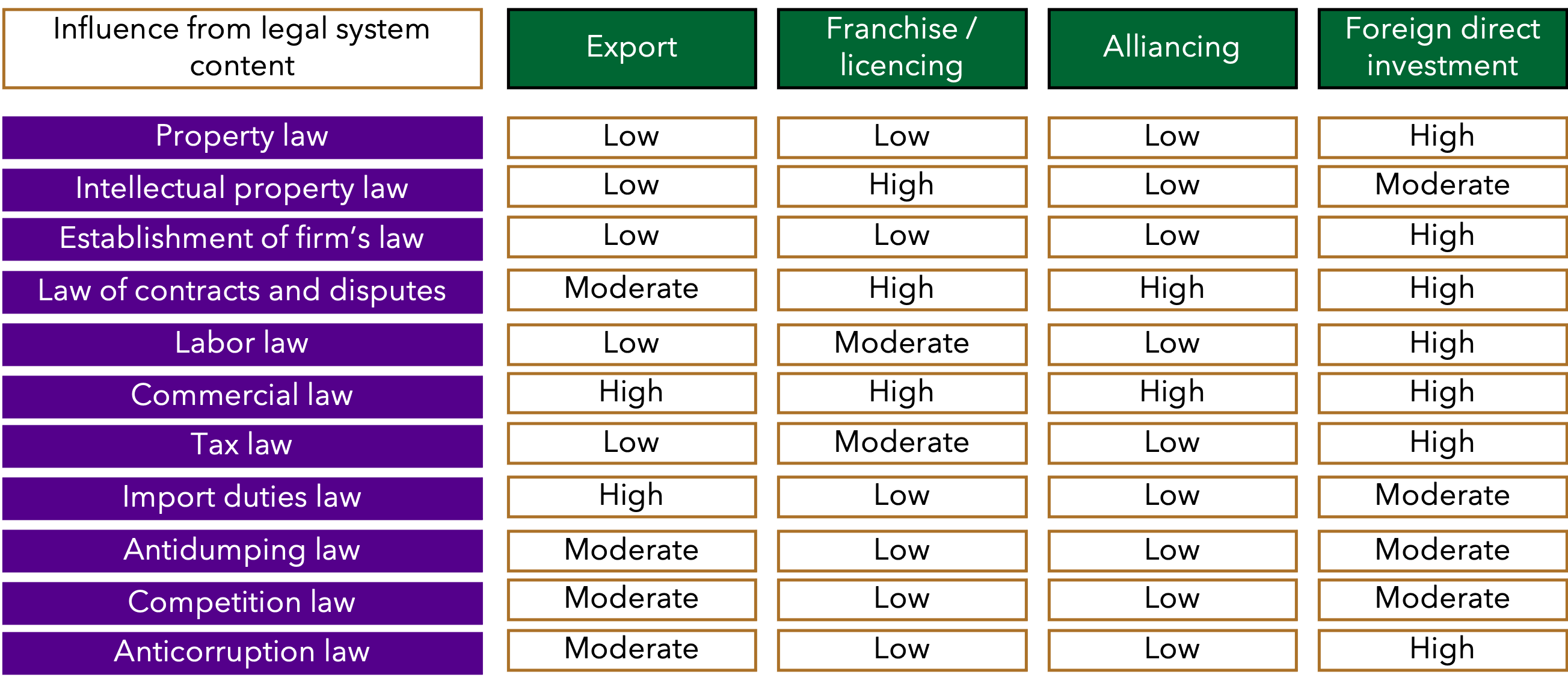
Each of these areas of legislation is differently relevant to various forms of doing business internationally (Exhibit 8-6).
Trade, import duties, anti-dumping, and trade law are most important for export and international trade. It is crucial to consider Intellectual property law and commercial law when doing business with international franchising and licensing activities. Competition law is important in non-equity alliances. In the case of equity alliances and foreign investments, property law, the right to establish organizations and tax law are very important.
Property law is very important due to the inviolability of property, the conditions of its acquisition and disposal. It has been observed frequently, even top-level managers or entrepreneurs working locally in their countries are shocked when they encounter a different approach to property and assets in another country. For the Western Europeans, the North Americans and persons from other democratic countries, the inviolability of private property and freedom of acquisition may appear as an obvious, unquestioned given, but not in all countries. For example, in some Arab countries, foreigners cannot own and have sole control over companies. In such countries, foreigners are only allowed to own a certain part of the shares, and the controlling shareholder and manager must necessarily be citizens of their country.
Therefore, when planning foreign direct investments in a such a country, it is very important to find a local partner for co-ownership of the business. Nationalization is possible in authoritarian countries and in fake democracies. Nationalization means that the shares of a private shareholder are expropriated by the State, in other words simply taken away. The formal reasons and justifications for this can be very diverse, sometimes it can be decided by the court, and sometimes it is enough just to order from the country’s leadership. So as physical property is expropriated, then intellectual property is also under similar threats.
Ex. 8‑6 Influence of different legal aspects for various models of international business
Keywords: law, trade, foreign investment, alliance, franchising
For the security of intellectual property in another country, not only the law there is important. Law can provide that illegal copying, piracy or other harmful action against the intellectual property are prohibited; however, a lot depends on the enforcement of the law. If tradition and culture tolerate theft of intellectual property, law enforcement agencies usually do not pay much attention to enforcement in such cases, and criminals are not pursued or even some activities are not recognized as intellectual property infringement.
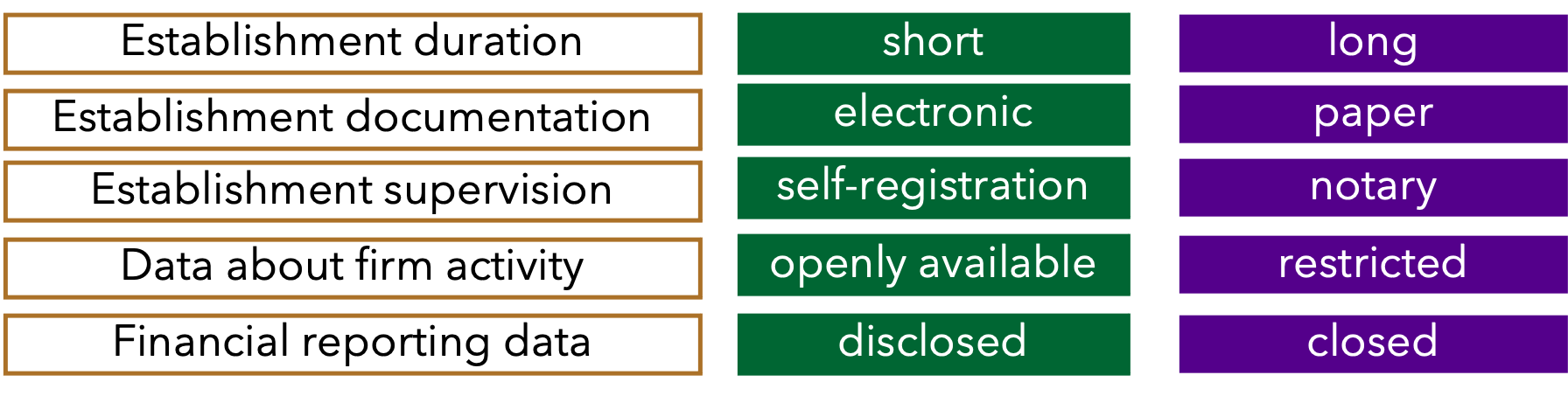
Enterprise laws also vary greatly between countries around the world (Exhibit 8-7). In some countries it takes just one or a few days to set up a new firm and it can be done electronically, but there are countries where it takes one or several months to set up a new firm. Even among countries in the same political and economic union, such marginal differences can be found in the duration and formalities of establishing new firm. For example, in Northern European countries, Finland, Estonia, the establishment of a firm can be done electronically, and it takes not more than one day. A firm’s constitution of statute is prepared by founders according to the template form, and the documents are uploaded to the state-administered electronic system in Northern Europe. As opposite, in Spain, the establishment of a firm can take a month or more, the articles of the firm are drawn up by a notary in paper form, the registration steps in the state registry are also carried out by a notary, the physical presence of the founders at the notary is necessary during the establishment of the firm. The reasons for these differences are attributed to several aspects. Electronic documents and their recognition are still at different levels of progress in different countries of the world. For this reason, even firm is opening a bank account in some countries, it is mandatory to sign many documents by hand. The freedom and rights provided to foreigners to establish firms and open bank accounts vary greatly.
An organization has to face lot of challenges at the time of establishing its subsidiary in another country. Although parent organization’s representative has the right to represent this organization internationally. All authorizations and documents required for representation have to be translated into the national language of the foreign country in many cases. Simple translations usually are not enough, in some countries to accept foreign document, a translation may be required to be certified by sworn translator. Not all countries have such a concept as a sworn translator, so in some country’s translations must be notarized.
Ex. 8‑7 Main aspects of enterprises regulatory frameworks
Keywords: regulatory, firm, establishment
Even after the documents are notarized in organization’s country of origin, for them to be recognized in another country, there is a need to be certified by the embassy by so called apostille. By signing and stamping documents, an embassy official confirms that these documents are genuine and must be recognized in another country. Thus, when establishing a subsidiary in another country, an organization needs to submit representation documents to the state authorities of another country, it is necessary to ensure that all documents are accompanied by an embassy apostille. It is one of the reasons, why countries seek to have their own embassies in other countries, as this facilitates the procedures of international business, whether at the establishment stage and when challenges arise for operating firms.
Although electronic documents and the use of electronic signatures are becoming very popular at the local country level, the lack of a unified standard is often encountered in international business. Therefore, if a document is signed with an electronic signature by a representative of an organization in a particular country, it is often impossible to check the authenticity and legality of the signature in another country in fast and easy way. Thus, in international business, it is often necessary to sign founding documents and contracts by hand and send them through international courier services. In response to this need, several large global parcel delivery operators have a standardized service – the delivery of documents within 24 hours to any point in the world.
Even in such economic-political unions as the European Union, the electronic signature and its recognition are not harmonized between different countries. Among companies from different continents, this problem is even more complicated.
Although English is considered the international business language, law, rules and firm establishment documents in a specific country are drafted only in the national language. Some countries have two national languages, so in such countries it is allowed to choose one of the official national languages.
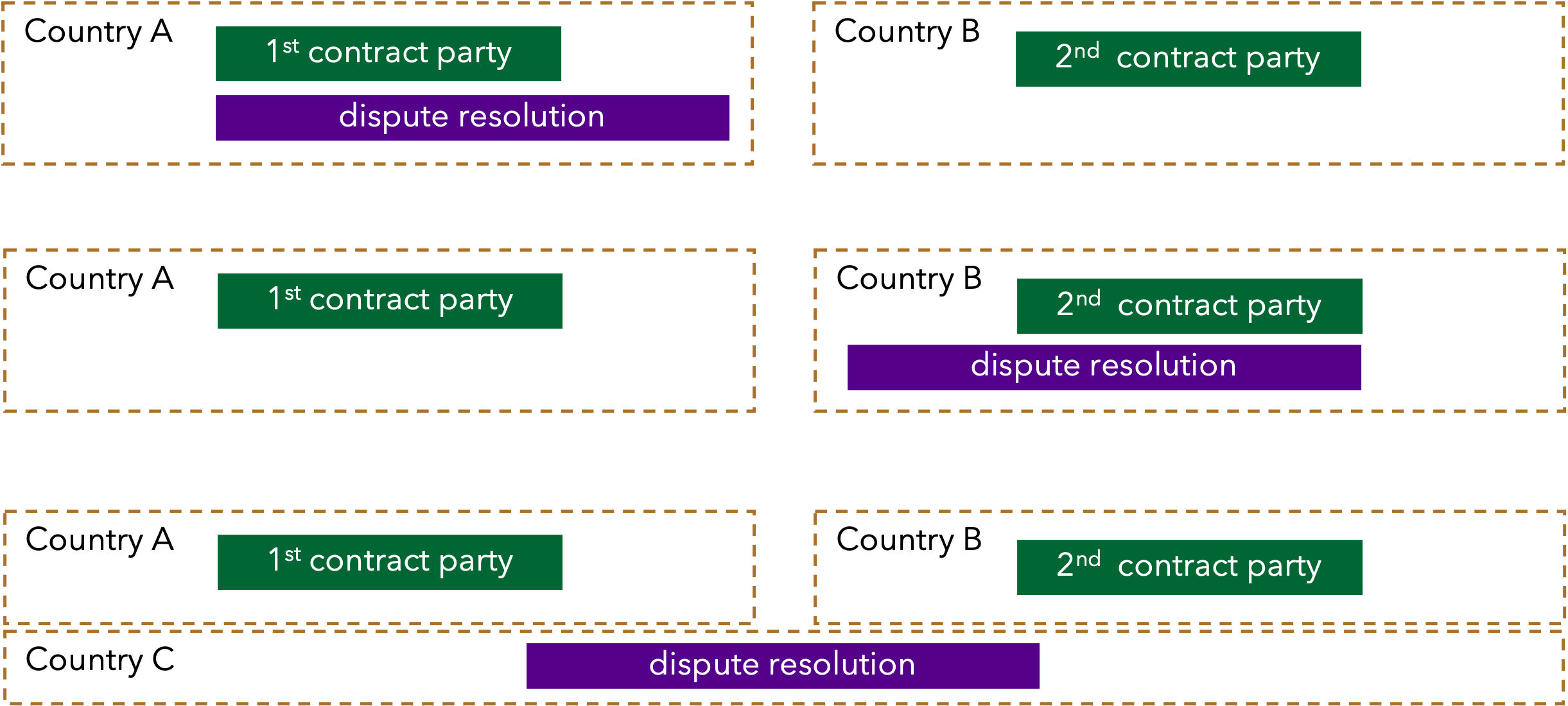
Ex. 8‑8 Options for dispute resolutions in international business
Keywords: arbitration, dispute
Some countries recognize the English language, and most national legislation is translated into English, but most countries around the world do not. Surprisingly, even local notaries, civil servants in various countries around the world often do not speak English. An advisory service of local consultants and lawyers is very important. For this reason, before starting a business in another country, especially if it is an investment, the services of international business consulting firms are used.
In different countries, the legal forms of organization, the requirements for the authorized capital, and the liability of the owners also differ. Although there are differences between countries, the general principle of separating the liability and obligations of the business owner and the organization remains, with limited liability companies being the legal form used in many countries to establish companies. More details about organization forms and structures are described in chapter 11 of the book.
The law of contracts and disputes depends on the dominant legal principle in the country – civil code-based or common-law based on a precedent (Exhibit 8-8). In international business, not only the legal framework of the country where the business is being developed is important, but also the legal principles and disputes in cases of international contracts. When concluding a trade, franchise, alliance or investment agreement between entities from different countries, the question of which legal basis will be used to resolve disputes and interpret the terms of the agreement often arises. In international business, it is very common for each organization to seek to have disputes and contract interpretation in accordance with the law of their own country. Nonetheless, the parties to the negotiating contract must agree on which state’s law will be used, if necessary. This clause, which stipulates which country’s law governs disputes, is almost always included in business contracts between entities from different countries. If, the parties to the contract do not agree on which of the parties’ law is used to resolve the disagreement, there is always the possibility to use a third party or to provide for the resolution of disputes in international arbitration if there are such disputes. The International Court of Arbitration of the International Chamber of Commerce – ICC or the SCC – Stockholm Chamber of Commerce Arbitration is often cited as the institution that deals with disputes between business partners.
Ex. 8‑9 Polarities of labor regulations among countries
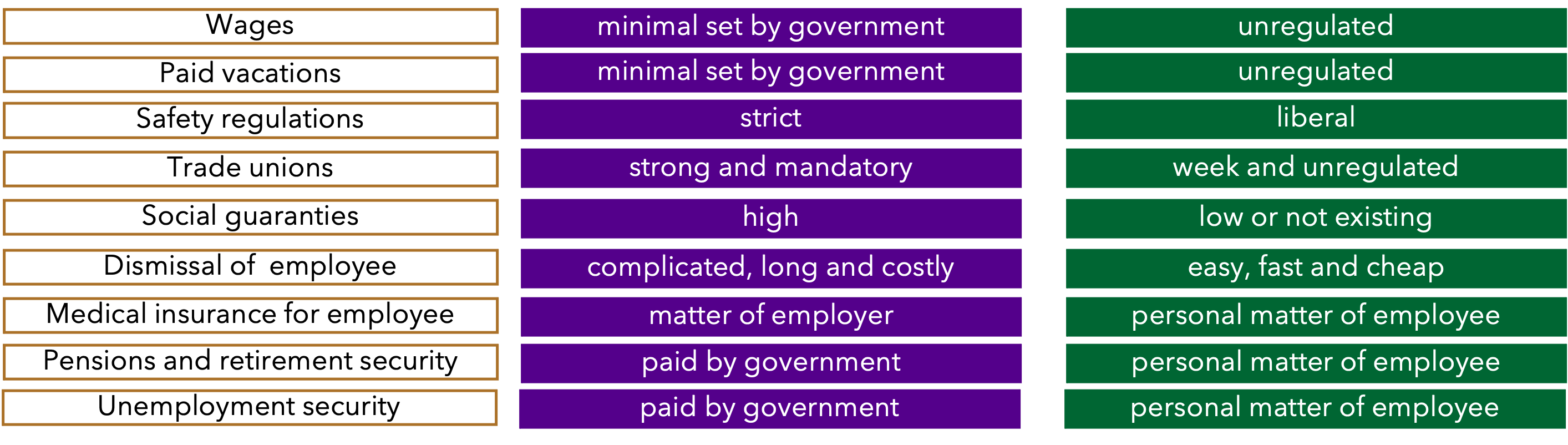
Keywords: wages, employment, trade unions
Labor law is very important when choosing foreign direct investment as a way of expanding business (Exhibit 8-9). In each country, the laws determine such important aspects related to the hiring of employees differently, such as recruitment, the procedure for job advertisements, types of employment contracts, the minimum wage, the duration and procedure of paid vacations, dismissal, workplace hygiene requirements.
In democratic countries dominated by left-wing political trends, the laws are usually on the side of the employee, and a lot of obligations and responsibilities are placed on the employer. For example, in some countries it is required that even in a job advertisement the employer must publicly indicate the offered salary, any conditions in the advertisement due to age, gender, race or other criteria is prohibited and penalized. An employer who violates these requirements in just an advertisement may receive a fine from state institutions controlling this area. In these countries, the most common temporary wage system is the monthly or hourly wage, but the state sets the minimum wage that the employer can pay per hour or month. For example, in Germany, the minimum monthly salary in 2022 was about 1,600 US dollars, in the United Kingdom – 1,700 US dollars, in the United States and Canada – 1,550 US dollars each, in Australia – 2,000 US dollars, in Spain 925 US dollars, but in South American countries it varied between 230 and 400 US dollars per month and in India just 95 US dollars per month. The minimum wage should not be confused with the average wage, because the average wage is decisive in many cases of labor market demand and supply, and the minimum wage is set as an obligation by the state for employers. In countries where the minimum wage is 5 or even 15 times lower than in Western Europe and the USA or Australia, the average wage is also significantly lower. Because of such wide wage differences, business costs for labor vary greatly. Those industries that require a lot of human labor usually choose countries with a low minimum wage for investment. To achieve economic transformation from low added value to high added value, some countries artificially increase the minimum wage and thereby push out investors who invested only for the sake of cheap labor and cost reduction. Thus, the state regulation of the minimum wage is very relevant when making decisions about the location of investments.
In Western European countries, especially those dominated by left-wing political trends, temporary employment contracts are often limited, if the work has attributes and criteria of permanence. Firing a hired employee in these countries is quite difficult, unless the employee has committed serious violations of labor discipline. However, in such cases, the employer must collect evidence of such violations, for the first violation, he must warn the employee and provide opportunities for improvement. For an employer to dismiss an employee unilaterally, for example due to a reduction in the amount of work in such countries, it takes time and lots of costs, or in some cases is next to impossible. In such cases, employers have to pay compensations in the amount of salary for a period of several months to several years, with several months’ notice of dismissal. Sometimes in US movies, it is possible to see an episode where the employer tells the employee “You’re fired” and the same day the employee starts putting personal belongings in a box and doesn’t come to work the next day. This type of dismissal is almost impossible in many European countries. In the countries of South America and Asia, the labor law is not as favorable to the employee as it is in Europe, as well as in US.
The number of working hours per week and the duration of holidays also differ. The legislation of most European countries provides for work of 40 hours per week, counting 5 days of 8 hours each. In some European countries, such as France, which has a 35-hour work week, there is debate over a four-day work week, but in Southeast Asia and the United States, legislation usually does not limit working hours, and a six-day work week or 60-hour work week is common. In Europe, legislation in many countries provides an employee with at least one month of annual paid leave, which the employee can use all at once or split into two weeks and several shorter periods per year. In China, an employee gets up to 5 days of vacation per year. In Canada, Argentina, the state sets up to 10 days of paid vacation per year. For example, in the USA, the number of paid vacations is not regulated by the state, and it is left to the agreement of the employer and the employee. Thus, when a US born multinational organization opens its subsidiary in Europe, one may be surprised by the abundance of state-guaranteed rights for employees. Occupational hygiene is also a matter of legal regulation, which varies between countries. In Europe, the relative amount of floor space per employee, the intensity of workplace lighting and other nuances are set in many countries by law. In Europe, the standard of 6 square meters per employee is usually applied, while in Asian cloth factories or remote service or call centres there is no such requirement, and it is common to have significantly more cramped people in the workplace.
For international trade regulation INCOTERMS are usually the conditions. It covers international trade transactions, import and export contracts, delivery, insurance and liabilities. The importance and features of which are described in part D chapter 13 of the book. INCOTERMS standardize trade conditions and responsibilities and help to interpret the various situations with the goods in a uniform way, from its dispatch to its receipt.
The law of taxes, including customs duties, is a separate type of law through which the state implements the content of its policy. Depending on the prevailing political direction in the country, the tax system can vary greatly. In some countries, taxes are very favorable to business and investors, in other countries; they are favorable to employees and the unemployed. The variety of taxes is detailed in the next section of this chapter on an economic environment.
Anti-corruption law is an important part of a country’s legislation as well as institutions implementing and enforcing them. International business is affected by the negative influence of corruption. That is happening that in some countries, multinational companies pay bribes to get favorable decisions from local authorities. Although bribery of an official is usually treated as a crime in legal acts, different countries have quite different responsibilities for it, and the effectiveness of law enforcement work in detecting corrupt activities also varies greatly. The severity of penalties for corruption crimes also varies. One of the most difficult manifestations of corrupt activity is the corruption of the courts themselves, when the judges make a favorable decision for the bribe giver. Corruption in such countries often reaches the political level. More than one famous corruption case has can shake the political career of heads of governments or even state presidents. A corruption in international business implicates unfair competition conditions. Local entrepreneurs, for example, to avoid the investments of a foreign competitor, can pay bribes to officials to delay business establishment processes and construction permit issuance processes. These dirty tools like bribery are still used in many Asian, African and South American countries, but it also happens in Europe or North America. The level of corruption varies between countries, but it is influenced not only by the severity and inevitability of punishments set by legislation, but also by society’s attitude towards corruption. In very strongly collectivist and hierarchical societies, a gift is sometimes perceived as a way of expressing gratitude or politeness. However, in the United States and the European Union, even payment for dinner of a state officer can be understood as illegal behavior and an attempt to bribe. A trading influence means that a state servant, for a reward, can influence the speeding up or slowing down of the bureaucratic process. Even members of parliament who have received rewards from business groups for passing laws in their favor can be accused of corruption. Scandinavian countries are considered to be the least corrupt, African countries and South American countries are among the most corrupt.
Construction and environmental law hold significance when planning investments in another country. Legislation sets out requirements and procedures that vary widely from country to country (Exhibit 8-10). To carry out economic activities, for example, to build industrial infrastructure, it is necessary to carry out procedures related to environmental impact assessment. These procedures include identifying areas of potential impact, independent assessment of environmental impact, involving the public in impact discussions and making a final decision, which may oblige the investor to make additional investments for the preservation of the environment or may prevent economic activity in the early stage (United Nations, 2018). In democratic countries, these processes are similar, but the detail, precision and duration of such procedures vary greatly. The enforcement of these procedures is greatly encouraged by international financing institutions and banks.
Ex. 8-10 Environmental law

Keywords: pollution, CO2, climate change
Often, investments in another country are financed with bank credits, so banks that protect their reputation and name contribute to the implementation of environmental principles in many democratic countries.
Share or comment this information on your social media:
Fundamentals of global business
First edition
For citation:
Jarzemskis A. (2025). Fundamentals of global business, Litibero publishing, 496 p.

Full scope of the book is available in various formats
C.8. Political, legal and economic environments in global business
About author
The author has been teaching at several universities since 2005. 40+ scientific publications, 10+ international research projects. More about author.