The following section summarizes the benefits of alliances to their participants and the disadvantages of alliances as it is reflected in exhibit 5-13.
The benefits of alliances can be structured as follows:
• Economy of scale in production.
• Specialization in core competence.
• Becoming big improves negotiating positions.
• Learning and acquiring knowledge.
• Market testing.
• Increasing sales and profits.
• Risk reduction.
Economies of scale are achieved only with large production volumes of identical products or identical services. Large production volumes require a very large market. Local producers can choose either to produce their own branded products or sell them, or to join the value chain by becoming suppliers of global organizations. Global organizations usually have very large markets, so a vertical alliance makes it possible for a manufacturer to receive very large orders for a certain product, part or component, which will later be integrated into the final product distributed on the global market. This encourages manufacturers to be in alliance with partners in the value chain of their products. For example, it is beneficial for a computer processor manufacturer to be in an alliance with a computer manufacturer, especially if the computer manufacturer with its own market undertakes to order many processors during the year and not turn to another manufacturer.
Focusing on core competence allows managers of organizations to focus all resources on improving the properties of a product, advancing production technologies, and not wasting resources and time on developing another product or assembling a final product of parts or components for end user.
The benefits of alliances can be structured as follows:
• Economy of scale in production.
• Specialization in core competence.
• Becoming big improves negotiating positions.
• Learning and acquiring knowledge.
• Market testing.
• Increasing sales and profits.
• Risk reduction.
Economies of scale are achieved only with large production volumes of identical products or identical services. Large production volumes require a very large market. Local producers can choose either to produce their own branded products or sell them, or to join the value chain by becoming suppliers of global organizations. Global organizations usually have very large markets, so a vertical alliance makes it possible for a manufacturer to receive very large orders for a certain product, part or component, which will later be integrated into the final product distributed on the global market. This encourages manufacturers to be in alliance with partners in the value chain of their products. For example, it is beneficial for a computer processor manufacturer to be in an alliance with a computer manufacturer, especially if the computer manufacturer with its own market undertakes to order many processors during the year and not turn to another manufacturer.
Focusing on core competence allows managers of organizations to focus all resources on improving the properties of a product, advancing production technologies, and not wasting resources and time on developing another product or assembling a final product of parts or components for end user.
Ex. 5‑13 Pros and cons of alliancing

Keywords: risk, trust, longevity, pros and cons of alliancing
Organizations that focus only on one product that supplies partners in the value chain send a signal to their partners that they themselves do not intend to compete with them, and to take over activities that are performed by their partners in the value chain. This point is important because it encourages partners to be more open with each other, to share information about production possibilities, plans, and planned investments for progress. Thus, the prevailing principle is that each partner focuses on their area of expertise and does not interfere in the partner’s business. Mutual trust between the alliance partners is one of the most important tools for ensuring the stability and longevity of the alliance (Kale & Singh, 2009).
An alliance with non-alliance business partners, suppliers, distributors or non-customers often speaks with one voice, presenting itself as a single entity. It is often used by horizontal alliances. In business, there is a common situation when negotiations and other business relationships take place from positions of power. A large market player intending to purchase raw materials or components often negotiates significantly lower prices from suppliers due to their size and the scale of future purchases, as they see this as an opportunity to apply economies of scale. Thus, the companies acting on behalf of the alliance create this size artificially. For example, the Italian dairy and cheese industry alliances used this to negotiate better market awareness and visibility in the global retail chains. Larger entities prefer collaborating with other larger entities while the alliance enables smaller entities act like and with larger ones.
Organizations should not underestimate such a seemingly trivial thing as the benefits of learning in an alliance. Alliance partners are interested not only in their organization’s capabilities and know-how, but also in the partners’ efficient work, because the partners are dependent on each other. If a manufacturer’s processors are slow, noisy, or too expensive, it will also affect the computer manufacturer that installs those processors. A computer manufacturer can always look for another processor manufacturer, however initially, more complex solutions such as – training, and information exchange with existing alliance partner are explored. Often, the production processes of partners are coordinated for a long time, a lot of joint improvements are made by selecting new materials, new design, so changing a partner to another one with whom there is no previous coworking experience is often not so easy. Alliances organize cooperation events for the exchange of good experience, training, synergizing of mutual activities, often the employees of the alliance partners go to each other’s places for internships, to get to know the specifics of the partners’ work. By better understanding the principles, limitations, and advantages of partners’ work, alliance partners can find common solutions beneficial to the alliance (Kandemir et al., 2006).
Market testing fees can often be seen in alliances. Instead of entering the market of an unknown country by themselves, organizations choose the form of a cooperation alliance with partners already operating in those markets. This can be both in the case of a horizontal as well as vertical alliance. For example, instead of organizing flights to a new country, alliance members prefer to accept a new alliance partner that already has experience serving the market of that country. Alliances often compete with other alliances, so sometimes it is better to include a partner into alliance who is experienced in a certain market, than for the alliance members themselves to try to test an unknown market.
The ultimate benefit that companies seek from being part of an international alliance is to increase market share and sales, as well as increase profits. Sometimes, to take the largest possible share of the market and beat competitors, it is much easier to be in an alliance than to be alone. When implementing a market capture strategy, it is often necessary to sacrifice profit in the short term, but with the expectation that the subsequent profit, when a dominant position in the market has already been achieved, will compensate for the short-term unearned profit in certain instances or possibly even an incurred loss. Cooperation in an alliance allows for a significant reduction in risk, especially where costs and high market uncertainty are concerned. The risk is shared between the alliance partners, each partner performs those activities that are the least risky for him and require the least risky investments. So instead of opening a new business to a new country, a partner that already serves that country’s market is accepted into the alliance.
However, all non-equity alliances have one major problem with their longevity, which is well illustrated by Wilma W. Suen’s (Suen, 2005) idea that alliance partners only exist as long as each partner benefits now or is expected to benefit in the future. The “saying we, thinking me” perfectly illustrates this idea and situation. This does not mean that the partners only want to take advantage of each other. An alliance is not a zero-sum equation, meaning one wins only if the other loses. Only such an alliance is sustainable, in which a synergistic effect is created, and in which each partner benefits or believes that each partner will avail benefit. However, much is based on future benefits, as alliances are often even referred to as strategic alliances, which means that benefits will only be achieved if strategic goals are met. Thus, in most cases, alliance partners evaluate being in an alliance through the criterion of expected future benefits. Partners who have been in the alliance for several or a dozen years often have accumulated experience of the losses they have experienced, so their ties become stronger.
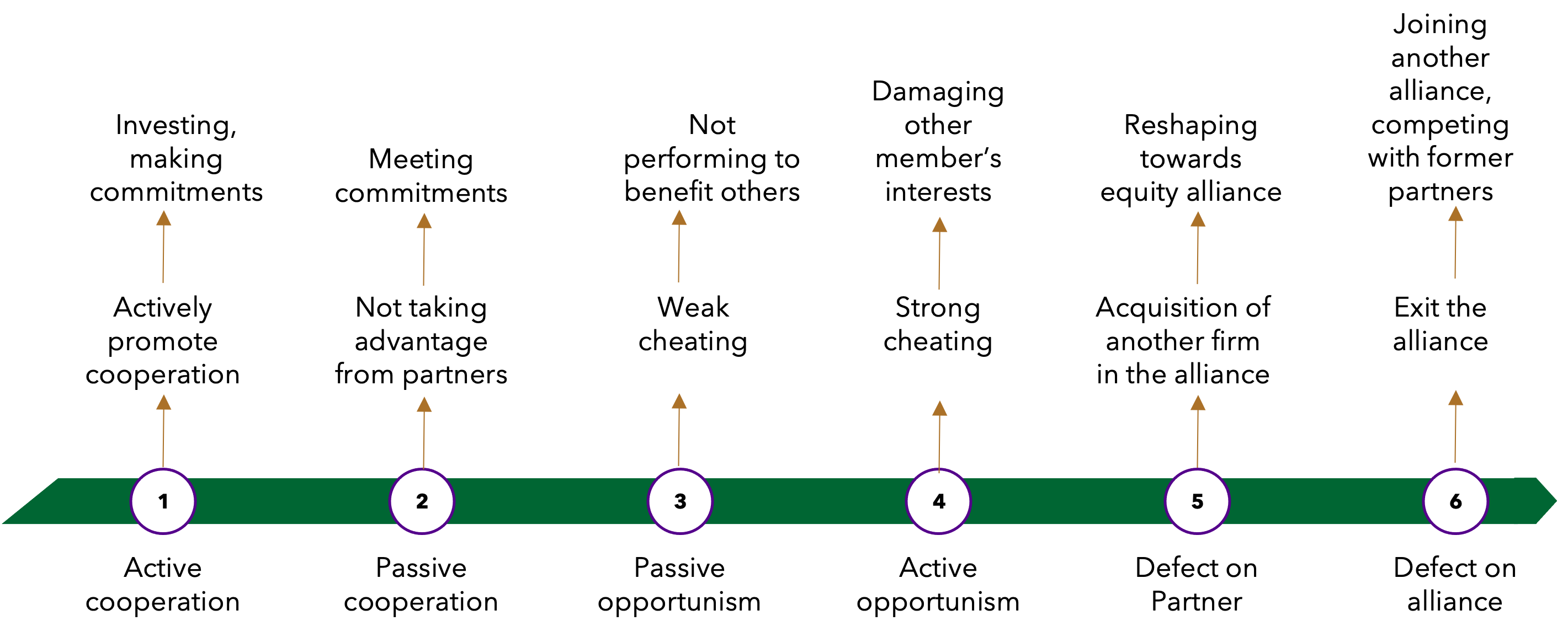
However, once a new alliance is formed, tangible benefits often must wait. Wilma W. Suen (Suen, 2005) divided the alliance into six stages of maturity. In the first stage of active cooperation, active contribution of each partner to the common value of the alliance take place; investments necessary to create this value are made. In the long run, if the partners do not receive the expected benefits and returns from the value created by the alliance, the stage of passive cooperation begins, but the partners’ contributions to value creation still remain. The third stage is the passive opportunism, which manifests itself in the fact that partners begin to default on their obligations, although they still hide or justify the non-fulfilment of obligations.
Ex. 5‑14 Lifecycle of alliance (Suen, 2005)
Keywords: opportunism, exit from alliance
The fourth stage becomes active opportunism, in which the scale of non-compliance increases and, as a result, obvious damage to alliance partners occurs. The end of an alliance often happens in two ways (Das & Teng, 2000). One way is when one partner acquires another alliance partner. This often happens when the partnership is needed more by one partner, and when the other enters the stage of passive or active opportunism, the first partner cannot accept the partner’s behavior. Frequent acquisitions or mergers in international business arise from pre-existing non-equity alliance relationships between companies. Another way to end an alliance is when the organization simply leaves the alliance and joins another more profitable alliance. If a large part of its partners leaves the alliance, such alliances dissolve and cease to exist (Suen, 2005; Das & Teng, 2001).
The reasons for alliance failures can be systematized as follows (Greve et al., 2010; Suen, 2005):
• Dominance of one large partner.
• Uneven levels of professionalism and capabilities of partners.
• Cultural and language barriers.
• Mistrust.
• Egoism and prioritizing one’s own interests.
• Dependence on one partner.
• False preconception.
• Different commitment of partners to the alliance.
• Different business procedures and used systems.
• Predation of the partner.
• Reluctance to take advantage of the alliance due to passivity.
• Overlap and internal competition between alliance partners.
If an international alliance is dominated by one large partner and many small partners, there is a very high probability that the large partner will contribute to the alliance’s activities with its resources more than the other partners, but at the same time it will legitimately expect to receive greater benefits. A large partner often dictates terms to smaller partners and operates from a position of power. Lesser partners may feel exploited in the alliance, and this may lead to them leave the alliance.
Uneven capacities and different levels of professionalism are manifested usually in horizontal alliances. Alliance partners of lower capacity and professionalism sometimes cause reputational damage to supply partners with higher professionalism and service or product quality. In such cases, the alliance often sets minimum standards that all alliance partners must adhere to. For example, the European alliance of international bus lines Eurolines, which has already dissolved at the time of writing this book, had set a quality standard for buses, their age, even the distances between seats. All members of the Eurolines alliance were required to decorate the buses with the same design, so that even when using the services of different operators, the passenger perceives a standardized service according to Eurolines requirements. Carriers from economically weaker countries, operating in market with lower purchasing power markets, used to hardly meet the quality standards requirements for buses, and this became the subject of constant disputes at alliance partner meetings.
Differences between languages and cultures in international business are described in more detail in part C of the book, but they are of considerable importance not only for international companies but also for international alliances. An international alliance essentially experiences all the effects related to cultural and linguistic differences, just as an international organization experiences them.
One of the significant disruptions of the alliance remains mutual distrust of the partners. In equity alliances, this problem is insignificant or does not exist at all, but an alliance that consists of mutually independent partners usually has a hard time overcoming the barrier of distrust. Independent companies usually act in the interests of their shareholders, have their own long-term strategies, although in the alliance partners are often saying “We”, but thinking “Me”. Even alliance partners who have been working together for a long time do not want to reveal extremely sensitive commercial and technological secrets to each other, because they are well aware that one day they may become competitors.
Prioritizing one’s own interests above the goals of the alliance is determined by the companies’ desire to ensure their financial results; however, the strategic benefit of being in the alliance may lead to certain sacrifices of one’s own interests. However, it is very important to understand that giving up financial benefits for the purposes of the alliance is usually short-term, and if the alliance does not find solutions that increase the financial benefits for the alliance partners, rather than reducing them, the survival the alliance will become doubtful in the long run (Rahman, 2007).
One of the biggest threats that occur in vertical alliances is dependence on one partner. If an organization in the vertical supply chain is asked by the customer of its products or services to be an exclusive supplier and undertake not to supply its products or services to others, such a situation may appear attractive at first. The organization secures its market, as it seems to have a regular customer much better than work in unpredictable market. For example, an organization producing car steering electronics included in the value chain of a car manufacturer gets a stable long-term contract, can produce large quantities of products, achieve economies of scale and not worry about sales and marketing. Such cooperation in a vertical alliance is indeed beneficial, but if one day the car manufacturer abandons the steering electronics from its strategic supplier – the alliance partner, it may mean the end of the business. This is not such a rare example, as it sometimes takes months or years to find another major buyer, and ongoing orders are needed to maintain production capacity and employees. The reason why a vertical alliance partner decides to abandon a supplier can be very diverse. It may be that the organization simply no longer needs that component or that service due to the technological features of the final product, or it may simply be that the organization has found another supplier that offers the same product at a lower price or simply better quality. Therefore, even when they have strategic customers with whom they have alliance relations, companies seek to have alternative sales channels and not depend on only one buyer. The same applies when dependence is on just one supplier. If a supplier is unable or unwilling to continue supplying its components or services, finding a new supplier takes time, and in certain industries, there may be only a few such suppliers in the world.
False preconceived notions and wishful thinking are a very common reason why alliance partners become disillusioned and leave the alliance after a year or so. It is no secret that many alliance partners come to the alliance expecting benefits that they will receive quickly and underestimate the need for commitment and contribution. If the benefits are not received quickly, or if they receive less than they imagined, the partners leave the alliance (Cui, 2013).
If one of the partners adheres to the obligations in the alliance and makes all contributions as agreed between the partners, and other partners are less compliant, ignore the agreed rules and principles of operation, those partners who sincerely contribute may begin to demand the same from the other partners, without receiving a proper response, sometimes they themselves decide to leave the alliance.
Sometimes, different information systems, different technologies, or even different business processes are a serious obstacle to cooperation for alliance partners (Todeva & Knoke, 2005). Changing to a different system and adjusting processes is sometimes too expensive. Often, the alliance creates its own information systems for cooperation, sales, order management, common processes, but this only succeeds in alliances whose partners are dedicated and believe in the benefits of long-term cooperation. A good example is when many mutual cooperation processes and systems are mutually harmonized by the partners of horizontal alliances of airlines.
There are often cases when people come to the alliance with predatory intentions. For example, a large alliance partner can entice small partners to join, and then simply seek to acquire them. This happens in both horizontal alliances and vertical non-equity alliances. Often non-equity alliances thus eventually become equity alliances. Being in an alliance is a great way to try to work with other companies before acquiring them, to assess their real value and benefits.
The passivity of the partner sometimes becomes the reason why the partner does not take the benefits that he could take from the alliance. Passivity occurs when the alliance partner does not allocate enough human resources to the alliance’s affairs or simply does not understand and communicate the benefits and value that the alliance can create.
Although organizations that are supposed to complement each other join alliances, it is not uncommon for overlaps in certain activities or competition to arise. One joins and contributes to the alliance with one’s main activity, core competence, but if the organization has other non-core products, activities or services, it often happens that they are the main ones for the alliance partners. Thus, organizations when joining an alliance to cooperate on some products or services, still remain competitors on others. This encourages even more distrust of alliance partners and not to disclose their confidential information.
Share or comment this information on your social media:
Fundamentals of global business
First edition
For citation:
Jarzemskis A. (2025). Fundamentals of global business, Litibero publishing, 496 p.

Full scope of the book is available in various formats
About author
The author has been teaching at several universities since 2005. 40+ scientific publications, 10+ international research projects. More about author.