Alliances based on ownership ties are also called equity alliances or alliances of related companies. Very often, equity alliances are formed based on non-equity alliances. In essence, an equity alliance is more like an international organization that has wholly or partially controlled subsidiaries in individual countries. The formation of equity alliances is a faster way to carry out international expansion than to create companies in other countries from scratch. Equity alliances are formed both in case of vertical and horizontal partnership. This usually happens when the supplier of a specific technology or component is critically important to the product manufacturer, but there is a risk that the supplier may supply the same technology or components to competitors or stop supplying them. A non-equity alliance relationship does not guarantee that this will not happen if the supplier’s shareholders decide to change strategy. Thus, an equity alliance is created to control the supplier through the acquisition of the suppliers’ shares. The acquisition of shares of an alliance partner does not necessarily mean the suppliers full integration into an international organization. The acquired organization can continue to operate under its own name and brand, with some operational autonomy, but strategic decisions are controlled at the shareholder level. In addition, if later this supplier really becomes unnecessary for the manufacturer, the manufacturer will always be able to sell the shares of such an organization to others. Thus, in an equity alliance, through the acquisition of shares, the partner is controlled for such a time and to such an extent as is useful.
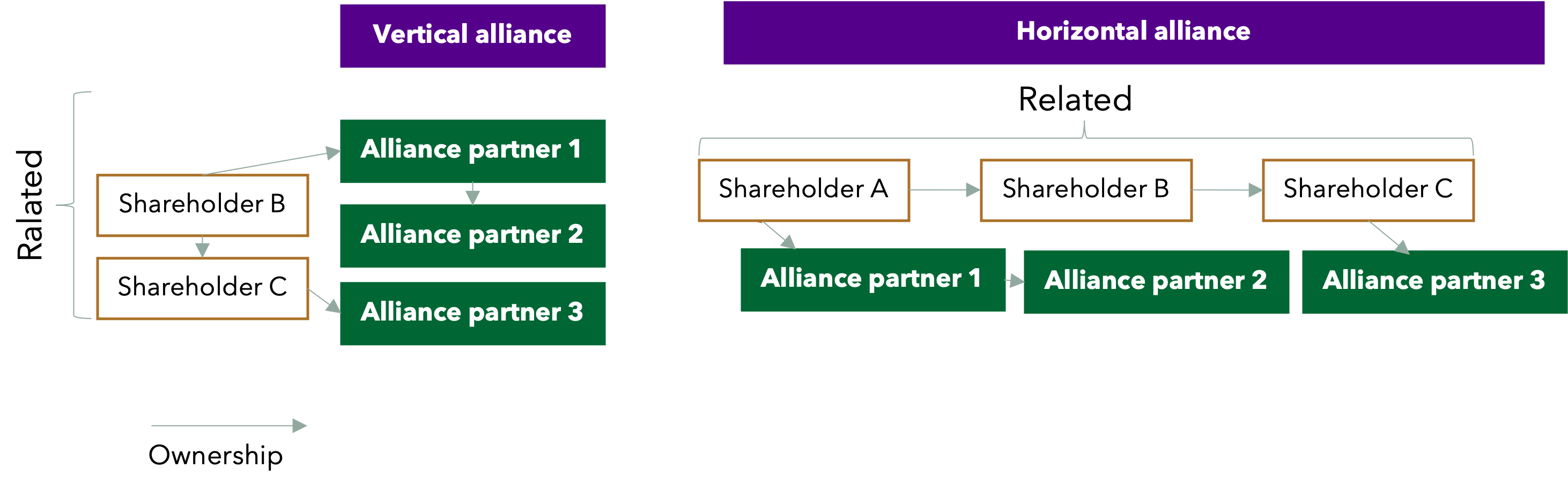
When it comes to equity alliances, it is important to mention the concept of related companies and the arm’s length rule (Exhibit 5-11). This rule is enforced by the governments of many countries and is enforced by tax collection agencies. This rule stipulates that companies that are related to each other must conduct transactions with each other under market conditions and at market prices.
Ex. 5‑11 Equity relation in alliance for arm’s length rule
Keywords: arm’s length rule, equity alliance
Related companies are those that are controlled by the same entity or that control each other. Usually, owning more than half of the shares in an organization is considered to be in control of the organization. The concept of an outstretched hand came from the concept of reaching out. The reason why related companies cannot transact with each other in non-market conditions is related to the prevention of tax fraud. This rule applies to both domestic and international transactions of related companies. Tax authorities pay special attention to transactions between related companies located in different countries. Since different countries usually have different tax systems and tax rates, it may be more beneficial to have a profit in one country than in another because of the difference in the amount of tax on the profit. To prevent shareholders of related companies from artificially shifting profits to a country with lower taxes, any transactions between related companies must be conducted as if they were between unrelated companies. Thus, a equity alliance is not a legal way to obtain more favorable prices from a supplier, but it ensures that the supplier remains loyal to its alliance partner. In the 21st century, more and more attention has been paid to ensuring fair competition, especially in the European Union, partly also in the United States. More than one US multinational organization has been fined by European Union institutions for violations of various laws and regulations, especially in the areas of related organization transactions. So, some alliancing action may be considered as the infringement of competition law.
Due to tax considerations, some equity alliances and related companies establish their headquarters in tax-friendly countries. For instance, in the European Union, in Ireland there are headquarters of many international companies, many of which are part of global equity alliances.
Share or comment this information on your social media:
Fundamentals of global business
First edition
For citation:
Jarzemskis A. (2025). Fundamentals of global business, Litibero publishing, 496 p.

Full scope of the book is available in various formats
About author
The author has been teaching at several universities since 2005. 40+ scientific publications, 10+ international research projects. More about author.