The General Agreement on Tariffs and Trade – GATT was concluded immediately after the World War II in Geneva, Switzerland. The purpose of this organization was to encourage countries to abandon protectionism and agree on the reduction of trade restrictions. The GATT pursued three main goals: non-discrimination, reduction of non-tariff restrictions, and transparent consultation and negotiation between nations using the GATT format. The principle of non-discrimination has been understood as ensuring that if a country imposes trade restrictions, they must apply to all countries equally and not target any one country. For example, a sugar import quota or a duty on imported clothing must be applied equally to all countries from which these products are imported. Certain exceptions are provided if countries decide to create economic or political unions, as well as for trade between countries with former colonies. One of the largest international negotiations on reducing trade restrictions took place in 1986-1993. It was a multilateral negotiation involving 123 countries. As the negotiations stalled for almost eight years, they were organized in certain stages, which were called rounds.
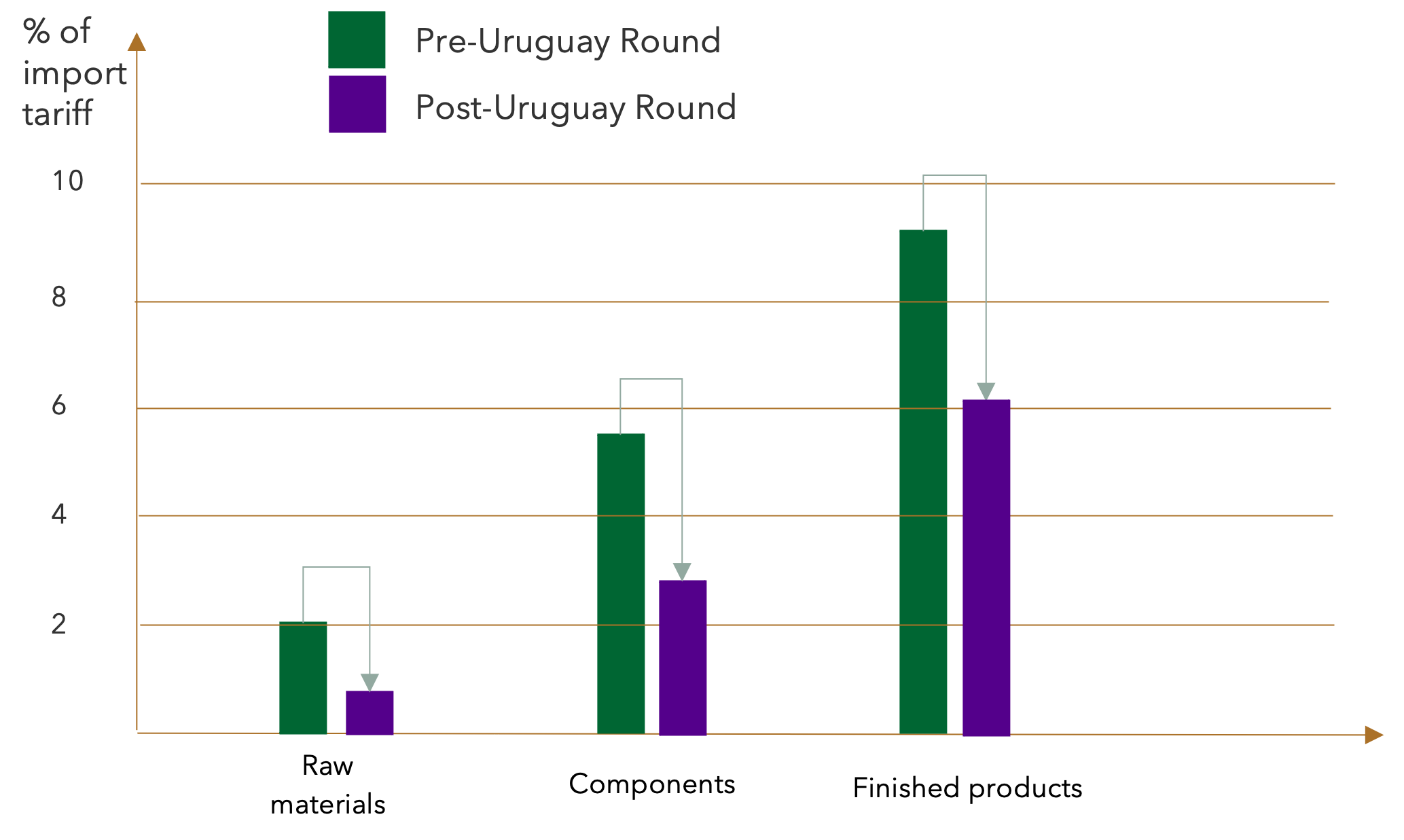
During the Uruguayan negotiations, the countries reached agreements on trade restrictions in three areas – to reduce customs tax amounts, to replace quotas with customs duties, to apply conditional protection measures only after proving the need for it. The percent of import duties decreased from 4.7 to 3 percent on average as consequence of negotiations (Exhibit 3-20). Import quotas were mainly exchanged to import duties for the textile industry, clothes, and agricultural products.
During the Uruguayan negotiations, the countries reached agreements on trade restrictions in three areas – to reduce customs tax amounts, to replace quotas with customs duties, to apply conditional protection measures only after proving the need for it. The percent of import duties decreased from 4.7 to 3 percent on average as consequence of negotiations (Exhibit 3-20). Import quotas were mainly exchanged to import duties for the textile industry, clothes, and agricultural products.
Ex. 3-20 Pre- and post-Uruguay round tariff structure in industrial countries
Keywords: Uruguay negotiations, GATT, raw materials, components, finished products
In the area of conditional restrictions, the parties have agreed not to apply additional administrative measures, unless certain harm is proven by scientific research. For example, in the food and pharmaceutical industries, countries reserved the right not to admit products if they do not meet the requirements established in that country, but this required scientific proof. For example, if one country feeds cattle with hormones and their meat is allowed for sale and consumption, but another country does not allow the importation of these cattle, then the other country has to prove that the meat from hormone-fed cattle is not safe for their consumers. From a moral point of view, after all, people are the same in both countries, so if such meat is really harmful, it should theoretically be banned in both trading countries, but in the real world, both countries apply different practices and even set different food safety standards. The same situation exists in pharmaceuticals, for example the vaccines used to vaccinate hundreds of millions of Chinese may not be recognized as safe in the USA and the European Union, the question arises whether this means that hundreds of millions of people are being vaccinated with unsafe vaccines.
In the Uruguay round of negotiations, the parties also agreed on fairer competition – on the reduction of anti-dumping policy and implementation measures and state aid. In the field of anti-dumping, it was agreed to apply stricter and faster measures to business entities that engage in dumping. In the area of state aid, it was agreed to gradually reduce government subsidies for industrial research.
GATT failed to achieve all of its trade liberalization goals, as many of them were detrimental to individual groups of countries.
Each party represented its own interests and those of its companies and employees. For some countries, trade restrictions constituted a competitive advantage over others, and the reduction of restrictions meant a loss of competitiveness, at least in the short term, and the need for structural reforms in the country’s internal economy in the long term.
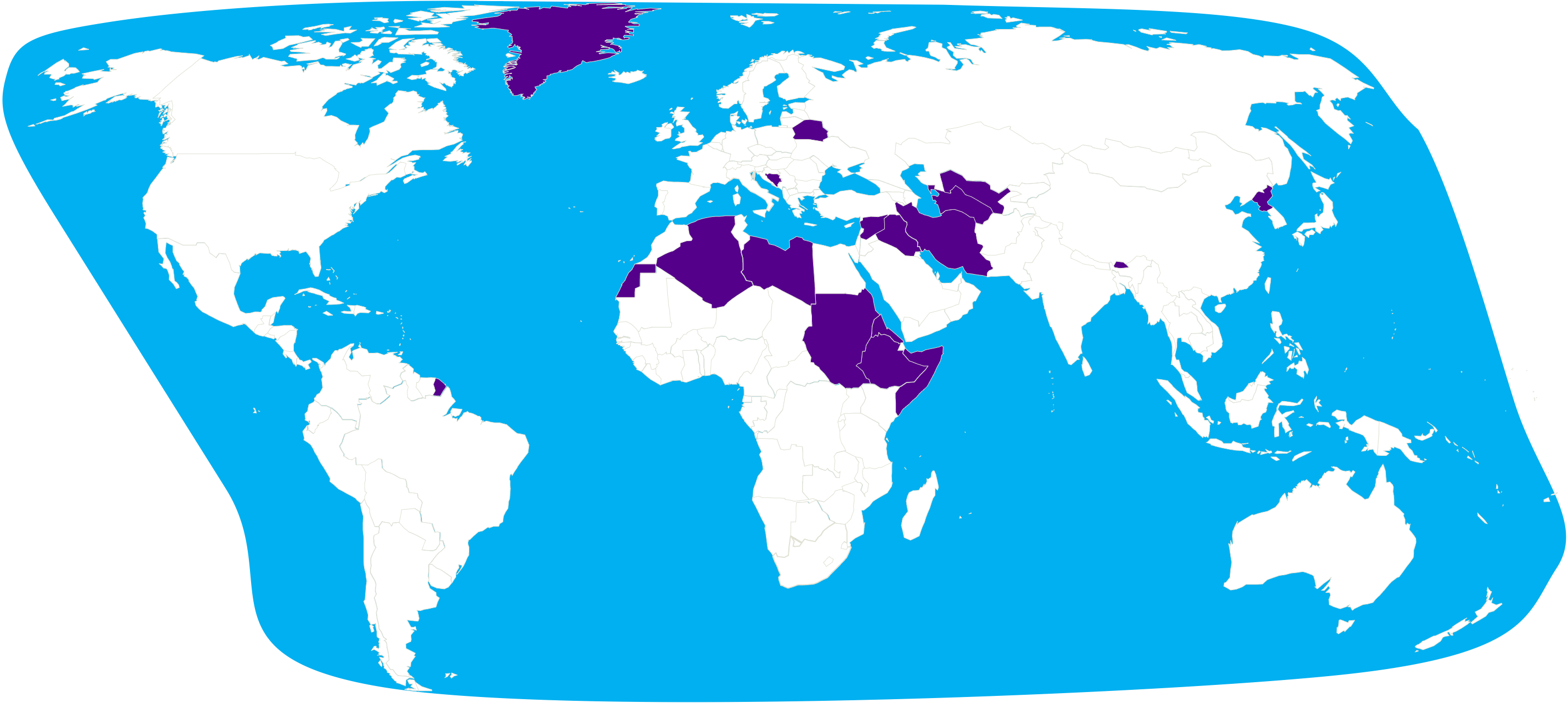
Ex. 3-21 WTO non-members including candidates
Keywords: WTO, members, trade agreement
Nevertheless, the GATT took the first steps in trade liberalization, and during the negotiations in Uruguay, the idea of GATT with the WTO – World Trade Organization was raised. The WTO was founded in 1995 in Geneva. Establishing the rules of international trade and resolving trade conflicts between its member countries, all of which have signed about 30 agreements. At the end of 2011, the WTO had 152 members and 26 observers. WTO non-members are presented in Exhibit 3-21. The main principles of the WTO are based on the following provisions:
• A country cannot give undue preference to one foreign trade partner over another. It also cannot discriminate against foreign goods and services.
• Trade must change towards greater freedom of trade by removing tax and other barriers.
• Trade processes must be foreseen, with all partners knowing that various trade barriers will not be raised suddenly and artificially.
• Trade must change towards greater competition.
• Trade must be tailored to less developed countries, allowing them longer transition periods, more flexibility and some privileges.
Despite the common goal of the WTO to create free movement of goods in the world, which should lead to the equalization of living standards, wages, and interest rates worldwide, this cannot be achieved due to the short-term damage of free trade to individual countries and the small businesses of those countries. Free trade is based on the further idea of globalization, but so-called anti-globalists often speak against the supporters of globalization. In many states, there are political forces and parties that put the national interests of their state above the general interest of humanity, both in the short and long term. Anti-globalists emphasize that free trade in the short-term benefits powerful multinational corporations that want to secure growth and higher profits and reduce the competitiveness of small local businesses (Salvatore, 2010).
On the other hand, international corporations really have obvious benefits of free trade, as they can very quickly be the first to get benefit of economies of scale, have a cost advantage and conquer the markets of other countries that have been limited by tariffs, quotas or conditional restrictions. Anti-globalists, in addition to the arguments against free trade, also use the argument of environmental protection, the argument of the independence of countries and the argument of the exploitation of underdeveloped countries (Salvatore, 2009). Differences in the views of supporters of globalization and anti-globalists often lead to political duels within countries; for example, the 2016, 2020 and 2024 elections in the United States revealed the divergence of opinions between the candidates of the Republican and Democratic parties. The Republican candidate’s slogans “America First” or “Make America Great Again” has become somewhat a symbol of neo-mercantilism and anti-globalism. Similar differences in views cause international geopolitical tensions, which even in the 21st century turn into barbaric military conflicts. For example, in the third decade of the 21st century, the Russian government questions the established world order formed after the World War II and after the fall of the Soviet Union and the demolition of the Berlin Wall in 1991.
Different countries around the world are unable to reach a common agreement on free trade, but the need for a larger market to achieve the benefits of specialization and economies of scale remains unchanged. For this reason, at least those countries and groups of countries that manage to agree join in economic, trade or even political entities called blocs. The next section elaborates on the blocks of states and their diversity.
Share or comment this information on your social media:
Fundamentals of global business
First edition
For citation:
Jarzemskis A. (2025). Fundamentals of global business, Litibero publishing, 496 p.

Full scope of the book is available in various formats
B.3. International trade and export business
- Economic rationale behind international trade
- Types of export
- Pros and cons of international trade
- Payments in international trade
- Product identification in international trade
- Tariff and non-tariff restrictions on international trade
- International dumping and cartels
- Protectionism and stages of trade liberalization
- Blocks of states to facilitate international trade
- Questions for Chapter Review
- Chapter Bibliography
About author
The author has been teaching at several universities since 2005. 40+ scientific publications, 10+ international research projects. More about author.