To have a unified product identification and numbering system in the world, a such classification of goods and services is used in the world, so called HS – harmonized system. It is an international product classification system, which is for identifying goods that cross national borders. This system was created by the World Customs Organization in 1988 and is applied internationally.
Ex. 3-13 Harmonized System codes are used in international trade and customs clearance

Keywords: harmonized system, product
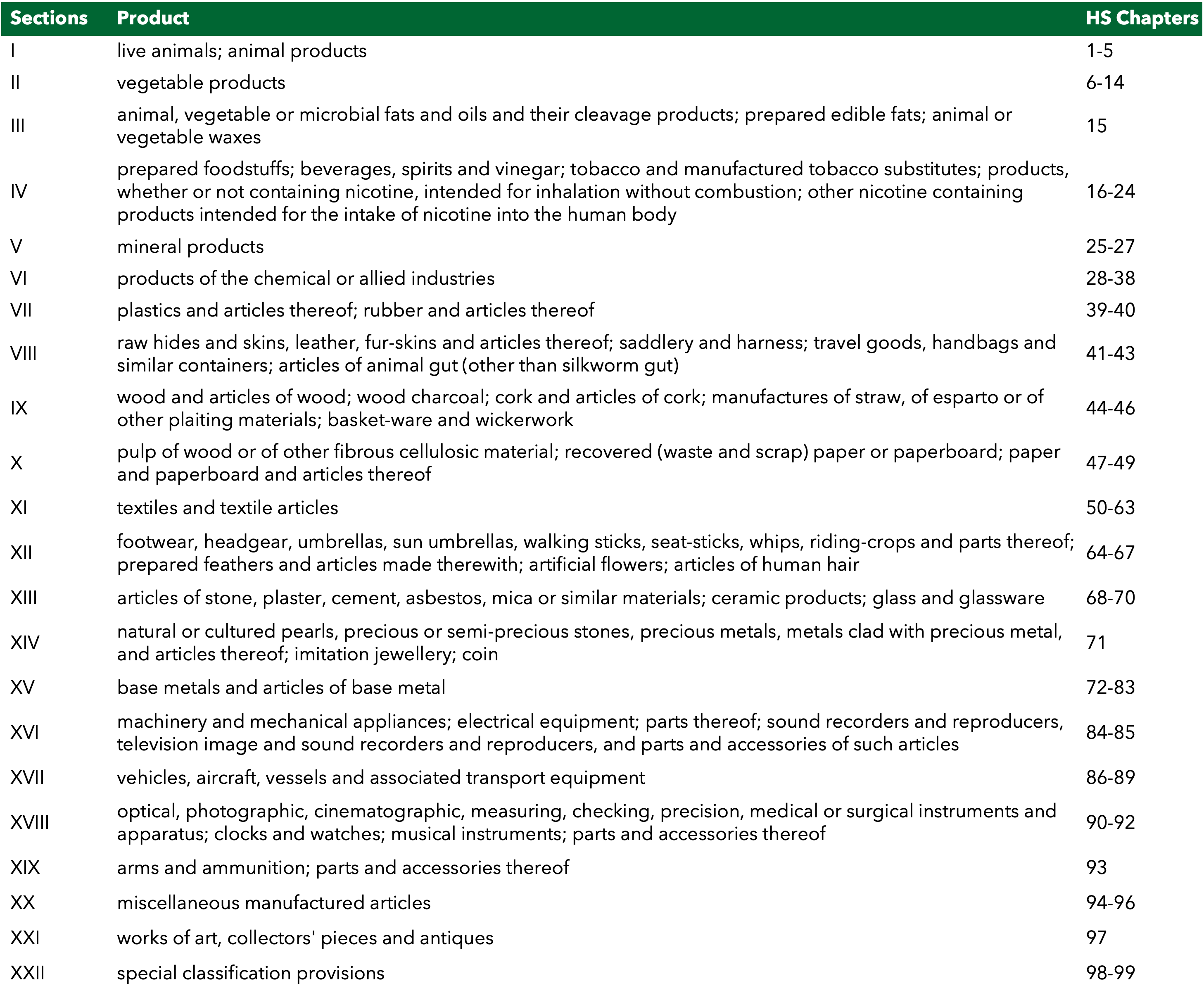
In the HS system, each product has its own HS code, which allows to identify goods crossing national borders and apply the correct import or export tariffs to them. The HS system is divided according to economic activity into 21 chapters. Each chapter consists of 99 sections, which are divided into 1,244 headings and 5,224 subheadings (Exhibit 3-13).
For example: HS code 1006.30. First, this code is assigned to section II – vegetable products. The first two numbers 10 refer to the section – cereals, 06- the heading indicates that it is rice and subheading 30- Subheading 1006.30
semi-milled or wholly milled rice, whether or not polished or glazed. Customs duties may be applied differently even to goods from the same sections and headings, but only to a subheading. More than 200 countries currently use this HS code system (Exhibit 3-14).
Trade tariffs are calculated when the goods cross the state border. Businesses have to pay tariff on all imported goods. In certain cases, this raises the problem of lack of working capital.
For example, an importer brings a large amount of goods at once, which he plans to sell within a year. Even if these goods are not sold, the entrepreneur has to pay the full customs duty, which can reach, for example, 20 percent.
If the value of the imported goods is 5 million Euro, then after importing them, importer would have to immediately pay the government 1 million Euros. This would happen before importer begins selling the goods in the local retail market. In order to ease the problem of lack of working capital for importers, so-called customs or bonded warehouses operate in many countries. The customs warehouse operates under the supervision of the state customs service, and when the goods are brought into the country and allocated in the customs warehouse, there is no obligation to pay customs duties immediately. A customs warehouse is a place of temporary customs storage. The duty has to be paid only when trader want to take the goods from the customs warehouse and start selling them in retail trade.
Ex. 3-14 Harmonized System sections and chapters
Keywords: trade, products
Goods can be taken from the customs warehouse only as much as they are intended to be sold in the short term. Thus, the customs warehouse allows to split the customs tax payment in parts, according to how much and how often they will be taken from the customs warehouse. The price of the service of storage in a customs warehouse is higher than in an ordinary warehouse, but due to significant savings in working capital, entrepreneurs often choose to store imported goods in a customs warehouse.
Customs warehouses are often located near seaports, airports, or right in the territory of seaports or airports. Sometimes the whole port is granted the status of a free port, which means that while the goods are in the territory of the port, they do not have to pay customs duty. Duty-free zones in seaports often become attractive for industrial establishment.
For example, in China, a number of factories are located in the free port areas where the imported components are assembled. In China, although it is considered that most of the products are produced, in fact, in most cases, only the last production function is performed there – which is assembly.
Ex. 3-15 Standardised international trade system, HS

Keywords: trade, products, SITC
So, after bringing the components to China for assembly to avoid paying import duty, they stay in a duty-free port, they are assembled in the factories there and the finished products are exported from China.
The HS and SITC systems differ in that the HS is more intended to classify goods according to their raw materials or the materials from which the goods are made. SITC is more for classification according to the level of product readiness and completion of processing or production.
Share or comment this information on your social media:
Fundamentals of global business
First edition
For citation:
Jarzemskis A. (2025). Fundamentals of global business, Litibero publishing, 496 p.

Full scope of the book is available in various formats
B.3. International trade and export business
- Economic rationale behind international trade
- Types of export
- Pros and cons of international trade
- Payments in international trade
- Product identification in international trade
- Tariff and non-tariff restrictions on international trade
- International dumping and cartels
- Protectionism and stages of trade liberalization
- Blocks of states to facilitate international trade
- Questions for Chapter Review
- Chapter Bibliography
About author
The author has been teaching at several universities since 2005. 40+ scientific publications, 10+ international research projects. More about author.