Payments in international trade. There are many ways to pay for goods in international trade. The problem of payment for goods is associated with the risk experienced by both a seller and a buyer. A seller wants to be sure that he will get money for the goods sold, and a buyer wants to be sure that he will get the goods for the money he paid. Trust between seller and buyer depends on many factors. If the seller and buyer have a long experience of cooperation, trust is significantly higher, but if the seller and buyer meet for the first time, there will be no trust. Another aspect is cultural.
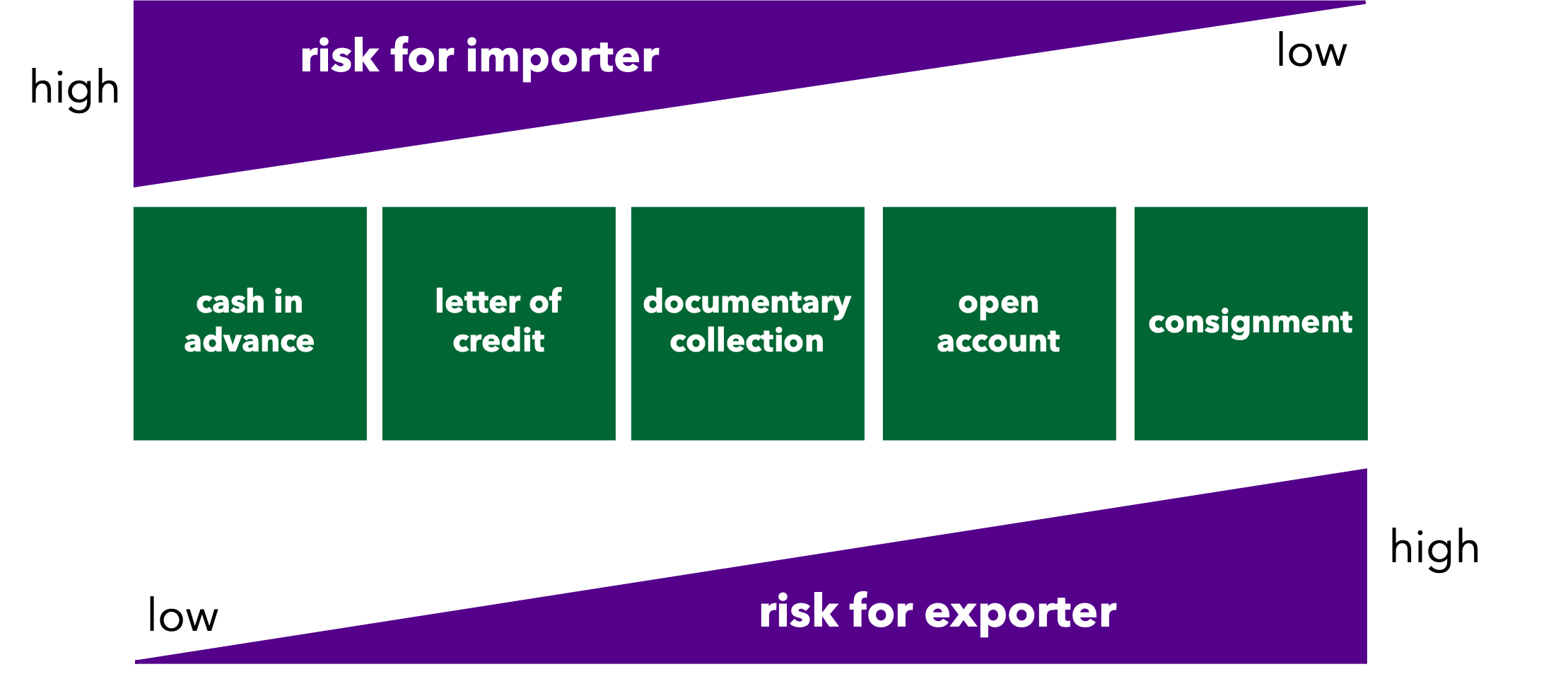
Ex. 3-7 Complex of international trade payments methods
Keywords: importer, exporter, risk, payments in international trade
Buyers and sellers in EU and USA exhibit a higher level of trust in business partners compared to, South American, Asian or African countries. Nevertheless, mistrust is justified due to many examples of fraud, when either money is not paid, or goods are not delivered.
There are several solutions to this payment problem, all of which involve a third party, usually banks. Banks serve more than 90 percent of all international trade transactions. Banks are used for international trade transactions using various forms of banking intermediation. Exhibit 3-7 presents conceptual model which reflects the distribution of risk between the exporter and the importer. According to this scheme, less risk is involved for the exporter to receive money in advance, the low risk is to sell under a letter of credit, the medium risk is to sell under the documentary collection method, and the highest risk is for the open account method and consignment. From the importer’s point of view, these risks are in reverse order. The consignment method involves less risk for the importer, followed by the order of increasing risk as follows: open account, collection of documents, letter of credit and prepayment. In case contract manufacturing exporters have the lowest risk in the case of payment before the beginning of production, while importers have the highest risk. In fact, this amount of risk for importers is greater than in the case of prepayment for manufactured goods, because next to the exporter’s reliability and transport risk, there is a production risk.
The first method of international trade is against what is often called “cash in advance” (Exhibit 3-8). This means that the manufacturer ships from his warehouse only when payment is received, that is, when the buyer receives the goods from the seller’s bank account. This way of payment is very beneficial for the seller, because there is no risk that the buyer will not pay. In other words, the buyer pays in advance. This payment method is very risky for the buyer. After transferring the money to the seller’s bank account, the buyer may not receive the goods or may receive damaged, incomplete or incorrect goods. Of course, the sales contract and INCOTERMS define the responsibility, insurance and obligation of the seller, but in global practice there are many cases where the buyer suffers loss. Legal protection of contractual terms does not always ensure the fulfilment of obligations, international courts are often expensive, and even court decisions are not always enforced, for example, when the seller goes bankrupt.
There are also cases of fraud from sellers, and it is very difficult to reach and claim goods from a seller in another country or even another continent. This payment method is very risky for the buyer. After transferring the money to the seller’s bank account, the buyer may not receive the goods or may receive damaged, incomplete or incorrect goods. This payment method is mainly applied to those buyers about whom there is not enough information, whose country’s economic or political situation is unstable or whose currency is not convertible. If the seller of the goods occupies a dominant position in the market and can impose favorable terms on the buyer, then in this case the prepayment method will also be chosen. This method of purchase is also applied in the B2C segment, especially in the form of e-commerce export. When buying from an online store, the buyer usually pays for the product first, and then only the product is sent to him. In the B2B sector, this payment method is not often found among business partners in international trade.
Although this settlement may seem unacceptable to the buyer, this method depends on the size, history, and reputation of the buyer. If the buyer is a new, little-known organization, then the manufacturer is unlikely to agree to export the goods without receiving advance payment. Importers agree to pay manufacturers in advance if they verify that this manufacturer is a well-known organization in the market with many years of experience. This payment method is common in the B2C e-commerce segment. When buying from an online store, the buyer usually pays money from and only after that the product is sent to him. To gain the trust of customers, e-shops, especially those dealing in international markets, apply a refund policy. Money is returned if the product is not delivered to the buyer or is damaged, and some stores allow buyer to simply return the product if buyer do not like it. However, in all these cases, the buyer has to trust the seller and assume all the risks for himself. In terms of risk distribution between the importer and the exporter, this payment method is more favorable for the seller.
Ex. 3-8 Cash in advance payment algorithm

Keywords: cash in advance, importer, exporter, payments in international trade
In this case, he receives money before sending the goods. This means that the importer pays for the goods and in some cases for transport and insurance, before he or his agent has accepted the goods.
Meanwhile, the exporter is compensated for non-fulfilment of the contract and protected against payment delays or insolvency. By immediately transferring funds, the buyer is not guaranteed whether the seller will fulfil his obligations as per the contract. The goods may not be dispatched or delivered at all or may not match the quantity or quality of the order for the amount due, and the buyer may not receive any refunds.
Schematically, the sequence of actions in this payment method is simple. After signing the contract (0), the importer makes a money transfer to the account indicated by the exporter (1). After receiving the payment, the exporter gives the goods to the transport organization (2), that carries the goods and hand them over to the importer (3). Transport payment, insurance and risk are shared by the exporter and the importer according to the international trade conditions INCOTERMS, choosing one of the conditions.
An importer often does not agree to pay in advance due to the above-mentioned risk of not receiving the goods. To reduce importer’s risk, third parties – banks – are often considered. This way of trading is less risky for an importer. According to this method, an importer is guaranteed to receive the goods, and the money will reach the exporter only when the importer signs on the consignment note, thus confirming that the goods have arrived. After the exporter delivers the goods to the importer and receives his confirmation that the goods have been delivered, he is also guaranteed to receive the money. This guarantee is provided by the bank. Banks are usually more trusted than trading partners, especially if they are international banks with a good reputation. Banks receive a commission for this mediation service. More than 90 percent of international trade transactions take place through the mediation of banks. This method of payment for international trade is carried out in the following steps.
Ex. 3-9 Letter of credit payment algorithm

Keywords: letter of credit, importer, exporter, payments in international trade
First, the exporter and importer sign a trade contract (0). An importer applies to his bank and from the relationship with the bank the importer deposits funds in the bank, transfers funds to his bank or takes a bank credit for import (1). The importer’s bank then issues the letter of credit which is given to the exporter by the buyer (2). A letter of credit serves as a guarantee to the seller that he will receive money on the successful delivery of goods (Exhibit 3-9). After receiving the letter of credit, the goods sent by the exporter are handed over to the transport company (3). The transport company delivers the goods to the buyer and at the same time a letter is received from the importer confirming the delivery of the shipment (4). This confirmation is usually signed on the consignment note. Transport company will return this confirmation to the exporter (5). Despite there are lot of electronic confirmation methods with development of information technology nowadays, yet, in international trade, the exporter often requires original documents with the signature of the importer. The exporter submits the proof of delivery of these goods – the bill of lading signed by the buyer – to his bank (6), and the latter submits it to the importer’s bank (7). After receiving this confirmation, the importer’s bank transfers the money to the exporter’s bank (8), and the latter wants to export (9). In this form of settlement, it is very important that the exporter trusts the importer’s bank. In this form of settlement, the importer can no longer withdraw his deposited funds from his bank until the exporter provides delivery. In this case, the importer will have to inform his bank that the goods were not received by the exporter within the agreed time. The importing bank basically guarantees the exporter that once the goods are sold, the buyer will not be able cancel the transaction and collect the goods. More detailed risks, conditions and insurance during transportation are determined by INCOTERMS.
In other words, a letter of credit is essentially a document that allows one party, such as the importer’s bank, to pay another party, the exporter, a debt owed by a third party, such as the importer. The letter of credit is issued at the request of the bank client and according to his instructions. The bank issuing the letter of credit is usually located in the importer’s country.
Ex. 3-10 Collection of documents payment algorithm

Keywords: collection of documents, exporter, importer, payments in international trade
Letter of credit can be categorized based on the bank’s obligation into revocable, irrevocable, irrevocable unconfirmed and irrevocable confirmed. Seller may find revocable letter of credit as unreliable because the bank is not legally obligated to pay. Although the letter of credit poses a lower risk for the importer, the importer is not protected from the case if the quality characteristics of the delivered goods do not meet the requirements or standards. The fact of goods delivery in this case is sufficient proof that the importer’s bank needs to pay the exporter’s bank for the goods.
Document collection is similar to trade payment using a letter of credit (Exhibit 3-10). In case of collection of the document, a third party – the bank acts as the intermediary. The essential difference from a letter of credit is that in case of collection of the document, if the quality parameters of the goods do not meet the conditions set by the importer and this becomes clear already after the physical delivery of the goods, then the importer has the opportunity to cancel the order of the goods and not pay money, and the goods are returned to the exporter. According to this payment method, the exporter has the right to dispose the goods until the buyer fulfils the exporter’s requirements: he pays for the goods or undertakes to pay for them after a certain time. So, if the importer refuses to pay for the goods because they do not meet the requirements, then the exporter continues to be the owner of the goods. In turn, banks act only as agents issuing documents for the fulfilment of export conditions, that is, they do not assume any obligations, unlike when paying with a letter of credit. This payment method is recommended when the buyer and seller trust each other, and the buyer’s financial condition is not in doubt. The partners must be convinced that the settlement cannot be hindered by force majeure, and the payment operations of the buyer’s country are unrestricted and under special control. The buyer and the seller enter into a contract for the supply of goods (0), which provides for payment in the form of collection. The exporter sends the goods, presenting them to the transport company (1), which concludes a contract for the transportation of goods with the seller and accepts the goods for transportation, issuing a bill of lading to the seller. The exporter presents this paperwork along with collection guidelines to their own bank for processing (2), while the carrier delivers the goods to the importer (2).
Ex. 3-11 Open account payment algorithm

Keywords: open account, exporter, importer, payments in international trade
According to the seller’s application, the bank prepares its instructions to the buyer’s bank and sends them together with the documents provided by the seller to the bank of the buyer’s country (3). The collecting bank informs the importer about the collection order received on his behalf and familiarizes him with the payment conditions. If the buyer accepts, otherwise undertakes to pay for the documents when the due date is reached or pays them immediately, the bank will hand over these documents to him (4). In this case, the bank does not undertake to make the payment itself, it is only obliged to make the payment at the customer’s request. When the payment deadline arrives, the importer’s bank debits the importer’s account to pay the accepted bill and forwards these funds to the exporter’s bank (5), which then transfers the money to the exporter and returns the acceptance documents approved by the importer (6). According to international practice, each counter party pays the fees of its own country’s banks in connection with the settlement by collection of documents.
An open account (Exhibit 3-11) is a trade arrangement form (0) in which goods are shipped to a foreign buyer (1) and given to him (2) before payment is made and without a written guarantee of payment. In this case, the buyer pays after receiving the goods and the invoice (3). Depending on the terms of the contract, the payment term may be set differently. In practice, a delay of one month, two months or even three months of payment is usually met as normal. This way of trading is risky for the exporter, because the importer may not pay for the goods for various reasons. Debt collection in another country is extremely complicated, lengthy and expensive process than in one’s own country. It is not always possible to collect the debt, for example after the bankruptcy of the importer. The exporter agrees to this method of settlement unless the exporter and importer have a partnership of many years in a non-equity alliance, or the exporter and importer have capital ties. This is how it is sold to subsidiaries, or how companies belonging to the same parent organization trade with each other.
Mutual relations are based on the creditor-debtor basis. In this case, the transaction is financed by the seller. Although the exporter has a strong interest in selling the goods, his position is not secure as the goods and documents are dispatched before payment is received. The seller must be sure that he will be settled, even in the case of issuing a cheque or accepting a bill of exchange.
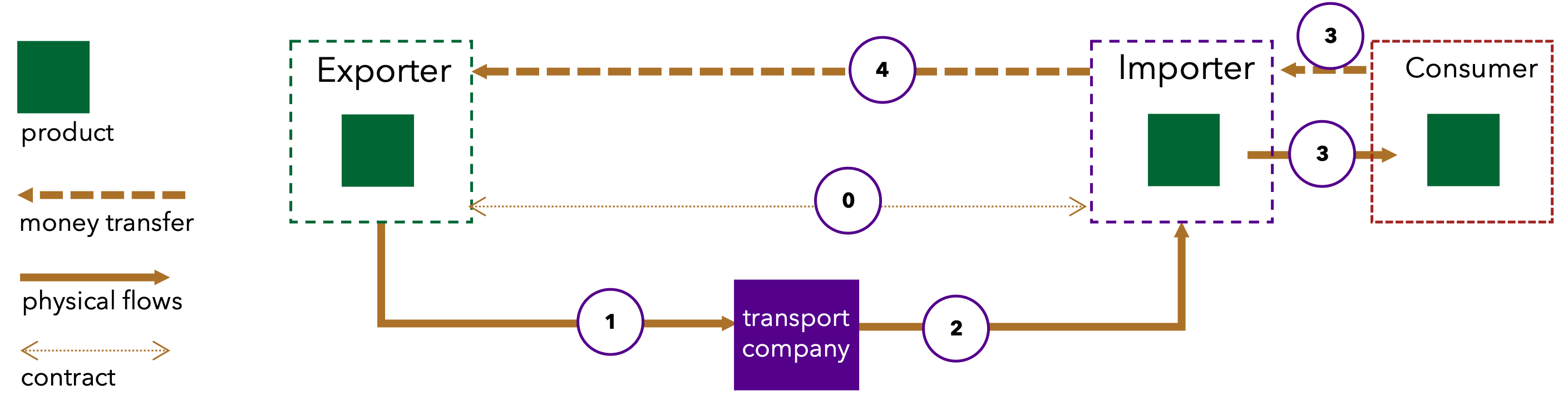
Another option is to insure oneself against the risk of insolvency. With the consignment payment method (Exhibit 3-12), the processes are very similar to the open account method, but the exporter receives payment only when the importer sells the goods to his customers. After concluding the consignment contract (0), the exporter sends the goods to the foreign buyer (1) and gives them to him (2). The importer then sells these goods to his customer (3). After receiving the money from his customer, the importer settles with the exporter according to the terms of the consignment agreement. This trade method is the riskiest for the exporter, because it is not known in advance how long the importer will take to sell the goods to his customers.
Ex. 3-12 Consignment payment algorithm
Keywords: consignment, exporter, importer, payments in international trade
Ultimately, the possibility of selling those goods remains uncertain. Exporters use this method only when trading with extremely reliable partners, usually their representatives abroad – subsidiaries, branches. This trade method can be applied when the manufacturer has a large amount of production in warehouses and there is a lot of competition in the foreign market. In this case, the importer practically takes no risk, this type of trade requires minimal investments, and the goods do not require working capital.
Thus, when exporting goods to other countries, the exporter faces the problem of payment and the risk, and the importer faces the problem of receiving the goods: are the goods received in the right condition? Is it exactly the same item that was ordered? will it be it on time or reach the correct destination. INCOTERMS conditions are used in order to harmonize the responsibilities related to the delivery of goods. These are international rules that provide for possible variations in the place of delivery and the distribution of responsibility. Thus, the exporter and importer do not need to prepare a new trade contract each time but simply refer to one of the delivery methods defined in the INCOTERMS. As these terms are related to logistics, they are described and explained in detail in Part D, Chapter 13 of the book.
The price of the product may vary significantly based on the specific INCOTERMS condition selected. If the condition is chosen that the buyer organizes the collection of the goods from the manufacturer himself, then the price will be lower than in the case when the manufacturer himself delivers and pays for the delivery.
When organizing international trade, comparing the possible prices of goods, is very important not only to know the price itself, but also the INCOTERMS condition with which this price is valid.
Share or comment this information on your social media:
Fundamentals of global business
First edition
For citation:
Jarzemskis A. (2025). Fundamentals of global business, Litibero publishing, 496 p.

Full scope of the book is available in various formats
B.3. International trade and export business
- Economic rationale behind international trade
- Types of export
- Pros and cons of international trade
- Payments in international trade
- Product identification in international trade
- Tariff and non-tariff restrictions on international trade
- International dumping and cartels
- Protectionism and stages of trade liberalization
- Blocks of states to facilitate international trade
- Questions for Chapter Review
- Chapter Bibliography
About author
The author has been teaching at several universities since 2005. 40+ scientific publications, 10+ international research projects. More about author.