Exporting increases the market because the goods are sold not only in one’s own country but also in other countries. Higher sales volumes mean more production is required. This also means that the revenue will be higher than just selling in the local market. Larger production volumes allow the application of the principles of economies of scale, so the unit cost of the product should decrease, which means that the product will be more competitive. It can be sold at a lower price, or a higher profit can be made if the price level is kept the same. The more the product gets sold in markets of different countries, its global awareness increases, and this greatly contributes to increasing brand credibility and awareness.
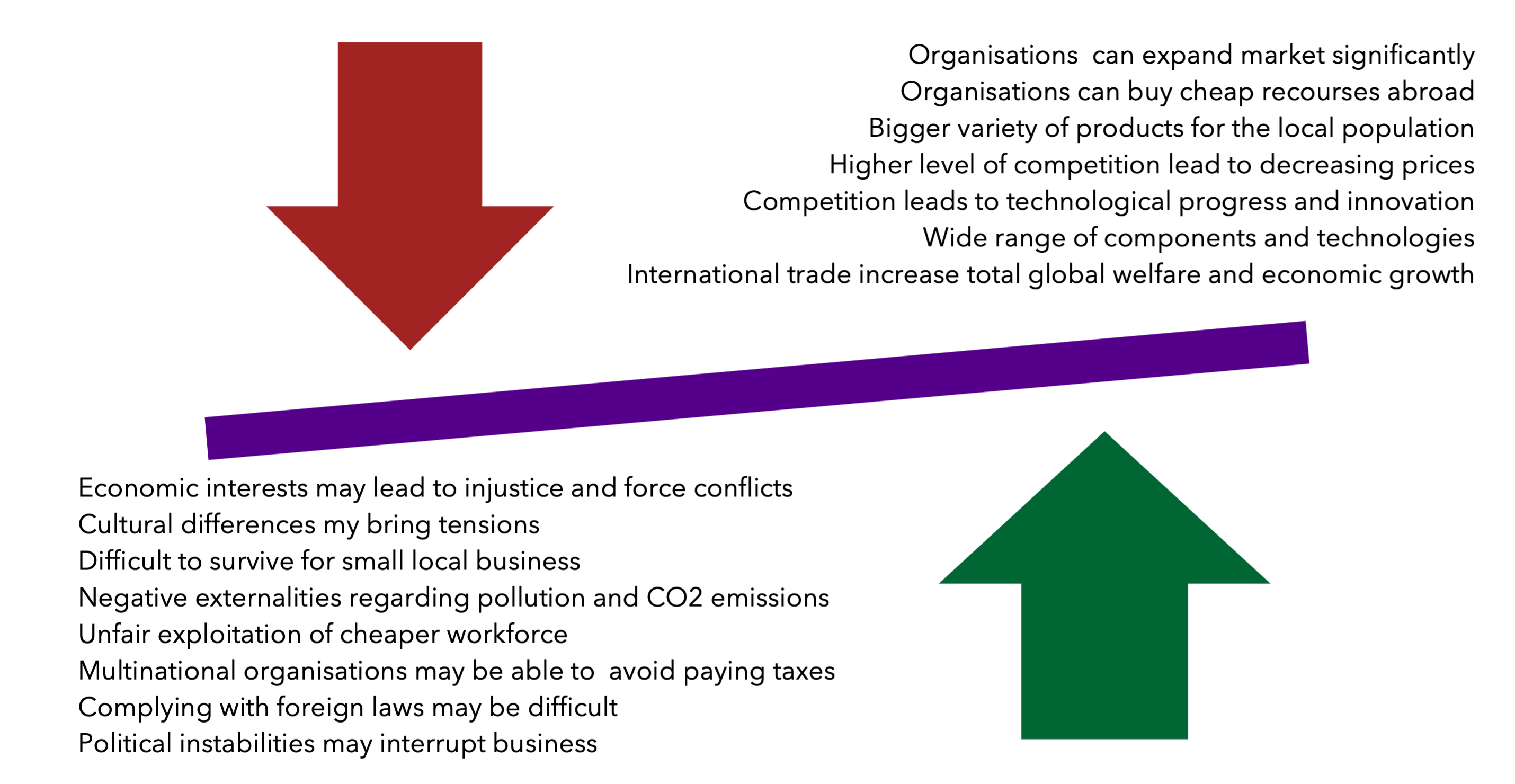
Sometimes, when entering a new market, manufacturers with an established brand enjoy a brand awareness advantage over competitors operating in that market. Pros and cons of international trade are presented in exhibit 3-6.
However, this logical chain of benefits is accompanied by significant limitations, and increasing sales by going to other countries’ markets is not the same as increasing sales in domestic market. There are certain crucial reasons for this disparity (Hill, 2007). One of the major reasons is especially in foreign markets, where different cultural, linguistic, religious, taste preferences and traditions prevails (Daniels et al., 2021).
Sometimes, when entering a new market, manufacturers with an established brand enjoy a brand awareness advantage over competitors operating in that market. Pros and cons of international trade are presented in exhibit 3-6.
However, this logical chain of benefits is accompanied by significant limitations, and increasing sales by going to other countries’ markets is not the same as increasing sales in domestic market. There are certain crucial reasons for this disparity (Hill, 2007). One of the major reasons is especially in foreign markets, where different cultural, linguistic, religious, taste preferences and traditions prevails (Daniels et al., 2021).
Ex. 3-6 Pros and cons of international trade
Keywords: salary, export, price
The possibilities of sales of a specific product can be absolutely different than it is in one’s own country. The entire C part of the book is dedicated to revealing the differences between different countries, presenting and describing them in a structured way. These differences suggest that a product that is popular in one country may have little or no impact in another country (Amato et al., 2021). So, at the time of planning to export, it is very important to conduct market research first. Before studying the possibilities of a particular product in the foreign market, it is very important to assess the characteristics of the buyers’ market of the entire product category. It is possible that the product category itself is not attractive to residents of another country. It is also possible that the other country does not even have such a product and is not aware about it. Some products are prohibited. For example, some Muslim countries in the Middle East prohibit the sale and consumption of alcohol. So, if an organization producing wine decides to export wine to these Muslim countries, it will not be a good decision. For example, the sale and consumption of cannabis is legal in the Netherlands, but if a businessman from this country decides to sell it on the Polish market, he is likely to be prosecuted and possibly even jailed. Of course, the extremes are described here, but it is crucial to find out the legal restrictions before exporting to another country. Electronic commerce has facilitated international trade. Many products can be sold to consumers simply by using the distribution and advertising channels of global e-stores. However, it is not uncommon for customs authorities to confiscate goods that a buyer tries to download from an online store to a country where these goods are not legal.
When planning to sell goods to another country, it is very important to find out whether the trade and use of the goods is prohibited in that country or not. Many products need to meet the legal requirements of that country (Davis et al., 2019). For example, in order for Europeans to export food products to the USA, it is not enough to have food and safety certificates valid in Europe. Food products must be tested and certified in accordance with current US regulations. Of course, it is possible to do so, but it should be remembered that it can take from several months to years and even more. Such compliance processes and procedures apply not only to food products, but also to cosmetics, electronics, toys, and products from many other industries. For example, in order to export goods to Europe, it is necessary to comply with product safety certification and receive a special marking. If an organization in Asia wants to export its products to the European Union or the United States, both may require different market-specific inspection and certification procedures. It is important that here is not only point about the formal inspection and certification procedure, which uses time and money, but also the exported product itself must meet those requirements in its characteristics. However, the requirements are not the same. They may be the same for the American market, different for the European market. Thus, a manufacturer cannot export the same product identically in different markets. Often products have to be adapted to export markets, change the chemical composition, design, or even color. For example, the requirements for car taillights in the US and the European Union differ. Therefore, the Japanese car manufacturer must produce different modifications of cars for different export markets. These examples clearly prove that although exports allow increasing the volume of production and sales, however, it does not mean that it is enough to simply produce more. Often this means that it will be necessary to produce a little differently, other materials, other components. A different design may be needed. Economic blocs of states often facilitate export, for example, in order to export to the countries of the European Union, it is enough to meet the general requirements of the EU. However, it is useful to examine additionally whether there are no specific restrictions in any country of the union of states. Further information regarding state blocks is provided in later sections of current chapter.
Destinations in exporting are related to the purchasing power of the market. In developed countries with higher GDP, higher wages, it is easier to sell the same product at a higher price than in countries that are developing or less developed. For example, for an average working consumer in the United States or the European Union, it is not difficult to pay 3 US dollars or 3 Euros for a tube of toothpaste. This amount will only be about 1/1000 of a person’s monthly salary. But the same tube of toothpaste for 3 US dollars or 3 Euros will be much more difficult to sell in Bangladesh or Mexico. Thus, when planning sales volume and prices in a less developed country, it is not worth relying only on historical domestic sales data. If it turns out that for the same product, which is paid 3 times more in the home country than the consumer can pay in the export market, the producers have serious questions about the benefits of exporting and the probability of profit. If the organization has strategic goals to expand the awareness of its products around the world, it is often necessary to export goods to markets where they will have to be sold at much cheaper prices than in their own country. In such cases, manufacturers use various methods to reduce the cost of manufactured products. Products are produced for certain export markets, sometimes using cheaper and lower quality materials. Often possible to find an inscription on the product that intends to show the target market. Thus, the same toothpaste purchased from the same brand may have different properties if it was purchased, for example, in the United States or Sudan. Some manufacturers, while protecting the quality and image of their brand products, sometimes decide not to supply products to certain low-income and low-GDP markets.
Aspect that may make the market of a particular country unattractive to exporters is the size of the market itself. A country with only two to three million inhabitants, such as Estonia or Latvia, may appear much less attractive than, for example, Poland, which has about 40 million inhabitants. Even small things like translating packaging labels into the language of the targeted country to which the export is intended make an impact. Due to the market of two million inhabitants, it may not be worth investing in all the activities related to advertising, information and distribution of the product for the manufacturer. Often, in order to expand exports, manufacturers do not target a single country, but a whole group of countries. Often, there are descriptions prepared in several languages on the product packaging. In most cases, exporters choose a group of countries located next to each other in the same region. If the market of one country is too small, there may already be a sufficient market in a group of countries with a small population. Often, the size of the market is also very important for distribution models and warehouse layout. If the market is small, it may not be profitable for the manufacturer to set up a distribution warehouse to serve it. However, if several countries are served, often manufacturers choose a location in one of the countries where they set up warehouses and from which they do all the distribution service for a particular group of countries.
The size of the market, the purchasing power of the market and the tastes, traditions and habits of the consumers of the market are very important factors. Sometimes they can offset each other. Although China’s average GDP per capita is significantly lower than that of the United States or European Union countries, due to its market size, it has a relatively small segment of consumers with purchasing power comparable to or greater than that of the United States or Europe. But since China has a population of 1.4 billion, even a small segment of the affluent buyer market out numbers the population of the United States and Europe. Popular US electric car manufacturers sold about as many electric cars to the Chinese market in 2022 as they did to the US and European markets. Here is an example where market size offsets the criteria of average purchasing power, which is usually measured by GDP per capita.
Another crucial factor that can also be a barrier for export is exchange rates. If the buyer pays in the export market in his domestic currency, known as the buyer’s country currency, then the exchange rate of this currency with the currency of the exporter’s country becomes crucial for the exporter. If the currency of the buyer’s country depreciates in relation to the currency of the exporter’s country, then the exporter will receive less income than planned when he converts the received money into his own currency. Thus, exporters have to constantly monitor the pricing of the buyer’s country and adjust prices according to exchange rates. Increasing prices in such cases is not always the right solution, because there are probably local competitors in the market of the buyer’s country, for whom the fluctuation of exchange rates will not affect their income, and therefore their prices. Sometimes countries seek to devalue the exchange rate in order to support local producers, thus making the country less attractive to foreign exporters.
To encourage exports, countries also sometimes take measures to reduce the exchange rate of the exporter’s country, thus making production in their country cheaper and goods in foreign markets more competitive (Salvatore, 2013). By reducing the exchange rate of their country, countries conditionally lower the cost of labor in their country, because the salary does not change in numerical terms if the currency devaluates. There is a conditional decrease in salary in relation to the currency of the other country. Thus, countries that independently own and manage a national currency have the tools to boost exports and strengthen exporters. These arguments for owning own instrument to regulate value of currency are quite strong, and they outweigh even joining one of the world’s majors and most stable currencies, the Euro. For example, Sweden, Denmark, and Poland have expressed their political determination to refrain from joining the Eurozone and remain in control of their own currency.
Manufacturers often conduct research before planning to export in an unknown foreign market. They do it themselves or hire consulting companies. Research is carried out by consulting companies either on an individual’s request or by selling data that is regularly collected. There are several international consulting and research companies in the market that constantly collect and collect data on the consumption of different products in different countries, the amounts spent on a specific product per year. For example, a producer of soft drinks, who has decided to export his produced soft drinks to a specific country, can simply buy an overview of the soft drinks market, including statistical analysis and the changes taking place in the last few years. Thus, even before going to produce for the export market, the manufacturer can preliminarily assess what revenue and sales volumes to expect. Such forecasts are always subject to uncertainty, because, for example, it is difficult to estimate how much the market will accept a new product in exchange for a competitor’s product already in use. When going to foreign markets, manufacturers often invest in advertising campaigns, which are extremely important when introducing a product of an unknown brand in the market. If the research reports show that this type of product is not consumed or is consumed very little in that country, it is very important for the producers to research whether it is related to restrictions, traditions, or tastes. For example, a manufacturer of a well-known brand of toothpaste, when entering the market in an African country, presented an advertising campaign explaining how the toothpaste would help achieve whiter teeth. The manufacturer did not know that in the culture of that African country, the standard of beauty and aesthetics was yellow teeth, and people even made efforts to make them yellower.
When exporting to another country, the importance of distance has to be considered. Containerization, global logistics service providers, and the development of aviation have greatly reduced the importance of distance for international trade (Bernhofen et al., 2016). More about this is explained in part D of the book. The distance to the export market can sometimes be even less than the distance to the consumer in the home country. For example, it is closer to Mexico from the west coast of the United States than it is to send goods to the east coast. However, despite these circumstances and exceptions, distance is named as one of the obstacles to export.
Although most of the examples of exporting in this book relate to the sale of physical products, exporting is also possible in the field of services. For example, a transportation service provided by a transport operator of one country is considered an export for residents of other countries. Ireland is the home country to one of the largest low-cost airlines, with aircraft serving markets between many European countries, from a point of view of trade balance and from a technical point of view, it counts as an export. However, in the field of services, when it is related to the provision and organization of the service in another country, for example, a chain of international cafes, a chain of restaurants, it cannot be considered as an export. If in the process of producing or providing a product or service, another country’s resource is used -like employees, infrastructure, which are located in another country, such a case of international business, is no longer considered as an export, but as another way of doing international business – a franchise, alliance or foreign investment, detailed explanation is given about them in Chapters 5, 6 and 7 of this book, respectively.
Ignoring all the above-mentioned circumstances, export remains one of the simplest ways of doing business internationally, requiring relatively the least investment and the least structural changes in the business.
Share or comment this information on your social media:
Fundamentals of global business
First edition
For citation:
Jarzemskis A. (2025). Fundamentals of global business, Litibero publishing, 496 p.

Full scope of the book is available in various formats
B.3. International trade and export business
- Economic rationale behind international trade
- Types of export
- Pros and cons of international trade
- Payments in international trade
- Product identification in international trade
- Tariff and non-tariff restrictions on international trade
- International dumping and cartels
- Protectionism and stages of trade liberalization
- Blocks of states to facilitate international trade
- Questions for Chapter Review
- Chapter Bibliography
About author
The author has been teaching at several universities since 2005. 40+ scientific publications, 10+ international research projects. More about author.