This section presents the theory of comparative advantage developed by David Ricardo (Ricardo, 1817). The theory of comparative advantage explains the emergence of the principles of specialization and economies of scale and the benefits of their application. The theory described in the section laid the foundations for the development of opportunity cost theory.
The theory of comparative advantage is based on the assumption that both trading parties can produce, grow or extract the same product. Because of their specific nature, fossil fuels and agriculture are sectors in which the law of absolute advantage can be applied. However, there is less absolute advantage when it comes to the industry. For example, textiles, manufacturing, or other industries can be developed in any country, regardless of climate or geology. Indeed, distance to raw materials can be an important factor when assessing the advantage of countries in producing one or another product. In the theory of comparative advantage, one of the most critical factors is the efficiency with which a product is made, extracted or grown.
Efficiency can be assessed through a wide range of criteria. Nowadays, economists look at the cost and abundance of labor, the cost of energy, an index of the efficiency of supply and distribution logistics, the cost of capital, and many other derivatives. To explain comparative advantage lets chose the time taken to produce a given quantity of output as a concise indicator to measure production efficiency. This simplification is very helpful in understanding the essence of relative advantage.
Let’s take a hypothetical example to illustrate a comparative advantage. Suppose there are two countries, Spain and the United States of America (Exhibit 1-9). Both countries have established a textile industry and an agriculture sector, with cloths measured in meters and tomatoes measured in kilograms.
Ex. 1‑9 Example of absolute and comparative advantage in cloth and tomatoes trade

Keywords: tomato, cloths, tradeSpain produces 3 kg of tomatoes per hour, – the USA 2 kg, Spain produces 4 meters of cloth per hour, – USA 6 meter. When considering the potential for trade between Spain and the USA, then it is clear that it is better for Spain to specialize in tomato and for the USA to specialize in cloth production. Technical both countries can produce both products, but if labor resources are limited, they will have to choose whether it is better to spend their time growing tomatoes or making cloth. Thus, for Spain, it is better to spend time on tomato production and export the surplus to the USA while importing cloth from the USA. In the USA, on the other hand, it is reasonable to specialize in producing cloth, export surplus cloth and import tomatoes. This principle is known as the opportunity cost principle, and it arises precisely when labor is scarce, and two products compete for a time resource of employees. The time saved in tomato production in the USA can then be allocated to the cloth industry, where the advantage over the other country is greater. The time saved in cloth production in Spain can be allocated to tomato production, where the advantage over the other country is greater. Of course, this is hypothetical as more factors are at play in the real world. An example of competition between products for a resource could be a such – if a country wants to move towards a different specialization, for example, from agriculture to information technology, it must move away from agricultural production because labor will be needed in information technology, so it has to change its education system over time to satisfy needs of new specialization. Another example is when the USA produces more tomatoes and more cloth per working hour than Spain, as in the right side of exhibit 1-9. In this case, it may seem that it will pay for the USA to export tomatoes and cloth to Spain, while it will not pay for Spain to export either tomatoes or cloth to the USA. The USA will have an absolute advantage in both products. However, the law of comparative advantage says that it will still be worthwhile for the USA to import some tomatoes from Spain, notwithstanding the fact that it is more efficient to grow a tomato in the USA. Why does this happen? The reason is that the USA can produce 6 meters of cloth or 2 kg of tomatoes per hour. If time resources are limited, it is better to use the time resources on production for which the same working hour generates a better result. If to imagine that a kilo of tomatoes costs the same as a meter of cloth, then it is better to spend the same time on 6 meters of cloth than on 2 kilograms of tomatoes. The tomatoes needed in the USA are available to import from Spain. In this case, the competition between products for human resources is even greater than in the first case.
Ex. 1‑10 Modern countries that are leading the way in semiconductor production
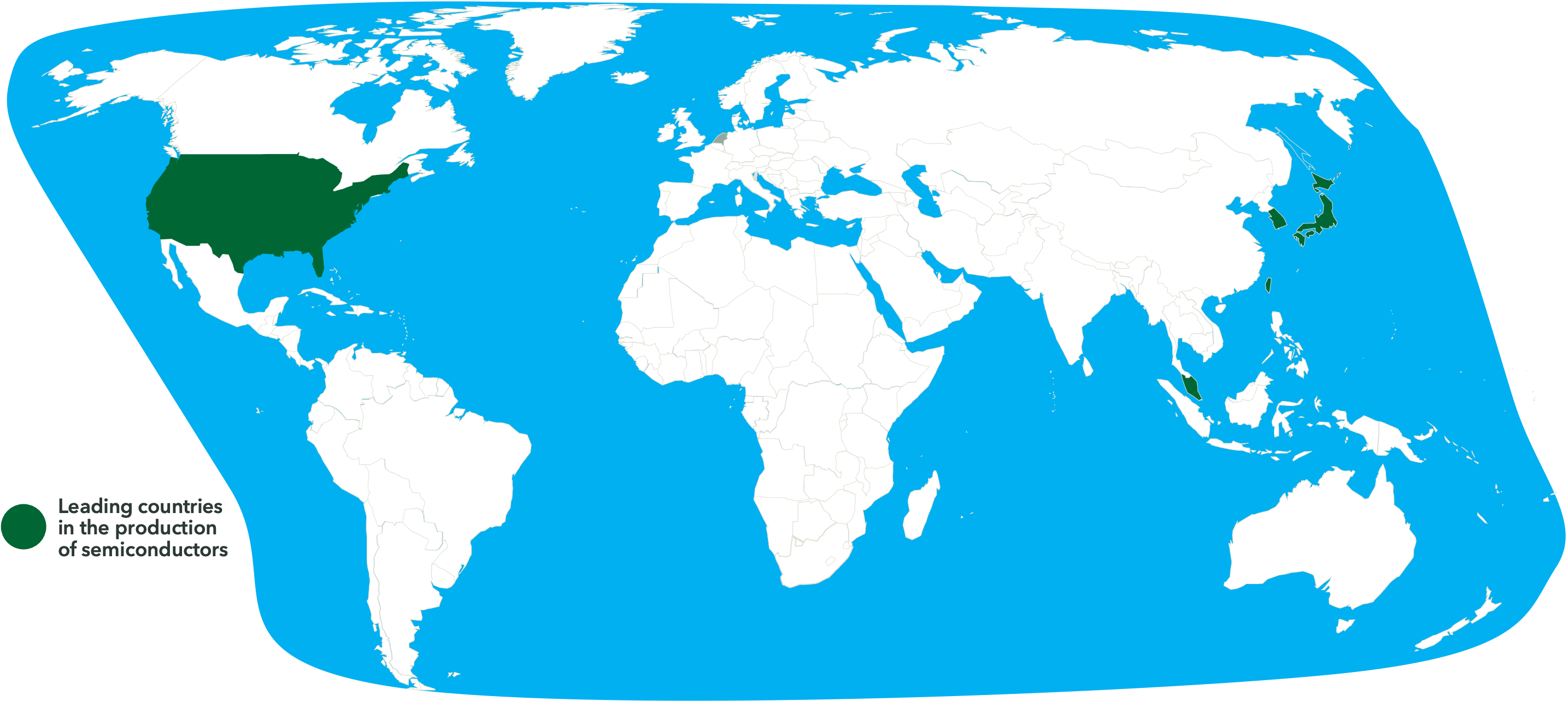
Keywords: Semiconductors, USA, Japan, South Korea, Taiwan
It is vital to mention the reasons that lead to differences in productivity in the production of the same product. Regarding absolute advantage, (1) climatic and (2) geological factors have been mentioned, but (3) technology and (4) the productivity of employees are also significant factors (more in the section on the Leontief paradox). Technology can nowadays largely compensate for the climatic and geological factors, for instance vertical farming is emerging, where tomatoes can be grown under artificial light, artificial heat and even without soil. Furthermore, genetic engineering and genetic modification of agricultural products play a significant role in making them resistant to diseases, pests and weeds and in increasing yields. The theory of comparative advantage has three main assumptions: first, the productivity of labor is constant, second, opportunity costs allow to complete specialization, and third, technological differences between two countries create international trade. According to Ricardo, the theory of comparative advantage has a static approach, but it is also a dynamic concept. The comparative advantage of a product in a given country can be different over time because of the changes in specialization, technology, resource endowments, business practices, demand patterns, and government policies.
The countries’ desire to specialize in higher value-added products is based on the theory of comparative advantage. Their specialization determines the prosperity of countries. Countries that specialize in higher value-added products have a higher gross domestic product. For example, the USA, the Netherlands, Japan, South Korea, and Taiwan are leaders in semiconductors (Exhibit 1-10). Relatively large part of the human resources of these countries is working this industry, including the education system output that is focused on high skilled engineers. The USA is also among the leading producers of agricultural products. For example, according to the United Nations Food and Agriculture Organization’s 2020 data, the US is the leading producer of wheat having 18 percents of world exports and having 26 percents maize.
Ex. 1‑11 The money factor in comparative advantage

Keywords: Money, costs
There are several reasons why the US is not directing its entire economy towards the highest value-added sector. The first is national security. The country wants to be able and capable of growing and extracting strategic reserves itself. Food is considered an important strategic product. Secondly, the number of human resources needed for the semiconductor industry is less than that needed for agriculture. The US has a sufficient population for industries, like agriculture and semiconductors; in other words, semiconductor development and production are not constrained by competition for agricultural labor in USA. However, it is essential to note that a distinction must be made between research and production. Indeed, the USA focuses on semiconductor research and experimental development but shifts physical manufacturing to Asian countries with cheaper labor. More on the labor cost factor diversity in the world is written in 8th chapter of this book. The question may arise whether a country can be less efficient in producing both products but still export its two products to another country. For example, the USA can produce 6 meters of cloth and 2 kg tomatoes per hour, whereas Spain only produces 4 and 1.
What are the reasons that Spain is not able to export both tomatoes and cloth to the USA? At this point, it is time to insert the monetary factor, which, from the economic point of view, makes the unit of time itself, such as the hour, relative. An hour worked in the USA and an hour worked in Spain is not the same in terms of the hourly remuneration of labor or the cost of capital per hour. If an hour of labor is cheaper in Spain than in the US, it is not the number of working hours is a factor, but value of those hours expressed by money. The money factor also has two dimensions, absolute and relative. Here is obvious, for example, that for 1 USD Spain can produce 8 meters of cloth and 6 kg of tomatoes, whereas, in the USA, it can only produce 6 meters and 2 kg. Thus, a country with cheaper labor can produce cheaper, even if it uses more time of human resources. This is where exchange rates come into play. In the exhibit 1-11 is presented that the production costs of both countries are calculated in US dollars, but in reality, the countries have their own national currencies. So, a country that devaluate its national currency against the other country’s currency as consequence it devalues national labor costs against the other country. Spain, for example, had a national currency, the Peso, until 1999, and to increase the competitiveness of its exports depreciating the Peso was one of the solutions. A country having national currency has a tool to manipulate the relative price of labor without changing the wages of workers within its own country. Spain joined the Eurozone in 1999. As of 1 January 1999, 11 European countries transferred monetary policy responsibility from their central banks to the European Central Bank. By 2022, 19 European countries have already joined the so-called eurozone, but not all. For example, EU members Sweden, Denmark, Poland, the Czech Republic, Bulgaria, Romania, and Hungary still have their own national currencies. Before BREXIT, as a member of the EU, the UK also had its own pound sterling and did not join the eurozone. Some eurozone countries are still considering shifting to the euro. Still, for example, Denmark has refused, and in other countries, there are opponents of the euro among politicians who want to keep their national currency. Some countries as Poland, Hungary, Cheech Republic are not in Euro zone by another reason – do not matching formal financial stability and inflation requirements defined within the monetary zone. The ability to manipulate the exchange rate and to make labor cheaper at home is an important political argument for keeping the national currency. It is not only exchange rates that determine the cost of labor. The price of labor is influenced by the demand for and supply of labor, the country’s standard of living, the ability to migrate to other countries, and other factors.
Theory of comparative advantage proposed by David Ricardo’s has certain limitations and can be directly applied under the following assumptions: including the presence of only two countries and two commodities, free trade, limited mobility of labor, constant cost of production, absence of transport costs, equally available technologies and equal value of labor (Exhibit 1-12).
Ex. 1‑12 Limitations of David Ricardo’s theory

Keywords: Limitations, value of labour, trade, production
The assumptions on which works Ricardo’s theory are hypothetical. They represent an ideal situation in which David Ricardo’s law of comparative advantage could be demonstrated. Although such ideal conditions do not exist, this does not invalidate the general concept of the Ricardo’s law. These conditions are designed only to enable the reader to demonstrate the essence of the law of relative advantage by eliminating distractions that would make it difficult to understand.
Ex. 1‑13 David Ricardo’s period of work in the context of other significant events
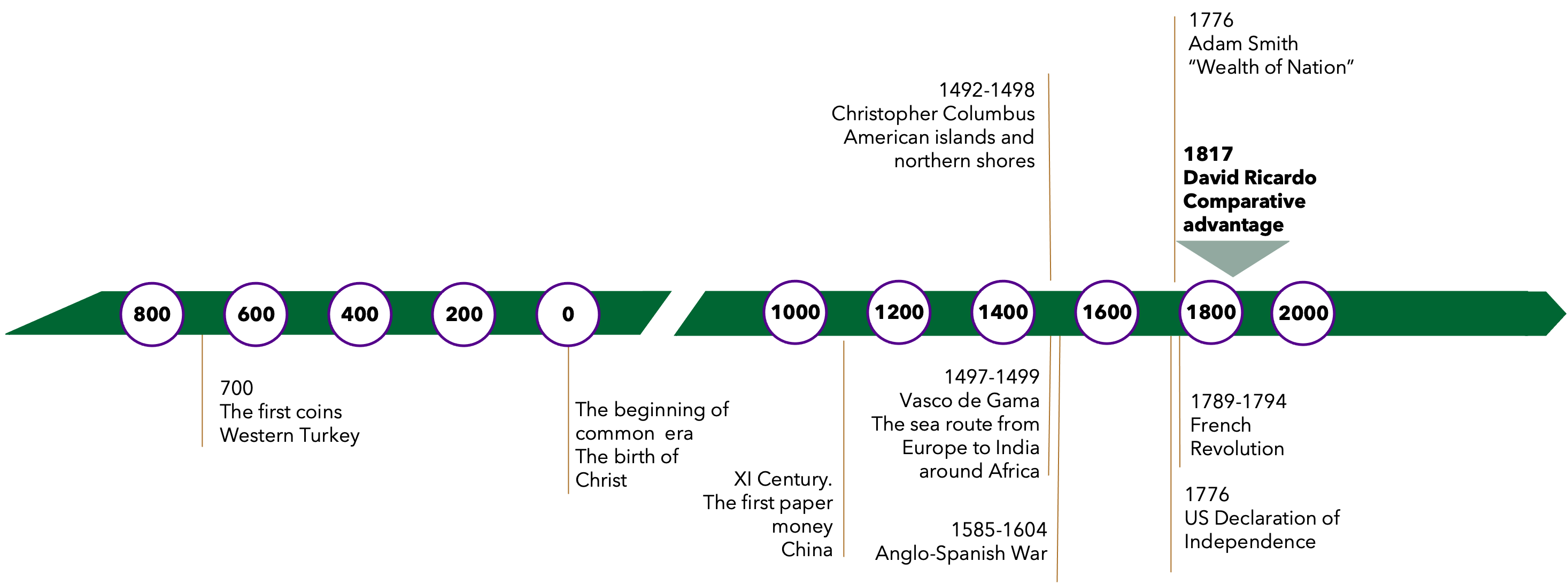
Keywords: French revolution, comparative advantage, Adam Smith, David Ricardo
David Ricardo’s (1772-1823) “The Period of Political Economy and Fiscal Principles” was published 40 years after Adam Smith (Exhibit 1-13). In addition to the theory of comparative advantage, which has been applied to international business, David Ricardo is also known for (1) the theory of reward and profit, (2) the labor theory of value, and (3) the theory of rent and the law of diminishing marginal returns.
Share or comment this information on your social media:
Fundamentals of global business
First edition
For citation:
Jarzemskis A. (2025). Fundamentals of global business, Litibero publishing, 496 p.

Full scope of the book is available in various formats
A.1 Theories of international economics
- Mercantilism
- Adam Smith and absolute advantage
- David Ricardo and Comparative advantage
- Standard theory of International trade
- Karl Marx and communism
- Hekscher – Ohlin theory
- Paul A Samuelson theory
- Leontief paradox
- Rybczynski theory
- John Hicks and progress
- Economies of scale theory
- Contemporary business internationalisation theories
- Questions for chapter review
- Chapter bibliography
About author
The author has been teaching at several universities since 2005. 40+ scientific publications, 10+ international research projects. More about author.